Lake Superior and Climate Change

The media gives us a lot of coverage of climate impacts in the American Southwest, or more exotic locales around the planet, than we generally get of the upper midwest.

That’s too bad, because something like 20 percent of the world’s fresh water is concentrated here. I can imagine a number of scenarios where that fact becomes a lot more urgent in coming decades. The health of the entire Great Lakes system is determined by the health of the greatest lake, Superior. As the video points out, the Lake is warming at a rate much faster than would have been predicted. The map below shows that, in fact, the upper Great Lakes area as a whole has been warming faster than the surroundings over the last 40 years.

You may have seen the ocean. You have have driven by Lake Ontario or Erie. You might have glimpsed Lake Michigan from the loop in Chicago. But if you haven’t spent time on Lake Superior, there’s something there that I will never be able to describe to you.

Chris Mooney on “The Republican Brain”

I’ve been sitting on this interview with Chris Mooney since meeting him in December at the American Geophysical Union Conference.

I had hoped by now to pull this into a larger piece on Republican science denial, which I still expect to do, but I think the interview is worth watching now rather than waiting.  I started reading “The Republican Brain” a few days ago, (my first iPad book buy..) and it is clear and eye opening.

It’s also, sadly, all the more timely in light of the continued absurdity of GOP lawmakers simply unable to even speak the words “sea level rise” –

ClimateProgress:

Virginia’s legislature commissioned a $50,000 study to determine the impacts of climate change on the state’s shores. To greenlight the project, they omitted words like “climate change” and “sea level rise” from the study’s description itself. According to the House of Delegates sponsor of the study, these are “liberal code words,” even though they are noncontroversial in the climate science community.

Instead of using climate change, sea level rise, and global warming, the study uses terms like “coastal resiliency” and “recurrent flooding.” Republican State Delegate Chris Stolle, who steered the legislation, cut “sea level rise” from the draft. Stolle has also said the “jury’s still out” on humans’ impact on global warming:

State Del. Chris Stolle, R-Virginia Beach, who insisted on changing the “sea level rise” study in the General Assembly to one on “recurrent flooding,” said he wants to get political speech out of the mix altogether.

He said “sea level rise” is a “left-wing term” that conjures up animosities on the right. So why bring it into the equation?

“What people care about is the floodwater coming through their door,” Stolle said. “Let’s focus on that. Let’s study that. So that’s what I wanted us to call it.”

Somehow, this seems an appropriate bookend:

Continue reading “Chris Mooney on “The Republican Brain””

New Apple Campus to be Enormous Solar Installation

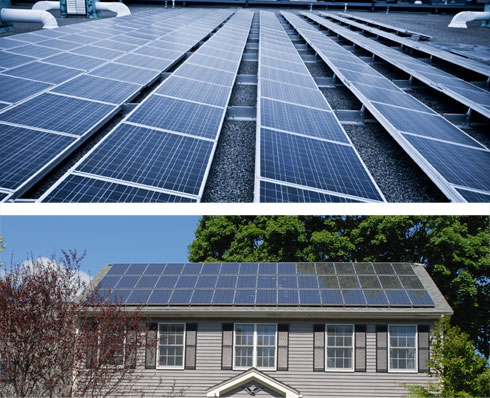
As more and more projects of this type pave the way, builders that are wedded to the architectural practices of past centuries will eventually all come around, and all of our buildings will become net producers, instead of primary wasters,  of energy.  They will also be more beautiful, and humane, bringing greater health and productivity to those who live and work inside them.

The potential was underlined a few weeks ago, when Germany, one of the world’s most heavily  industrialized nations, was producing almost HALF of its electricity from solar collectors like Apple will install here.

The application of this kind of technology is a threat to the very existence of the fossil fuel monopoly – it strikes at the heart of the oligarchic power of the Koch Brothers and their plutocratic brethren. That’s why the climate denial machine is doing all it can to slow or stop this progress.

LATimes:

The city of Cupertino, Calif., has posted online numerous floor plans and rendering of Apple’s proposed Campus 2 building.

The additional images of Campus 2 show more sides and aspects of the building Apple is hoping to build to house an additional 13,000 employees

The city posted the floor plans and renderings Thursday.

Apple hopes to begin construction later this year and move into the building, which has been described as looking like an object from outer space, by 2015.

Last month, Apple sent its neighbors in Cupterino a brochure seeking feedback. The building is  awaiting final approval from the city.

Among Campus 2’s features would be a 1,000-seat auditorium, a fitness center and a rooftop solar array that would make Apple one of the country’s largest solar power generators.

Steve Jobs, Apple’s late cofounder, announced plans for the building last year. Though he’d stepped down as CEO, Jobs pitched the project to the Cupterino City Council in June.

But while Campus 2 will certainly be an impressive building, Apple has said it will not replace 1 Infinite Loop as its main headquarters.

Prometheus Benefits from Science Input. Could have used some Writing Input too, but…

Ok, I took a couple hours off and went to see Ridley Scott’s new  movie “Prometheus”, widely touted as the prequel to the classic “Alien”, which is on everybody’s 10 best list for sci-fi movies.  Will try not to give anything away.

If you are looking  for pure entertainment, and you have not seen “The Avengers”,  go there.  Ditto if  you are taking the kids.
Prometheus gets a 9 for intensity, a 7 as a reasonably engaging waste of time, and a 5 for logic and comprehensibility. The Washington Post, below, notes that the producers consulted exobiologists for a rationale as to why characters might be able to take their helmets off on a distant moon.

Any nine year old knows that you never, never, never, NEVER take your damn helmet off when inspecting an alien installation of any kind, much less one with, – well, never mind…

Just don’t freaking take the damn helmets off, and DO NOT approach that weird snake-like thing – if you want to be a sympathetic character – because if you are that stupid, I really don’t care what happens to you…

Washington Post:

There’s a moment early in the new sci-fi film “Prometheus” where a scientist doffs his helmet on a distant alien moon.

Continue reading “Prometheus Benefits from Science Input. Could have used some Writing Input too, but…”

Solar Auction Turns Roof Space into Energy and $$$

When you understand the potential of the rapidly evolving renewable energy revolution, you get why fossil fuel interests, and their reliable Fox News echo chamber, are so desperately trying to distort the good news, and block progress on the emerging industrial revolution.  One of the world’s leading industrial nations, Germany, on a recent sunny afternoon, was producing almost HALF of its electricity from solar arrays on millions of roofs.

Wharton Business School:

Germany’s substantial investments in solar energy go back decades, and progress has been building gradually. But it passed a notable benchmark last week when its solar power met almost half of the country’s electricity demand at mid-day on a Saturday, and a third of its needs on a Friday, when industry was cranking full steam.

The development broke all records for solar power — at peak output, Germany used 22 gigawatts of solar generated electricity. That highlights Germany’s leadership position in the field — it has nearly as much solar power capacity as the rest of the world combined. And, in a country that plans to eventually abandon all nuclear energy in the wake of the Fukushima nuclear disaster, the amount produced on these very sunny two days was equal to the generating capacity of about 20 nuclear stations, according to press reports.

And that revolution will not be stopped here in the US, any more than buggy  whip manufacturers could stop Henry Ford, or Rush Limbaugh’s ridicule could stop “Al Gore’s information Superhighway”.

FastCompany:

Your most overlooked piece asset, your roof, is now a hot market.

A new firm launching this month, Gridbid, allows homeowners to auction the solar installation rights to their roofs online. The company says solar installers can save as much as 80% of what what they normally spend to find roof-top space, while the average residential utility bill drops between 10 to 35%.

Just because you want solar power (and you probably do, it’s starting to become the cheapest option in many states) doesn’t mean it’s easy to find a company to put panels on your roof. On the other side of the coin, there has been a proliferation of solar installers, companies that will pay for your solar installation in exchange for a cut of the money you make selling your extra solar power back to the grid. But these companies need lots of roofs to put their panels on, in order to scale their business. It’s pretty costly for them to go scout locations and then try to sell people on solar panels. Gridbid aims to be an easy place to connect these two mutually interested parties.

The idea, according to founder Thomas Kinshanko, CEO of parent company Habitat Enterprises, came after seeing all the inefficiencies that still plague the market for residential solar. “After speaking with over 100 players in the solar market, we found that solar installers were paying way too much in business development costs (sometimes up to 20% of total project cost) and building and home owners were struggling to find and select high quality, affordable solar installers,” says Kinshanko. “We came up with Gridbid to solve both problems.”

Piloted this March, Gridbid says it auctioned more than $300,000 in rooftop solar projects during its first week online, helping building owners go solar, while some of the 4,000 or so solar installers in the US competed to install more panels. Owners filled out a short online form and GridBid computed roofs’ solar potential and projected monthly savings. Local installers then submited “bids” for owners to select the best deal.

Globally, there’s no shortage of demand. McKinsey and Company’s Solar Power report(PDF) finds the solar-photovoltaic (PV) sector is already a $100 billion business, with installed capacity to grow almost 100 fold to 500 GW in the next eight years.


More Evidence: Arctic Warming Effect on Jet Stream = More Extremes

If you have not seen the video above from my “This is Not Cool” series at Yale Climate Forum, take some time to watch. It was based on the most current research that is beginning to explain the increasingly erratic swings in northern hemisphere weather patterns over recent years. Now a team from Cornell has published yet another paper underlining those findings, which explain why climate change is producing not only unprecedented warm events like this recent spring, but also wild swings into record-breaking snow and ice storms.

Cornell University: 

The dramatic melt-off of Arctic sea ice due to climate change is hitting closer to home than millions of Americans might think. That’s because melting Arctic sea ice can trigger a domino effect leading to increased odds of severe winter weather outbreaks in the Northern Hemisphere’s middle latitudes — think the “Snowmageddon” storm that hamstrung Washington, D.C., during February 2010.

Cornell’s Charles H. Greene, professor of earth and atmospheric sciences, and Bruce C. Monger, senior research associate in the same department, detail this phenomenon in a paper published in the June issue of the journal Oceanography.

“Everyone thinks of Arctic climate change as this remote phenomenon that has little effect on our everyday lives,” Greene said. “But what goes on in the Arctic remotely forces our weather patterns here.”


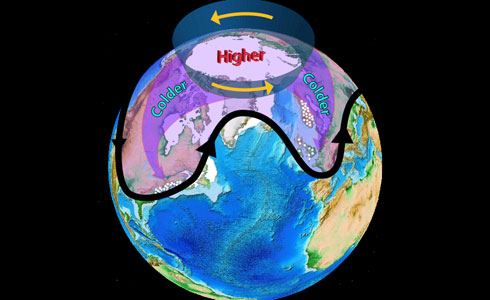
Negative Arctic Oscillation conditions are associated with higher pressure in the Arctic and a weakened polar vortex (yellow arrows). A weakened jet stream (black arrows) is characterized by larger-amplitude meanders in its trajectory and a reduction in the wave speed of those meanders.

A warmer Earth increases the melting of sea ice during summer, exposing more dark ocean water to incoming sunlight. This causes increased absorption of solar radiation and excess summertime heating of the ocean — further accelerating the ice melt. The excess heat is released to the atmosphere, especially during the autumn, decreasing the temperature and atmospheric pressure gradients between the Arctic and middle latitudes.

Continue reading “More Evidence: Arctic Warming Effect on Jet Stream = More Extremes”

Household Energy Use Going Down – yet no one Freezing in the Dark. How is that Possible?

I’ve reported before that, despite the increase in the number of gadgets, devices, and ostensibly labor-saving and life-enhancing improvements in technology in US households, energy use is leveling off or declining.  Note to science deniers: No visible increase in the number of donkey carts has been noted, and I’m not aware that more people are freezing in the dark.

Energy Information Agency:

Total U.S. energy consumption in homes has remained relatively stable for many years as increased energy efficiency has offset the increase in the number and average size of housing units, according to the latest results from the Residential Energy Consumption Survey (RECS). The average household consumed 90 million British thermal units (Btu) in 2009, based on RECS data. This continues the downward trend in average per-household energy consumption of the last 30 years. Improvements in efficiency for space heating, air conditioning, and major appliances have all led to decreased consumption per household, despite increases in the number of homes, the average size of homes, and the use of electronics. Newer homes also tend to feature better insulation and other characteristics, such as double-pane windows, that improve the building envelope.

RECS characteristics data, released in early 2011, showed an increasing number of televisions, computers, and other electronic devices that add to household plug loads as well as the greater use of energy-efficient appliances.

In America’s industrial manufacturing heartland, despite a booming auto sector, and creating jobs at a rate faster than almost any other state, Michigan electrical demand follows the larger nationwide trend.

Michigan Public Service Commission:

Electricity – Assuming normal summer temperatures, Michigan’s total electric sales are projected to decrease by 0.2 percent in 2012.This would mark the second year in a row of declining electricity demand. Although slight growth is projected in the residential and industrial sectors, these increases are expected to be offset by a decline in commercial usage. Given the anticipated demand and reinforced by the availability of estimatedreserve margins within the MISO and PJM footprints,there should be an adequate supply of electricity over the summer.

“The Outlook is Not Good”. Climate Change in Malawi, and the Language of Faith

Regular readers will remember that I have featured interviews here with Katharine Hayhoe, and Richard Cizik, both evangelical Christians who have been successful communicating the science of climate to their communities.

I know that for many scientists, and many readers of this blog, the language and assumptions of faith are a stumbling block. Nevertheless, they are an essential part of life, and a key to understanding the world, for most of humanity. Ignoring this reality is not a promising strategy when the need for change is so urgent.

Victor Mughogho is a Christian activist in Malawi, who describes conditions on the ground in this video, and who has a way of describing the urgency of the moment in language that is vivid and scripturally based.  If we are going to close the gap between the faith and science communities, there is a great need for more bridge builders like this.

Sojourners: 

Mughogho says about 85 percent of his country lives and farms the land in rural areas.

“For them, rainfall is everything,” he said. “WIthout rain, there’s no agriculture, no livelihood.”

In the 70s and 80s, rural Malawians could count on consistent rainfall in October.  They could plant maize on the same day each year and have a guaranteed return. Now, the unpredictable weather means they plant multiple times a year, hoping and praying for rain — and end up with a fraction of what they used to reap.

“We had a severe famine in Malawi — a food crisis that was threatening the lives of of close to 5 million people,” Mughogho said. “People weren’t just starving; people were dying. People were resorting to eating poisonous stuff from the forest.”

Mughogho’s ministry, Eagles Relief and Development Program, helps Malawians grow drought-tolerant crops, set up community gardens, and provide childcare and education for orphaned children.

Mughogho says it’s a community responsibility to work together to address the problem.

“We are trying to [educate] churches to understand their biblical mandate for social action,” he said. “… We ask the question, ‘What do you have in this community that can help address the challenges you are facing?'”

And, he emphasized, climate change is a global issue.

“It needs global minds put together,” he said. “Who is better suited for that task than the Christians?”

For more information on Victor Mughogho’s (and others’) efforts in Malawi and globally, see posts on the Evangelical Environmental Network‘s blog HERE.

Below: Faith based groups deploy solar energy in Malawi

Continue reading ““The Outlook is Not Good”. Climate Change in Malawi, and the Language of Faith”