

Scientists have made a biological discovery in Arctic Ocean waters as dramatic and unexpected as finding a rainforest in the middle of a desert. A NASA-sponsored expedition punched through three-foot thick sea ice to find waters richer in microscopic marine plants, essential to all sea life, than any other ocean region on Earth.
The discovery is the result of an oceanographic expedition called ICESCAPE, or Impacts of Climate on EcoSystems and Chemistry of the Arctic Pacific Environment. The NASA-sponsored mission explored the seas along Alaska’s western and northern coasts onboard a U.S. Coast Guard icebreaker during the summers of 2010 and 2011. The finding reveals a new consequence of the Arctic’s warming climate and provides an important clue to understanding the impacts of a changing climate and environment on the Arctic Ocean and its ecology.
Month: June 2012
Nasa Video: Venus Transit 2012
I don’t have any welder’s goggles, so could not see Venus crossing the disc of the sun, although I did look up several times while enjoying the sparkling day here in the upper midwest.
Here’s NASA’s video of what I missed. Worth a few minutes of your time. And, oh yeah, DO go full screen.
Launched on Feb. 11, 2010, the Solar Dynamics Observatory, or SDO, is the most advanced spacecraft ever designed to study the sun. During its five-year mission, it will examine the sun’s atmosphere, magnetic field and also provide a better understanding of the role the sun plays in Earth’s atmospheric chemistry and climate. SDO provides images with resolution 8 times better than high-definition television and returns more than a terabyte of data each day.
On June 5 2012, SDO collected images of the rarest predictable solar event–the transit of Venus across the face of the sun. This event happens in pairs eight years apart that are separated from each other by 105 or 121 years. The last transit was in 2004 and the next will not happen until 2117.
The videos and images displayed here are constructed from several wavelengths of extreme ultraviolet light and a portion of the visible spectrum. The red colored sun is the 304 angstrom ultraviolet, the golden colored sun is 171 angstrom, the magenta sun is 1700 angstrom, and the orange sun is filtered visible light. 304 and 171 show the atmosphere of the sun, which does not appear in the visible part of the spectrum.
Wind Power: From NIMBY to YIMBY
Rural communities in my neck of the woods have had but one serious model for rural development up until recently, that was, more prisons. It’s what’s become a signature of the “conservative” vision for our future.
Renewable energy is now offering a way for rural people, always the best stewards of their own land, to stay on the land their ancestors worked and husbanded.
Here’s how two very different communities went from NIMBY, (not in my back yard), to YIMBY (yes in my back yard).
Contrast this positive approach with the recently leaked proposal for a phony, astro-turfed “grass roots” anti wind movement – funded by Koch brother and other regressive interests, to block wind development, and keep our rural areas in poverty and dependence on big energy and big oil.
In February, a group of anti-wind activists gathered in Washington, DC. Their goal: establish a coordinated, nation-wide program of “wind warriors” who could be dispatched to fight the industry anywhere, anytime.
The organization would combine efforts and create “what should appear as a ‘groundswell’ among grass roots” to counter legislation supporting wind energy on the federal, state and local levels.
The leader of the group was John Droz, Jr, a long-time wind opponent and a senior fellow at the ultra-conservative American Tradition Institute. ATI calls itself an “environmental” think tank. The organization, known best for suing climate scientist Michael Mann, is devoted to spreading doubt about climate change, opposing state-level renewable energy targets, and stripping away environmental regulations.
The ATI is so extreme that it was denounced by the American Association for the Advancement of Science for contributing to an “environment that inhibits the free exchange of scientific findings and ideas.”
In Kansas, Saving Energy is a Win
Saving, instead of wasting. Using wisely. Planning for the future. Building our communities.
These used to be conservative values, as opposed the snarling, overbearing, oxycontin chomping, conspicuous-consumption driven image that the word evokes today.
Maybe we can get back to the real conservatism that our fathers knew – and maybe it starts in places like Iola, Kansas.
What does the Sierra Club have in Common with Karl Rove? Both Support Wind Energy.

Renewal of federal tax credits for wind energy can save U.S. jobs and reduce dependence on foreign oil, according to Karl Rove, an adviser to former President George W. Bush.
“We’ve got a growing economy that’s increasing energy consumption and wind energy should be part of the solution,” Rove said today on a panel at a wind conference in Atlanta. Extending the so-called production tax credit “should be a priority.”
A bill to extend through 2016 the 2.2-cent-a-kilowatt-hour credit for electricity produced by wind turbines, biomass, geothermal and landfill-gas plants has stalled in congress along with about 100 other expiring tax-related incentives.
The tax credit is one of the major topics of debate this week as executives gather for the Windpower 2012 annual conference.
There are about 75,000 U.S. wind-industry workers, according to the American Wind Energy Association. Letting the credit lapse will lead to the elimination of 10,000 wind- industry jobs this year and another 27,000 in 2013, the Washington-based trade group estimates.
ATLANTA, Ga., June 5, 2012 – A solid base of bipartisan support for wind energy will—and must—spur passage of a Production Tax Credit extension this year, policy and industry leaders said today at the WINDPOWER 2012 Conference & Exhibition.
Highlighting the bipartisan nature of wind power was an engaging dialogue between Karl Rove, former senior advisor to President George W. Bush, and Robert Gibbs, former Press Secretary and advisor to President Obama. As American Wind Energy Association (AWEA) CEO Denise Bode commented in introducing them, both administrations supported wind energy and extending the Production Tax Credit (PTC).
“This is an industry that is not just accustomed to innovation – it thrives on it,” said Carnahan.
The panel also called for members of the industry to continue outreach efforts to educate members of Congress about the importance of the PTC to American manufacturing jobs.
“You look at poll after poll and Americans want wind energy,” said Blittersdorf.
Americans recognize the critical value of wind energy and the clean energy economy. That’s why almost two-thirds – 64 percent – of those surveyed in the latest United Technologies/National Journal Congressional Connection Poll agree with President Obama that the PTC’s vital job-creating benefits should be continued.
The Sierra Club disagrees with Iowa Republican Congressman Steve King on many issues. But we agree with him that the PTC needs to be renewed for the sake of American jobs, clean American energy, and American health. He deserves credit for standing up to those in his party who would sabotage the growing success story that is the domestic wind industry.
Still, many in Congress seem to have different priorities, and they might let these clean energy credits slip away – all while pushing for massive tax breaks for the same dirty energy industries that are raking in billions in profits while making our kids sick.
Among the Deniers at Denia-Palooza
Yes, I attended the 7th International Climate Conference of the Heartland Institute.
After that, I went to the Creation Museum to get my bearings.
Sound Familiar? Scientists Voice Misgivings over BP’s Use of Private Emails.

What has been will be again, what has been done will be done again; there is nothing new under the sun. – Ecclesiastes 1:9
No accident. This is now a standard weapon against pesky truth seeking scientists and academics.
In an opinion piece in the Boston Globe, the scientists, from the Woods Hole Oceanographic Institution, said they volunteered in the early days of the spill to deploy robotic technology to help BP and the Coast Guard assess how much oil was gushing from the well.
The two researchers turned over some 50,000 pages of research notes and data to BP. But BP demanded more, and obtained a court subpoena for the handover of more than 3,000 confidential emails. The scientists handed over the emails last week – but with severe misgivings, they wrote.
“Our concern is not simply invasion of privacy, but the erosion of the scientific deliberative process,” they wrote. They feared the email exchanges, in which the scientists discuss hitting dead ends or challenging each other on their conclusions, were open to deliberate misinterpretation.
“Incomplete thoughts and half-finished documents attached to emails can be taken out of context and impugned by people who have a motive for discrediting the findings. In addition to obscuring true scientific findings, this situation casts a chill over the scientific process. In future crises, scientists may censor or avoid deliberations, and more importantly, be reluctant to volunteer valuable expertise and technology that emergency responders don’t possess.”
Christopher Reddy and Richard Camilli in the Boston Globe:
Late last week, we reluctantly handed over more than 3,000 confidential e-mails to BP, as part of a subpoena from the oil company demanding access to them because of the Deepwater Horizon disaster lawsuit brought by the US government. We are accused of no crimes, nor are we party to the lawsuit. We are two scientists at an academic research institution who responded to requests for help from BP and government officials at a time of crisis.
Because there are insufficient laws and legal precedent to shield independent scientific researchers, BP was able to use the federal courts to gain access to our private information. Although the presiding judge magistrate recognized the need to protect confidential e-mails to avoid deterring future research, she granted BP’s request.
It is the lack of legal protection that has us concerned.
Continue reading “Sound Familiar? Scientists Voice Misgivings over BP’s Use of Private Emails.”
Tundra to Forest Feedback: Century Changes in “just a few Decades”
Didn’t somebody say “payback’s a bitch”?
Once again, research shows it’s feedback that’s the real bitch.
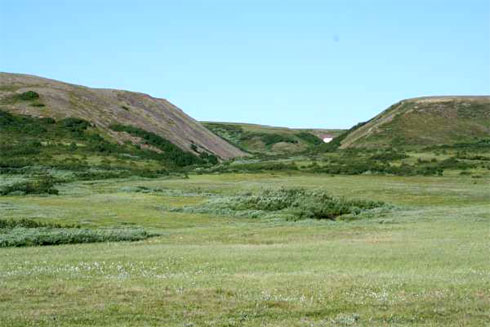
Across a large area of western Siberia, shrubs are rapidly growing into trees more than six feet tall, a process that is expected to further increase temperatures in this rapidly warming part of the Arctic, according to a new study.
Relying on satellite images and fieldwork, scientists from Oxford University and Finland found that in 8 to 15 percent of a 36,000-square-mile region in western Siberia, willow and alder shrubs had turned into trees over the last 30 to 40 years as temperatures have climbed. Oxford scientists said their research showed that the growth of shrubs could be an even more important factor in the greening of the tundra than the migration of trees northward from the boreal forest. The rapid growth of trees is expected to further warm the Arctic for two reasons. In the Arctic spring and autumn, shrubs are often buried under snow, but trees grow above the snow, their dark surfaces absorbing sunlight. In addition, trees create a microclimate that traps heat. “The speed and magnitude of the observed change is far greater than we expected,” said Bruce Forbes of the Arctic Center at the University of Lapland and a co-author of the paper, published in the journal Nature Climate Change.
LONDON (Reuters) – Plants and shrubs have colonised parts of theArctic tundra in recent decades growing into small trees, a scientific study found, adding the change may lead to an increase in global warming pressures if replicated on a wider scale.
Scientists from Finland and Oxford University investigated an area of 100,000 square km, roughly the size of Iceland, in the northwestern Eurasian tundra, stretching from western Siberia to Finland.
Using data from satellite imaging, fieldwork and observations from local reindeer herders, they found that in 8-15 percent of the area willow and alder plants have grown to over 2 metres in the last 30-40 years.
A report of the research is published on Sunday in the journal Nature Climate Change.
Dr. Marc Macias-Fauria of Oxford, in Time:
It’s a big surprise that these plants are reacting in this way. Previously people had thought that the tundra might be colonized by trees from the boreal forest to the south as the Arctic climate warms, a process that would take centuries. But what we’ve found is that the shrubs that are already there are transforming intro trees in just a few decades.
Post-Flood Midwest Farms a Wasteland. Deniers – “They need more CO2”

Devastating floods on the Missouri River last year were the type of event that will become more and more familiar in a warming world. In the ivory towers of Climate Denial think tanks, “CO2 is good for plants”. In the real world where the rest of us live, things get stickier.
Mason Hansen guns his pickup and cranks the steering wheel to spin through sand up to 4 feet high, but this is no day at the beach.
Hanson once grew corn and soybeans in the sandy wasteland in western Iowa, and his frustration is clear. Despite months spent hauling away tons of sand dropped when the flooded Missouri River engulfed his farm last summer, parts of the property still look like a desert.
–
Shawn Shouse, an Iowa State University engineer and agribusiness expert, said most farmers can repair their land, but for some it will take another year or two of work. The first chore is removing the sand.
“The sand doesn’t hold nutrients and water the way soil does, so it’s not suitable for growing crops,” he said. “If the deposits are thin, they can stir them into the soil and probably get along well. But when the deposits are several feet thick, they really have to move that sand somewhere else. That can be really expensive _ and you have to figure out what to do with it.”
–The U.S. Department of Agriculture has approved more than $20 million in disaster aid for Iowa and Nebraska, which will help farmers with the cost of moving sand, grading land and filling scour holes.
“It’s just totally, totally devastating,” Olson said. “The dollar amount for what it takes to put it all back together again is going to be tremendous. And it’s going to cost you, the taxpayer, in case you haven’t already figured that out.”
Hundreds of farmers are still struggling to remove sand and fill holes gouged by the Missouri River, which swelled with rain and snowmelt, overflowed its banks and damaged thousands of acres along its 2,341-mile route from Montana through North Dakota, South Dakota, Nebraska, Kansas, Iowa and Missouri. The worst damage and the largest sand deposits were in Iowa and Nebraska.
“We’ll be working on this for years,” Hansen said. “It’ll never be right. Ever. People don’t have any idea how big of a mess this is.”

How Smart Meters Work
Smart Meters can help consumers save money by choosing when to run appliances. And they can help utilities manage the electric grid — enhancing energy efficiency. In Houston, CenterPoint Energy’s Dwayne Turner explains how they’ll work. (From the Earth: The Operators Manual series)
We started seeing the cracks in the old Soviet Union as the widespread use of copying technology began to free up information, as a network of self-publishing writers used xeroxes as their own self publishing tools. The internet, widely reviled by Rush Limbaugh and others at the beginning as “Al Gore’s Information Superhighway” boondoggle, has proven in the Arab Spring uprising, to be potentially a tool for making information available and prying open cracks even in closed societies.
As the tools of the information age, smart grids, smart meters, and distributed generation, become more widely available, the grip of big energy on the power system will gradually be loosened, and power, both economic, and political, will devolve away from big companies, and big government, toward states, counties, communities, private companies, and individuals. Watch and be amazed.