Fukushima Discharging Radioactive Water. It’ll Probably Be OK. I Think.

For the record, I don’t think this is a terribly dangerous release.

That said, it’s just one more self inflicted black eye for an industry that does not need more bad PR.

BBC:

The message from experts is, overwhelmingly, that the release is safe – but not all scientists agree on the impact it will have.

Tritium can be found in water all over the world. Many scientists argue if levels of tritium are low, the impact is minimal.

But critics say more studies on how it could affect the ocean bed, marine life and humans are required.

The IAEA, which has a permanent office at Fukushima, said an “independent, on-site analysis” had shown that the tritium concentration in the water discharged was “far below the operational limit of 1,500 becquerels per litre (Bq/L)”.

That limit is six times less than the World Health Organization’s limit for drinking water, which is at 10,000 Bq/L, a measure of radioactivity.

On Friday, Tepco said seawater samples taken on Thursday afternoon showed radioactivity levels were well within safe limits, with a tritium concentration below 1,500 Bq/L. 

Japan’s environment ministry said it had also collected seawater samples from 11 different locations on Friday and would release the results on Sunday.

James Smith, professor of environment and geological sciences with Portsmouth University, said that “in theory, you could drink this water”, because the waste water is already treated when it is stored and then diluted.

And physicist David Bailey, who runs a French laboratory measuring radioactivity, agreed, adding: “The key thing is how much tritium is there.

“At such levels, there is no issue with marine species, unless we see a severe decline in fish population, for instance,” he said.

But some scientists say we cannot predict the impact of releasing the water.

American professor Emily Hammond, an expert in energy and environmental law with George Washington University, said: “The challenge with radionuclides (such as tritium) is that they present a question that science cannot fully answer; that is, at very low levels of exposure, what can be counted as ‘safe’?

“One can have a lot of faith in the IAEA’s work while still recognising that compliance with standards does not mean that there are ‘zero’ environmental or human consequences attributed to the decision.”

Thank You, Exxon. Finally Some Drilling We Can Get Behind

When you do something a lot, you get better at it.
20 years of advanced drilling practice has made Oil majors pretty good at doing just that.
Maybe they are good for something.

New York Times:

A new class of start-ups is investing in the industry, as is the U.S. Energy Department, which estimatesthere’s enough energy in the rocks below the surface to power the entire country five times over. And much of the research and development needed for the new geothermal technologies is already done, thanks in large part to recent advances by the oil and gas industry — including fracking.

How’s that for irony? At the end of the day, it might be techniques developed by Big Oil that ultimately help make fossil fuels obsolete.

Over the past 20 years, fossil fuel companies have gotten very, very good at drilling.

“It’s something that climate people never like to talk about,” Brad told me. “But the cost of drilling has gone down. The oil and gas industry has drilled thousands and thousands of wells and every time they get a little better.”

By using new techniques like horizontal drilling, fiber-optics and magnetic sensing, some experts think it might be possible to tap into geothermal energy almost anywhere on earth.

“The thing that made me think that this could be real is the fact that the major costs of these geothermal projects often is drilling,” Brad said. “And drilling is not something we have to learn to do from scratch. Drilling is something the United States has just gotten incredibly good at.”

Continue reading “Thank You, Exxon. Finally Some Drilling We Can Get Behind”

Idalia is Opportunity for Disinformers. Heads Up.

I kind of like the way Ryan McBeth thinks.
The self-styled “military from the grunt perspective” YouTube has some wise words about misinformation here, so I’ll cut him some slack for his brief “both sides” climate take above.
More important, he makes what I think are some solid points about social media awareness that everyone should take to heart. For those of us that have been navigating the misinformation space for quite a while, it may seem obvious, but perhaps McBeth’s voice is one that will resonate with some demographics.
His point is that the gullibility that gave us “jewish space lasers” can easily be weaponized. Just sayin’.

Ryan Mcbeth:

On August 30st I made a video where I mentioned that Hurricane Idalia would be used by Russia to spread disinformation.

Hours later the phrase “10 Billion to Ukraine” was suddenly retweeted by an influential Twitter user.

The phrase was “10 Billion to Ukraine,” was most likely a phrase that was specifically orchestrated by the adversary to be spread by Americans. Many of these Americans may not be aware that their opinion was generated in a foreign country and spoon-fed to them like applesauce to a baby.

Like babies do, the applesauce was regurgitated again as authentic opinion, but had enough nearly identical language that randomness is unlikely. 

Popular Twitter user @DC_Draino also known as Rogan O’Handley was also involved in spreading this disinformation, although it cannot be determined if he knew he was spreading inauthentically engineered disinformation.

Tropical Mosquitoes Invading North, Bringing Disease

Filing this next to Murder Hornets.

Raw Story:

Health authorities in Paris fumigated areas of the French capital for the first time on Thursday to kill disease-carrying tiger mosquitoes whose rapid advance through northern Europe is thought to have been accelerated by climate change.

Roads were closed and people asked to stay in their homes in southeast Paris during the early hours of Thursday as pest control contractors sprayed insecticide in trees, green spaces and other mosquito-breeding areas.

Such scenes are a regular occurrence in tropical cities and becoming increasingly common in Europe as the tiger mosquito, which can carry the dengue, chikungunya and zika viruses, spreads from its native southeast Asia.


The tiger mosquito, also known as Aedes albopictus, arrived in southern Europe in the first decade of this century and has been pushing rapidly north ever since, establishing itself in France, Germany and Switzerland.

Health experts say it has thrived on the continent in part because of climate change, with warmer weather shortening the incubation period for its eggs while winters are no longer cold enough to kill off the pests.

After first being spotted in France in 2004, it is now present in 71 of its 96 departments on the mainland, even in areas close to the northern Channel coast, according to health ministry data.

Detroit Free Press:

The Asian tiger mosquito, which can transmit the Zika, Dengue and Chikungunya viruses, has been identified in Michigan for the first time this year.  

 The finding  comes amid an increase in mosquitos to biblical  proportions in Michigan after the heavy rainfall this summer and more ticks in the state than usual  due to warmer winters.   

The Asian tiger mosquito is not native to the state and was first identified in Michigan in 2017 in Livonia, then for a second and third time in 2018 and 2020, also in Wayne County. The insects are commonly found in tropical and mild regions, but global warming gives room for them to travel north, according to the Michigan Department of Health and Human Services (MDHHS). 

In Idalia’s Wake

Continue reading “In Idalia’s Wake”

How Climate Change makes Hurricanes More Dangerous

Above, Jeff Berardelli, Chief Meteorologist of WFLA-TV Tampa, in our conversation from last year. Jeff spoke about the physics behind our understanding of hurricanes like Idalia.

Below, Jeff Masters PhD, makes similar points for Yale Climate Connections:

As far back as 1987, MIT hurricane scientist Kerry Emanuel theorized that the wind speeds in hurricanes can be expected to increase about 5% for every one degree Celsius (1.8°F) increase in tropical ocean temperature, assuming that the average wind speed near the surface of the tropical oceans does not change. Computer modeling has found a slightly smaller magnitude (4%) for the increase. 

A 4-5% increase in hurricane winds may not seem like a big deal, but damage from a hurricane increases exponentially with an increase in winds. For example, according to NOAA, a Category 2 hurricane with 100 mph winds will do 10 times the damage of a Category 1 hurricane with 75 mph winds. This includes damage not only from winds, but also from storm surge, inland flooding, and tornadoes. Bottom line: A 4-5% increase in winds yields about a 40-50% increase in the destructive potential of a hurricane (Figure 1).

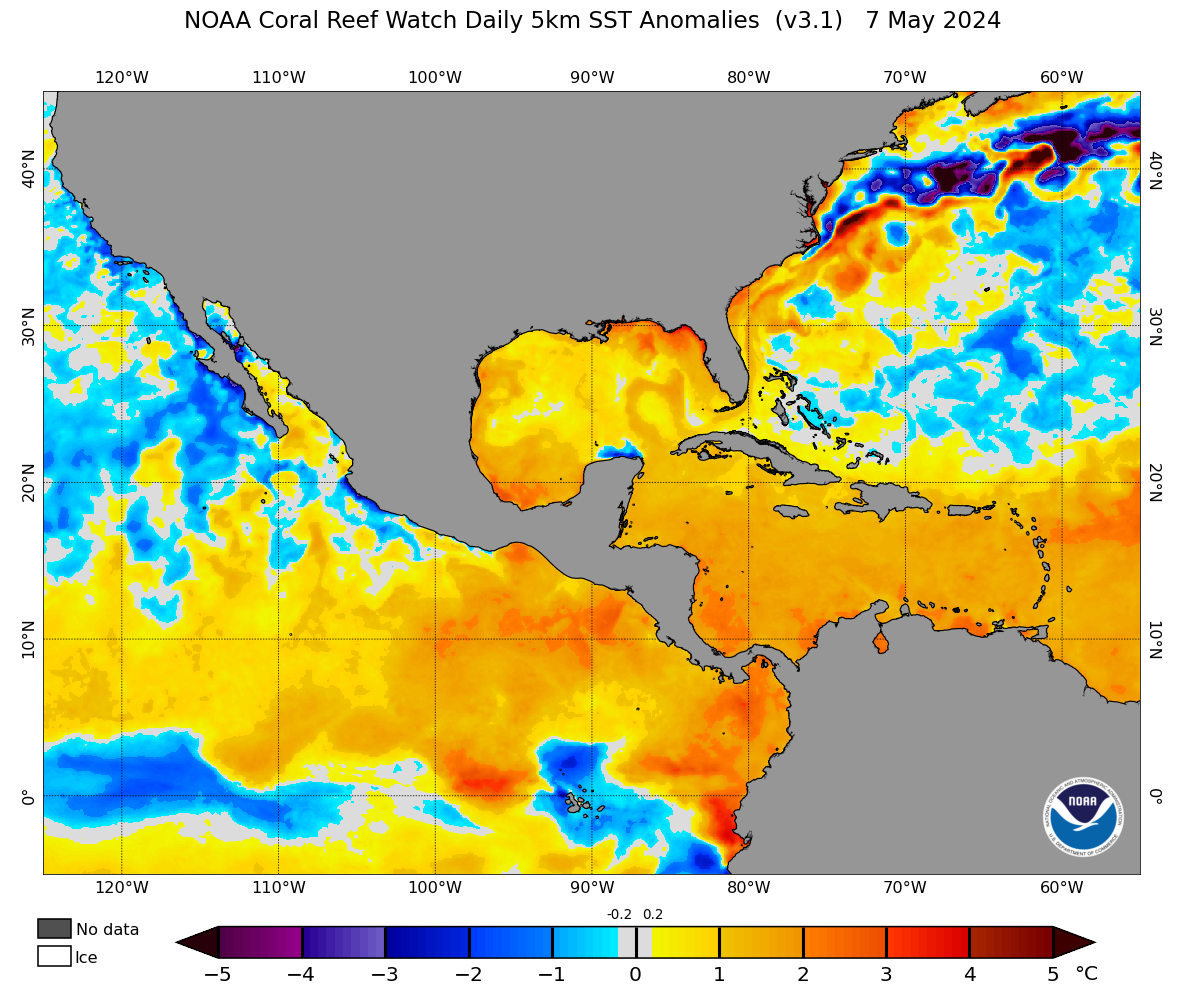
According to NOAA’s Coral Reef Watch, sea surface temperatures along Idalia’s path through the western Caribbean and eastern Gulf of Mexico were about 1-2 degrees Celsius (1.8-3.6°F) above the long-term average. Using the theoretical results above, this increase in sea surface temperatures equated to a 50-100% increase in Idalia’s destructive power.

Not all of this year’s unusual warmth in the Gulf of Mexico can be confidently attributed to human-caused global warming. If we restrict ourselves to looking at just the long-term trend in August sea surface temperatures in the Gulf, these have warmed about 0.84 degree Celsius (1.51°F) per century, according to NOAA (Figure 2), which is close to about a 1-degree Celsius increase since preindustrial times. That also aligns with the long-term trend for the global oceans, which have warmed about 1 degree Celsius since preindustrial times in the late 1800s.

It thus appears reasonable to theorize that increased sea surface temperatures of about 1 degree Celsius since preindustrial time in the Gulf of Mexico from human-caused global warming led to a 40-50% increase in Idalia’s destructive power by increasing the hurricane’s winds by at least 4-5%. This could well be an underestimate of the influence of human-caused climate change on the record-warm sea surface temperatures in the Gulf, since the unusual atmospheric circulation patterns responsible for the hot and windless conditions experienced there this summer, which contributed to the record sea surface temperatures, could have had a climate change connection.

States Doing End Run Around Clean Energy Misinformers

Readers here will be aware of the nationwide campaign of disinformation about clean energy, coordinated by the fossil fuel industry.

The problem is not limited to a single state. 
Wisconsin and Minnesota have long had policies in place to insure that siting regulations are set at the state level. Other states are looking to follow suit.
Above, a clip from my conversation with David Loomis PhD, formerly a long time Professor of Economics at Illinois State University, and expert on clean energy technologies and deployment across the midwest.

I asked Dr. Loomis about a recent clean energy siting reform initiative in Illinois, aimed at overcoming astro-turf pushback from Facebook Frenzied opposition, convinced that wind and solar energy are part of a demonic Deep State plot.

NPR:

Researchers say that in many groups, misinformation is raising doubts about renewable energy and slowing or derailing projects.

The opposition comes at a time when climate scientists say the world must shift quickly away from fossil fuels to avoid the worst impacts of climate change. But 60% of U.S. electricity still comes from carbon-based fuels.

For the Biden administration to hit its target of an electricity sector free of fossil fuels by 2035, the country has to double or triple the wind and solar power capacity it installs over the next few years and maintain that higher level of deployments for about a decade, says Kelly Speakes-Backman, who leads the Energy Department’s Office of Energy Efficiency and Renewable Energy.

Last year, a Department of Energy study found that setback regulations now represent the single-greatest barrier to securing locations for wind projects in the U.S. Setbacks limit how close wind projects can be to buildings, and (University of Michigan researcher Sarah) Mills says they often make sense to reduce things such as noise and “shadow flicker,” the moving shadows and strobing sunlight that turbines can cast onto buildings. But she says misinformation can fuel setbacks that are more stringent than needed and sometimes act as outright bans on renewable energy.

Now, Michigan is looking at similar siting reforms, announced today as part of a larger package of progressive initiatives by Michigan Governor Gretchen Whitmer.

Detroit News (Paywall):

Michigan lawmakers are planning to make it easier for companies to launch large-scale solar energy projects to address climate change and avoid bitter disputes in places like Keene Township, an 1,800-person agricultural area in western Ionia County.

Democrats who control the Michigan House and Senate are expected to introduce bills to shift the power to permit major solar projects to state government in the coming weeks. Democratic leaders view the measures as crucial to reaching a proposed 100% clean energy standard by 2035, and they could serve as a test run for passing more aggressive environmental proposals in the future.

Continue reading “States Doing End Run Around Clean Energy Misinformers”