
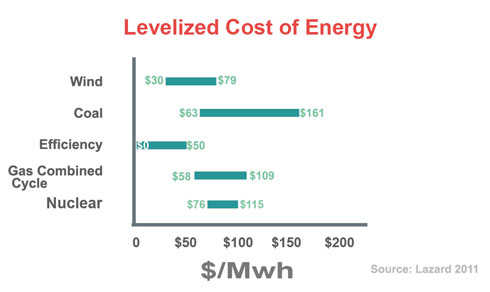
Cost of Wind Power Expected to Drop Even Further. Congress Yawns.

As the graph above indicates, wind energy is already more than competitive with all other sources.  Of course, this is just the beginning.  New techniques of manufacturing are lowering the cost of building new turbines, and new designs are making turbines so much more efficient and sensitive,  that large areas, formerly impractical for wind farms, are becoming cost effective.

For the republicans that dominate the US House, apparently cheaper and cleaner energy is not as interesting as fantastically expensive wars for oil have been. Wonder why?

North American Wind Power: 

Worldwide, wind power prices fell to $1.2 million/MW in the first half of 2011, mainly because of improvements in supply-chain efficiency and economies of scale. Competition from Chinese manufacturers and their excess capacity to build machines and flood the market also played a role.

In addition, the capacity factor of wind turbines continues to rise as better technologies enter the market, further driving down turbine costs. Combined, these factors are expected to bring down the cost of wind energy by 12% by 2016, making onshore wind cost competitive with coal, gas and nuclear power.

“Global wind power growth looks very strong and is on a continued rise, largely because of China’s incredible level of investment,” says Konold. “Withhold that, and the picture looks more muddled.

“Developed economies are not reaching their fullest potential due to financial and policy uncertainty, and many developing economies are running into technical problems, despite slightly stronger growth in wind power capacity,” he continues. “Although continued growth in wind power won’t be as strong as it could be, as the supply increases and prices fall, wind energy is quite likely to continue its upward trend.”

Continue reading “Cost of Wind Power Expected to Drop Even Further. Congress Yawns.”

Beyond Season’s End: Sportsmen Concerned about Climate Change

I’ve been communicating with Todd Tanner, spokesmen for a group called Conservation Hawks, which I think is doing some great work, alerting sportsmen, hunters, and fishermen to the gathering threats of climate change. From the interview below, sounds like Todd and I are on the same page.

And, Todd has a standing offer to anyone that can convince him that climate change is not a threat.

Field and Stream:

The Conservation Hawks is a new group dedicated to harnessing the power of sportsmen to address climate change. Stop. Before you give in to anger, or to the “conservation fatigue” that can fall upon us like a giant wet carpet whenever climate change is mentioned, consider this: If you can convince Conservation Hawks chairman Todd Tanner that he’s wasting his time, that he does not have to worry about climate change, he will present to you his most prized possession: A Beretta Silver Pigeon 12 gauge over/under that was a gift from his wife, and has been a faithful companion on many a Montana bird hunt. I know the gun, and I’ve hunted and fished with Todd for years. He’s not kidding. You convince him, he’ll give you the gun.


Hal Herring
: First, are you serious about the Beretta?

Todd Tanner: I am serious. If somebody can convince me that I don’t have to worry about climate change, I’ll give it them. Or I’ll auction it off and donate the proceeds to the charity of their choice. But it will have to be a real argument, with real facts. I don’t think that argument exists, but I’m willing to be surprised.

HH: Why the Conservation Hawks?

TT: Let’s say you are walking down a trail in the wilderness with your wife and kids, and you come upon a grizzly sow, standing on a carcass. She charges, flat out. You’re in front of your family. What do you do? Just give up? Pretend it’s not happening? Let her maul you and everything your care about? Of course you don’t. You take action. That is how I see climate change. It’s real, it’s threatening everything we love. Not taking action is not an option.

HH: Why now?

TT: This is the point where we can still stand up and have an effect. Maybe it’s the last point. I want that freedom we’ve enjoyed to fish and hunt to continue. Maybe most important, I have a son. I cannot be complicit in surrendering all this that I’ve had and loved for my whole life—just say, sorry, I gave up and let it be taken from him. When I knew the science, and the facts.

Seasonsend.org 

Rising summer temperatures pose a threat to coldwater brook trout in the Adirondacks, a recent study shows.

Researchers recorded air and water temperatures over the course of 11 summers and correlated readings to spawning activity. A rise of 1.8 degree Fahrenheit delayed spawning by approximately one week and reduced the number of nests. Late spawning is likely to delay the emergence of fry, which could uncouple synchronicity with the emergence of prey.

Water temperatures near 70 degrees Fahrenheit stress the fish, which do not have sufficient energy to feed. Consequently the growth of their reproductive organs slowed. High temperatures effectively caused the trout to shut down in the middle of the summer, the paper’s authors said.

However, hot summers presently pose less of a threat to brook trout than non-native species and habitat loss,says co-author Cliff Kraft, a professor of natural resources at Cornell University. But if temperatures continue to climb, at some point there will be no brook trout. Without quick and dramatic curbs on greenhouse gas emissions, climatologists currently estimate that Earth will warm by more than 7 degrees Fahrenheit by the end of the century.

Prius in “Incredible” Sales Boom

Just as the fossil-fuel-dominated right wing media hates the Chevy Volt this year, they used to hate the previous cutting edge fuel efficient vehicle, the Toyota Prius.  The Prius has now, after 15 years, become the third best selling car in the world.  On hearing the news, right wing climate deniers only grumble and grip their buggy whips more tightly…

Media Matters: 

The Prius is now the world’s third best-selling car line, but before it became a clear success story, it was the target of attacks from conservative media similar to those now being leveled against electric vehicles.

In 2000, the year the Prius was released in the U.S., Diane Katz and Henry Payne wrote at the Wall Street Journal that hybrid cars are not “what the public wants.” The next year, the Cato Institute’s Patrick Michaels declared the Prius would “never” deliver a profit for Toyota and hyped how “demand has been weak” for hybrids. That these conservative pundits have clearly been proven wrong with time is a lesson for today’s pundits who suggest that current electric car sales mean that electric cars will never be successful. As Bloomberg reporter Jamie Butters noted in a video report, “a lot of people will criticize the sales of the Chevy Volt by GM or the Nissan Leaf, but when you really look back they’re selling at significantly higher opening volumes than the Prius when it came out 15 years ago.”

Even after Prius sales had significantly ramped up, conservative media were still downplaying the market for hybrids in the U.S. In 2004, a Fox News guest declared that “Americans don’t want hybrids”:

JOHN GIBSON: What about hybrids? Is it true that Americans desperately want hybrids and get better gas mileage and be kinder to the environment, or is that sort of environmentalist propaganda?

DAVID NAUGHTON, NEWSWEEK: Americans don’t want hybrids. That’s not true at all. Americans are buying a few hybrids, but Hummer outsells the Toyota Prius by two to one. And even Toyota sells as many Camrys in a couple of months as they will an entire year of Prius.

It gets a ton of attention. It’s a technological marvel, but as long as gas is $1.50 a gallon in this country, people don’t want green cars. They want big cars; they want SUV’s. [Fox News, The Big Story with John Gibson, 1/6/04, via Nexis]

That same year, The Weekly Standard‘s Henry Payne called tax incentives for hybrid vehicles a “sweet bonus for upscale customers like Arianna Huffington and Cameron Diaz.” The criticism is strikingly similar to the conservative narrative that electric car subsidies only benefit the rich, when in fact tax incentives help make electric vehicles available to the middle class, just as they did with the Prius.

In 2005, the Wall Street Journal‘s Holman Jenkins dedicated twocolumns to spewing contrariannonsense claiming if more people switched to Priuses, it wouldn’t reduce oil consumption. And in 2007 Rush Limbaugh absurdlydeclared that driving a Prius causes “more environmental damage than if you had a Hummer.” Electric cars have recently endured similar attacks from conservative media outlets who deny the fact that they have substantially lower carbon dioxide emissions and feign concern about how the batteries will be recycled.

Fox News was running with similar attacks in 2006: suggesting that the Prius would not sell, criticizing incentives for hybrid cars, and sowing unwarranted doubt about the environmental benefits of hybrids.

Continue reading “Prius in “Incredible” Sales Boom”

I, for one, Welcome our New Bloated, Bloodsucking, Disease Bearing Overlords

Is yet another disease vector coming our way? This one likes to get up close and very personal…

AZ Central:

Kissing bugs transmit the disease as they drink blood from humans, typically at night, and spread the parasite through feces. After a brief period of relatively minor symptoms, including a sore at the bite and a fever, the disease usually goes dormant. It re-emerges years or decades later, with severe heart or gastrointestinal problems in about 20 percent to 40 percent of patients. There are treatments for acute infections, but once the disease causes major organ damage, it cannot be reversed.The disease is also transmitted by blood transfusions, organ transplants and in childbirth.Screening of the blood supply began in most areas of the nation in early 2007, and the CDC says 1,000 infected donors have been identified. Nearly all donors acquired it in their home country, but a handful had never been in south or central America, and officials are investigating where they contracted the parasite.

ScienceDaily (Mar. 15, 2012) — In the spring of 1835, Charles Darwin was bitten in Argentina by a “great wingless black bug,” he wrote in his diary.

“It is most disgusting to feel soft wingless insects, about an inch long, crawling over one’s body,” Darwin wrote, “before sucking they are quite thin, but afterwards round & bloated with blood.”

In all likelihood, Darwin’s nighttime visitor was a member of Reduviid family of insects — the so-called kissing bugs because of their habit of biting people around the mouth while they sleep.

From this attack, some infectious disease experts have speculated, the famed naturalist might have contracted Chagas disease, a parasite-borne illness carried by kissing bugs, that today afflicts millions of people in Central and South America. Darwin’s bite may have led, ultimately, to his death from heart problems.

This hypothesis has been contested for decades, but if Darwin had experienced this bug attack in the United States, no one would have made such a speculation, since Chagas disease is almost unheard of in the U.S.

That could change, new research shows.

Lori Stevens, a biologist at the University of Vermont, and her colleagues, found that 38 percent of the kissing bugs they collected in Arizona and California contained human blood.

This upends the previous understanding of insect experts and doctors that the eleven species of kissing bugs that occur in the US don’t regularly feed on people.

“This finding was totally unexpected,” says Dr. Stephen Klotz, head of the infectious diseases department at the University of Arizona medical school and a co-author on the study.

And more than 50 percent of the bugs the research team collected also carried Trypanosoma cruzi, the parasite that causes Chagas disease.

Their study is reported in the March 14 online edition of the journal Emerging Infectious Diseases.

“The basic message is that the bug is out there, and it’s feeding on humans, and carries the parasite,” says Stevens, “so there may be greater potential for humans to have the disease in the United States than previously thought.”

“We think the actual transmission is higher than the seven cases we have identified,” says Patricia Dorn, an expert on Chagas disease at Loyola University and co-author on the new study, “but, even with these findings, we think the transmission of Chagas — of the T. cruzi parasite — is still very low in the US.”

But with a warming climate that rate might rise.