

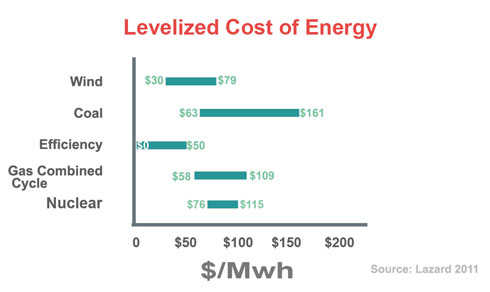
As the graph above indicates, wind energy is already more than competitive with all other sources. Of course, this is just the beginning. New techniques of manufacturing are lowering the cost of building new turbines, and new designs are making turbines so much more efficient and sensitive, that large areas, formerly impractical for wind farms, are becoming cost effective.
For the republicans that dominate the US House, apparently cheaper and cleaner energy is not as interesting as fantastically expensive wars for oil have been. Wonder why?
Worldwide, wind power prices fell to $1.2 million/MW in the first half of 2011, mainly because of improvements in supply-chain efficiency and economies of scale. Competition from Chinese manufacturers and their excess capacity to build machines and flood the market also played a role.
In addition, the capacity factor of wind turbines continues to rise as better technologies enter the market, further driving down turbine costs. Combined, these factors are expected to bring down the cost of wind energy by 12% by 2016, making onshore wind cost competitive with coal, gas and nuclear power.
“Global wind power growth looks very strong and is on a continued rise, largely because of China’s incredible level of investment,” says Konold. “Withhold that, and the picture looks more muddled.
“Developed economies are not reaching their fullest potential due to financial and policy uncertainty, and many developing economies are running into technical problems, despite slightly stronger growth in wind power capacity,” he continues. “Although continued growth in wind power won’t be as strong as it could be, as the supply increases and prices fall, wind energy is quite likely to continue its upward trend.”
The wind industry, in an uphill fight to save its federal incentive,
just released its final report on 2011.Wind was 31 percent of new U.S. generating capacity
last year. All renewables accounted for 39 percent.
Natural gas was 42 percent, according to American Wind
Energy Association (AWEA) Chief Economist Elizabeth Salerno.
Wind added almost seven gigawatts of new capacity in 2011,
about the same as seven nuclear reactors. (Nuclear added none.)It is the kind of growth wind has sustained since the middle of
the last decade, when the Bush administration established some
certainty about the availability of the production tax credit (PTC).With an average annual investment of $15 billion in the subsequent
five years, the U.S. industry now has almost 47 gigawatts of installed
capacity in 38 states and 472 manufacturing facilities in 42 states
that provide 30,000 of the 75,000 U.S. wind industry jobs.In 2005 to 2006, only about 35 percent of the value of a wind
turbine installed in the U.S. was made in the U.S.; last year,
it was over 65 percent.The key driver behind wind’s growth has long been the Production
Tax Credit (PTC), which allowed it to leverage private capital.
During the recession, the availability of private capital waned and
the Bush and Obama administrations upped federal support in the
form of a long-term extension of the PTC and a cash grant option.With tax equity liquidity returning, conservative Republicans
in Congress have not only withdrawn the cash grant option,
but are refusing to extend the tax credit incentive.
It’s not just the national congress. Here in Wisconsin the Koch booger funded Goobernor (Snot Walker) has been trying to stop wind development by putting onerous regulations on new wind development (land setbacks) and has cutted tax breaks for wind and solar and dumped them into other areas that don’t compete directly with fossil fuel interests or the big utlities. He is claim it is for the ‘property rights’ of rural landowners. Some how the property rights of people that live downwind from coal plants don’t count. Also in his recall effort his big corporate backers (especially the Koch brothers) have ensured that he is well rewarded for his effort to make this state toxic by ensuring he is able to spend 7:1 against his opponent despite the fact that the polls are almost tied (indicating that his opponent isn’t someone that everyone hates and is donating against).
got it.
http://climatecrocks.com/2011/03/25/wisconsin-gop-hates-windpower-windpower-hates-wisconsin/
http://climatecrocks.com/2011/03/08/wisconsin-republicans-anti-labor-and-anti-wind-two-sides-of-the-same-coin/
Oh you’re too good!