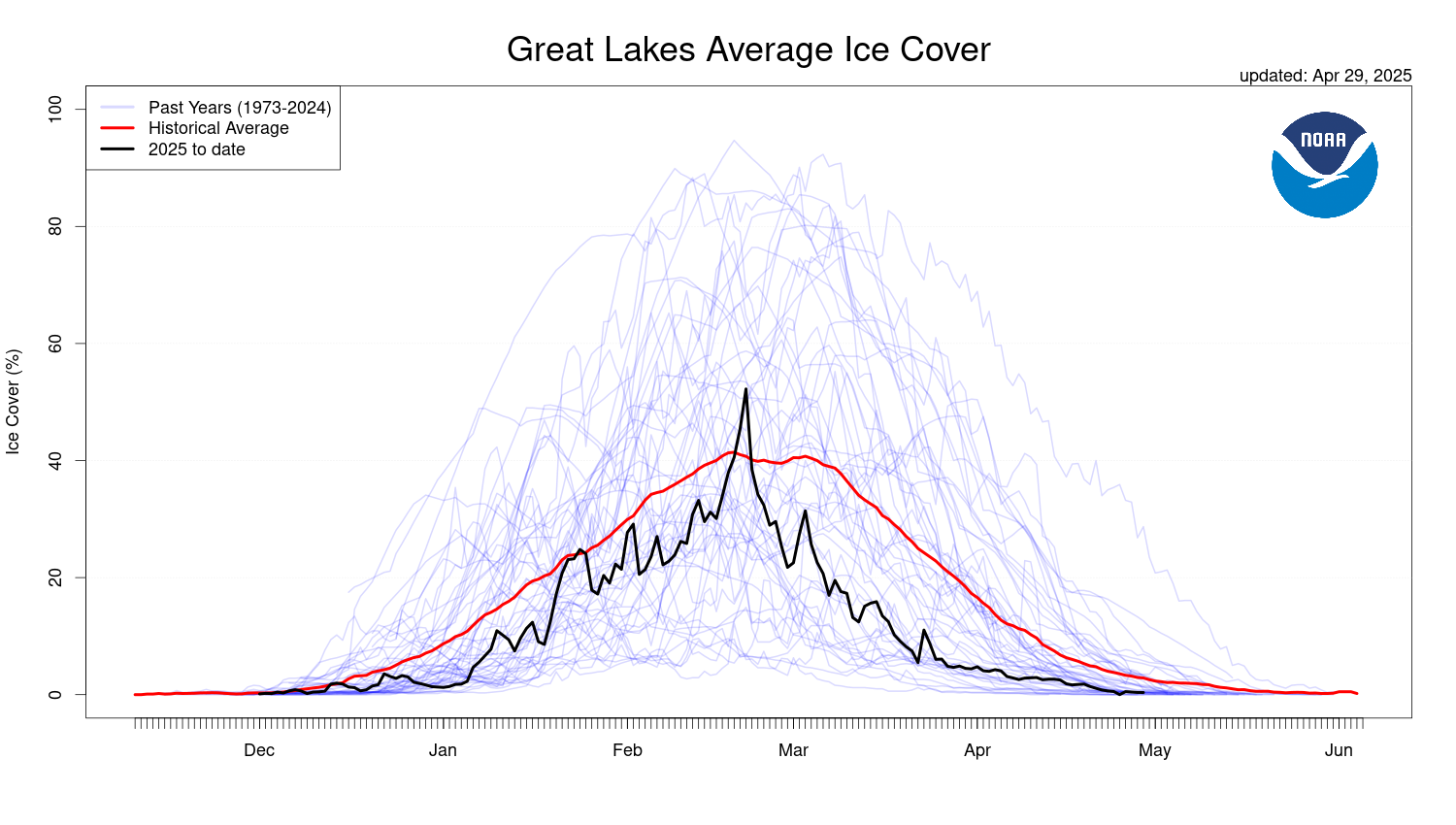
As of February 13, 2023, only 7 percent of these five freshwater lakes was covered in ice, which is significantly below the 35-40 percent ice cover that is expected for this time of year, according to NOAA’s Great Lakes Environmental Research Laboratory(GLERL).
Ice extent across the basin briefly jumped up to 21 percent in early February in response to a cold snap, but has been declining since. Maximum ice cover typically occurs between mid-February and early March.
Although there is year-to-year variability in the ice cover of the lakes, NOAA research has found that in recent years ice cover is in a downward trend. An analysis led by Jia Wang, an ice climatologist at NOAA’s GLERL, found significant declines in average ice cover of the Great Lakes between 1973 and 2017. During the winter period of those 44 years, which runs from December 1 to April 30, average ice cover on the Great Lakes declined about 70 percent.
Ice cover protects the shoreline of lakes – without it, high waves can scour the coastline and cause severe flooding.
Low ice coverage on the lakes can be a set up for large severe “lake effect” snow storms, says Ayumi Fujisaki-Manome, a researcher at NOAA’s Cooperative Institute for Great Lakes Research at the University of Michigan. “The moisture and heat from the lake surface water are absorbed into the atmosphere by storm systems, and then fall back to the ground as snow in the winter. When ice is not present, we can end up with big snow storms like those that hit Buffalo, New York in December.
Iowa’s early diversification of our energy portfolio has kept energy rates below the national average and provided new revenue for Iowa communities. This success is now under attack by outside forces.
Iowa is a national leader in renewable energy thanks to early vision by leaders like Gov. Terry Branstad and Sen. Chuck Grassley. However, this leadership has made our state a target for national efforts to kill clean energy development.
Under the guise of local messengers, we have seen the same opposition messaging across the state and country, and the same misinformation spreading online. Regardless of whether it is wind or solar, the underlying opposition playbook is the same. Here in Linn County, propaganda is being distributed by Citizens for Responsible Solar, a dark-money organization based in Virginia.
These anti-renewable energy organizations have appeared in Worth and Winnebago Counties, Adams County (my home county), Madison County, and more. The groups are operating from the same playbook featuring shared materials and draft petitions from national sources that originate thousands of miles from Iowa.
Not by coincidence, these groups propose the same type of moratorium on clean energy projects (wind or solar) for their counties. It is important to understand these moratorium discussions are not being held in good faith. Their mission is to kill new development, not to help develop common-sense ordinances.
Linn County already has comprehensive zoning policies and development requirements, including the adoption of an updated Renewable Energy Ordinance in late 2020, to ensure the safety of citizens and foster an environment for economic development.
As Chair of the Iowa Conservative Energy Forum (ICEF) and a farmer myself, I hope to be a common-sense voice to make sure we are looking out for Iowa landowners before national interest groups. I caution colleagues and friends in rural Iowa to understand efforts to ban renewable energy development by organizations claiming to protect home rule, are in fact banning the rights closest to your home — your land rights.
Our goal at ICEF is to be an ally of landowners who look to find common ground, and to provide facts and figures free of online hysteria. We need to fight back against organizations and their local messengers that promote a national agenda claiming to protect property rights. In reality, these groups are effectively creating eminent domain policies by not enabling landowners to make their own decisions on their own land.
Correlation is of course, not causation. But it’s not nothing.
“Dilbert” cartoonist Scott Adams is famously a climate denier.
Based on experience, and examples that I’ve pointed to many times, that would generally make me think – “Yeah, he’s probably a racist, too.” But, damn. He really is a racist jerk.
Also, he has no concept of social media algorithms.
UPDATE: “Dilbert” pulled from multiple news papers, including a lot of the big ones. I can tell you as a former cartoonist that you make the huge percentage of your money from the handful of really big papers. The smaller papers pay so little that they barely move the needle.
The Los Angeles Times cited Adams’ “racist comments” while announcing Saturday that Dilbert will be discontinued Monday in most editions and that its final run in the Sunday comics — which are printed in advance — will be March 12.
The San Antonio Express-News, which is part of Hearst Newspapers, said Saturday that it will drop the Dilbert comic strip, effective Monday, “because of hateful and discriminatory public comments by its creator.”
The USA Today Network tweeted Friday that it also will stop publishing Dilbert “due to recent discriminatory comments by its creator.”
The Plain Dealer in Cleveland and other publications that are part of Advance Local media also announced that they are dropping Dilbert.
“This is a decision based on the principles of this news organization and the community we serve,” wrote Chris Quinn, editor of The Plain Dealer. ’“We are not a home for those who espouse racism. We certainly do not want to provide them with financial support.”
Christopher Kelly, vice president of content for NJ Advance Media, wrote that the news organization believes in “the free and fair exchange of ideas.”
“But when those ideas cross into hate speech, a line must be drawn,” Kelly wrote.
The first breath of spring can make us feel that all is right with the world. But when it comes as eerily warm temperatures in the 80s in February amid weather whiplash doled out by our overheated planet — not so much. It feels wrong because it is wrong. Welcome to the new abnormal.
This week sees a “meteorological battleground” setting up across the continental U.S., pitting a massive winter storm from the West against far-too-early Spring heat in the East. This major winter storm is dumping heavy snow and ice across the northern U.S. from the West Coast to the Northeast. Widespread very strong, gusty winds are expected across the West and High Plains while heavy rain with the potential for flash floods and severe weather are predicted for the Midwest and Plains. Meanwhile, historic heat is building across the Southeast and mid-Atlantic states, with record-breaking February temperatures soaring into the 80s. Almost the entire country is experiencing some form of extreme weather this week.
The connections with climate disruption are everywhere in our weather. Some of these links — to hotter weather, heavier downpours, strengthening hurricanes — are crystal clear. Rock-solid science has long told us that as the global average temperature increases, extreme heat will rise even faster. And because a warmer atmosphere holds more moisture, more of our precipitation is coming in the form of heavy downpours. Hurricanes get their energy from warm ocean water, becoming stronger and intensifying more rapidly as temperatures rise. More than 90 percent of the excess heat trapped by carbon pollution has been absorbed by the ocean, and the world’s oceans were the hottest ever recorded in 2022. Climate scientists have long warned of these changes and the predictions are now coming to pass.
Other links between extreme weather and human-caused climate change are more complex and are the subject of active research as we seek to pin down some of the specific mechanisms by which climate change is turning our weather world upside down. One area of intensive investigation is how an overheating world is affecting the winter jet stream. Mounting evidence suggests that Arctic warming is linked to winter cold snaps in the U.S., increasing their frequency and persistence.
The Arctic is heating up nearly four times as fast as the rest of the globe. This reduces the temperature difference between the equator and pole, increasing disruptions of the polar vortex — a swirl of cold air in the stratosphere that circles the North Pole — and favoring a wavier winter jet stream, which is the high-altitude wind current that creates and steers weather systems from west to east. A wavier jet stream tends to swing in larger north-south meanders and travel east more slowly, bringing more frequent and persistent cold plunges over the United States. A warming ocean may also be leading to more intense Nor’easters and coastal winter storms that bring large snowfalls and bitter cold snaps.
Below, jet stream over US shows clearly why Los Angeles is under a blizzard warning;
If you’ve ever had that creepy sensation that you are suddenly driving on black ice with no meaningful traction between the road and your wheels, this is for you.