Reposting: Jennifer Francis – “We’re in for an Interesting Fall and Winter”

My interview with Jennifer Francis of Rutgers last spring touched on the effects of newly open arctic waters on the jet stream, and extreme weather that may be resulting from that. We’ve seen a series of  extreme events globally, including the Russian heatwave of 2010, Pakistan floods of the same summer, and the unusual spring in  North America, that are related to behavior in the jet stream.

In the above interview I conducted this past September, Dr Francis re-iterated that, following the crash of northern sea ice over the summer, fall and winter might well be “very interesting”.

For the record, there is not by any means a smoking gun connection between arctic events and the current east coast frankenstorm – but nevertheless, here we are…
According to Kevin Trenberth,  asking whether a particular event is connected to climate change, is in any case the wrong question – all weather going forward carries the signature of increased warming, and increased atmospheric moisture.

Below, see the Yale forum video that discusses the arctic connection to jet stream effects.

Continue reading “Reposting: Jennifer Francis – “We’re in for an Interesting Fall and Winter””
Sandy Update 10/27: Heightened Threat to NYC

Paul Douglas Updates Saturday morning:

Threat Increases for New Jersey, Metro New York, Long Island, Boston and coastal New England.

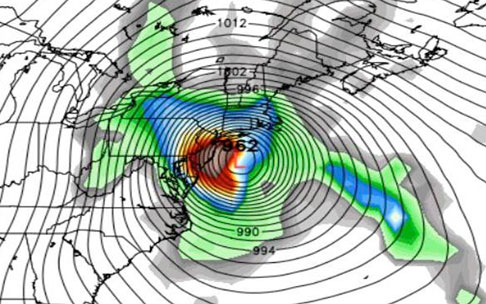
Don’t be misled into thinking the threat has eased because “Sandy” is a tropical storm. All the models show a rapidly re-intensifying storm tonight and Sunday as an approaching surge of Canadian air energizes the system; a dramatic contrast in barometric pressure producing hurricane-force winds into Monday over a broad, 200-250 mile wide arc approaching coastal Delaware, New Jersey and far southern New England. Sandy is still a force to be reckoned with, still a potentially historic storm from Cape May and Atlantic City northward to New York City and bedroom communities of coastal Long Island.

Latest models are strongly suggesting a heightened risk for New York City, Long Island, Providence, Cape Cod and the islands (Nantucket and Martha’s Vineyard). The northward wobble I talked about earlier today continues, and there is now a 70-75% risk that Sandy will pass just south of New York City Monday morning.

The worst-case scenario for New York is a track just south of the city, with sustained hurricane-force southeast winds, capable of funneling water into New York Harbor and right up the Hudson and East Rivers. That scenario now looks considerably more likely than it did 12-24 hours ago.

UPDATE: Sandy has now re-strengthened to Hurricane force.

Lookit them Yo Yos! That’s the Way Ya Do it!!!!!!! Music Channel Breaks Glass on Climate Emergency

10/26/12: MTV’s Sway Williams breaks the climate silence, asking President Barack Obama a tough question about global warming. Obama says he’s “surprised it didn’t come up in the debates.”

Desmogblog:

To the 2012 Presidential Debate moderators, here’s a little tribute to all of you for failing to ask any questions about the single largest threat to U.S. national security, public health and the economy. I’m looking at you Candy “all you climate change people” CrowleyJim Lehrer, and Bob “200 questions” Schieffer. You all just got owned by MTV, that bastion of vital political coverage.

Suggest headphones for this video. Crank it loud and tweet this posting as far as possible.

Transcript:

When MTV Breaks The Climate Silence, Obamas Says ‘We’re Not Moving As Fast As We Need To,’ Says He’s ‘Surprised’ By Climate Silence, Portrays Climate Change As Threat For ‘Future Generations’ And ‘It’s Going To Have A Severe Effect.’

TRANSCRIPT:

Q: Until this year global climate change has been discussed in every presidential debate since 1988. It was a big part of your previous campaign but pushed back on the back burner. Given the urgency of the threat, do you feel that we’re moving quickly enough on this issue, number one, and Samantha from New Jersey wants to know what will you do to make it a priority?

OBAMA: The answer is number one, we’re not moving as fast as we need to. And this is an issue that future generations, MTV viewers, are going to have to be dealing with even more than the older generation. So this is a critical issue. And there is a huge contrast in this campaign between myself and Governor Romney. I am surprised it didn’t come up in one of the debates. Gov. Romney says he believes in climate change. That’s different than a lot of members of his own party that deny it completely. But he’s not sure that man-made causes are the reason. I believe scientists who say we are putting too much carbon emissions into the atmosphere and it’s heating the planet and it’s going to have a severe effect. There are a lot of things we have done a lot of things in the last four years. We have already doubled the fuel efficiency standards on cars and trucks. That’s the first increase in 30 years in the fuel mileage standards. As a consequence we will be taking huge amounts of carbon out of the atmosphere, even as we’re also saving folks money at the pump and reducing our dependence on foreign oil. We have doubled clean energy production — wind, solar, biofuels — and that means that increasingly people are getting electricity, companies are generating power, without the use of carbon-producing fuels. And that’s helping as well. The next step is to deal with buildings and really ramp up our efficiency in buildings. If we had the same energy efficiency as Japan, we would cut our energy use by about 20 percent, and that means we’d be taking a whole lot of carbon out of our atmosphere. And if we do those things, we can meet the targets that I negotiated with other countries in Copenhagen, to bring our carbon emissions down by about 17 percent, even as we’re creating good jobs in these industries. In order for us to solve the whole problem though, we’re gonna have to have some technological breakthroughs. Because countries like China and India, they’re building coal-power plants and they feel that they have to prioritize getting people out of poverty ahead of climate change. So what we have to do is help them and help ourselves by continuing to put money into research and technology about how do we really get the new sources of power that are going to make a difference.

Teachable Moments: Get used to ’em.

Washington Monthly:

You might ask yourself, aren’t hurricanes supposed to weaken as they head north? Why are these pressures so low? Or as the Weather Channel’s Bryan Norcross put it: “What the hell is going on?”

Norcross’ answer: “This is a beyond-strange situation. It’s unprecedented and bizarre.”

These historic low pressure levels simulated by the model are equivalent to a category 3 or 4 hurricane, which have peak winds over 115 mph. But Sandy’s winds will not be that high, because as it transitions into this hybrid hurricane-nor’easter, its core will unwind. So its peak winds will diminish, but strong winds will be felt over a vast area. Think of a compressed slinky expanding as you let it go.

WJLA meteorologist Ryan Miller notes 66,549,869 people live in the National Hurricane Center’s track zone for Sandy. A large percentage of these people will likely contend with tropical storm force winds – 40-60 mph, if not somewhat greater….

A very prominent and respected National Weather Service meteorologist wrote on Facebook last night,

I’ve never seen anything like this and I’m at a loss for expletives to describe what this storm could do.

Bloomberg:

Sandy may combine with a second storm coming out of the Midwest to create a system that would rival the New Englandhurricane of 1938 in intensity, said Paul Kocin, a National Weather Service meteorologist in College Park, Maryland. The hurricane currently passing the Bahamas has killed 21 people across the Caribbean, the Associated Press reported, citing local officials.

“What we’re seeing in some of our models is a storm at an intensity that we have not seen in this part of the country in the past century,” Kocin said in a telephone interview yesterday. “We’re not trying to hype it, this is what we’re seeing in some of our models. It may come in weaker.”

Sandy’s apparent weakening doesn’t accurately predict the storm it may become, said Matt Rogers, president of Commodity Weather Group LLC in Bethesda, Maryland. Computer models suggest the hurricane may transform into a hybrid system over the weekend because of another storm moving in from the Midwest.

“When the storm phases with the energy from the west, it is forecast to deepen rapidly,” Rogers said. “Indeed, it is expected to continue weakening until phasing really takes place late Sunday into early Monday.”

The 1938 hurricane killed more than 500 people after crossing Long Island and battering Connecticut and Rhode Island.

“We can say even now our worst fears may be realized,” Kocin said. “If we were seeing what we’re seeing today one day out, we would really be shouting the alarms.”

Continue reading “Teachable Moments: Get used to ’em.”

Sandy Update Friday 10/26

Above, Sandy from the Space Station, video sped up 500 percent.

Update from Paul Douglas:

Hurricane Sandy remains a potent threat, even though it has weakened slightly overnight, to a Category 1 storm. Little has changed in terms of forecast track or intensity; a majority of weather models continuing to pull a hybrid Hurricane Sandy – severe Nor’easter into the Mid Atlantic coast by late Monday or early Tuesday of next week.

A couple of points: Sandy is forecast to mutate into a huge storm, with gale force (50 mph) winds cover a 500 mile radius, which is nearly unprecedented. Hurricane-force winds may impact an area 150 to 200 miles wide, on either side of Sandy’s track. There will be significant beach erosion and coastal flooding. Extreme flooding is possible at high tide, and a full moon will complicate matters.

I want to underscore the risk posed by inland flooding. Sandy will be a prodigious rain-maker, with some 6-10” rainfall amounts well inland, capable of severe flash flooding 1-2 days after landfall.


The Navy NOGAPS simulation shows an intense “Frankenstorm” hybrid approaching the coast of Delaware or south Jersey Monday morning and midday, severe flooding from the Delaware Valley southward to D.C. and the Tidewater of Virginia.


Worst-Case For New York City. The GFS model suggests landfall closer to New York City and northern New Jersey on Tuesday, a long fetch of high winds over the Atlantic capable of creating a 10-15 foot storm surge for Long Island, with 5-10 foot surges into New York Harbor. This is a possibility, but right now we believe the odds of this happening are less than 1 in 3, with landfall farther south, from Atlantic City to Ocean City, Maryland. Today we will be looking for any signs that models are nudging Monday landfall farther north, closer to New York City.

Brace for Impact: Sandy Now a “Frankenstorm”

Associated Press:

WASHINGTON (AP) — An unusual nasty mix of a hurricane and a winter storm that forecasters are now calling a”Frankenstorm” is likely to blast most of the East Coast next week, focusing the worst of its weather mayhem around New York City and New Jersey.

Government forecasters on Thursday upped the odds of a major weather mess, now saying there’s a 90 percent chance that the East will get steady gale-force winds, heavy rain, flooding and maybe snow starting Sunday and stretching past Halloween on Wednesday.

Meteorologists say it is likely to cause $1 billion in damage.

The storm is a combination of Hurricane Sandy, now in the Caribbean, an early winter storm in the West, and a blast of arctic air from the North. They’re predicted to collide and park over the country’s most populous coastal corridor and reach as far inland as Ohio.

Meteorologist Paul Douglas has sent out this alert:

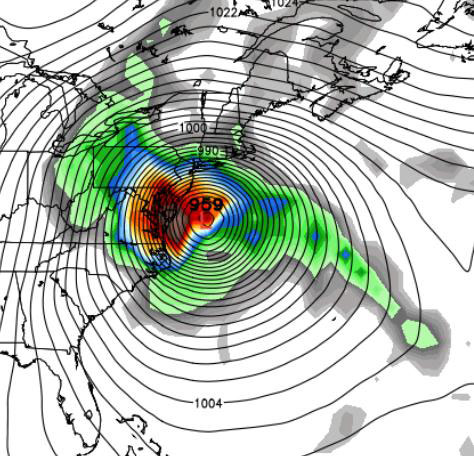
Top: Sunday 1pm
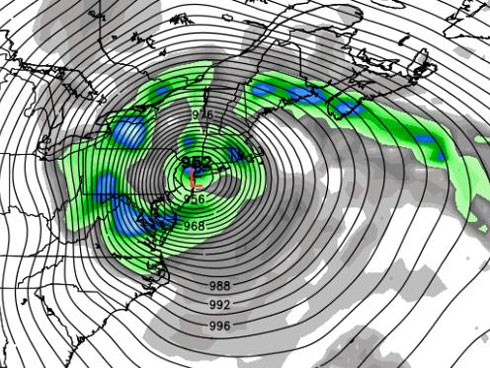
Bottom: Sunday midnight

Sandy resembles Hurricane Debby, which morphed into “The Perfect Storm” on Halloween, 1991. The similarities are striking. As Hurricane Sandy drifts north it may lose some of its hurricane characteristics, morphing into a violent Nor’easter as it passes the Outer Banks of North Carolina, most likely being pulled inland by an approaching trough of low pressure late Sunday and Monday. Although the precise path is still in doubt, there’s little question that Sandy will impact a wide swath of the east coast, and residents from Miami to Boston need to stay up on the forecast, discuss contingency plans, and be ready to take measures to lower the risk to life and property. I’m most concerned about people on barrier islands, especially the Outer Banks, which may suffer a major blow Sunday and Sunday night.

  Continue reading “Brace for Impact: Sandy Now a “Frankenstorm””

Insurance Giant Study Warns “Extreme Events a Game Changer”

We’re watching the progress of Hurricane Sandy as it heads on a course that may bring it ashore on the US east coast.

Mandatory disclaimer: No particular weather event can be ascribed to climate change – however, as one very well informed advisor messaged me yesterday , the set-up for this storm track is “.. certainly what I’d expect to see occurring more frequently in association with the huge ice loss this summer.”

Big re-insurer Munich Re (Re-insurers are companies that insurance companies go to for insurance) has been publishing their concerns about climate change hazards since 1973, and climate expert Peter Hoppe figured prominently in Welcome to the Rest of Our Lives, one of my most popular recent videos.

From a powerpoint by Munich Re’s Peter Hoeppe. Munich Re publication from 1973 warning of impacts of extreme events due to climate change.

The video above describes the concerns that Munich Re has, and the company has now released a study that quantifies some of these risks. According to the vid,”between 1980 and 2011 the number of weather related loss events increased almost 5 fold” in North America.

According to Munich Re hazards expert Peter Hoeppe, “..the higher the sea surface temperature.. the higher the risk for high intensity hurricanes is..”, and we have seen those SSTs increase around the globe, due to human caused climate change.

According to the Munich Re press release on the most recent report:

A new study by Munich Re shows that North America has been most affected by weather-related extreme events in recent decades. The publication “Severe weather in North America” analyzes all kinds of weather perils and their trends. It reports and shows that the continent has experienced the largest increases in weather-related loss events.

Continue reading “Insurance Giant Study Warns “Extreme Events a Game Changer””

Tea Party Imposters Undermining Internet Discourse

When I brought up this topic for Environmental Journalists last week, many seemed surprised, and unfamiliar with the idea. Here, the Center of American Progress’ Lee Fang discusses his investigation of phony internet “boiler rooms” where “fake online personas” are created to distort online discussion threads, and create the illusion of mass movements and “spontaneous” public sentiment that does not exist.

Most of us in the climate blogging community have a strong sense that this is going on, but so far have been unable to pin it down specific to the climate issue.  Clearly evidence exists that this is a real phenomenon for right wing activists in general – it seems like we are getting closer to the bottom of this cesspool.

Regular readers will have seen the Tea Party Troll Training below:

Hurricane Update: Mega Storm Threat Growing

Capitol Weather Gang 0315 am thursday, 10/25:

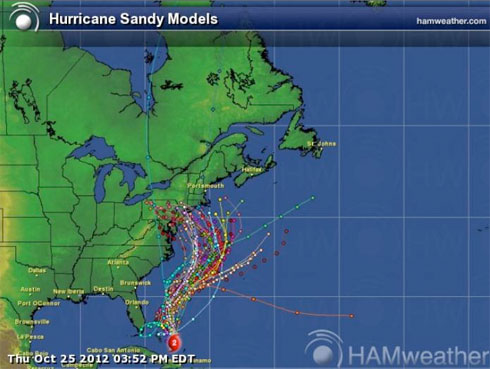
There is a consensus forming in weather forecast models that hurricane Sandy is unlikely to go out to sea. Instead, it more likely will merge with a strong fall cold front and transition into a powerhouse, possibly historic mid-latitude storm along the mid-Atlantic and/or Northeast coast Sunday through Wednesday.

The majority of models now take Sandy from its current position just west of Santiago de Cuba in southern Cuba before curving the storm towards either the mid-Atlantic or Northeast coast. Models disagree on where the storm will recurve and make landfall: simulations vary from the mid-Atlantic to Maine. There remains a chance, though diminishing, the storm will slide harmlessly out to sea.

Below, US Navy model run from the Fleet Numerical Meteorology and Oceanography Center (FNMOC)

Continue reading “Hurricane Update: Mega Storm Threat Growing”

Monday Morning 7am – DC in the Crosshairs?


I’m getting frequent updates. Will try to keep posting regularly on this.

Monday Morning, 7 am. This is what I consider to be the most reliable weather model looking out more than 4-5 days, the European ECMWF model. It has consistently hooked Sandy inland for the last 3 days, and it continues to push the storm into the northeast coast, but now closer to Rehoboth and Ocean City, Maryland. If this solution verifies D.C. would experience hurricane force winds and flooding rains. The models indicate possible landfall anywhere from the Chesapeake Bay to Cape Cod, but I put more stock in the ECMWF solution.