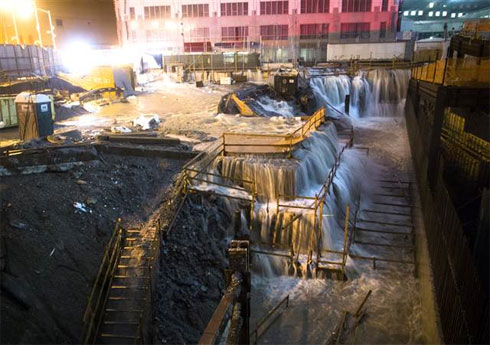
NYTimes: Huge Damage


NYTimes:

Power remained out for roughly six million people, including a large swath of Manhattan. Early risers stepped out into debris-littered streets that remained mostly deserted as residents awaited dawn to shed light on the extent of the damage. Bridges remained closed and seven subway tunnels under the East River remained flooded.

The storm was the most destructive in the 108-year history of New York City’s subway system, said Joseph J. Lhota, the chairman of the Metropolitan Transportation Authority, in an early morning statement. “We are assessing the extent of the damage and beginning the process of recovery,” he said, but did not provide a timetable for restoring transit service to a paralyzed city.

At least 16 deaths — including seven in the New York region — were tied to the storm, which toppled trees and sparked fires in several areas, The Associated Press reported.

Finishing up a video right now. More later.

Visualizing CO2

I was waiting to post this till after the storm, but its a visual metaphor for the amount of CO2 emitted by New York City, and given the current situation, makes an interesting juxtaposition.

Description:

In 2010 (the latest year for which we had data) New York City added 54 million metric tons of carbon dioxide (equivalent) to the atmosphere, but that number means little to most people because few of us have a sense of scale for atmospheric pollution.

Carbon Visuals and the Environmental Defense Fund wanted to make those emissions feel a bit more real – the total emissions and the rate of emission. Designed to engage the ‘person on the street’, this version is exploratory and still work in progress.

54,349,650 million tons a year = 148,903 tons a day = 6,204 tons an hour = 1.72 tons a second

At standard pressure and 59 °F a metric ton of carbon dioxide gas would fill a sphere 33 feet across (density of CO₂ = 1.87 kg/m³). If this is how New York’s emissions actually emerged we would see one of these spheres emerge every 0.58 seconds.

Emissions in 2010 were 12% less than 2005 emissions. The City of New York is on track to reduce emissions by 30% by 2017 – an ambitious target.

For a set of stills from this movie, see:http://www.flickr.com/photos/carbonquilt/sets/72157631827283027/

For more information see:
http://www.carbonvisuals.com/work/new-yorks-carbon-emissions-in-real-time

Sandy’s Climate of Doubt, Denial, and Fear

It’s like a drunk.

I might actually be true that he got fired because his boss was a jerk. And, maybe, his wife left him because, well, his mother was right – she was a tramp.

And when social services took his kids away, — that was an over-reaching, busybody bureaucracy.
When the power company turned his lights off, that had to be a mistake, because he’s darn sure he mailed the check. That cop that stopped him for speeding was just running a speed trap to meet his quota, and the judge that sentenced him to 30 days was just trying to look tough with elections coming up.

When the bank foreclosed on his home, it really was their fault, for talking him into that loan.

Those other guys at the shelter, what a bunch of losers.  How do people end up like that?

How much longer can we avoid this conversation?

Graham Readfern:

A 30-YEAR-OLD man has just become the first New Yorker to be killed by the destructive force of the super-charged storm Sandy which, as I type, is moving across the eastern side of the United States.

The New York Times reported how the man died when a tree fell on his house in Queens. The former-Hurricane Sandy has already claimed more than 60 lives in Caribbean countries.

There are something like 50 million Americans currently in the storm’s path. It seems inevitable that more people will lose their lives in the coming hours.

Whatever transpires we no doubt all hope that the number of fatalities is low. But neither good fortune nor any god will decide. The death toll will be what it is, and families will grieve.

It seems insensitive to mention the billions of dollars of damage the storm will cause. It might, to some, seem insensitive to mention human-caused climate change at a time like this.

But given that neither Mitt Romney nor Barack Obama had the courage, the foresight or the necessary leadership qualities to be able to mention the issue in their official debates, I’d say their insensitivity is far greater than any which a freelance journo and blogger across the Pacific may be able to muster.

Continue reading “Sandy’s Climate of Doubt, Denial, and Fear”

Monday Evening Storm Update: Stronger than Expected – “A Meteorological Bomb”

Paul Douglas’ Monday evening Sandy Update:

Hurricane Sandy Headlines:

…SANDY MOVING MORE QUICKLY TOWARD SOUTHERN NEW JERSEY…

…LANDFALL EXPECTED EARLY THIS EVENING…

SUMMARY OF 200 PM EDT…1800 UTC…INFORMATION
———————————————-
LOCATION…38.3N 73.1W
ABOUT 110 MI…180 KM SE OF ATLANTIC CITY NEW JERSEY
ABOUT 175 MI…285 KM SSE OF NEW YORK CITY
MAXIMUM SUSTAINED WINDS…90 MPH…150 KM/H
PRESENT MOVEMENT…NW OR 305 DEGREES AT 28 MPH…44 KM/H
MINIMUM CENTRAL PRESSURE…940 MB…27.76 INCHES

I realize there was (a lot) of skepticism, cynicism and name-calling with this storm. “Meteorologists are hyping the weather again!” Americans were understandably hesitant about taking Sandy seriously, in spite of repeated warnings. As I tell my staff at The Media Logic Group, it’s good to be skeptical, but perpetual cynicism in the face of overwhelming evidence isn’t good – in fact it can be dangerous. The prevailing wisdom for many coastal residents was: “I’ll believe it when I see it, and if it gets bad…we can always leave at the last minute!” Maybe not. Because at the last minute roads and bridges may be inundated, barrier islands cut off. You’ll have no choice but to ride out the storm. Emergency management and 911? In spite of best efforts they may not be able to reach your location in time.

Synopsis. Sandy’s 90-100 mph. winds will reach coastal New Jersey this evening. Winds in New York and Long Island will gust to 90 mph, with a second, even stronger, more damaging storm surge late this evening, coinciding with high tide and a full moon. Astronomical forces have conspired to turn this from a 1 in 50 year storm to a 1 in 100 year storm surge for many coastal locations.

Monster-Storm. As expected the heaviest rains and reports of inland flooding are taking place from south Jersey, the Delaware Valley and southern Pennsylvania south to D.C., Baltimore, the Delmarva Peninsula (Bethany Beach and Rehoboth) and Virginia’s Tidewater into OBX. Rainfall amounts may exceed 2-4” over southern New England, but inland flooding will be worse over the Mid-Atlantic than over most of New England.

Impact Of First Storm Surge. This photo, courtesy of WeatherNation TV, was taken in Atlantic City around midday when an 8 foot surge was reported. A second surge is likely, coinciding with landfall and high tide this evening.

Maximum Surge. Still reeling from a 6-12 foot surge late morning and midday, a second, slightly higher surge if forecast for late evening from northern New Jersey and “The New York Bight”, northeastward to Groton, CT. Based on a track across southern New Jersey, sustained wind speed/direction and underwater topography (Continental Slope) a 10 foot plus storm surge is anticipated in western Long Island Sound, impacting Long Island, Greenwich, CT, and portions of Queens and Brooklyn. Map: NOAA.

The second, most damaging storm surge takes place close to landfall and high tide tonight, between 8 pm and midnight at many locations. This will be the height of the storm, in terms of wave-power and inundation of low-lying areas – as bad as it gets.

Continue reading “Monday Evening Storm Update: Stronger than Expected – “A Meteorological Bomb””

Sandy Update from Paul Douglas, Monday 1300 hrs

Paul Douglas:

Hurricane – Nor’easter Sandy Still On Track To Deliver Punishing Blow. It’s tempting to look at a Category 1 hurricane and think “no big deal – we’ve seen worse”. But it’s a combination of factors, meteorological, geographical and astronomical, that will make Sandy (much) more than a minor inconvenience from today into Tuesday. Latest model guidance suggests that winds won’t subside below tropical storm force in New York City until Wednesday morning. This is a long-duration, high-impact storm. Based on the latest 12z guidance (above) peak winds are forecast to come this afternoon and evening, some (slight) easing of winds by late evening as Sandy comes ashore near Atlantic City. Important: the storm is actually stronger, deeper, with lower pressure than predicted by the models yesterday at this time. Peak sustained winds have increased from 75 mph early Sunday to 90 mph (now), with gusts over 100 mph.

Monday Midday Headlines:

At last report Sandy was packing 90 mph winds with gusts over 100 mph – a central pressure of 27.85”, even deeper/stronger than some computer models were predicting yesterday.

The next 12-24 hours will be critical; Sandy comes ashore tonight, but two surges of water, magnified by high tide and a full moon, will sweep ashore – later this morning and midday, a second, slightly higher surge predicted for late evening. That is risk #1. Winds will be a factor, bringing down tree limbs and subsequently power lines, plunging millions (potentially) into darkness. People need to be prepared and ready for an extended period of time without power. Inland flooding will be another problem, especially from Philadelphia and Harrisburg to Washington D.C, Baltimore, Annapolis and the Delmarva Peninsula. If you’ve been flooded by a previous hurricane or tropical storm you’ll probably see significant flooding from Sandy.

Conditions will slowly improve Tuesday, but tropical storm force winds may not die down until a Wednesday time frame.

Sandy Update from Jeff Masters

Image from Brooklyn NY

Weather Underground:

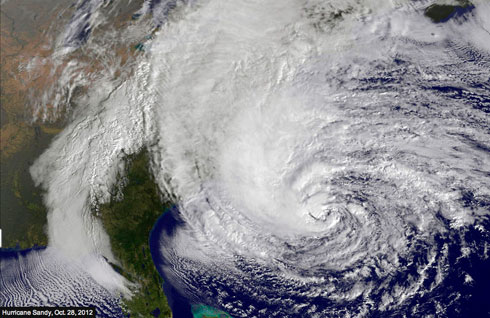
The final countdown to Hurricane Sandy’s arrival has begun, and this extraordinary and historic storm is already causing havoc all along the U.S. coast from North Carolina to Massachusetts. The scale of this massive storm truly earns Sandy the title of “superstorm”. Sandy’s tropical storm-force winds span an area of ocean 940 miles in diameter, and both North Carolina and the island of Bermuda, 700 miles to the east, are under tropical storm warnings. The region of ocean covered by 12-foot high seas spans an area of ocean an incredible 1560 miles in diameter. Winds near hurricane force are expected to affect waters from Virginia to Massachusetts today.

Record storm surge flooding has already occurred in regions along the New Jersey coast this morning, and the highest water levels recorded in over a century of record keeping are expected over much of the New Jersey and New York coasts this evening during the 8 – 9 pm EDT high tide cycle. Sandy brought sustained winds of 60 mph and waves 30 feet high early this morning to the buoy east of Cape Hatteras, NC. A wind gust of 58 mph occurred at New York City’s La Guardia Airport at 9:51 am EDT, and a buoy atRobins Reef, NJ recorded sustained winds of 42 mph, gusting to 55 mph. As of 8 am EDT, Sandy has dumped heavy rains of 7.87″ at Cape Hatteras, NC; 4.01″ at Ocean City, MD; 3.12″ at Dover, DE; and 3.22″ at Virginia Beach, VA. As of 9 am EDT, peak storm surge values of 5″ were observed at Lewes, Delaware, 4.2′ at Cape May, NJ, 4′ at Atlantic City, NJ, 2.9′ at Philadelphia, and 3.9′ at New York City.

Latest data from the Hurricane Hunters shows that Sandy is intensifying as its core traverses the warm waters of the Gulf Stream. At 8 am EDT, an Air Force hurricane hunter aircraft found top winds of 98 mph in the heavy thunderstorms to the southwest of Sandy’s center, at a point about 150 miles east-northeast of Cape Hatteras, NC. A dropsonde released in the eye measured a central pressure of 945 mb, but observed winds of 19 knots at the surface, so Sandy is probably a 943 mb hurricane that is very close to Category 2 strength. The Hurricane Hunters did not observe an eyewall, and saw very little temperature difference from inside to outside the eye, so Sandy is not going to be able to undergo rapid intensification. The storm could still see an increase of 5 mph in its winds before landfall tonight between 6 pm – 10 pm EDT, due, in part, to interaction with the low pressure system to its west that is pulling the hurricane towards the coast. The new, higher winds of Sandy don’t have a lot of time to pile up additional storm surge water, so the NHC storm surge forecasts will probably not change today. But it is clear that Sandy is not going to pull its punch, and this superstorm is going to deliver a punishing multi-billion dollar blow to a huge area of the Eastern U.S.

Sandy Update 10/29 early am

I’m jammed most of the day today, but here are some good Sandy links. Will try to stay current.

Current photos and videos

SandyCam here:

http://new.livestream.com/breakinglivenowdirect/sandycam

Sandy to Deliver Massive Blow- Climate Central:

In part, the storm is feeding off of much warmer-than-average ocean waters located off the East Coast. Sea surface temperatures hit record highs off the New Jersey and New England coasts this summer, and warmer water can help maintain a hurricane, or hurricane-like hybrid storm, much farther north than they would typically be able to survive at this time of year. Sandy is tapping into energy from both the ocean and the jet stream, as researcher Adam Sobel explained.

The multifaceted storm is expected to dump upwards of 5-to-10 inches of rain or more along its path, potentially leading to extensive inland flooding. On top of that, as cold air wraps into its circulation, rain may change to snow in the higher elevations of Maryland, West Virginia, Virginia, and Pennsylvania, potentially dumping upwards of 2-to-3 feet in some locations.

Climate Change Connection?

The storm track is being influenced by an unusually strong “blocking” pattern in the upper atmosphere, with a massive dome of high pressure located southwest of Greenland. Without this blocking, the storm would have been able to turn out to sea, without harming the U.S. It’s an example of what can happen when blocking patterns appear at precisely the wrong time.

Additionally, there are many other ingredients that are converging to create a menacing situation, including a deep dip in the jet stream across the eastern U.S. that is playing a role in essentially capturing the storm and flinging it inland.

“History is being written as an extreme weather event continues to unfold, one which will occupy a place in the annals of weather history as one of the most extraordinary to have affected the United States,” wrote Weather Channel senior meteorologist Stu Ostro.

“A meteorologically mind-boggling combination of ingredients is coming together: one of the largest expanses of tropical storm (gale) force winds on record with a tropical or subtropical cyclone in the Atlantic or for that matter anywhere else in the world; a track of the center making a sharp left turn in direction of movement toward New Jersey in a way that is unprecedented in the historical database; a ‘warm-core’ tropical cyclone embedded within a larger, nor’easter-like circulation; and eventually tropical moisture and arctic air combining to produce heavy snow in interior high elevations,” Ostro said.

Recent studies, including Ostro’s own work, have shown that blocking patterns such as the one that is currently over the Atlantic have appeared with greater frequency and intensity in recent years. Some scientists think that may be related to the loss of Arctic sea ice, which is one of the most visible consequences of manmade global warming. The 2012 sea ice melt season, which ended just one month ago, was extreme, with sea ice extent, volume, and other measures all hitting record lows. The loss of sea ice opens large expanses of open water, which then absorbs more of the incoming solar radiation and adds heat and moisture to the atmosphere, thereby helping to alter weather patterns. Exactly how weather patterns are changing as a result, however, is a subject of active research.

Continue reading “Sandy Update 10/29 early am”

New Denialist Meme: Obama Created Sandy to Help His Election

An endlessly rich source of denialist paranoia and craziness, Infowars, now suggest that President Obama is using secret technology to direct Hurricane Sandy up the East Coast…

I know you’re busy – cut to the chase in the video above at 1:10..

Infowars:

Hurricane Sandy is being described as the “worst storm in 100 years” and will possibly mutate to super-storm status once it combines with a polar air mass over the eastern United States enabling it to cause widespread damage and chaos, but how convenient is the timing of this “natural” event in regards to the election? Is it possible that the storm is a contrived event designed to throw the election for Obama?

Kevin Trenberth: Hurricane Sandy mixes super-storm conditions with climate change

Kevin Trenberth in The Conversation:

As I write this, Hurricane Sandy remains a very large, powerful hurricane. On Sunday afternoon (local time), Sandy brought winds gusting to 103km/h to coastal North Carolina. Heavy rains are already occurring from North Carolina to New Jersey with amounts recorded of 4cm so far.

But Sandy is predicted to turn left and move ashore on the Atlantic coast somewhat south of New York and north of Washington DC in a day or so. Rainfalls exceeding 15cm are likely in some areas, but a major risk is from the coastal storm surge on top of very high sea levels made higher by climate change.

A large easterly wind fetch has already piled waters up along the coast, and with high tide and the storm surge, and storm force winds extending a huge 800km plus from the center, the potential for the ocean surges to be over 3m is very real in the New York City area.

The sea surface temperatures along the Atlantic coast have been running at over 3C above normal for a region extending 800km off shore all the way from Florida to Canada. Global warming contributes 0.6C to this. With every degree C, the water holding of the atmosphere goes up 7%, and the moisture provides fuel for the tropical storm, increases its intensity, and magnifies the rainfall by double that amount compared with normal conditions.

Global climate change has contributed to the higher sea surface and ocean temperatures, and a warmer and moister atmosphere, and its effects are in the range of 5 to 10%. Natural variability and weather has provided the perhaps optimal conditions of a hurricane running into extra-tropical conditions to make for a huge intense storm, enhanced by global warming influences.

Continue reading “Kevin Trenberth: Hurricane Sandy mixes super-storm conditions with climate change”