

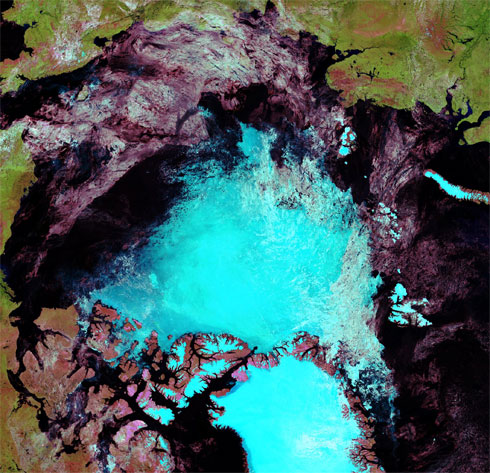


As a commenter has pointed out, the sun is low enough now in the Arctic sky that insolation is no longer much of a factor in how much more ice melts. The primary driver at this point is residual heat that has been stored up over the summer, which will be considerable. The temp anomalies image above suggest there is a fair amount of warm water left.
LOL
Deny the measurements all along – stick to what we’re good at.
BTW:
Shock News : Arctic To Gain 170,000 Manhattans Of Sea Ice Over The Next Few Months
Posted on August 30, 2012 by stevengoddard
Morons talking about a “death spiral” should see if they can get their lobotomy reversed.
http://stevengoddard.wordpress.com/2012/08/30/shock-news-arctic-to-gain-170000-manhattans-of-sea-ice-over-the-next-few-months/#comment-126079
I posted:
So unless the Arctic goes ice free year round, AGW is a fraud????
Have I stumbled onto the Onion’s Climate page?
It is, of course, awaiting moderation.
Goddard is irrelevent and the small number of diehard fans are completely nuts. It’s fun to poke them with a stick every now and then and watch them get mad but I wouldn’t make a habit of it, you’ll never change their minds or get a reasonable response. On that note, go and ask Goddard for a large blue crayon and say you want to draw a graph. http://uknowispeaksense.wordpress.com/2012/08/26/idiotic-denier-graph-of-the-day-august-262012/
Wow, a fair-sized area looks to be 4C above average, and a very large proportion is about 1-2C above average — someone somewhere should be able to estimate the quantity of heat contained in all the water, and also be able to estimate a rough estimate of heat loss.
My questions from another thread about this are:
What is the (approximate) freezing point of seawater?
Does sea ice contain salt, or is it only “fresh” water that freezes; leaving the salt behind?
If it is the latter (as I suspect), then the remaining water gets saltier and saltier as more ice forms, and this should slow the rate it freezes. So, all the melting we have seen so far would seem to raise the temperature for ice to start refreezing?
Neil
I should have mentioned in my earlier reply that Peter has done a fine job of explaining all this stuff in a video, but his prodigious production rate has finally swamped me… I don’t remember which one has the Thermohaline circulation in it.
My favorite Arctic Sea Ice summary video is this one:
Looks like I exceeded the WP link limit for its spam detector… maybe Peter can delete my earlier comment, which is this:
I’m trying something new. That is terse, simple answers, very contrary to my normal manner.
Sea ice is fresh water.
Formation of sea ice leaves behind saltier water that stays mixed.
Colder, saltier water is dense, so it drops.
Descending cold water is part of what fuels the global currents such as the Atlantic Conveyor, and frequently pushes warmer water into vicinity of the sea ice. See this Wikipedia article:
http://en.wikipedia.org/wiki/Thermohaline_circulation
This is where the old bathtub analogy breaks down, the heat isn’t just from the arctic, it comes in from other places as well.
That’s how you do it. Short, sharp and to the point. That way there can be no confusion as to what you’re saying. I like your new style. Well done.
That is kinda’ what I figured. So all the melted ice makes the water less salty, so it actually makes it have a higher freezing temperature.
What is the approximate freezing temperature of typical seawater?
Neil
The melting rate looks to be slowing down:
http://nsidc.org/data/seaice_index/images/daily_images/N_stddev_timeseries.png
Maybe the lower salinity is (partially) offsetting the greater latent heat? We’ll see…
Neil
maybe a slight slowing, which we should expect any time now – but judging by the historic curves, it still
appears the bottom is weeks away