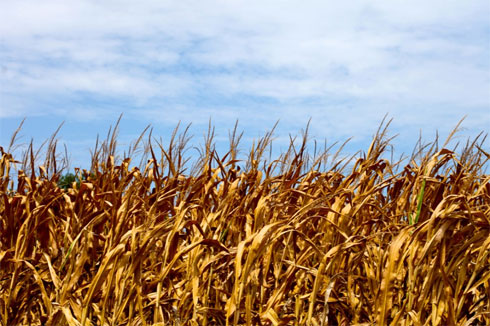
Hot, Dry Weather Will Linger: NOAA

Des Moines Register/AP:

WASHINGTON — The unusually hot dry weather that has gripped the nation will not let up its stranglehold over the next few months, federal weather forecasters said Thursday.

And that means the heartland’s “flash drought” will linger at least until around Halloween and even spread a bit farther north and east.

The National Oceanic and Atmospheric Administration’s outlook for August through October shows that nearly every state likely will have hotter than normal temperatures. Much of the Midwest is likely to be drier than normal, too.

“It certainly is grim news for us in Illinois and other parts of the Midwest,” said Illinois state climatologist Jim Angel. “I kind of have given up hope for short-term relief.”

New figures released Thursday show that the percentage of the country now suffering from drought edged up from nearly 51 percent last week to more than 53 percent this week; the chunk of the country experiencing severe drought or worse rose in one week from 31 percent to 35 percent. Experts call it a flash drought because it developed in a matter of months, not multiple seasons.

“It’s really unpleasant,” said drought specialist Kelly Helm Smith at the National Drought Mitigation Center in Nebraska. She said relief “is not on the radar that I’m aware of.”

For the Midwest, forecasters don’t see any improvement until at least past October. In fact, if the weather phenomenon El Nino forms as predicted, that means even more dry weather next winter for the Midwest and North, said seasonal forecaster Dan Collins of NOAA’s Climate Prediction Center in Maryland.

NOAA’s forecast for just the month of August indicates a high probability for little rain for all or parts of 15 states that are the epicenter of the drought. That region encompasses Illinois, Indiana, Missouri and Iowa and the states generally surrounding them.

All told, 42 states or parts of them have been hit by the drought. A NOAA map shows it stretches from California east to Ohio and from Texas north to Minnesota. Tiny pockets of drought also dot the East, including much of Georgia and South Carolina.

The forecast for the next three months would push the drought farther north into Minnesota, North Dakota and Michigan, and farther east into Pennsylvania, New York and West Virginia. But in the Southwest, especially Arizona and New Mexico, and to a lesser degree Colorado and Utah, the drought will ease a bit. And the eastern drought pockets are also likely to improve a bit.

NOAA is also forecasting more triple-digit hot weather for several days starting Saturday for much of the Midwest from Kansas and Nebraska to Indiana and Michigan, with temperatures about 12 degrees hotter than normal. And that will make the drought even worse, forecasters say.

Bill McKibben: The Terrifying New Math of Climate Change

Rolling Stone:

The Second Number: 565 Gigatons

Scientists estimate that humans can pour roughly 565 more gigatons of carbon dioxide into the atmosphere by midcentury and still have some reasonable hope of staying below two degrees. (“Reasonable,” in this case, means four chances in five, or somewhat worse odds than playing Russian roulette with a six-shooter.)

This idea of a global “carbon budget” emerged about a decade ago, as scientists began to calculate how much oil, coal and gas could still safely be burned. Since we’ve increased the Earth’s temperature by 0.8 degrees so far, we’re currently less than halfway to the target. But, in fact, computer models calculate that even if we stopped increasing CO2 now, the temperature would likely still rise another 0.8 degrees, as previously released carbon continues to overheat the atmosphere. That means we’re already three-quarters of the way to the two-degree target.

How good are these numbers? No one is insisting that they’re exact, but few dispute that they’re generally right. The 565-gigaton figure was derived from one of the most sophisticated computer-simulation models that have been built by climate scientists around the world over the past few decades. And the number is being further confirmed by the latest climate-simulation models currently being finalized in advance of the next report by the Intergovernmental Panel on Climate Change. “Looking at them as they come in, they hardly differ at all,” says Tom Wigley, an Australian climatologist at the National Center for Atmospheric Research. “There’s maybe 40 models in the data set now, compared with 20 before. But so far the numbers are pretty much the same. We’re just fine-tuning things. I don’t think much has changed over the last decade.” William Collins, a senior climate scientist at the Lawrence Berkeley National Laboratory, agrees. “I think the results of this round of simulations will be quite similar,” he says. “We’re not getting any free lunch from additional understanding of the climate system.”

We’re not getting any free lunch from the world’s economies, either. With only a single year’s lull in 2009 at the height of the financial crisis, we’ve continued to pour record amounts of carbon into the atmosphere, year after year. In late May, the International Energy Agency published its latest figures – CO2 emissions last year rose to 31.6 gigatons, up 3.2 percent from the year before. America had a warm winter and converted more coal-fired power plants to natural gas, so its emissions fell slightly; China kept booming, so its carbon output (which recently surpassed the U.S.) rose 9.3 percent; the Japanese shut down their fleet of nukes post-Fukushima, so their emissions edged up 2.4 percent. “There have been efforts to use more renewable energy and improve energy efficiency,” said Corinne Le Quéré, who runs England’s Tyndall Centre for Climate Change Research. “But what this shows is that so far the effects have been marginal.” In fact, study after study predicts that carbon emissions will keep growing by roughly three percent a year – and at that rate, we’ll blow through our 565-gigaton allowance in 16 years, around the time today’s preschoolers will be graduating from high school. “The new data provide further evidence that the door to a two-degree trajectory is about to close,” said Fatih Birol, the IEA’s chief economist. In fact, he continued, “When I look at this data, the trend is perfectly in line with a temperature increase of about six degrees.” That’s almost 11 degrees Fahrenheit, which would create a planet straight out of science fiction.

So, new data in hand, everyone at the Rio conference renewed their ritual calls for serious international action to move us back to a two-degree trajectory. The charade will continue in November, when the next Conference of the Parties (COP) of the U.N. Framework Convention on Climate Change convenes in Qatar. This will be COP 18 – COP 1 was held in Berlin in 1995, and since then the process has accomplished essentially nothing. Even scientists, who are notoriously reluctant to speak out, are slowly overcoming their natural preference to simply provide data. “The message has been consistent for close to 30 years now,” Collins says with a wry laugh, “and we have the instrumentation and the computer power required to present the evidence in detail. If we choose to continue on our present course of action, it should be done with a full evaluation of the evidence the scientific community has presented.” He pauses, suddenly conscious of being on the record. “I should say, a fuller evaluation of the evidence.”

So far, though, such calls have had little effect. We’re in the same position we’ve been in for a quarter-century: scientific warning followed by political inaction. Among scientists speaking off the record, disgusted candor is the rule. One senior scientist told me, “You know those new cigarette packs, where governments make them put a picture of someone with a hole in their throats? Gas pumps should have something like that.”

The Third Number: 2,795 Gigatons

Continue reading “Bill McKibben: The Terrifying New Math of Climate Change”

John Abraham on Climate, Science, and Evapotranspiration.

I’ve profiled John Abraham here before. Abraham vaulted to international prominence with his searing, point by point, no-stone-unturned,  scorched earth destruction of “Lord” Christopher Monckton’s climate disinforming nonsense.  He is a founding member of the Climate Science Rapid Response Team, which assists media in connecting with real science and scientists on climate stories.

Futuredude:

FutureDude: So, tell me a little about what you do?

John Abraham: I’m a professor of thermal sciences at the University of Saint Thomas, which is in Saint Paul, Minnesota. Much of my research is on clean and renewable energy especially for the developing and impoverished parts of the world. We want to bring them clean and reliable energy to create a positive impact on their lives.

I also do research on climate change both in education and via my own basic research. I‘m involved in oceanography. I’m working with a team who are trying to measure how much heat is going into the ocean. Because that can tell us where our environment is heading. So I do basic research and public education.

So you live and breathe science every day. Did you have any interest in the future when you were growing up?

The future is where our possibilities lie. The future presents opportunities as well as challenges. It challenges us today and it provides opportunities in the future. What can we do today to ensure that we have the greatest possibilities for ourselves and for coming generations, so that we can live fulfilled and happy lives in the future?

I firmly believe that the actions we take now will have direct consequences in the future. We can make things better or we can make things worse.

Some people believe in fate. Things are just going to happen. I don’t believe that. I believe that we make our own fate. And it’s the responsibility of a scientist to try to help us all understand how the things we do today impact where we’re going to go tomorrow.

Continue reading “John Abraham on Climate, Science, and Evapotranspiration.”

In Michigan – Small Businesses Resoundingly Support Clean Energy Initiative

In America’s manufacturing Heartland – a move is afoot to vault Michigan into leadership in renewable energy. The usual suspects are agin’ it. But small business people love the idea.

Small Businesses Majority:

Michigan small business owners overwhelmingly support increasing the state’s renewable energy standard to 25 percent by 2025, according to opinion polling released by Small Business Majority. Nearly eight in 10 (79 percent) Michigan small businesses support setting standards that require utilities to meet a certain percentage of energy demand through renewable energy sources such as wind, solar and bio-fuels (for example, requiring a 25 percent target in renewable fuels by 2025). A state initiative that would require Michigan to have 25 percent of its electric energy produced by renewable resources by 2025 is expected to be on the November ballot.

Michigan small business owners also strongly support government investments in clean energy and believe such investments have an important role in creating jobs and boosting the economy—even if it means an increase in utility costs.

Other findings from the poll include:

  • 86 percent of respondents support EPA rules to reduce the emissions of mercury, arsenic, chromium, nickel and acid gases from new and existing power plants. More than half (53 percent) strongly support it.
  • 74 percent of small business owners favor proposed rules to reduce smog and soot pollution that crosses state lines (the “Good Neighbor Rule”)
  • 77 percent of Michigan small business owners believe government should play an important role in creating financial incentives that encourage people to take energy efficiency measures, like installing energy efficient light bulbs. Almost eight out of 10 business owners believe government should provide incentives through funding and policy efforts.
  • 65 percent of Michigan small business owners are willing to install solar panels or some other source of clean energy and 57 percent are willing to switch to hybrid or electric vehicles
  • Small business owners polled were politically diverse: 39 percent identified as Republican, 38 percent as Democrat, 10 percent as independent and 13 percent as “other.

Is it Warming Yet? More Americans Say,.. “Like,..Duhh…”

Bloomberg:

A record heat wave, drought and catastrophic wildfires are accomplishing what climate scientists could not: convincing a wide swath of Americans that global temperatures are rising.

In the four months since March there has been a jump in U.S. citizens’ belief that climate change is taking place, especially among independent voters and those in southern states such as Texas, which is now in its second year of record drought, according to nationwide polls by the University of Texas.

In a poll taken July 12-16, 70 percent of respondents said they think the climate is changing, compared with 65 percent in a similar poll in March. Those saying it’s not taking place fell to 15 percent from 22 percent, according to data set to be released this week by the UT Energy Poll.

Following a winter of record snowfall in 2010, the public’s acceptance of climate change fell to a low of 52 percent, according to the National Survey of American Public Opinion on Climate Change, which was published by the Brookings Institution in Washington. After this year’s mild winter, support jumped to 65 percent, the same as that found by the UT Energy Poll in March.

“There has been a rebound in belief” in global warming, Barry Rabe, a University of Michiganprofessor who published the research on the Brookings study. “All respondents are quite likely to use observations of weather as a big part of their explanation.”

Yale 360:

With 70 percent of Americans now agreeing that global warming is affecting weather in the U.S., the public is showing increasing support for measures that would tackle the problem of climate change, according to a new survey. Conducted by the Yale Project on Climate Change Communication, the survey showed that 60 percent of Americans would be more likely to vote for a candidate who supports legislation that would reduce the federal income tax and make up for that decrease in revenue by increasing taxes on fossil fuels. The ongoing survey — which divides the U.S. public into six categories on global warming, from the alarmed to the dismissive — showed that an overwhelming majority of people who identified themselves as alarmed, concerned, or cautious about global warming say that if people with their views worked together, they could influence politicians’ views on global warming. The people in these three groups, as well as people who described themselves as disengaged on the issue of global warming, said by a wide margin that they trusted President Obama more than Mitt Romney as a source of information on climate change. Only people who described themselves as dismissive of human-caused climate change said they trusted Romney more than Obama on the issue, the Yale survey showed.

Business Week:

While the survey didn’t ask about the causes of climate change, Sheril Kirshenbaum, the poll director, said “there is no debate” that man-made carbon emissions are warming the planet. “We need to get beyond arguing if it’s occurring and start developing policies to adapt to extreme weather events and rising sea levels,” she said in an e-mail.

Still, the American public’s views on the issue are linked to recent trends in the weather, Rabe said.

The jump in public opinion over the past four months took place in southern states, including drought-ravaged Texas, where it climbed 13 percentage points to 70 percent this month, according to the poll. Other areas of the country showed modest variations in levels of support.

The latest University of Texas poll also found a sharp divide between political parties, with 87 percent of Democrats saying climate change is taking place compared with 53 percent of Republicans. In March 45 percent of Republican respondents said climate change is happening.

Among independent voters, those saying temperatures are rising jumped to 72 percent in July from 60 percent in March.

Partisan affiliation is the best predictor of someone’s belief in climate change, Rabe said.

I suspect partisan affiliation is also the best predictor of whether you think those WMDs are still out there,  that Barack Obama was born in Kenya, or that the latest Batman movie is part of a nefarious communist plot.

“Horror Story”: Corn Disaster Emerging in Heartland

 Accuweather:

Additional corn crop failures are likely, due to too little rain and too much heat through the middle of August.

Spotty downpours will grace northern and eastern areas of the corn belt into August, but not enough rain will fall on a large part of the corn belt, leading to a disaster.

AccuWeather.com agricultural meteorologists feel that a lack of rain will continue to take its toll on non-irrigated corn in much of Nebraska and Kansas, as well as huge sections of Illinois, Missouri, Iowa, southeastern South Dakota, southwestern Minnesota, southwestern Michigan and southeastern Wisconsin.

In these areas, a few tenths of an inch of rain will fall here and there in the weeks ahead with some areas barely getting a drop.

Reuters:

Broiling heat blanketed much of the Midwest on Tuesday, exacerbating the region’s worst drought in more than 50 years and devastating corn, soy and other vital crops.

From Chicago to St. Louis to Omaha, Nebraska, temperatures eclipsed 100 degrees Fahrenheit and the National Weather Service (NWS) issued heat advisories across Midwest and mid-Atlantic states.

Many of the NWS heat advisories don’t expire until next week. Temperatures in Kansas City, Kansas for instance, are expected to hit 104 degrees Fahrenheit (40 degrees Celsius) on Wednesday.

The current drought is the worst since 1956, the National Oceanic and Atmospheric Administration said in a report posted on its website.

In Iowa, Gov. Terry Branstad convened a hearing to discuss the drought and its effect on the state’s pork industry, which relies heavily on corn feed.

“It’s important that we do all we can to help people through this difficult time,” Branstad told local radio station KILJ. “And obviously more rain would help.”

About 55 percent of the contiguous United States is in a drought, just as corn plants should be pollinating, a period when adequate moisture is crucial. The United States ships more than half of all world exports of corn, which is made into dozens of products, from starch and ethanol to livestock feed.

“We’re moving from a crisis to a horror story,” said Purdue University agronomist Tony Vyn. “I see an increasing number of fields that will produce zero grain.”

Zero grain.

We’ll adapt to that.

Continue reading ““Horror Story”: Corn Disaster Emerging in Heartland”

The Knock-on Effects of Global Warming: Too Darn Hot for Nuclear Power

NYTimes:

It was so hot  last week, a twin-unit nuclear plant in northeastern Illinois had to get special permission to continue operating after the temperature of the water in its cooling pond rose to 102 degrees.

It was the second such request from the plant, Braidwood, which opened 26 years ago.  When it was new, the plant had permission to run as long as the temperature of its cooling water pond, a 2,500-acre lake in a former strip mine, remained below 98 degrees; in 2000 it got permission to raise the limit to 100 degrees.

The problem, said Craig Nesbit, a spokesman for Exelon, which owns the plant, is not only the hot days, but the hot nights. In normal weather, the water in the lake heats up during the day but cools down at night; lately, nighttime temperatures have been in the 90s, so the water does not cool.

Asked whether he viewed Braidwood’s difficulties as a byproduct of global warming, Mr. Nesbit said: “I’m not a climatologist. But clearly the calculations when the plant was first operated in 1986 are not what is sufficient today, not all the time.”

 —

At the Union of Concerned Scientists, a group that is generally critical of nuclear power safety, David Lochbaum, a nuclear engineer, said the commission was supposed to grant exemptions from its rules if there was no increase or only a minor increase in risk, and if the situation could not have been foreseen.

The safety argument “is likely solid and justified,’’ he wrote in an e-mail, but “it is tough to argue (rationally) that warming water conditions are unforeseen.’’ That is a predictable consequence of global warming, he said.

 Of course, in a world where pursuing facts is mocked and derided as being “reality based”..,  those nasty “unforeseen” events happen more and more often, don’t they?
More below about knock-on effects of climate change on thermal plants.

Greenland. The Giant Stirs, ever So Slightly.

Arctic Sea Ice Blog:

When writing The dark side of Greenland, a recent blog post on decreasing reflectivity of the Greenland ice sheet, with images comparing the southwest of Greenland with satellite images from previous years, I of course realized that when that ice sheet becomes less reflective, it will soak up more solar energy and thus melt faster. But the practical aspect of this theory never really dawned on me, until I saw this video:

Levels in the Akuliarusiarsuup Kuua river, also knows as the Watson river, have reached such heights that they have smashed the two bridges connecting the north and south of Kangerlussuaq, a small settlement in southwestern Greenland, located at the head of the fjord of the same name. The river water stems from different meltwater outflow streams from Russell Glacier (an outflow of the Greenland ice sheet), and is a tributary of Qinnguata Kuussua, the main river in the Kangerlussuaq area.

Of course the local media are covering the story. Here are a few excerpts from different news articles from Sermitsiaq (via Google translate):

What has happened in detail over the inland ice, which caused this incident, is not yet known, but the fierce heat has certainly been an important player. And unfortunately it looks like the weather will not come to the Greenlanders’ rescue, as the air temperatures over the ice sheet are expected to remain warmer than normal at least the next 7-10 days, writes Greenland meteorological Jesper Eriksen at dmi.dk.

However, it’s not only hot on the icecap at Kangerlussuaq. Deep in the ice, there are also plus degrees:

In Greenland, it has been very hot over the inland ice in comparison to normal conditions. On July 11th at 15 UTC the recorded temperature at the Summit Camp weather station, which is located at the ice cap’s highest altitude (3200 metres), was 2.2 degrees Celsius. That is quite high for this height, particularly in light of the fact that ice has a relatively high albedo.

Just 2.2 °C doesn’t sound like much (although it looks to be a new record for July), until one realises that we are talking Summit Camp here. At an altitude of 3200 metres. In the middle of the Greenland ice sheet. Nothing but ice.

3.5 million liters of water pressed through the narrow river every second. It’s almost a doubling of previous records. It’s no wonder that a 20 ton wheel loader was torn away from the bridge in Kangerlussuaq like a toy.

Dr. Mauri Pelto sent me a link to that video – here:

Graph of the Day: Heat Records Exceed Cold by Increasing Margins

Climate Central:

As the climate has warmed during the past several decades, there has been a growing imbalance between record daily high temperatures in the contiguous U.S. and record daily lows. A study published in 2009 found that rather than a 1-to-1 ratio, as would be expected if the climate were not warming, the ratio has been closer to 2-to-1 in favor of warm temperature records during the past decade (2000-2009). This finding cannot be explained by natural climate variability alone, the study found, and is instead consistent with global warming.

When you look at individual years, the imbalance can be more stark. For example, through late June 2012, daily record highs were outnumbering record daily lows by a ratio of 9-to-1.The study used computer models to project how the records ratios might shift in future decades as the amount of greenhouse gases in the air continues to increase. The results showed that the ratio of daily record highs to daily record lows in the lower 48 states could soar to 20-to-1 by mid-century, and 50-to-1 by 2100.

Drought in US could have Global Impact

We won’t know the full extent of the US drought for weeks, depending on how long the current dry spell lingers.  As of now, we are in one of the ten driest years on record. Stay tuned.

Illinois State Climatologist Jim Angel:

People have asked me several times this week, “how much rain do we need to end the drought?”

There is no easy way to answer this. The normal rainfall per week in Illinois is about an inch. So we need that inch per week just to keep from slipping farther behind. Taking it a step farther, that means you need well over an inch per week to start recovering from drought. Of course, no amount of rain at this point will undo the damage done to crops already.

There is one product, based on the Palmer Hydrological Drought Index, that attempts to answer this question. However, I would treat it as an estimate. Even so, it gives you an idea of how far we have to go for a recovery.  They update this map once a month, so at the end of June we would have needed 9 to 12 inches of rain across much of Illinois in July to end the drought. That is a tall order. The wettest July on record for Illinois is 8.03 inches in 1958. Not to mention that July is almost half over.

Personally, I’m not sure it would take record-breaking rainfall. And I’m not sure we want 9 to 12 inches in one month because that could lead to all kinds of other problems like flooding and heavy soil erosion.

Based on past droughts in Illinois, a month with rainfall 50 percent above normal (around 6 inches) followed by several months with near-normal rainfall would be capable of turning things around without the more serious consequences of heavy rainfall.