

The video above tells the story of Amory Lovins and his famous 1976 essay “The Road not taken”.
The essay has become a still-relevant prophetic classic of the environmental/renewable energy movement for its clear eyed assessment of the relative advantages of renewable energy – “The Soft Path”, versus the “Hard Path” technologies – fossil fuel and nuclear.
In the essay, Lovins pointed out the contradictions of a centralized grid in what he already perceived as a new age of networking and connectivity, and foresaw the implications of emerging climate science.
“The commitment to a long-term coal economy many times the scale of today’s makes the doubling of atmospheric carbon dioxide
concentration early in the next century virtually unavoidabIe, with the prospect then or soon thereafter of substantial and perhaps irreversible
changes in global climate. Only the exact date of such changes is in question.”
What makes Lovins so compelling today is that his predictions of energy consumption growth, reviled as wildly beyond the pale when he first wrote them, have born out in the real world over 40 years.
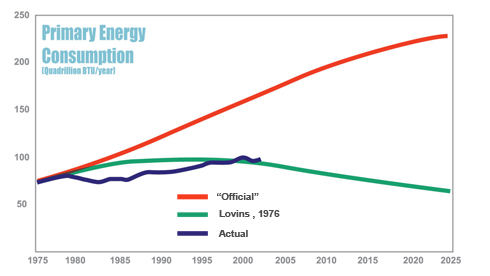
Now Lovins is back in Foreign Affairs again, with an assessment of where we’ve been, and where we are going in the ongoing transition from scarce to unlimited energy. Here are a few sample graphs.
As the world shuddered from the 1973 oil shock, the economist Phil Gramm predicted that just as with whale oil, innovators would innovate, capitalists would invest, markets would clear, and substitutes for petroleum would ultimately emerge. He was right. By 2010, the
United States was using 60 percent less oil to make $1 of gdp than it had in 1975. Now, the other shoe is dropping: since its use in the United States peaked in 2005, coal has lost one-fourth of its share of the U.S. electric services market to renewable energy, natural gas,
and efficient use.After just a few centuries, the anomalous era of oil and coal is gradually starting to come to an end. In its place, the era of everlasting energy is dawning.
Underlying this shift in supply is the inexorable shrinkage in the energy needed to create $1 of gdp. In 1976, I heretically suggested in these pages that this “energy intensity” could fall by two-thirds by 2025.
By 2010, it had fallen by half, driven by no central plan or visionary intent but only by the perennial quest for profit, security, and health.
Still-newer methods, without further inventions, could reduce U.S. energy intensity by another two-thirds over the next four decades, with huge economic benefits.–
From tropical to subarctic climates, new passively heated and cooled buildings can replace furnaces and air conditioners with superinsulation, heat recovery, and design that exploits the local climate.
European companies have built 32,000 such structures at roughly normal capital cost and cost-effectively retrofitted similar performance into Swedish apartments constructed in the 1950s and into century-old Viennese apartments. The business case would be even stronger if it included the valuable indirect benefits of these more comfortable, pleasant, and healthful buildings: higher o⁄ce labor productivity and retail sales, faster learning in classrooms, faster healing in hospitals, and higher real estate values everywhere.
–
New coal and nuclear plants are so uneconomical that official U.S. energy forecasts predict no new nuclear and few new coal projects will be launched. Investors are shunning their high costs and financial risks in favor of small, fast, modular renewable generators. These reduce the financial risk of building massive, slow, monolithic projects, and needing no fuel, they hedge against volatile gas prices.
Already, wind and solar power’s falling costs are beating fossil-fueled power’s and nuclear power’s rising costs. Some solar panels now sell wholesale for less than $1 a watt (down 75 percent in three years), some installed solar-power systems in Germany sell for $2.80 a watt, and some U.S. wind-power contracts charge less than three cents per kilowatt-hour—all far below recent forecasts.
Solar power’s plummeting cost, a stunning market success, is ruining some weaker or slower solar-cell-makers, but solar and wind power are extinguishing the prospects of coal and nuclear power around the world. So is cheap new natural gas—a valuable transitional resource if its many uncertainties can be resolved, but not a serious disappointment if they cannot, since higher efficiency and renewable energy should lower the demand for gas
Skeptics of solar and wind power warn of their fluctuating output. But the grid can cope. Just as it routinely backs up nonworking coal-fired and nuclear plants with working ones, it can back up becalmed wind turbines or darkened solar cells with flexible generators (renewable or not) in other places or of other kinds, or with systems that voluntarily modulate demand. Even with little or no bulk power storage, diversified, forecastable, and integrated renewables can prove highly reliable.
Such integration into a larger, more diverse grid is how in 2010 Denmark had the capacity to produce 36 percent of its electricity from renewables, including 26 percent from wind (in an average wind year), and how four German states were 43–52 percent wind-powered. But U.S. and European studies have shown how whole continents could make 80 percent or more of their power renewably by operating existing assets differently within smarter grids, in markets that clear faster and serve larger areas.

Lovins new book, Reinventing Fire, lays out these ideas in much greater detail, but for anyone wanting a quick primer on where the energy revolution has come from, and where it is going, from an observer with a proven and prescient track record, this piece is a great read and a good place to start.