

Believe the scientists, not some asshole on Tic Toc.
Above, NOAA Hurricane expert Jim Kossin.
Below, Dr Jeff Masters in Yale Climate Connections:
With the U.S. taking such a beating from extreme hurricanes in recent years, it’s worth reviewing how climate change is contributing to making hurricanes worse.


As far back as 1987, MIT hurricane scientist Kerry Emanuel theorized that the wind speeds in hurricanes can be expected to increase about 5% for every increase of one degree Celsius (1.8°F) in tropical ocean temperature, assuming that the average wind speed near the surface of the tropical oceans does not change. Computer modeling has found a slightly smaller magnitude (4%) for the increase.
A 4-5% increase in hurricane winds may not seem like a big deal, but damage from a hurricane increases exponentially with an increase in winds. For example, according to NOAA, a Category 2 hurricane with 100 mph (161 kph) winds will do 10 times the damage of a Category 1 hurricane with 75 mph (121 kph) winds. This includes damage not only from winds but also from storm surge, inland flooding, and tornadoes. Bottom line: A 4-5% increase in winds yields about a 40-50% increase in hurricane damage (Figure 1).
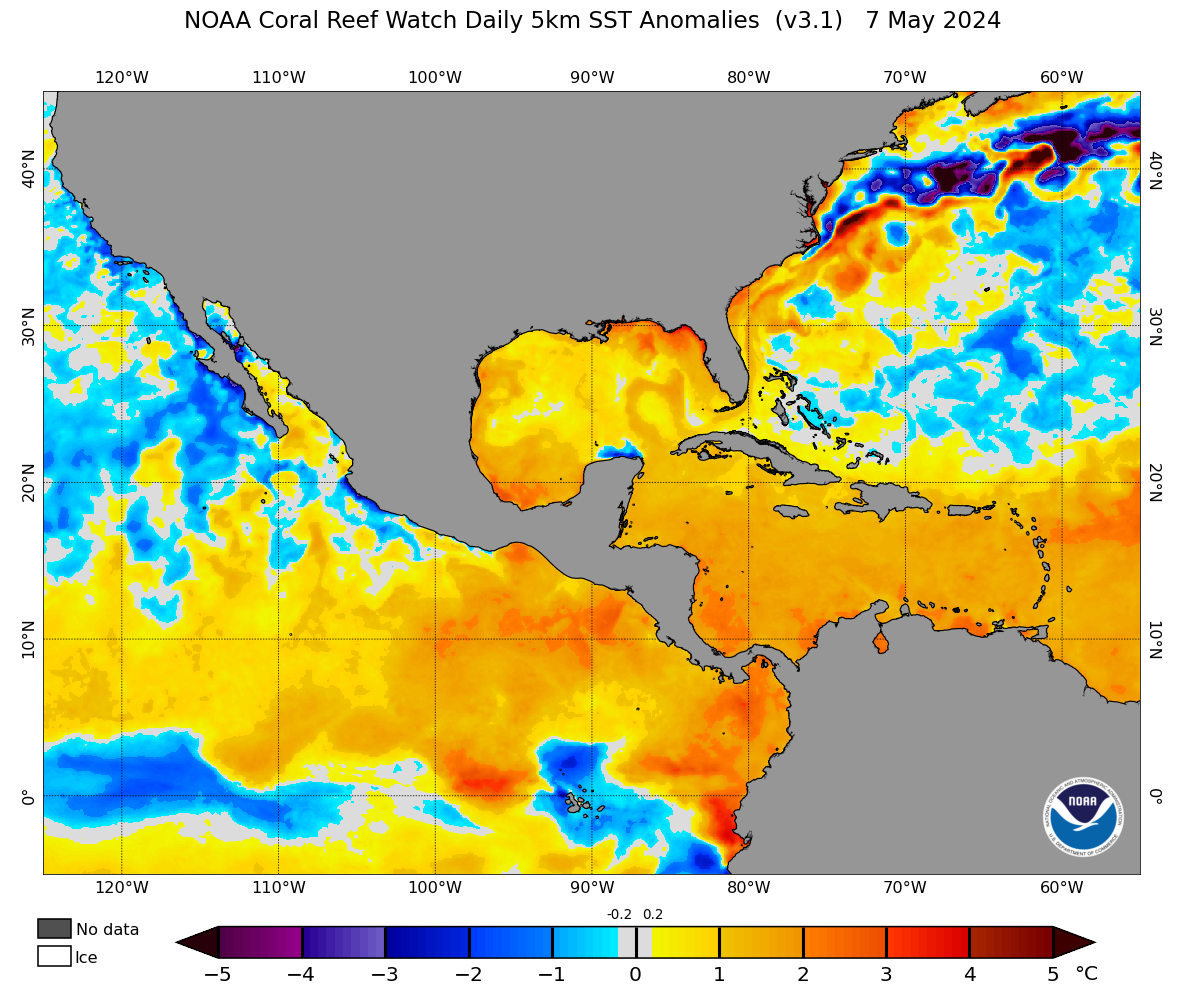
According to NOAA’s Coral Reef Watch, sea surface temperatures along Helene’s path through the western Caribbean and eastern Gulf of Mexico were about 1-2 degrees Celsius (1.8-3.6°F) above the long-term average. Using the theoretical results above, this increase in sea surface temperatures equated to a 50-100% increase in Helene’s destructive power.

It thus appears reasonable to theorize that increased sea surface temperatures of about 1 degree Celsius since 1910 in the Gulf of Mexico from human-caused global warming led to about a 40-50% increase in Helene’s destructive power, all else being equal, by increasing the hurricane’s winds by at least 4-5%. This could well be an underestimate of the influence of human-caused climate change on the record-warm sea surface temperatures in the Gulf, since the unusual atmospheric circulation patterns responsible for the hot and low-wind conditions experienced there over the past two years, which contributed to the record sea surface temperatures, could have had a climate change connection.

According to research published in 2019 in Nature Communications, “Recent increases in tropical cyclone intensification rates,” Atlantic hurricanes showed “highly unusual” upward trends in rapid intensification during the period 1982–2009, trends that can be explained only by including human-caused climate change as a contributing cause. The largest change occurred in the strongest 5% of storms: For those, 24-hour intensification rates increased by about 3-4 mph per decade between 1982 and 2009.
Helene is one of just 10 historical storms since 1950 that have rapidly intensified by at least 40 mph in the 24 hours before landfall (using data from the regular six-hourly fix just before landfall, data from the actual landfall point, or in the case of Hurricane King of 1950, the point one hour after landfall). It is sobering to see that five of those storms, below in boldface, occurred in the past seven years.

One thought on “Yes, Climate Change Makes Hurricanes Worse”