
You’re a wind turbine tech.
The biggest pain in your butt is that morning climb to the Nacelle.
Naturally, someone has you covered.

You’re a wind turbine tech.
The biggest pain in your butt is that morning climb to the Nacelle.
Naturally, someone has you covered.

Senior Editor Mark Fischetti in Scientific American:
Continue reading “Scientific American: Call it What it Is”An emergency is a serious situation that requires immediate action. When someone calls 911 because they can’t breathe, that’s an emergency. When someone stumbles on the sidewalk because their chest is pounding and their lips are turning blue, that’s an emergency. Both people require help right away. Multiply those individuals by millions of people who have similar symptoms, and it constitutes the biggest global health emergency in a century: the COVID-19 pandemic.
Now consider the following scenarios: A hurricane blasts Florida. A California dam bursts because floods have piled water high up behind it. A sudden, record-setting cold snap cuts power to the entire state of Texas. These are also emergencies that require immediate action. Multiply these situations worldwide, and you have the biggest environmental emergency to beset the earth in millennia: climate change.
Given the circumstances, Scientific American has agreed with major news outlets worldwide to start using the term “climate emergency” in its coverage of climate change. An official statement about this decision, and the impact we hope it can have throughout the media landscape, is below.
This idea is not a journalistic fancy. We are on solid scientific ground. In January Scientific American published an article about a study entitled “World Scientists’ Warning of a Climate Emergency.” At the time, more than 11,000 scientists from 153 countries had signed a report to signify their agreement that the world is facing a climate emergency that requires bold action. As of April 9 another 2,100 had signed on. As our article said, “the adverse effects of climate change are much more severe than expected and now threaten both the biosphere and humanity…. Every effort must be made to reduce emissions and increase removal of atmospheric carbon in order to restore the melting Arctic and end the deadly cycle of damage that the current climate is delivering.” Our article also noted that as of January, “1,859 jurisdictions in 33 countries have issued climate emergency declarations covering more than 820 million people.”
Journalism should reflect what science says: the climate emergency is here. The statement we have issued was coordinated by Covering Climate Now, a global journalism initiative with more than 400 media partners. Here it is:
April 12, 2021
From Covering Climate Now, Scientific American, Columbia Journalism Review, the Nation, the Guardian, Noticias Telemundo, Al Jazeera, Asahi Shimbun and La Repubblica:
The planet is heating up way too fast. It’s time for journalism to recognize that the climate emergency is here.
I need a break.
You?
Continue reading “BigTime Battery Barrier Broken, Boosting Biden”WASHINGTON (AP) — Two big South Korean electric vehicle battery makers said Sunday they have settled a long-running trade dispute that will allow one company to move ahead with plans to manufacture batteries in Georgia. President Joe Biden called it “a win for American workers and the American auto industry.”
The agreement between LG Energy Solution and SK Innovation ended the need for Biden to intervene in a case closely watched for its implications on Biden’s clean-energy agenda, which includes a sharp increase in the number of electric vehicles as part of his plan to address climate change. Biden had until Sunday night to make a decision, following a ruling in February by a trade commission.
The companies said in a joint statement that SK will provide LG Energy with a total of $1.8 billion and an undisclosed royalty. They agreed to withdraw all pending trade disputes in the United States and South Korea and not assert new claims for 10 years.
“We have decided to settle and to compete in an amicable way, all for the future of the U.S. and South Korean electric vehicle battery industries,” said Jun Kim, CEO and president of SK, and Jong Hyun Kim, CEO and president of LG Energy.
The companies pledged to work together to strengthen the EV battery supply chain in the U.S. and support the Biden administration’s efforts to advance clean energy policies, including electric vehicles.
The U.S. International Trade Commission had decided in February that SK stole 22 trade secrets from LG Energy, and that SK should be barred from importing, making or selling batteries in the United States for 10 years.
The decision could have left Ford and Volkswagen scrambling for batteries as they both roll out additional electric vehicle models, a priority for the companies and for the Biden administration. SK has contracts to make batteries for an electric Ford F-150 pickup truck and an electric Volkswagen SUV.
The commission said SK could supply batteries to Ford Motor Co. for four years and to Volkswagen AG for two years. The decision had jeopardized a $2.6 billion battery factory that SK is building in Commerce, Georgia.
Democratic Sen. Jon Ossoff of Georgia, who at Biden’s request had jump-started negotiations between two companies, said the settlement “has saved the battery plant in Commerce, Georgia, ensuring thousands of jobs, billions in future investment, and that Georgia will be a leader in electric vehicle battery production for years to come.”
U.S. Trade Representative Katherine Tai said the deal “builds confidence” in the reliability and responsibility of the two companies as suppliers to the U.S. auto industry. The agreement puts the U.S. “in a stronger position to drive innovation and … clean energy technology while also respecting the rights of technology innovators at the heart of trade and manufacturing policy,” Tai said.
Will Texas learn the lessons of the deadly Valentine’s Day Blackout?
Above, Michael Webber of U. Texas is somewhat optimistic.
Below, discussion from Houston Chronicle, and part of my interview with Chronicle energy reporter Chris Tomlinson, who is not optimistic.
Since the February power outages, Texas legislators have been busy weighing a host of improvements for the state’s grid, from weatherizing equipment to shaking up oversight to partnering with the billionaire investor Warren Buffett on new emergency-use power plants.
But hardly any of them have focused on what some believe could be a more widespread fix: plugging into other U.S. power supplies.
While Texas has long opposed opening its grid to avoid federal oversight, and ostensibly to keep prices low, energy experts say the calculus is not what it once was and that the benefits of connecting to the outside world are at least worth examining, especially as renewable energy is poised for a major expansion under the Biden administration.
Not only is the state missing out on a potential lifeline in future blackouts, they warn, it also risks passing up billions of dollars in new investments for clean, marketable electricity.
“We export every form of energy you could imagine except electrons,” Michael Webber, a professor at the University of Texas at Austin, told reporters recently. “This is ridiculous,” he said. “Let’s at least study the option.”
Texas is the only contiguous state with its own grid, a decision prompted by the creation in 1935 of a federal commission to oversee interstate power transactions. Today, the state has just a handful of transmission lines linking to neighboring power supplies.
Continue reading “Texas May Learn Blackout’s Lesson – or Not”Though a more integrated grid would probably not have prevented outages in February— surrounding states were also struggling to meet demand — it could have helped shorten them substantially, according to Dan Cohan, an associate professor of civil and environmental engineering at Rice University. The blackouts left 4.5 million Texans without power and water for days and contributed to at least 197 deaths.
Most importantly, Cohan said, having outside power supplies would strengthen the grid’s reliability during the state’s most frequent natural disasters.
“The vast majority of our crises are more often a summer drought, or a summer hurricane, or a summer flood that hits Texas more strongly than other states, where we would have plenty of power that we could have been importing in,” he said.
Some question, though, whether joining other grids would be worth the cost, especially because building new transmission lines is expensive and obtaining permits can take years. Without a robust build-out, the state would be giving up its autonomy without gaining substantial backup capacity.
Skeptics also point out that the Legislature, which is heavily influenced by the oil and gas sector, is best served going after more immediate, attainable goals. For renewable advocates, that means expanding resources along the Gulf Coast, where weather patterns vary from windy areas in West Texas and can add more in-state reliability.
For some conservatives, it means cutting back on intermittent wind and solar power and encouraging a return of coal and other fossil fuel generation.
“I don’t see that interconnecting to other (regional power entities) makes the resources more reliable or not,” said Michelle Richmond, a lobbyist for the state’s largest power companies. “From our perspective, the ERCOT system has worked well,” she added, referring to the grid’s manager, the Electric Reliability Council of Texas.
And profitable, so innovators say.
General Motors will build an electric version of the Silverado at Factory ZERO in Detroit and Hamtramck.
The Silverado EV will sit on GM’s Ultium battery platform and will offer customers a GM-estimated range of more than 400 miles on a full charge, the automaker said Tuesday.
Both retail and fleet versions will come in a variety of options and GM said it expects there will be high demand for the pickups. GM did not provide a start of production date for the Silverado EV.
GM also is building the GMC Hummer EV pickup and Hummer EV SUV at Factory ZERO.
“The vehicles coming from Factory ZERO will change the world, and how the world views electric vehicles,” GM President Mark Reuss said in a statement. “The GMC Hummer EV SUV joins its stablemate in the realm of true supertrucks, and Chevrolet will take everything Chevy’s loyal truck buyers love about Silverado — and more — and put it into an electric pickup that will delight retail and commercial customers alike.”
In January 2020, GM said it would invest $2.2 billion in Factory ZERO, then called Detroit-Hamtramck assembly, to produce a variety of all-electric trucks and SUVs.
In October 2020, GM renamed the plant Factory ZERO to reflect GM’s vision of a future with zero crashes, zero emissions and zero congestion.
GM has said all of its light-duty vehicles will be zero emissions by 2035 and the company will be carbon neutral by 2040.
Continue reading “As EVs Charge Ahead, Farmers Worry about End of Ethanol”DES MOINES, Iowa (AP) — The president and auto industry maintain the nation is on the cusp of a gigantic shift to electric vehicles and away from liquid-fueled cars, but biofuels producers and some of their supporters in Congress aren’t buying it. They argue that now is the time to increase sales of ethanol and biodiesel, not abandon them.
To help address climate change, President Joe Biden has proposed an infrastructure plan that includes billions of dollars to pay for 500,000 electric vehicle charging stations, electrify public vehicles and enhance the nation’s power grid. These moves follow initiatives in California and other states to mandate electric vehicle sales and a goal by General Motors to shift production fully to electric vehicles by 2035.

Forget the think tanks and ivory towers of academia, or the centers of commerce and finance – the clean energy future that we need will succeed, or fail, bit by bit, in contentious meetings in small rural townships across the midwest and heartland, where clean energy projects are sited, or not, thru the ordinances passed by earnest but often overwhelmed township boards and planning commissions, who must contend with opposition that are a minority, but very loud, shrill, and often deliberately intimidating.
The meetings get a little animated, as this unusually vivid narration of a recent meeting from the Greenville, Michigan, Daily News.
Note: apologies but, weirdly, WordPress seems to be foreshortening my images today. go figure.
Greenville Daily News (Michigan):
MAPLE VALLEY TOWNSHIP — After hosting a stormy wind meeting in February via Zoom, followed by a vote to repeal the township’s controversial wind ordinance in March via Zoom, Maple Valley Township officials met for an in-person — but no less turbulent — meeting Thursday evening.
Three dozen people attended an unruly 90-minute meeting inside the freezing Coral Community Center (“We went over to Gratiot County and stood right underneath a turbine and this (Community Center) furnace was louder than that turbine,” Planning Commissioner Randy Davis told audience members, most of whom left their coats on).
The Planning Commission hasn’t met since last autumn and in the meantime John Schwandt, who was chairman of the Planning Commission, was elected supervisor of the Maple Valley Township Board last November, so Schwandt submitted his resignation as Planning Commission chairman before the start of Thursday’s meeting (as he can’t hold both positions at the same time).
The remaining four members of the Planning Commission (with Carolyn Kelsey absent due to illness) decided to make Roger Becker the new chairman and Andi Knapp — the newest member who was participating in her first meeting — the new vice chairwoman. As the Planning Commission began to move through roll call and reading previous meeting minutes, their quiet voices could not be heard in the spacious Community Center.
“Are you talking to us or are you talking to yourselves? Speak up!” a man yelled from the audience.
“We’re just doing basic stuff up here,” Davis responded. “Ninety-nine percent of you don’t even care about this stuff. When it comes to the wind, we’ll speak up.”
This comment did not go over well with audience members who began freely speaking their minds. An argument also ensued among audience members about whether the Planning Commission should have five or seven members.
“I think we should close this meeting, there’s more than 25 people here, ain’t that the law?” asked Maple Valley Township Zoning Administrator David Kelsey, who was seated in the front row next to Schwandt.
“That ended March 30th,” a woman in the audience responded.
The meeting continued with Becker reviewing some of the residents’ concerns that led to the township’s prior wind energy ordinance being repealed — sound limit, sound waves, height limit, setbacks (including setbacks around lakes) and turbine safety manuals.
Albert Jongewaard, senior development manager for Apex Clean Energy, was present and offered to answer questions from the audience — some of whom wanted to ask him questions and some of whom didn’t want him to speak at all. As Jongewaard attempted to speak, audience members spoke and argued among themselves and with Jongewaard at alternating volumes while members of the Planning Commission spoke quietly among themselves for a time and did nothing to bring back the meeting to order.
Only when audience members began standing up and yelling at each other did Becker attempt to restore order. Becker — who referred to turbines as “windmills” throughout the meeting — shared how he recently attended an Apex-hosted meeting at the Newell farm in Maple Valley Township. He said township officials want to hear from residents about what they would like to see in a new ordinance.

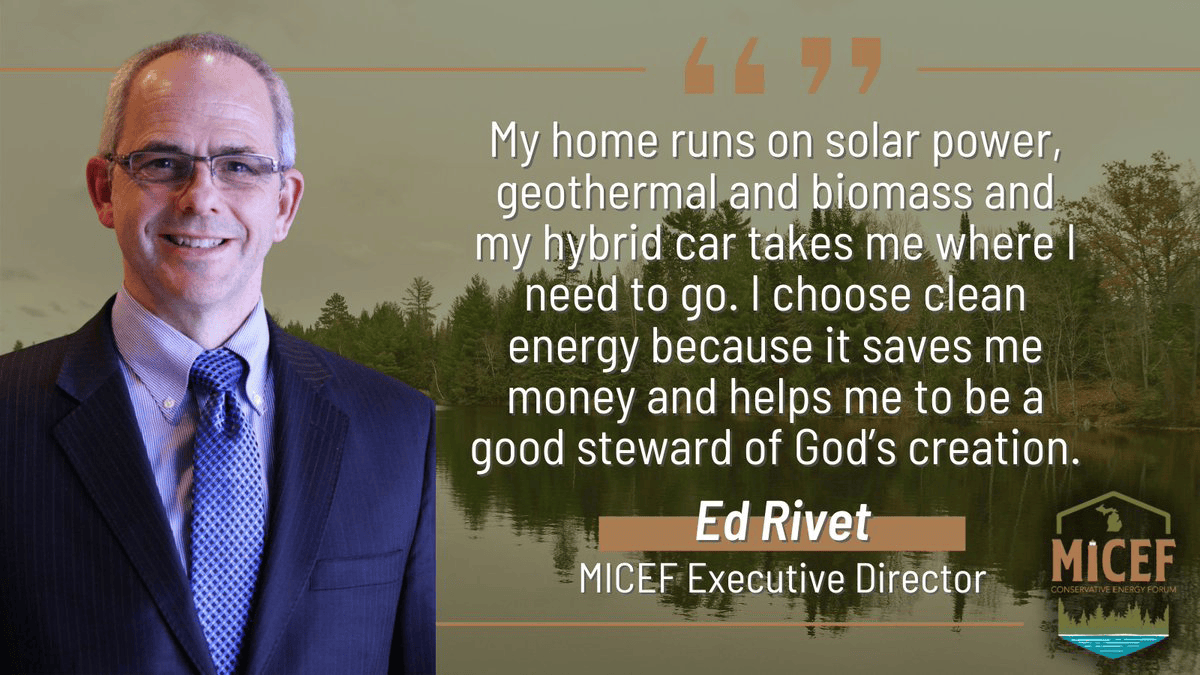
Conserve. Conservative. It says so right in the name.
Above, my friend Ed Rivet…
A conservative promoter of clean energy has launched an initiative in Iowa to help counter local opposition to wind and solar developments.
The Iowa Land & Liberty Coalition, a project of the Iowa Conservative Energy Forum, will focus on building support for renewables in counties that have either rejected large renewable projects or considered adopting restrictions.
“We’re protecting private property rights,” sais Nick Boeyink, Land & Liberty’s Iowa field operations director. “There are lots of landowners that, with bad policy, wouldn’t have the freedom to receive income on their land. They should be allowed to do with that land what they please.”
Land & Liberty chapters are operating in several Midwestern states: Michigan, Wisconsin, Minnesota, Indiana and now Iowa. Boeyink said several Iowa counties are moving toward restrictive ordinances or moratoriums that could serve as blueprints for other counties. That was a large factor in the decision to establish a Land & Liberty chapter in the state now, he said.
Hardin County last fall unanimously approved an indefinite moratorium on wind farms. Today the county’s board of supervisors is expected to consider modifications that would include a half-mile setback from any neighboring dwelling.
Madison County’s board of supervisors last October approved the state’s first moratorium on wind and solar projects. It will expire in October, at which time county supervisor Aaron Price expects passage of a new law that would outright or in effect outlaw wind turbines.
More and more, the experts I have been speaking to are bringing up the progress in Geothermal, which has been quietly innovating on the back of the incredible advances in drilling practices that have been pioneered in the oil/gas sector.
For example, it came up, unbidden, in my recent conversation with Daniel Cohan at Rice University, who notes the potential for Geothermal to be a player in the wake of the Texas blackout debacle. (starts about 1:50 if you’re rushed)
Micheal Webber at U of Texas brought it up, unbidden, as well.
It may be that geothermal is ready for its moment.
A piece of technology created in Alberta is pushing the boundaries of geothermal energy and drawing international attention.
The Calgary-based company Eavor Technologies has created a closed-loopgeothermal system that touts itself as the world’s first scalable clean energy derived from the natural heat of the earth.“It’s a new type of geothermal, this closed-loop. It’s on-demand,” explained the company’s chief technology officer Matt Toews. “That’s been a challenge with [other clean energy like] wind and solar.”
The system is described as similar to a massive subsurface radiator, much like how a vehicle radiator circulates fluid in a closed-loop to remove heat from a gasoline engine. It does not use fracking or water and has no earthquake risk. The “loop” is a closed network of pipes that are installed below ground and cycle through a facility above it.
Eavor deploys the technology around the world but the technical team is based in Calgary. There is an operational project near Sylvan Lake, west of Red Deer.
“Those are all the inputs into what we do. Instead of putting that into oil and gas, we are putting it into a clean energy source.”
In its fledgling stage, Eavor quickly caught the eye of Alberta Innovates, which looks to partner with researchers, small companies and large industry to develop within the province.
“Alberta Innovates is the research and innovation arm within Alberta,” explained Maureen Kolla, acting executive director for clean technology at AI.
“We want to help develop solutions that can help meet the challenges we face in Alberta, like diversifying the economy or meeting an environmental target.”
Alberta Innovates provided $1 million in funding to the $13-million project near Sylvan Lake, Toews said. He described the company as a “critical piece of funding” when the Eavor was first getting off the ground.
“It’s a bit of a snowball effect. You need someone to take the first step. It’s great to have a company like Alberta Innovates that is ready to be there,” Toews said.
Continue reading “Geothermal Ready for Its Moment?”In February, the energy firm closed on a financing round where it raised US$40 million with lead investors that included major oil companies BP and Chevron.
“That felt like a big validating moment from what we’ve been up to the last several years,” Toews said.