
Peak Gas Coming Sooner than you Thought

I heard from some folks that the Texas Blackout was some kind of setback to decarbonization. That’s anything but the truth.
If anything, we’ll see an acceleration in big battery deployment, which is already happening. Within 10 days of the Blackout, an announcement came about a new 100 MWH Tesla battery 40 miles from Houston. Batteries, both behind and in front of the meter, will be big winners here, and the buildout in Texas will be so massive, that it will accelerate the battery cost and deployment curves the way Germany accelerated global solar 10-15 years ago.
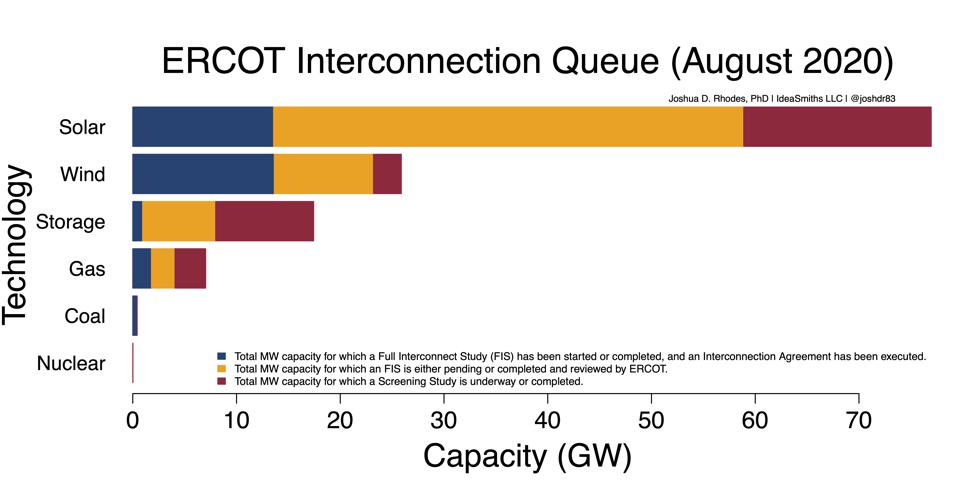
Above, you see the ERCOT queue from August of 2020. If there’s any change post blackout, it will be that the battery bar gets a lot longer.
2 links below to articles written pre-blackout that I believe will still hold up.

Josh Rhodes in Forbes:

Texas has long been a leader in wind power, but is quickly catching up on solar. The ERCOT Interconnection Queue, which shows the latest list of projects that are trying to connect to the system is, in fact, dominated by solar projects. Almost 77,000 MW of solar projects are in some stage of connecting to the grid. For reference, the all-time high peak power demand in ERCOT is just shy of 75,000 MW. Not all projects in the interconnection queue will get built, but the amount of solar (76,961 MW), wind (25,886 MW), and energy storage (17,436 MW) vs. natural gas (7,042 MW) in the queue does give a snapshot of what types of projects that investors see as most worth looking at. A preliminary analysis of historical projects in the ERCOT queue indicated that roughly 70% of projects that made it to the latter stage of the queue ended up being completed – solar and wind each have roughly 13,500 MW worth of projects in that latter stage.

Bloomberg:

One of the largest utilities in the U.S. put $8 billion into a bet that natural gas would dominate American electricity much like coal had before. “We really consider this to be a growth play,” Tom Fanning, chief executive officer of Southern Co., said in an interview just five years ago, as his company set on its landmark acquisition: natural-gas distributor AGL Resources Inc.

Gas looked to be on the verge of generational dominance at the time. The American fracking boom had made the fuel superabundant and cheap, hastening coal’s rapid decline, while energy from wind and solar had higher costs and lower reliability. A giant utility like Southern would naturally see gas pipelines and storage as the key to a durable and lucrative future, meeting demand that would continue to grow.

Now those expansive time horizons are in deep doubt. In fact, there are flashing signs that the U.S. power sector is approaching peak gas, with demand topping out decades ahead of schedule. “The era of robust growth in the U.S. natural gas market is likely coming to a close,” says Devin McDermott, an analyst at Morgan Stanley. “It doesn’t mean the market falls apart. It doesn’t mean gas demand falls off of a cliff. It means that we need less new supply going forward.”

Continue reading “Peak Gas Coming Sooner than you Thought”

Ron Johnson Now the Poster Boy for Clueless Old White Dude-itude

As Emily Atkin notes elsewhere on this page, climate denial seems to be a pretty good proxy or predictor for a host of other toxic attitudes, beliefs, and behaviors.

No better example than Republican Senator Ron Johnson of Wisconsin, who has been in the news lately for his blatantly racist comments about the deadly January 6 Capitol Insurrection.

With the former White House occupant leaving the stage, Mr Johnson has become the poster boy for Clueless Old White Dude-itude.

New York Times:

Mr. Johnson was the chief executive of a plastics company started by his wife’s family when he first ran for the Senate in 2010. He campaigned as a new-to-politics businessman concerned about federal spending and debt, and he spent $9 million of his own money on the race.

But there were signs in that first campaign of Mr. Johnson’s predilection for anti-intellectualism. On several occasions, he declared that climate change was not man-made but instead caused by “sun spots” and said excess carbon dioxide in the atmosphere “helps the trees grow.” He also offered a false history of Greenland to dismiss the effects of global warming.

“You know, there’s a reason Greenland was called Greenland,” Mr. Johnson told WKOW-TV in Madison back then. “It was actually green at one point in time. And it’s been, you know, since, it’s a whole lot whiter now so we’ve experienced climate change throughout geologic time.”

In the interview on Thursday, Mr. Johnson was still misinformed about the etymology of Greenland, which got its name from the explorer Erik the Red’s attempt to lure settlers to the ice-covered island.

“I could be wrong there, but that’s always been my assumption that, at some point in time, those early explorers saw green,” Mr. Johnson said. “I have no idea.”

Continue reading “Ron Johnson Now the Poster Boy for Clueless Old White Dude-itude”

VW Ramps up EV Play

VW exec: “I think (EVs) are going to be 20 to 30 percent of the market, relatively quickly.”

Electrek:

VW is having some incredible success on the stock market reminiscent of Tesla and its EV strategy.

For a long time, Volkswagen has been considered a blue-chip stock, though it went through some significant struggles around 2015 following the Dieselgate scandal.

It always was one of the biggest and most valuable automakers trailing only behind Toyota until Tesla surpassed everyone.

Some other companies, like GM and Ford, started to have some success on the stock market after announcing acceleration of their respective EV plans. 

Now it’s Volkswagen’s turn, with the stock growing over 100% over the last six months, and most of that growth coming over the last month alone:

The bulk of the increase comes after VW held its “Power Day,” which was compared to Tesla’s “Battery Day,” and the announcement of serious investments in battery cell production.

The stock is up 25% today alone, which is a massive swing for a company like VW.

Products like the VW ID.3 and ID.4 have also been well-received but people want to see volumes. Luckily VW is executing and it looks like it is starting to happen this year.

VW also surprised Korean battery makers LG and SK this week by informing them they’d be using their own batteries going forward, a strategy pioneered by Tesla. 

The decision by the world’s second largest automaker to move the bulk of its cars to a different battery cell in two years came as a shock to LG Energy Solution and SK Innovation, three people with knowledge of the situation told Reuters.

Emily Atkin Has No Time for your Climate Denial BS

Going thru my interview with Emily Atkin, who edits the great climate newsletter Heated.

I’m working on a piece about the crossover between climate denial and the tsunami of Bullshit that is swamping our democracy.

Above, Atkin mentions congressional hearings, and the endless nattering of fossil fuel tools, which made me think of the clip of Scientist Richard Alley handling Dana Rohrabacher, on ice ages and “earth wobbles”. (which are real, just not responsible for current warming)

Poll: Climate Alarm Continues to Grow

Yale Program on Climate Change Communication:

Over the past five years, the U.S. population as a whole has shifted towards the Alarmedsegment. In October 2015, the Alarmed (17%) outnumbered the Dismissive (10%) by seven percentage points. As of December 2020, however, the Alarmed outnumber the Dismissive by more than 3 to 1 (26% vs. 8%), representing a major shift in these two “issue publics” most engaged with the issue of global warming and reflecting a deeper change in the political climate of climate change.

While only four percent of the Alarmed and one percent of the Concerned say they are currently participating in a campaign to convince elected officials to take action to reduce global warming, more than half of the Alarmed (58%) and about one in three of the Concerned (35%) say they either definitely or probably would participate in such a campaign.

Continue reading “Poll: Climate Alarm Continues to Grow”

Market Rewarding Switch to EVs

Wall Street Journal:

BERLIN—Investors are piling into a long-neglected sector: old-school car makers that are reinventing themselves as electric-vehicle producers.

After years lamenting that their shares were undervalued, Ford Motor Co. F +1.77% , General Motors Co., Volkswagen AGVOW +5.18% and other blue-chip car manufacturers are seeing sharp share-price gains this year as they embrace the new technology.

Ford is up 49% so far this year, while GM’s shares have surged 48%. VW’s stock is up 55% and even briefly rose 29% in intraday trading one day this week when the company held a “Power Day” event, saying it would build six EV battery factories in Europe alone over the next 10 years. VW has this week also eked ahead of SAP SE to become the most valuable stock on the German DAX index.

By comparison, the S&P 500 index is up just 7.4% so far this year.

The new infatuation with established auto makers, many of which have been in business for more than a century, follows an earlier rush into electric-vehicle stocks that has driven shares of Tesla Inc.and other electric vehicle and battery manufacturers into territory that some analysts say is reminiscent of the dot-com bubble of the 1990s.

Conventional auto makers have long stewed in the shadow of Tesla, whose market capitalization remains twice that of VW, GM and Ford combined. But as the incumbents deepen their commitment to electric cars, they are beginning to persuade investors that they are serious about turning away from fossil fuels and embracing green technology.