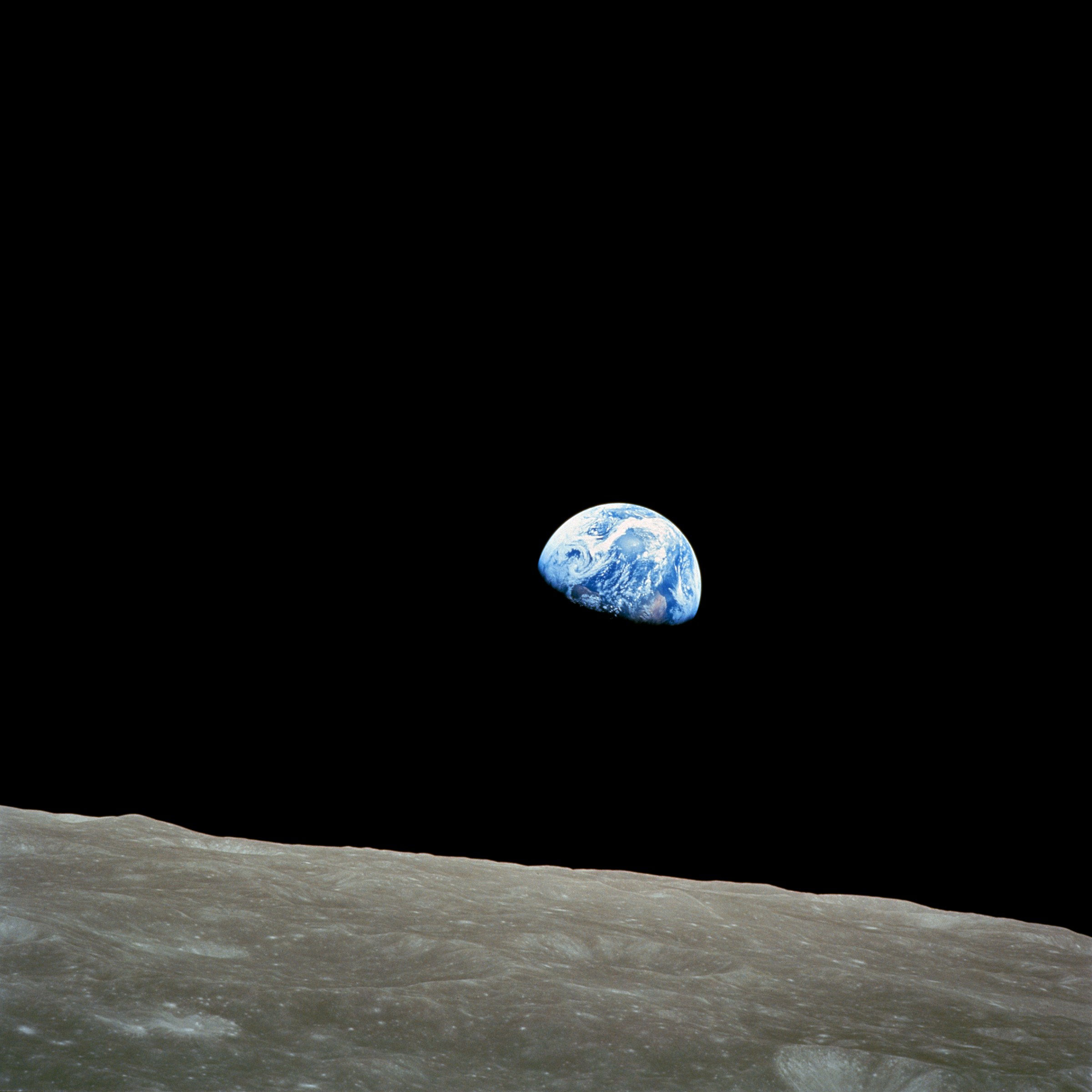
47th anniversary of Apollo 8 astronauts snapping an iconic picture in human history – earthrise over the dead surface of the moon. Video above records the astronauts being ambushed by the unexpected moment, and scrambling to grab the shot.
A few years ago, on the 45th anniversary of this photo, NASA’s Scientific Visualization Studio released the video below. It’s a visualization of the events leading up to the photo’s capture. The video gives you a front row seat on the view seen by lunar astronauts in the Apollo 8 mission, as, during a roll maneuver of their craft, they peered from a window and noticed Earth ascending over the lunar horizon.
You are there, as they capture one of the iconic photos of the 20th century – Earth rising over the moon.
The picture has had a profound impact on human consciousness in the succeeding years. By all means click for a larger image.
Expected temperature anomalies for thursday, December 24, 2015
As the eerily warm, moist autumn in Eastern North America dribbles into an even eerier, water logged Christmas season, we’ve seen a lot of ham fisted reporting along the lines of, “What about all this warm weather, is it climate change?”, with the teeth grindingly shallow answer being, “why no, it’s El Nino!”.
I asked Mike Mann of Penn State to weigh in.
“Yes, El Nino is part of it. So are the vagaries of weather. But so too is human-caused climate change. We’ve had weather before, we’ve had big El Ninos before. We have never, at least during my adult life,had anything like this before. Near 80F in DC on Christmas Eve day? That’s not “weather” and it’s not “El Nino”. It is something more.”
Simple concept. Yes, El Nino makes cold air breakouts from Canada less likely, and a warm December more likely – but the kind of records we are breaking this year, many of them set in previous El Ninos, are indications that there is indeed “something more.”
That something more is a large amount of heat and moisture in the atmosphere that was not there 10, 20, or 50 years ago. Heat and moisture that are part of every weather event, including the current one.
So, yes, Virginia, there is an El Nino, but that’s not the only thing that’s slouching toward Bethlehem with this year’s unsettlingly balmy Noel.
“Forgive me if I am not justified in what I ask,” said Scrooge, looking intently at the Spirit’s robe, “but I see something strange, and not belonging to yourself, protruding from your skirts. Is it a foot or a claw?”
“It might be a claw, for the flesh there is upon it,” was the Spirit’s sorrowful reply. “Look here.”
From the foldings of its robe, it brought two children; wretched, abject, frightful, hideous, miserable. They knelt down at its feet, and clung upon the outside of its garment.
“Oh, Man, look here! Look, look, down here!” exclaimed the Ghost.
As we move into an election year, with a burgeoning El Nino, 2 record warm years in a row, record breaking temps for Christmas across the US, and a wave of exteme events guaranteed to continue and probably accelerate, GOP candidates are completely out of touch on the climate issue, even among their own electorate. The only candidate with any recognition of the problem whatever, Lindsay Graham, just dropped out.
The party is a prisoner to hard right primary voters, who tend to be rabidly anti-science. It’s a problem of their own making.
A majority of U.S. Republicans who had heard of the international climate deal in Paris said they support working with other countries to curb global warming and were willing to take steps to do so, according to a Reuters/Ipsos poll on Tuesday.
The desire for action is notable for an issue that has barely made a ripple on the campaign trail among 2016 Republican presidential candidates. Few of the Republican White House contenders have said much at all about the United Nations summit in Paris this month, though Democratic candidates, such as Hillary Clinton, have welcomed it.
More than half, or 58 percent, of Republicans surveyed said they approved of U.S. efforts to work with other nations to limit global warming, the poll showed. Forty percent said they would support a presidential candidate who did so.
A snip here, but go to the link for the whole piece. And if you haven’t yet, check the video above, and go to Inside Climate News to follow up on the whole story.
An InsideClimate News investigative series has shown that Exxon launched its own cutting-edge CO2 sampling program in 1978 in order to understand a phenomenon it suspected could harm its business. About a decade later, Exxon spearheaded campaigns to cast doubt on climate science and stall regulation of greenhouse gases. The previously unpublished papers about the climate task force indicate that API, (American Petroleum Institute) the industry’s most powerful lobbying group, followed a similar arc to Exxon’s in confronting the threat of climate change.
Just as Exxon began tracking climate science in the late 1970s, when only small groups of scientists in academia and the government were engaged in the research, other oil companies did the same, the documents show. Like Exxon, the companies also expressed a willingness to understand the links between their product, greater CO2 concentrations and the climate, the papers reveal. Some corporations ran their own research units as well, although they were smaller and less ambitious than Exxon’s and focused on climate modeling, said James J. Nelson, the former director of the task force.
“It was a fact-finding task force,” Nelson said in an interview. “We wanted to look at emerging science, the implications of it and where improvements could be made, if possible, to reduce emissions.”
The group was initially called the CO2 and Climate Task Force, but changed its name to the Climate and Energy Task Force in 1980, Nelson said.
The current El Nino event is now on a scale rivaling or exceeding the gigantic 1997-98 event – which lead to the extremely warm temperatures of 1998, the warmest up to that time in the modern record.
That record has been exceeded now several times, in 2005, 2010, and 2014, but just barely. 2015 is blowing it out of the water – and if history is a guide, 2016 is set up to be even warmer.
October 2015 was the first month to be more than a full degree Celsius warmer than the average, followed by November, which was the second month on record to be a full degree warmer than average.
2015 will likely be the first year which averages more than a full degree Celsius over the 1850-1900 average temperature, according to the UK Met Office. This means we are already halfway to the internationally agreed-upon 2° Celsius limit for warming.
2015’s record heat is boosted by an intense El Niño. Research shows that as the world has warmed, El Niños have become more variable and intense, and extreme El Niños will be more frequent as temperatures climb.
The Christmas season will see temperatures on the east coast of the US that may be as much as 30° Fahrenheit above average, though attribution studies linking this warmth to man-made climate change are still pending and significant warming being due to jet stream patterns influenced by El Niño.
Let’s start with last January, when I posted excerpts from interviews I had just completed at last year’s AGU conference.
Worth reviewing in light of what we have seen this year.
I’ve paired his update on renewables with some important interviews with renewable experts Brewster MacCracken of Austin’s Pecan Street Project, and Michael Osborne, Chairman of the Austin Texas Electric Utility Commission.
Saving society from self-destruction should be reason enough to tackle global warming and limit climate destruction. After all, the economy is totally screwed when record-shattering and city-destroying natural disasters are handicapping state after state and country after country, and public health emergencies are multiplying. Yet, even if you completely ignored global warming, clean technology is now often better and even cheaper.
Starting with solar, rooftop solar panels often have an attractive return on investment, especially when compared to paying ever-increasing electric bills for the rest of your life. If buying solar panels outright or with a loan from the bank doesn’t work for you, leasing them may still be cheaper than paying your normal electricity bill. When it comes to wholesale electricity, utility-scale solar is increasingly more competitive than electricity from fossil fuels.
On the grid side of things, solar power is very beneficial since it is so decentralized, so widely distributed, and often put in place near the point of electricity use. Decentralization and wide distribution help grid security and improve reliability. The grid as a whole becomes more stable. When implemented near the point of use (like on rooftops), solar power reduces the transmission length of electricity, which saves money on expensive transmission infrastructure and also improves efficiency of the electricity transfer. Solar power also creates electricity in the middle of the day, a time of high electricity demand, which reduces the need for expensive peaker plants.
Wind power is often the cheapest option for new electricity generation plants. The typical levelized cost of electricity from wind power is lower than any other source of electricity. Wind power is also quite decentralized and distributed, offering similar benefits to solar power.