

West Virginia Senator Jay Rockefeller on West VA water supply – recently contaminated by spillage of coal industry chemicals: I wouldn’t drink the damn stuff.
Month: February 2014
UK Floods Impacts Widen. Wildlife, Food Security Under Threat?
If you haven’t checked in over the weekend – there’s been a lot of news in recent days about continuing extreme events in the UK . (by all means scroll down to catch up). I think what we are seeing this winter, with extremes in the US east, west, and arctic, as well as the UK, are setting up to create greater awareness in the english speaking world about the cost of climate change.
I’ll continue to update as I can – today is a busy day. New video coming in the next day or two.
As gales swept southern and western parts of the UK, with already drenched counties bearing the brunt of the storms, it has emerged that parliament’s select committee on the environment warned in a report last year that “the current model for allocating flood defence funding is biased towards protecting property, which means that funding is largely allocated to urban areas. Defra’s [the Department of the Environment’s] failure to protect rural areas poses a long-term risk to the security of UK food production, as a high proportion of the most valuable agricultural land is at risk of flooding.”
“We need a response from government that recognises the importance for our long-term food security of safeguarding high-quality farmland,” said Neil Sinden of the Campaign to Protect Rural England. “We need to view the countryside as more than a place for building, and value it for the food it provides.”
Defra has estimated that 35,000 hectares of high-quality horticultural and arable land will be flooded at least once every three years by the 2020s. This could rise to around 130,000 hectares by the 2080s if there is no change to current flood defence provision.
Peter Kendall, chairman of the National Farmers Union, which has produced evidence showing that 58% of England’s most productive farmland lies within a floodplain, said the floods were a wake-up call for a country that has “believed for too long that producing food wasn’t a big issue”.
“We are seeing more of these intense extreme weather events,” Kendall said. “Climate change does now really challenge mankind’s ability to feed itself.”
UK Met Office: Current Storms “..highly Unusual”, Consistent with Climate Change
The UK Met Office has released a snapshot of best analysis of the current extreme weather battering the Isles. The last few months have seen global extreme weather events related to a stubbornly extreme jet-stream set-up, that is also implicated in severe cold events in eastern North America, drought in California, and unseasonable warmth in the Alaskan arctic.
This kind of jet stream activity is seen by many scientists as related to arctic ice loss, due to man made climate change.
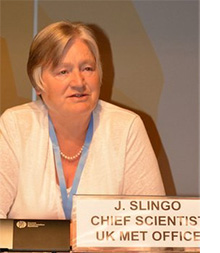
Climate change is likely to be a factor in the extreme weather that has hit much of the UK in recent months, the Met Office’s chief scientist has said.
Dame Julia Slingo said the variable UK climate meant there was “no definitive answer” to what caused the storms.
“But all the evidence suggests there is a link to climate change,” she added.
“There is no evidence to counter the basic premise that a warmer world will lead to more intense daily and hourly rain events.”
More than 130 severe flood warnings – indicating a threat to life – have been issued since December. In contrast, there were only nine in the whole of 2012.
–Speaking ahead of the launch of a Met Office report – produced by the Centre of Ecology and Hydrology – into recent climatic events, Dame Julia said the UK had seen the “most exceptional period of rainfall in 248 years”.
Unsettled weather at this time of year was not unexpected – but the prolonged spell of rain, as well as the intensity and height of coastal waves, was “very unusual”.
“We have records going back to 1766 and we have nothing like this,” she said. “We have seen some exceptional weather. We can’t say it is unprecedented but it is exceptional.”

Sea level along the English Channel has already risen by about 12cm in the last 100 years. With the warming we are already committed to over the next few decades, a further 11-16cm of sea level rise is likely by 2030. This equates to 23-27cm (9-101⁄2 inches) of total sea level rise since 1900.
Continue reading “UK Met Office: Current Storms “..highly Unusual”, Consistent with Climate Change”
Woody Guthrie Live
Uncanny Woody Guthrie embodiment by Rob Tepper, part of his Dust Bowl Production series.
If you like ’em, let ’em know.
More below.
Giant Waves Consuming Ancient UK Coastal Landmarks

UPDATE: MET Office Scientist Tells ITV storms consistent with Climate Change:
Climate Change is a key factor in the storms that have battered parts of Britain this winter, according to the Met Office’s chief scientist, who also warned that the country should prepare itself for similar events in the future.
Dame Julia Slingo said while there was not yet “definitive proof”, “all the evidence” pointed to Climate Change, and suggested that detecting when and how storms develop would become increasingly important.
“Is it consistent with what we might expect from climate change?
“Of course, as yet there can be no definitive answer on the particular events that we have seen this winter, but if we look at the broader base of evidence then we see things that support the premise that climate change has been making a contribution.”
Dame Julia said while none of the individual storms had been exceptional, the “clustering and persistence” were extremely unusual.
It’s one thing to see man made structures swallowed by the gigantic waves and relentless jet-stream driven storms that have hit the UK this winter – but when geological features that have stood for hundreds, if not thousands of years, are erased, one has to pause.
The accelerated re-arrangement of coastlines due to climate change and sea level rise is underway, but we haven’t seen anything yet.
Hate to give traffic to the Daily Mail, but there is this:
A huge ancient formation known as Pom Pom Rock has been destroyed after constant pounding by ferocious waves on the South coast.(below)The rock off Portland, Dorset, was said to have weighed hundreds of tonnes and dates back 150 million years to the Jurassic age.
It comes as a landmark rock arch that has stood for centuries in Cornwall was reduced to rubble by towering waves and 70mph winds. Porthcothan Bay is famed for its picture-postcard beach and caves – but its massive stone archway has now collapsed into the sea.(above)
The towering outcrop once resembled a giant rocky doughnut. Now, though, it looks like someone has taken a huge bite out of it.

Continue reading “Giant Waves Consuming Ancient UK Coastal Landmarks”
UK Pounding to Continue
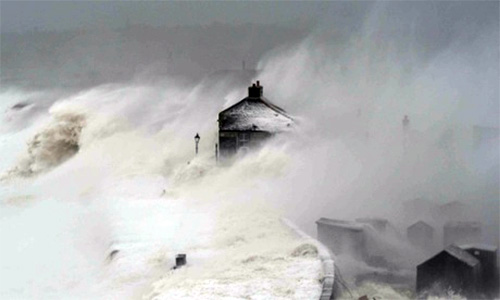
Coastal infrastructure that has withstood the sea since Victorian Times is being steadily washed away. This winter’s phenomena of globally linked jet stream pattern is providing a significant window into the future, and showing that climate change is here, now, ready or not.
Never-ending storms.
It’s been the litany for the United Kingdom ever since December unleashed her fury on the island nation’s rocky coasts. Then, the isles witnessed their windiest month ever in a series of storm events that threw about 100 ton boulders and reshaped coastal cliffs as if they were child’s toys. A month later, the wettest January on record cut off entire towns from road transport while flooding thousands of hectares of low-lying farmland. Now, with 23 straight days of rain occurring in January and with February hot on its heels, it appears that the UK may see its wettest winter in at least 100 years.
–
Conservatives, who had been ideologically opposed to responses to human-caused climate change (which they seem to believe they can wish away), appear to have been caught flat-fooded by the recent string of disasters as the government had cut funding to flood prevention efforts by more than 10% over 2013. These cuts took place at the same time that some of the wettest spring-time weather on record abruptly switched to extreme summer drought and wildfires and as climatologists were increasingly warning of severe weather risks for both the UK and Europe as the globe continued to warm. Climate change, on the other hand, suffered from no such lack of clarity — battering England with a two month period of record shattering weather that is likely to extend at least through February.
After so long an intense period of storminess, one would expect a bit of respite. For what the UK has suffered amounts to the fury of a nearly two month long hurricane. But there is yet no rest for storm-ravaged England. NOAA’s Ocean Prediction Center, the Euro, and the GFS models all predict a powerful 950 mb storm to rush into England on the 8th. This storm is expected to be at least as potent as the most recent disaster with a wide field of hurricane force winds and heavy rains:
Continue reading “UK Pounding to Continue”
Classic Climate Crocks Repost: “In the 70s, They Said There’d Be an Ice Age”
I’d been doing the Crock series for only a year when I cranked this one out – I really learned a lot on this one, and had great fun doing it. Still a favorite for many, so I hear.
UK Weather Report, Stuck Jet Stream, and Warm Arctic Update
Update on “Warm Arctic, Cold Continents’, from Dr. Jason Box.

Posted on February 6, 2014 by Jason Box
I updated my calculation of running 5-day temperature anomalies versus the same 5-day period for the ‘climate normal’ (a.k.a. most recent 30 year period beginning on a “1″ year) 1981-2010. These data are from the US NCEP NCAR Reanalysis mixture of observations from satellites, ground stations, aircraft and numerical modeling.
Most striking to me is the Arctic Ocean area persisting warm…(above)
Continue reading “UK Weather Report, Stuck Jet Stream, and Warm Arctic Update”
Big Coal’s War on Water Continues
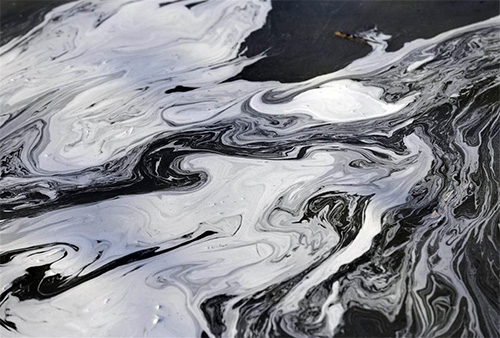
As I have continued to report, we can have fossil fuels, but we can’t continue to have fossil fuels, and fresh, clean, water, too. Aided by climate denial, we continue to subsidize the fossil fuel industry, not only with our tax dollars , but with our children’s bodies, lungs, and brains.
They need the water. Your baby will have to look elsewhere. STFU.
Five days after coal ash began leaking into the Dan River in North Carolina last weekend, Duke Energy still can’t say if the mess will ever be cleaned up.
On Sunday, a security guard at the Duke Energy plant in Eden discovered that the gray sludge was leaking out of a storage pond and into the river through a hole in a storm water drainage pipe beneath the pond. Since then, up to 82,000 tons have flowed into the river.
Environmental groups have blasted Duke Energy for taking more than 24 hours to notify the public of what they say is one of the worst spills of its type in U.S. history.
A Wednesday statement from Duke Energy said that the company was “exploring multiple options to permanently and safely seal the broken stormwater pipe that has released ash into the river,” but it did not say when the leak would be sealed or if the river could be cleaned.
North Carolina’s environmental regulators are waiting on the results of tests to determine the toxicity of the sludge. According to The Associated Press, coal ash “is known to contain a witch’s brew of toxic chemicals, including lead, arsenic, mercury and radioactive uranium.”
And as time passes, the gray sludge is making its way toward the city of Danville in Virginia, which uses the river for drinking water.
“How do you clean this up?” Dan River Basin Association program manager Brian Williams told the AP. “Dredge the whole river bottom for miles? You can’t clean this up. It’s going to go up the food chain, from the filter feeders, to the fish, to the otters and birds and people. Everything in the ecosystem of a river is connected.”
Duke Energy has claimed that the spill has “the lowest level lab instruments can accurately measure” of dangerous trace metals.