

As I begin planning for another Greenland expedition to study ice melt, I decided to explore whether the cold eastern North America, was part of what some scientists are calling the Warm Arctic – Cold Continents pattern. Examination of US NCEP NCAR Reanalysis data reveals that YES, the story has an important Arctic climate dimension.
While it’s easy to understand that abnormal summer warmth promotes high melting, winter warming also promotes melting through the loss of snow, ice, and land “cold content”. The higher the ground temperature, the fewer degrees of heating it takes to reach the melting point. Thus, winter warming preconditions the surface for earlier melt onset and more melting overall.
That’s one reason why this January’s Arctic climate concerns me. Greenland temperatures have remained more than 5 degrees C above average after the first week of the year. The snowpack heating the abnormal warmth increase the likelihood of an earlier melt onset and above average Greenland melting this coming summer.
Continue reading “Dr. Jason Box on Warm Arctic, Cold Continents”
Month: February 2014

From NOAA, the Vortex in Profile

A few days of unusually cold weather in the U.S. and Canada aren’t a sign that a century-or-more trend of rising global surface temperatures has reversed itself. In fact, the cold wasn’t even all that widespread for the Northern Hemisphere. For a visual reality check, all you need to do is look up- and downstream of the contiguous United States a few hundred miles. (above)
This map shows differences from average air temperature across the Northern Hemisphere for January 5-7, 2014, based on NCEP Reanalysis data provided by NOAA ESRL’s Physical Sciences Division. Temperatures far below average are dark blue; temperatures far above average are red.
Clearly, while Americans in the Lower 48 were shivering, Alaskans were experiencing unusually balmy winter temperatures. Across the Atlantic, temperatures were warmer than average in Scandinavia, Europe, and western Russia.
These alternating temperature extremes encircling the globe are not a coincidence. These locations are connected by undulations of the jet stream, which developed deep kinks after the high-altitude Arctic circulation known as the “polar vortex” wobbled a bit in early January. Check back next week for a follow-up post on how NOAA climate scientists monitor the influence of the polar vortex through the Arctic Oscillation Index.
Keystone Debate: Joe Romm, Josh Fox on the Ed Show
Bill Nye the Naive Guy?
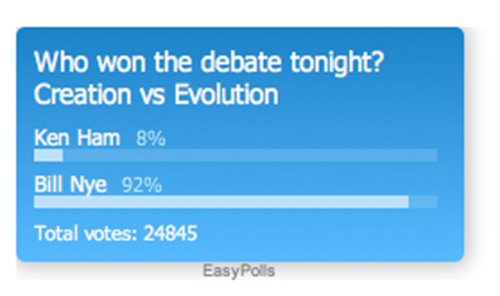
Bill Nye has come into a lot of criticism for some of his not-so-well-thought-out appearances debating climate deniers, and his decision to debate the founder of Kentucky’s Creation Museum.
The obviously unscientific result above notwithstanding – it’s a dilemma for anyone who wishes to defend science against ignoramuses – hence the connection to this blog. What’s that old saying about pig wrestling?
It was like watching the Broncos play the Seahawks. Nye never had a chance. Ham won this debate months ago, when Nye agreed to participate. By last Friday, when I spoke with Ham, Nye hadn’t even arrived in Kentucky, but Ham was already basking in the glow of victory (Nye didn’t respond to my request for comment). “The response,” Ham told me, “has been absolutely phenomenal.” He talked about the media attention. He talked about how professional the stage was going to look. He talked more about the media attention. “It’s going to create a lot of discussion. I think that’s very healthy,” said Ham, in reference to the raging scientific debate over whether evolution actually happened. “In many ways aggressive atheists have shut down that discussion.” But, Ham continued, “the public wants to hear about” origins. Fortunately, Nye has given them that chance.
When I asked whether the debate would bring any financial perks, Ham hastened to talk me down. “The ticket sales won’t come to half the cost of the debate,” he explained. The publicity, though, may be priceless. The last time Ham gained national media attention, it was for his failure to raise enough money to build the enormous Noah’s Ark theme park he’s been planning as an accompaniment to his slick creation museum. This time, he gallops onto the national stage as defender of the faith—a stance that may open some pocketbooks. Perhaps Ham will dedicate a plank in the replica ark to his bowtied benefactor.
Yeah, That Looks Normal: A Drive Through Icy Hell in Slovenia
Alaska is lukewarm slush. The arctic is anomalously warm as a whole (see map below the fold).
Slovenia, in eastern central Europe is, uhhh…hmmm.
Three days of blizzards have inflicted “the worst devastation in living memory” in the small Alpine country of Slovenia, according to local media.
About 50,000 homes lost power as trees and electricity poles buckled under up to six inches of ice after oscillating temperatures caused some snow to melt and then freeze again.
Authorities estimate that roughly half of Slovenia’s forests — about 1.2 million acres — have been damaged.
Continue reading “Yeah, That Looks Normal: A Drive Through Icy Hell in Slovenia”

Alaska Slushy in Winter Warmth

Minus 11 F when I got up monday in Mid Michigan.
While much of the continental United States endured several cold snaps in January 2014, record-breaking warmth gripped Alaska. Spring-like conditions set rivers rising and avalanches tumbling.
This map (above) depicts land surface temperature anomalies in Alaska for January 23–30, 2014. Based on data from the Moderate Resolution Imaging Spectroradiometer (MODIS) on NASA’s Terra satellite, the map shows how 2014 temperatures compared to the 2001–2010 average for the same week. Areas with warmer than average temperatures are shown in red; near-normal temperatures are white; and areas that were cooler than the base period are blue. Gray indicates oceans or areas where clouds blocked the satellite from collecting usable data.
A persistent ridge of high pressure off the Pacific Coast fueled the warm spell, shunting warm air and rainstorms to Alaska instead of California, where they normally end up. The last half of January was one of the warmest winter periods in Alaska’s history, with temperatures as much as 40°F (22°C) above normal on some days in the central and western portions of the state, according to Weather Underground’s Christopher Bart. The all-time warmest January temperature ever observed in Alaska was tied on January 27 when the temperature peaked at 62°F (16.7°C) at Port Alsworth. Numerous other locations—including Nome, Denali Park Headquarters, Palmer, Homer, Alyseka, Seward, Talkeetna, and Kotzebue—all set January records.

Keystone “Wheel Still in Spin”

The release of the State Department’s Environmental Impact Statement on the proposed Keystone XL tar sands pipeline initiates the final stage in the permitting process: the 90-day National Interest Determination. The multiple reasons to oppose granting a construction permit include an overriding national interest in forestalling the development of a major new fossil fuel source that will exacerbate global climatic disruption and undermine the transformation of the energy system to decarbonized sources.
The Final Supplemental Environmental Impact Statement (SEIS) on the KXL project remains essentially unchanged from the earlier Draft SEIS in contending that the pipeline would not significantly alter total global emissions of greenhouse gases. The SEIS concludes that, with or without the KXL pipeline, the Canadian tar sands will be extracted and transported to market. Jeffrey Sachs, director of the Earth Institute at Columbia University, notes (Keystone: The Pipeline to Disaster) “the tragic, indeed fatal, flaw of the State Department review”:
The urgent planetary need is clear. The world has to wean itself from fossil fuel dependence in the coming 20-40 years. We simply can’t go on drilling, excavating, and burning every ton of coal, oil, and gas the fossil fuel industry finds. If we do so, the basic “carbon arithmetic” of CO2 buildup spells disaster. …
Using climate science, it is possible to calculate the tolerable limits on total future fossil fuel use. The basic idea is the need for the world to adhere to a “carbon budget,” meaning the total amount of fossil fuels that can be burned while avoiding global warming by more than 2-degrees C.
The State Department Environmental Impact Statement doesn’t even ask the right question: How do the unconventional Canadian oil sands fit or not fit within the overall carbon budget? Instead, the State Department simply assumes, without any irony or evident self-awareness, that the oil sands will be developed and used one way or another. For the State Department, the main issue therefore seems to be whether the oil will be shipped by pipeline or by rail. The State Department doesn’t even raise the possibility that the pipeline should be stopped in order to keep a lid on the total amount of unconventional fossil fuels burned around the world.
So now we come to the battle over the National Interest Determination. The SEIS is a big step in the process, but in releasing it, the State Department stressed that the wheel is still in spin on a final decision on the permit. The Washington Post reported:
Transmission Allows Wind Storage in Canada

Ironically, in light of the State Department’s seal of approval for tar sands oil:
A pair of utilities, Minnesota Power and Manitoba Hydro, have inked a Renewable Optimisation Agreement (ROA) under which electricity from excess wind produced in North Dakota can be stored in Manitoba’s hydro reservoir when loads and prices are low, with the potential for selling that power back onto the huge United States Midwest Independent Transmission System Operator (MISO) market at times when needs are high.
The deal involves the pair building a new 400 mile 500 kV transmission line, with a capacity of 750 megawatts, connecting northeastern Minnesota with Winnipeg, at a cost of $1bn split between the two utilities.
Manitoba Hydro is already an external participant with MISO, as a large hydroelectric system with some of the lowest electricity prices in North America.
“We can act as a rechargeable battery for the MISO market,” says Manitoba Hydro Division Manager of Power Sales and Operations David Cormie. “The arrangement we have with Minnesota Power is that they are going to invest in new transmission in the US, and Manitoba Hydro will invest in the transmission in Canada, and at the same time Manitoba Hydro is going to build new power dams that create more storage capability.”
Continue reading “Transmission Allows Wind Storage in Canada”
Behind Blue Eyes
Was this song actually a psychically prescient anthem for internet trolls?
Do Trolls Make Us Dumber?
“Anybody can become angry — that is easy, but to be angry with the right person and to the right degree and at the right time and for the right purpose, and in the right way — that is not within everybody’s power and is not easy.”― Aristotle
“The greatest lesson in life is to know that even fools are right sometimes.” ― Winston Churchill
“The whole problem with the world is that fools and fanatics are always so sure of themselves and wiser people so full of doubt.”
― Leah Wilson
“Wise men profit more by fools than fools by wise men.”― Cato
“We are never deceived; we deceive ourselves.” – Johann W. von Goethe
“Life teaches us to be less severe with ourselves and others.” – Johann W. von Goethe
“The best lack all conviction, while the worst are full of passionate intensity.”- W. B. Yeats
As many of you know, I’ve been mulling over my policy on open discussion, and whether there should be some kind of screen or control on trolls and those who abuse the comment threads.
I’ve come to a policy that I’ll call “modified open door”. You may be aware that we haven’t seen a couple of the more obnoxious posters in a few weeks. That’s because I’ve blocked them – or at least, insofar as I understand WordPress’ tools for screening comments.
