
Renewables Changing the Math of Energy Grid

capacity

Ever wonder what an unraveling paradigm looks like? The energy revolution that has been building for the last decade is now beginning to eat away at the assumptions that underly our antique electrical grid.

I’ve written here how in Germany, torrents of new renewable energy have outstripped the country’s transmission system, resulting in negative pricing of power in some regions.  We’ve seen it , here and there, in some renewable energy early-adopter regions in the US. Now its coming on in a big way, and starting to undermine the assumptions for the “hub and spoke” centralized system of large thermal power plants.  Near zero and negative pricing sounds like a good thing for you and me, but its an urgent signal that something fundamental is changing in the way we produce power, ready or not.

It’s an alarm bell for policy makers that the new energy technologies are going to change the energy business similar to the way the internet changed..well, everything.

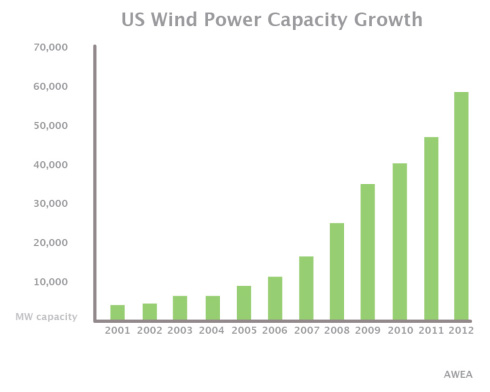
The rumblings discussed here are a warning.  Wind energy prices in my moderate-to-good wind resource region are now about half of what they were just 3 years ago, and still heading south, as technology improves.  Wind energy observers tell us that wind-baggers in congress and elsewhere may slow progress down, but can’t stop the rush to wind energy.

Looking to the near future, solar photovoltaics will be the “new wind” of this decade.

solarprice

We can learn a lot from looking at Germany to see how they reconcile the new logic a distributed energy systems with the legacies of the outmoded old grid.  What Germany will have to sell to the rest of us will be the expertise that they are building on now.  We can ignore the lessons and stumble on the same rocks, or we can learn, and perhaps leapfrog Germany’s huge lead in these areas.

Yesterday’s headline on Bloomberg news was “Nuclear Industry Withers in US as Wind Pummels Prices”, and raises a complaint about “government subsidized wind power” outcompeting (government subsidized) nuclear power, and even undercutting the much touted shale gas. Italics are mine.

Bloomberg:

A glut of government-subsidized wind power may help accomplish a goal some environmentalists have sought for decades: kill off U.S. nuclear power plants while reducing reliance on electricity from burning coal.

That’s the assessment of executives and utility experts after the U.S. wind-energy industry went on a $25 billion growth binge in 2012, racing to qualify for a federal tax credit that was set to expire at year’s end.

The surge added a record 13,124 megawatts of wind turbines to the nation’s power grid, up 28 percent from 2011. The new wind farms increased financial pressure on traditional generators such as Dominion Resources (D) Inc. and Exelon Corp. in their operating regions. That’s because wind energy undercut power prices already driven to 10-year-lows by an abundance of natural gas.

The wind power boom has benefited consumers in regions where wind development is fastest, contributing to a 40 percent wholesale power-price plunge since 2008 in the Midwest, for example. Yet the surplus is creating havoc for nuclear power and coal generators that sell their output into short-term markets.

Continue reading “Renewables Changing the Math of Energy Grid”

London. A Billion for Bike Lanes.

The city of London is going big into bicycles. See visualization above.

Daily Kos:

Here’s a sampling of what you can do with £1 billion ($1.4 billion):

  • A new ‘Central London Grid’ of bike routes in the City and West End, using segregation, quiet streets, and two-way cycling on one-way traffic streets, to join all the other routes together
  • A new network of ‘Quietways’ – direct, continuous, fully-signposted routes on peaceful side streets, running far into the suburbs, and aimed at people put off by cycling in traffic
  • Substantial improvements to both existing and proposed Superhighways, including some reroutings
  • Major improvements to the worst junctions, making them safer and less threatening for cyclicsts

Carbon Tax Continues to Gain Cred. Deniers Worried.

carbontax

There are a few remaining rational actors in the Republican party, and they have a problem.

They recognize that, as tarnished as their brand is now with young people, another 5 years of unmitigated climate change will cement the party’s place in history alongside Nero, if that’s not a done deal already.

For that reason, there is a lot of casting about for some kind of face-saving sideways approach to the climate issue, and one that has been steadily gaining currency is the “revenue neutral” carbon tax, or “fee and dividend” – in which taxes collected at mineshaft, port, or wellhead pass through instantly to citizens in the form of a monthly or annual “dividend” check. Former Secretary of State under Reagan George Schultz recently appeared on capitol hill in support of the idea.

NYTimes:

For the past few years, Mr. Shultz, an economist, has been studying energy policy at Stanford University’s Hoover Institution. He recently traded his hybrid car for an all-electric one, and he advocates a carbon tax to pay for the research and development of alternative energy sources.

.. he said that Congress should pass a fee-and-dividend carbon tax that would remit revenues to consumers. The tax would be revenue-neutral, covering the cost of research and development for alternative energy sources without generating extra income for the government.

But in Washington, where Republicans and Democrats are deeply divided over the size and scope of government, talk of new taxes and regulations is toxic. A carbon tax like the one Mr. Shultz supports has been proposed by Senators Barbara Boxer of California and Bernie Sanders of Vermont, although Mr. Shultz did not endorse their measure.

Continue reading “Carbon Tax Continues to Gain Cred. Deniers Worried.”

Chief of US Pacific forces: Climate Change Top Threat

Climate deniers are heavily weighted on the side of the aisle that does a lot of chest pounding about patriotism, they love our servicemen, defend Freedom, constitution, yada yada.  Therein lies a conflict for them.  Military commanders around the world are raising some of the most urgent warnings about climate change.

They hated every time former US Navy Chief Oceanographer David Titley affirmed the science, and I’m sure were glad when Titley retired not long ago. But the reality remains. Military people know that when things go seriously wrong, they are the ones left to clean up messes, or sort out chaos.

The Chief of US Pacific Forces is the latest high profile, active military commander to speak up about climate change.

Boston Globe:

CAMBRIDGE — America’s top military officer in charge of monitoring hostile actions by North Korea, escalating tensions between China and Japan, and a spike in computer attacks traced to China provides an unexpected answer when asked what is the biggest long-term security threat in the Pacific region: climate change.

Navy Admiral Samuel J. Locklear III, in an interview at a Cambridge hotel Friday after he met with scholars at Harvard and Tufts universities, said significant upheaval related to the warming planet “is probably the most likely thing that is going to happen . . . that will cripple the security environment, probably more likely than the other scenarios we all often talk about.’’

“People are surprised sometimes,” he added, describing the reaction to his assessment. “You have the real potential here in the not-too-distant future of nations displaced by rising sea level. Certainly weather patterns are more severe than they have been in the past. We are on super typhoon 27 or 28 this year in the Western Pacific. The average is about 17.”

Continue reading “Chief of US Pacific forces: Climate Change Top Threat”

You Can Fool Climate Deniers, But You Can’t Fool Mother Nature. Plants Pack up and Move North.

You can fool a climate denier a lot easier than you can fool a fungus.

Climate News Network:

The Arctic is warming faster than many other parts of the planet, and plants are providing some of the clearest signs of the impacts, with vegetation now growing nearly 500 miles further north than it did a few decades ago.

LONDON, 10 March – The Arctic is on the move. The North Pole is in the same place, but Arctic conditions have begun to shift. A study of 30 years of satellite data confirms that the difference in temperatures between the seasons has diminished.

Conditions now have shifted the equivalent of four or five degrees of latitude southward. At the same time, vegetation has moved north, colonizing the thawing permafrost.

A team of 21 scientists from 17 institutions in seven nations reports in Nature Climate Change that as the cover of snow and ice has diminished and retreated in the Arctic Circle, the temperatures have begun to increase – at differing rates – during the four seasons. Although conditions differ from region to region, overall the growing season is beginning earlier, and the autumn freeze is starting later.

Conditions in northern latitudes now increasingly resemble those found several hundred miles further south 30 years ago. One of the authors, Bruce Forbes of the University of Lapland in Finland, told the Climate News Network that in his own research region of north-west Siberia “we are seeing more frequent and longer-lasting high pressure systems. In winter, the snow cover comes later, is deeper on average than in the 1960s, but is melting out earlier in spring.”

Climate is a complicated business, and there is always legitimate room for argument about the validity of one selected set of measurements, a potential bias in the observations, or the reliability of comparison data collected two generations earlier.

But vegetables can’t be fooled. Plants grow where they can. If deciduous shrubs are growing taller, and colonizing sites ever further north, then conditions must be getting warmer, and staying warmer.

Winners – and losers

Professor Forbes says that indigenous reindeer herders report that alder and willow, normally stunted by the polar winter, are growing taller: his own research team has confirmed this with dendrochronology, the science of tree ring measurement.

Continue reading “You Can Fool Climate Deniers, But You Can’t Fool Mother Nature. Plants Pack up and Move North.”

Old: “The Hockey Stick”. New: “The Scythe”


The team at Center for American Progress took the results of the most recent extension of high res global temperatures, and added on projected warming for the coming century.

The result looks less and less like a “hockey stick”. More like a scythe.

Climate Progress:

A stable climate enabled the development of modern civilization, global agriculture, and a world that could sustain a vast population. Now, the most comprehensive “Reconstruction of Regional and Global Temperature for the Past 11,300 Years” ever done reveals just how stable the climate has been — and just how destabilizing manmade carbon pollution has been and will continue to be unless we dramatically reverse emissions trends.

Researchers at Oregon State University (OSU) and Harvard University published their findings today in the journal Science. Their funder, the National Science Foundation, explains in a news release:

With data from 73 ice and sediment core monitoring sites around the world, scientists have reconstructed Earth’s temperature history back to the end of the last Ice Age.

The analysis reveals that the planet today is warmer than it’s been during 70 to 80 percent of the last 11,300 years.

… during the last 5,000 years, the Earth on average cooled about 1.3 degrees Fahrenheit–until the last 100 years, when it warmed about 1.3 degrees F.

In short, thanks primarily to carbon pollution, the temperature is changing 50 times faster than it did during the time modern civilization and agriculture developed, a time when humans figured out where the climate conditions — and rivers and sea levels — were most suited for living and farming. We are headed for 7 to 11°F warming this century on our current emissions path — increasing the rate of change 5-fold yet again.

Continue reading “Old: “The Hockey Stick”. New: “The Scythe””

The Weekend Wonk: Alan Savory on Greening Deserts and Reversing Climate Change

I’ve been hearing from a lot of people about this TED talk, asking me if I had seen it, and what do I think.

Finally got around to watching it last night, and I agree, this is a worthy topic for discussion, for a couple of reasons.

a) We are clearly in carbon overshoot, and need to come up with novel ways to manage forests and soils over coming decades, to soak up as much carbon as possible

b) This speaks to what is for some, a standard ecological prescription, which is that animal husbandry is always in every case destructive, and contributes to climate change and desertification. Savory agrees that there is a right and wrong way, but makes a case that with the right practices, ruminants can become a powerful tool for healing damaged land and sequestering carbon.

One remembers that when European settlers (ok, illegal aliens) came to America, they found black soil 6 feet and more thick in Iowa, Illinois and the plains. That soil has now been reduced to inches by technological agricultural practices, and a major project for the coming century would be to turn that around, if we are to maintain a viable agricultural base. And those original soils, well, the Buffalo had something to do with that…

Indigent to the prairie and a primary food source for Indian tribes, the buffalo was slaughtered to near-extinction by the white man in the 1860s. This photograph, which captures only a fraction of the bones from the estimated millions of buffalo shot for their hides and often left to rot, can be found in Michael Blake's "Indian Yell: The Heart of an American Insurgency."
Indigent to the prairie and a primary food source for Indian tribes, the buffalo was slaughtered to near-extinction by the white man in the 1860s. This photograph, which captures only a fraction of the bones from the estimated millions of buffalo shot for their hides and often left to rot, can be found in Michael Blake’s “Indian Yell: The Heart of an American Insurgency.”

From Hockey Stick to Ski Jump

skijump2

In an enormous leap forward, new analyses of temperature records for the last 11000 years have now been published.

Don’t look for the climate denial blogosphere to learn anything from new science. Expect instead a newly focused attack on the facts, – trolls will have to bone up – and a new buzzword.

The older temperature graphs took in only the past 1000 or 2000 years, and were recognizable for the pronounced upward swing at the end. The new, longer graphs include a hump that peaked 9500 years ago, when the planet’s axial tilt was most extreme toward the sun, and have declined slowy until the past century, where we see a dramatic spike.

Less like a Hockey stick, said one scientist. More like a Ski Jump. With a brick wall at the end.

Associated Press:

A new study looking at 11,000 years of climate temperatures shows the world in the middle of a dramatic U-turn, lurching from near-record cooling to a heat spike.

Research released Thursday in the journal Science uses fossils of tiny marine organisms to reconstruct global temperatures back to the end of the last ice age. It shows how the globe for several thousands of years was cooling until an unprecedented reversal in the 20th century.

Scientists say it is further evidence that modern-day global warming isn’t natural, but the result of rising carbon dioxide emissions that have rapidly grown since the Industrial Revolution began roughly 250 years ago.

The decade of 1900 to 1910 was one of the coolest in the past 11,300 years — cooler than 95 percent of the other years, the marine fossil data suggest. Yet 100 years later, the decade of 2000 to 2010 was one of the warmest, said study lead author Shaun Marcott of Oregon State University. Global thermometer records only go back to 1880, and those show the last decade was the hottest for this more recent time period.

“In 100 years, we’ve gone from the cold end of the spectrum to the warm end of the spectrum,” Marcott said. “We’ve never seen something this rapid. Even in the ice age the global temperature never changed this quickly.”

LA Times:

“By the year 2100, we will be beyond anything human society has ever experienced,” said study leader Shaun Marcott, a postdoctoral researcher at Oregon State University‘s College of Earth, Ocean and Atmospheric Sciences.

According to NASA, the average global temperature for 2012 was 58.3 degrees Fahrenheit, making it the ninth-hottest year in recorded history. However, there is no single, agreed-upon method of calculating these temperatures, so scientists tend to discuss climate change by highlighting deviations from a specific reference point.

While a 1-degree Fahrenheit increase sounds small, it represents an enormous amount of heat energy. For instance, a 10-degree drop would plunge the world into another period of major glaciation, while every 1.8-degree increase would gradually amount to a roughly 65-foot rise in sea level due to melting polar ice, according to NASA climatologist James Hansen.

Previous efforts to measure past climate conditions have relied heavily on measurements of tree ring thickness. At high latitudes, tree growth is controlled mostly by temperature, so thick rings suggest warm years. But trees don’t live longer than several thousand years, so those efforts have focused on shorter periods of time — just 1,500 to 2,000 years.

Continue reading “From Hockey Stick to Ski Jump”