Graphene May Solve Fresh Water Shortages

One word. Graphene.

Reuters:

A defense contractor better known for building jet fighters and lethal missiles says it has found a way to slash the amount of energy needed to remove salt from seawater, potentially making it vastly cheaper to produce clean water at a time when scarcity has become a global security issue.

The process, officials and engineers at Lockheed Martin Corp say, would enable filter manufacturers to produce thin carbon membranes with regular holes about a nanometer in size that are large enough to allow water to pass through but small enough to block the molecules of salt in seawater. A nanometer is a billionth of a meter.

Because the sheets of pure carbon known as graphene are so thin – just one atom in thickness – it takes much less energy to push the seawater through the filter with the force required to separate the salt from the water, they said.

The development could spare underdeveloped countries from having to build exotic, expensive pumping stations needed in plants that use a desalination process called reverse osmosis.

“It’s 500 times thinner than the best filter on the market today and a thousand times stronger,” said John Stetson, the engineer who has been working on the idea. “The energy that’s required and the pressure that’s required to filter salt is approximately 100 times less.”

Welcome to the Anthropocene: Extending the New Climate Data

extendedmarcottThe new study extending the  temp record back to 11,0oo years has gotten a lot of press.

I don’t read or speak Dutch, but a Dutch blogger has extended the graph forward a century, and backward to the last glacial period.  I expect this will be translated into english, and will provide more info when I see it.  If anyone wants to try google translate to make sense of it, by all means.

Powerful image of the anthropocene, though.

The Anthropocene is an informal geologic chronological term that serves to mark the evidence and extent of human activities that have had a significant global impact on the Earth‘s ecosystems. The term was coined recently by ecologist Eugene F. Stoermer, but has been widely popularized by the Nobel Prize-winning atmospheric chemistPaul Crutzen, who regards the influence of human behavior on the Earth’s atmosphere in recent centuries as so significant as to constitute a new geological epoch for its lithosphere. To date, the term has not been adopted as part of the official nomenclature of the geological field of study.

UPDATE – a reader sends in this translation from the Chrome browser:

Guest Blog by Jos Hage Boot

Starting in March 2013 appeared in Science an article about a temperature reconstruction for the last 11,000 years . The lead author is Shaun Marcott from Oregon State University and the second author Jeremy Shakun, which we know from the previous year published and interesting research on the relationship between CO2 and temperature during and after the end of the last ice age. Temperature reconstruction of Marcott is the first full period of the Holocene covers. Obviously not perfect and the coming years will probably details on what changed. A normal part of the scientific process.

The temperature reconstruction ends mid century, therefore, in the graphs of their study the rapid temperature rise after 1850 is clearly visible. And what do you find? Again something that looks like a hockey stick as the graph in Mann et al 2008 .

Shhhh….Be Vewy, Vewy Quiet…

National Review:

Deciding whether to approve the Keystone XL pipeline is surely one of the toughest challenges of Barack Obama’s presidency. He hasn’t made up his mind yet, of course. Or has he?

Bloomberg reports that the Obama administration “is preparing to tell all federal agencies for the first time that they should consider the impact on global warming before approving major projects.” Up to now, under the National Environmental Policy Act (NEPA), federally approved projects had to consider potential impacts like dangerous spills or air pollution, but not global warming. Directing all federal agencies to take climate change into account under NEPA will transform environmental policy in this country, putting a huge new drag on the economy in the process.

But let’s concentrate on Keystone. The Bloomberg report makes it clear that Obama’s order opens the way for further litigation and substantial delays on Keystone, whether the federal government officially blocks construction or not. That’s because NEPA allows citizens and environmental groups to file claims against projects even after they win government approval.

So the Obama administration could green-light the pipeline, file a report that stops short of calling Keystone a major global-warming hazard, and still find the project delayed for years by environmental groups bringing court challenges under the new NEPA guidelines.

In this scenario, headlines loudly proclaiming Obama’s approval of Keystone would shield him from Republican attacks. Simultaneously, the president could mollify the left by claiming credit for guidelines that effectively allowed his allies to stop the pipeline. And that would be right. Obama can publicly “approve” Keystone, while simultaneously handing the left the tool they need to put the project on semi-permanent hold. Environmentalists would take the political heat, while Obama would get off scot-free. Pretty clever.

On Display at CPAC: Racism, Homophobia, Misogyny, Climate Denial – Who’da thunk it?

Young attendees at CPAC conference asked to respond to the idea of climate change.

Compare to another young attendee’s views on race.

ThinkProgress:

ThinkProgress spoke with Terry, who sported a Rick Santorum sticker and attended CPAC with a friend who wore a Confederate Flag-emblazoned t-shirt, about his views after the panel. Terry maintained that white people have been “systematically disenfranchised” by federal legislation.

When asked by ThinkProgress if he’d accept a society where African-Americans were permanently subservient to whites, he said “I’d be fine with that.” He also claimed that African-Americans “should be allowed to vote in Africa,” and that “all the Tea Parties” were concerned with the same racial problems that he was.

At one point, a woman challenged him on the Republican Party’s roots, to which Terry responded, “I didn’t know the legacy of the Republican Party included women correcting men in public.”

He claimed to be a direct descendent of Confederate President Jefferson Davis.

Huffington Post:

“I’m embarrassed to call myself a Republican right now,” Jimmy LaSalvia, co-founder and president of the gay conservative group GOProud, said at the Conservative Political Action Conference in National Harbor, Md., on Thursday. The gay Republican was referring to GOProud’s exclusion from participation at CPAC for a second year in a row, banned as an official sponsor. LaSalvia attended CPAC as a guest of the Competitive Enterprise Institute, a sponsor of CPAC which hosted a panel Thursday on which LaSalvia appeared, “A Rainbow on the Right: Growing the Coalition, Bringing Tolerance Out of the Closet.”

At the packed panel, attended by younger CPAC members, including quite a few conservative gays and lesbians, conservative commentators and activists on the panel who support marriage equality, including CNN pundit Margaret Hoover and Washington Post columnist Jennifer Rubin, made the case for gay marriage as a conservative value. Earlier in the day Senator Marco Rubio, criticized those who would call him a “bigot” for not supporting same-sex marriage, underscoring the tension the issue continues to cause among conservatives. LaSalvia, for his part, however, agreed with Rubio, making a similar statement during the panel discussion and getting applause from the audience

The Weekend Wonk: Anton Vaks on Permafrost Melt

I’m posting the interview I did by Skype with Anton Vaks, whose recent research figured prominently in one of my recent videos.

Doctor Vaks has looked at the growth of speleothems, i.e. stalactites and stalagmites, in caves underlying areas of continuous and discontinuous permafrost in Siberia.  400,000 years ago, during an interglacial period slightly warmer than this one (so far), large areas of permafrost did go into a melting process once temp reached about 1.5 C above preindustrial temps. We are a little more than half way to that point, at about 0.8C above preindustrial.

The good news is, as the orbital cooling processes kicked in, the planet cooled, and permafrost did not run away. The bad news is, we are pushing the process much, much harder than the orbital forcings ever have.

Per Youtube limitations, had to break it up. Part 2 below.

If you have not seen yet, the permafrost video is below.

Continue reading “The Weekend Wonk: Anton Vaks on Permafrost Melt”

Melt Season’s First Signs in Arctic

Andrew Freedman in Climate Central:

Following more than two decades of Arctic sea ice thinning and melting, an unusual event just weeks before the start of the spring melt season is providing visual proof of how vulnerable the ice pack really is.

During the end of February and continuing into early March, large fractures in the sea ice were observed off the north coast of Alaska and Canada, from near Ellesmere Island in the Canadian Arctic to Barrow, Ala., the northernmost city in the U.S.

The rapid climate change in the Arctic and sharp decline of sea ice has been attributed to manmade global warming, along with natural climate variability, and projections show the region becoming seasonally sea ice free by midcentury.

According to the National Snow and Ice Data Center (NSIDC) in Boulder, Colo., this fracturing event appears to be related to a storm that passed over the North Pole on Feb. 8, 2013, creating strong off-shore ice motion. The event is unusual but not unheard of, as similar patterns were seen in early 2011 and 2008. However, the NSIDC said the fracturing this time is more extensive.

The spread of the ice fractures can be seen in a video animation from satellite imagery, provided by the NSIDC.

The NSIDC said the fracturing is likely a sign of the prevalence of young and thin sea ice, which can be disturbed more easily by weather patterns and ocean currents, and also melts more easily when exposed to warm air and ocean temperatures during the melt season. As Arctic sea ice extent has plummeted since 1979, down to a record low in September 2012, first-year ice has become much more common across the Arctic, as thick, multiyear ice has declined.

“The large area of fractured ice is located in predominantly first-year ice, which is thinner and easier to fracture than thick, multiyear ice,” the NSIDC said on its website.

Continue reading “Melt Season’s First Signs in Arctic”

Broken Planet

marsearth
A friend points here and comments:
“We have found a habitable environment that is so benign and supportive of life that probably if this water was around and you had been on the planet, you would have been able to drink it.”
JOHN P. GROTZINGER, a California Institute of Technology geology professor, on findings from the Mars rover about the planet’s distant past.

Good thing it’s not possible to break a planet.

A Renewable New York State

nystate

In January I posted on a University of Delaware study showing how a key, energy intensive region of the country could be run entirely on renewable energy.

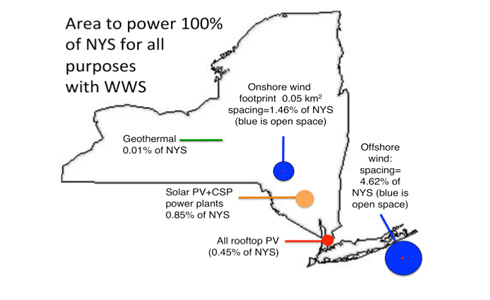
Now we have a new study from Mark Jacobson and his team at Stanford, visualizing a renewable future for New York State.  Forming an idea of what this will look like is the first step in bringing it to reality.

Abstract

This study analyzes a plan to convert New York State’s (NYS’s) all-purpose (for electricity, transportation, heating/cooling, industry) energy infrastructure to one derived entirely from wind, water, and sunlight (WWS) generating electricity and electrolytic hydrogen. Under the plan, NYS’s 2030 all-purpose end-use power would be provided by

10% onshore wind (4020 5-MW turbines),
40% offshore wind (12,700 5-MW turbines),
10% concentrated solar (387 100-MW plants),
10% solar-PV plants (828 50-MW plants),
6% residential rooftop PV (~5 million 5-kW systems),
12% commercial/government rooftop PV (~500,000 100-kW systems),
5% geothermal (36 100-MW plants), 0.5% wave (1910 0.75-MW devices),
1% tidal (2600 1-MW turbines),
and 5.5% hydroelectric (6.6 1300-MW plants, –
of which 89% exist).

The conversion would reduce NYS’s end-use power demand ~37% and stabilize energy prices since fuel costs would be zero. It would create more jobs than lost because nearly all NYS energy would now be produced in- state. NYS air pollution mortality and its costs would decline by ~4000 (1200-7600) deaths/yr, and $33 (10-76) billion/yr (3% of 2010 NYS GDP), respectively, alone repaying the 271 GW installed power needed within ~17 y, before accounting for electricity sales. NYS’s own emission decreases would reduce 2050 U.S. climate costs by ~$3.2 billion/yr.

An important concern to address in a clean-energy economy is whether electric power demand can be met with WWS (water, wind,solar) supply on a minutely, daily, and seasonal basis. Previous work has described multiple methods to match renewable energy supply with demand and to smooth out the variability of WWS resources (Delucchi and Jacobson, 2011). Such methods include

(A) combining geographically-dispersed WWS resources as a bundled set of resources rather than separate resources and using hydroelectric or stored concentrated solar power to balance the remaining load;

(B) using demand-response management to shift times of demand to better match the availability of WWS power;

(C) over-sizing WWS peak generation capacity to minimize the times when available WWS power is less than demand and provide power to produce heat for air and water and hydrogen for transportation and heat when WWS power exceeds demand;

(D) integrating weather forecasts into system operation;

(E) storing energy in batteries or other storage media at the site of generation or use; and

(F) storing energy in electric-vehicle batteries for later extraction (vehicle-to-grid).

Wind Performance Over Time

turbines

So there’s a group in the UK called “The Renewable Energy Foundation”, right? You’d be forgiven if you thought that was a group that supported renewable energy, but you’d be wrong. It is, of course, another fake “grass roots” group dedicated to poisoning dialogue and feeding the right wing echo chamber with bad information.  I hear some of their most recent nonsense from otherwise intelligent people, and some of that has made its way into comments here, so it seems reasonable to post a response from Tom Gray of the American Wind Energy Association.

Power of Wind:

There was quite a bit of ballyhoo around the anti-wind network a few weeks ago concerning a study funded by the misnamed Renewable Energy Foundation (a British anti-wind group). The study suggested there was an issue with wind turbine performance over time that would have a negative impact on wind energy’s economics. We cross-posted the European Wind Energy Association’s response, which described the wind turbine life span study as “propaganda,” here. (see below)
Now a new analysis from energy economics and technical expert David Milborrow, a longtime contributor to the publication Windpower Monthly, has found that the output of older wind farms in Denmark, where some of the first wind farms in Europe (both land-based and offshore) were built, has remained strong.  Quoting Mr. Milborrow’s conclusion:
“REF’s report suggests that the capacity factor of Danish onshore wind farms falls off by four percentage points over 15 years, whereas an analysis of the capacity factor of 20-year-old turbines suggests that the degradation only amounts to about 0.7 percentage points over 20 years. REF says performance of offshore wind turbines falls by 30 percentage points over ten years, from 40% to 10% approximately, whereas an analysis of the data from the longest-running Danish offshore wind farms reveals that two of them have increased in performance, and the third has only recorded a 1.5 percentage-point drop in capacity factor, extrapolated to 20 years. It is not clear what accounts for the discrepancy between the analysis laid out above and the REF work.”

Concerning the Renewable Energy Foundation, EWEA’s previous response noted, “The Renewable Energy Foundation claims to be ‘a registered charity promoting sustainable development for the benefit of the public by means of energy conservation and the use of renewable energy’ although [its] website is made up almost exclusively of criticism of wind energy.”

European Wind Energy Association:

The anti-wind energy Renewable Energy Foundation yesterday published an “anonymously peer reviewed”  study by wind energy critic Professor Gordon Hughes (author of ‘The myth of green jobs’ and ‘Why wind energy is so expensive’) claiming that the economic life of wind turbines is 10-15 years rather than the 20-25 years stated by the wind industry.

Given that the author and publisher have a history of attacking wind energy and the fact that they do not say who peer-reviewed the study, perhaps one should not take the study too seriously. But that does not stop it being reported in the British media.

Continue reading “Wind Performance Over Time”