

Month: February 2013
Minding Nemo: Jeff Masters on Snowstorms in a Warming World
I spent tuesday in Ann Arbor, at the regional Town Hall meeting to review the latest US Global Change Research program report on climate change impacts. More on that in later posts.
As I keep dropping in on meetings like this, I learn more and more that Woody Allen was right. 90 percent of life is showing up.
I bumped into Dr. Jeff Masters – which seemed right on script, because I needed a meteorological ninja to beat down the predictable flurry of climate deniers pumping the “it’s snowing outside, there can’t be climate change” meme. Short, sweet, and to the point.
Strangely Anti Climactic?
After years of talking about it, we are finally poised to control our own energy future. We produce more oil at home than we have in 15 years. We have doubled the distance our cars will go on a gallon of gas, and the amount of renewable energy we generate from sources like wind and solar – with tens of thousands of good, American jobs to show for it. We produce more natural gas than ever before – and nearly everyone’s energy bill is lower because of it. And over the last four years, our emissions of the dangerous carbon pollution that threatens our planet have actually fallen.
But for the sake of our children and our future, we must do more to combat climate change. Yes, it’s true that no single event makes a trend. But the fact is, the 12 hottest years on record have all come in the last 15. Heat waves, droughts, wildfires, and floods – all are now more frequent and intense. We can choose to believe that Superstorm Sandy, and the most severe drought in decades, and the worst wildfires some states have ever seen were all just a freak coincidence. Or we can choose to believe in the overwhelming judgment of science – and act before it’s too late.
The good news is, we can make meaningful progress on this issue while driving strong economic growth. I urge this Congress to pursue a bipartisan, market-based solution to climate change, like the one John McCain and Joe Lieberman worked on together a few years ago. But if Congress won’t act soon to protect future generations, I will. I will direct my Cabinet to come up with executive actions we can take, now and in the future, to reduce pollution, prepare our communities for the consequences of climate change, and speed the transition to more sustainable sources of energy.
This will take some time to parse.
Good strong words affirming the reality of the problem. Important commitment to deal with it in general terms, peculiar reference to McCain/Lieberman cap and trade bill as a proposed solution. I was expecting some kind of carbon tax proposal, if anything.
Then I got dizzy with the sudden pivot:
..as long as countries like China keep going all-in on clean energy, so must we.
In the meantime, the natural gas boom has led to cleaner power and greater energy independence. That’s why my Administration will keep cutting red tape and speeding up new oil and gas permits.
Kind of wished there was a little more clarity in there. As always, we’ll have to wait for the details.
Paul Douglas on Powerful Storms and Ocean Temps
How can the Gulf Stream strengthen a blizzard?
More from your Live at Five Climate Update meteorologist, Paul Douglas, at Weathernation.tv.
Georgia Nuke Becoming Boondoggle Poster Child
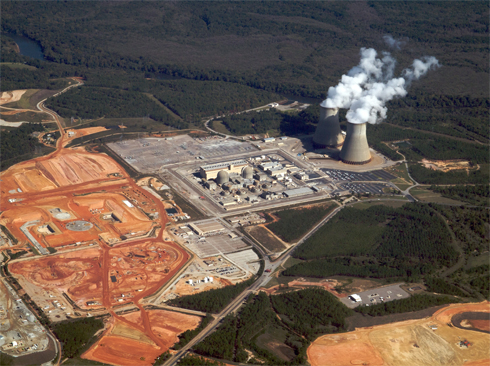
Looks like another news outlet has noticed that the Vogtle Nuclear Power plant, currently under construction in Georgia, is the recipient of federal loan guarantees some 15 times larger than the widely trumpeted Solyndra bankruptcy. And yes, Vogtle is turning into a boondoggle. So the Christian Science Monitor became the latest major pub to carry the story.(see below)
Don’t look for this to become a nightly hobby horse for Fox News, talk radio, and conservative congressmen – because it does not fit the right wing narrative. That Narrative is that coal, gas and nuclear power are good American sources of energy, and renewable power, solar and wind, are part of a subversive, socialist, Kenyan plot.
That a nuclear project is off the rails should not be a shock. We ran that experiment in the 70s and 80s, and it turned into one of the largest economic disasters the nation had yet seen in those innocent times. More recently, the Congressional Budget Office noted that the risks of nuclear loan guarantees for taxpayers were prohibitively high.
Private lenders have declined to finance new reactors because of the enormously high cost of new nuclear power and the substantial risk that any such investment will fail. In 2003, the Congressional Budget Office (CBO) estimated that the chance of a loan for new nuclear reactor construction resulting in default would be “very high – well over 50 percent.”
The Obama administration’s proposed loan guarantee for Vogtle transfers the risk onto American taxpayers, who would pay up to $8.33 billion if Southern Company and its partners run into the same kind of trouble that is routine in the nuclear power industry—cost overruns, delays and project cancellations. And Vogtle does have a history that should trouble taxpayers worried about assuming responsibility for the massive loan guarantee: the original two reactors at the Georgia site took almost 15 years to build, came in 1,200 percent over budget and resulted in the largest rate hike at the time in Georgia.
Further, this loan is an expensive gamble on a technology with a long history of bankrupting utilities and soaking ratepayers. There is an extremely high risk that taxpayers will be on the hook if the Vogtle loan guarantee proceeds. The loan guarantee is an up-front bailout that will enable Southern Company to make an uneconomic investment.
Robert Baker, a former utility regulator, said he planned to ask Georgia’s Public Service Commission to adopt a plan that would trim the utility’s profits if the project comes in over budget. Because the monopoly is guaranteed a profit on every dollar it spends, Baker said it has a disincentive to control costs.
Continue reading “Georgia Nuke Becoming Boondoggle Poster Child”
Fox Airhead Discovers: It’s Not Always Sunny in Dusseldorf
When a Fox News airhead “analyst” Shibani Joshi told the Fox & Friends audience last week that solar energy was doing well in Germany because “they’ve got a lot more sun than we do”, the youtube clip went viral, as more evidence that Fox is indeed the preferred news source for what Bobby Jindal calls “the stupid party”.
One has to assume that sometime over the weekend, someone showed her a globe. At some point monday, a nearly invisible apology appeared, not on television, but on an obscure posting on the Fox News website.
But I incorrectly stated that the chief difference between the U.S. and Germany’s success with solar installations had to do with climate differences on a “Fox and Friends” appearance on Feb. 7. In fact, the difference come down more to subsidies and political priorities and has nothing to with sunshine.
The apt adage is “Never attribute to malice that which is adequately explained by stupidity.”
That said, a quick look at Shibani Joshi’s wikipedia entry shows that she is married to Joshi Rahul Advani, “a principal at Energy Capital Partners”, a firm that, according to its website, “focuses on investing in the power generation, midstream gas, electric transmission and energy and environmental services sectors of North America’s energy infrastructure.”
So in this case, stupidity conveniently serves Joshi’s long term financial interests, as well as the ideological bent of her employer. Don’t believe for a second there would have been an apology if not for the outcry from citizens fed up with journalists, businesspeople and public officials who’ve built careers by failing upward with exactly this kind of serial incompetence.
Germany’s 10 Huge Lessons About Solar Energy

If you’re Fox News, you look at the explosion of solar energy in Germany, and conclude that, Germany, at its Canadian latitude, must have more sunshine than the United States. I’ll take credit for begging Media Matters to upload the video that has gone insanely viral.(skip to 2:52 if you’re rushed)
Serious observers of the renewable energy industry the indispensable CleanTechnica blog have been taking a harder look at the world’s most dynamic and hopeful example of sustainable transformation – and distilled instructive and enlightening 10 lessons.
Feed In Tariffs Work
Well, maybe there are other things that could drive even stronger growth, but nothing else has done so to date. Germany leads the world in solar in many respects. As of the end of 2011, it had more solar power per capita than any other country, it has more solar power relative to electricity production than any country other than Italy (which has also used FiTs), and it has more solar power per GDP than any country other than the Czech Republic (which also followed Germany’s lead and implemented FiTs). Clearly, Germany and those who have followed with their own FiTs have seen more solar power growth than others. As John Farrell noted back in 2011 (still true today), FiTs have been used for the installation most solar (and wind) power in the world:
Germany (attn Fox – at the latitude of Newfoundland) crushes the US (which has not implemented FiTs) in solar power capacity:
- In 2011, Germany had over 80 times more peak solar power compared to electricity demand than the US.
- Germany has over 57 times more solar power per capita than the “Sunshine State” of Florida.
- Germany has over 21 times more solar power per capita than the US.
- Germany has over 39 times more solar power relative to electricity production than the US.
- Germany has about 24 times more solar power per GDP than the US.
Prices Will Get Lower. Much Lower
Solar panels are a global commodity. Their price is essentially the same all around the world. However, the “soft costs” of a solar power system can vary tremendously. As noted back in June 2012, German solar installations cost a little more than half what US solar installations cost. At that time, German systems were being installed for an average of $2.24 per watt, while US systems were being installed for an average of $4.44 per watt. Now, US systems are probably down to about $4.00 per watt, but German systems are down to about $2.00 per watt.
The good news is, people have studied this, and we have a pretty clear indication of where the costs differ.
Continue reading “Germany’s 10 Huge Lessons About Solar Energy”


CleanTechnica: Germany Has More Solar Power Because Everyone Wins

One more from CleanTechnica expands on a key point:
Suddenly everyone knows about Germany’s solar power dominance because Fox Newsheads made an ass of themselves, suggesting that the country is a sunny, tropical paradise. Most media folks have figured out that there are some monster differences in policy (e.g. a feed-in tariff), but then latch on to the “Germans pay a lot extra” meme. Germans do, and are perfectly happy with it, but that’s still not the story.
The real reason Germany dominates in solar (and wind) is their commitment to democratizing energy.
Half of their renewable power is owned by ordinary Germans, because that wonky-sounding feed-in tariff (often known as a CLEAN Contract Program in America) makes it ridiculously simple and safe for someone to park their money in solar panels on their roof instead of making pennies in interest at the bank.
It also makes their “energy change” movement politically bulletproof. Germans aren’t tree-hugging wackos giving up double mochas for wind turbines — they are investing by the tens of thousand in a clean energy future that is putting money back in their pockets and creating well over 300,000 new jobs (at last count). Their policy makes solar cost half as much to install as it does in America, where the free market’s red tape can’t compete with their “socialist” efficiency.
Fox News’ gaffe about sunshine helps others paper over the real tragedy of American energy policy. In a country founded on the concept of self-reliance (goodbye, tea imports!), we finance clean energy with tax credits that make wind and solar reliant on Wall Street instead of Main Street. We largely preclude participation by the ordinary citizen unless they give up ownership of their renewable energy system to a leasing company. We make clean energy a complicated alternative to business as usual, while the cloudy, windless Germans make the energy system of the future by making it stupid easy and financially rewarding.
I’m all for pounding the faithless fools of Fox, but let’s learn the real secret to German energy engineering and start making democratic energy in America.
The main point here: Germany doesn’t get an enormous amount of sunlight, relatively speaking. Its annual solar resources are roughly comparable to Alaska’s. Just about every single region in the continental United States has greater solar potential, on average, than Germany.
Yet despite those limitations, Germany has still managed to be the world leader in solar power. At the end of 2012, the country had installed about 30 gigawatts of solar capacity, providing between 3 percent and 10 percent of its electricity. The United States, by contrast, has somewhere around 6.4 gigawatts of solar capacity.
Why the difference? Policy is the big factor. The German government has heavily subsidized renewable energy for years through a variety of measures. Perhaps most crucially, the country’s “feed-in tariffs” allow ordinary people to install solar panels on their rooftops and sell the power to the grid at favorable rates. (The costs are then shared by all electricity users.)
Solar installations are also much cheaper in Germany — about half as cheap as they are in the United States. Partly that’s because the industry is bigger. But a recent reportfrom Lawrence Berkeley National Laboratory discovered a bunch of smaller factors, too. Permitting is easier in Germany. And German solar installers spend less on marketing, inspections, and grid-connection fees. That all adds up.
New Wind Turbines Compete Head on with Cheapest Fossil Fuel
Competition + mass production + experience + new technology = Wind turbines competing head on with gas turbines.
And don’t believe for a moment that they won’t continue to improve, or that the cost of gas will stay as low as it is today.
Takeaway: the more fossil fuel you use, the more expensive it gets. The more renewable energy you use, the cheaper it gets.
Superficially, wind turbines haven’t changed much for decades. But they’ve gotten much smarter, and considerably bigger, and that’s helped increase the amount of electricity they can generate and lower the cost of wind power.
GE’s new 2.5-120 wind turbine, announced last week, is a case in point. Its maximum power output, 2.5 megawatts, is lower than that of the 2.85 megawatt turbine it’s superseding. But over the course of a year it can generate 15 percent more kilowatt hours. Arrays of sensors paired with better algorithms for operating and monitoring the turbine let it keep spinning when earlier generations of wind turbines would have had to shut down.
The technology is part of a trend that’s made wind power almost as cheap as fossil fuels. In 1991, wind power cost 15 cents per kilowatt hour. The cost has now dropped to 6.5 cents per kilowatt hour, says Ryan Wiser, deputy group leader for Electricity Markets and Policy at Lawrence Berkeley National Laboratory, in Berkeley, California. New natural gas power plants are expected to generate electricity at about 6.5 cents per kilowatt hour.
Indeed, last month the Electric Reliability Council of Texas said that the latest data on wind turbine performance and costs suggests that wind power is likely to be more cost-effective than natural gas over the next 20 years, and it could account for the majority of new generating capacity added over that that time in Texas. Before the council factored in the latest data, it had expected all new generation to come from natural-gas plants.
The biggest impact on electricity production comes from making wind turbines bigger. Increasing the size of a wind turbine’s blades, and making the tower taller, allows a turbine to capture more wind, especially at low speeds. Making wind turbines larger is getting difficult, in part because they’ve have grown so large that the wind conditions at the highest point of the blades’ sweep can be very different than those at the bottom. To compensate for the difference, GE had to develop control algorithms to respond to input from a variety of sensors as the blades spin. This helped the company step up from a 100-meter-diameter wind rotor to a 120-meter one.
Continue reading “New Wind Turbines Compete Head on with Cheapest Fossil Fuel”

“New England Will Be Closed” – Blizzard of ’13 Update
Blizzard update from Paul Douglas and AlertsBroadcaster:
…this storm will negatively impact more people in the northeast than even Superstorm Sandy did in late October and early November. Although coastal flooding won’t be nearly as severe, the impact of heavy snow, high winds and potential power outages will result in a very high-impact weather event for New England and metro New York City. 23 million Americans are under a Blizzard Warning right now.
Although computers have been converging (slowly) around a final solution, there is lingering uncertainty. This should be a plowable snowfall for New York City, enough to shovel and plow meaning at least 4-8″. Recent computer models are hinting at considerably more than that, especially for New York’s northern and eastern suburbs. By the time the 2 storms phase into one (monster) the heaviest precipitation shield may be just north/east of New York City. That, and 42 F. water temperatures in the Atlantic off the coast of New Jersey and Long Island may keep precipitation falling as a cold rain into the evening hours. The faster the changeover to all snow late Friday, the greater the ultimate snow amounts will be. I still believe a foot or more is likely in the city, with as much as 15-20″ from north Jersey into Westchester and Fairfield Counties. Eastern Long Island may also pick up some 15-20″ amounts.
1+1=3.
Much like Sandy we have an imminent convergence of two weather systems; a clipper-like system approaching from the Great Lakes will merge with a developing coastal storm over the Carolinas. The northern storm provides much of the energy, while the southern storm provides a jolt of southern moisture, spiked with moisture off the Atlantic. That’s why the weekend storm will be formidable: impacting such a huge area with 1-3 foot snows.
Snowfall Predictions. I realize, at first glance, this looks like a map of current temperatures. It’s not. This is the latest (Bufkit/Cobb Method) snowfall prediction from NOAA’s NAM weather model; as much as 25″ for the northern/eastern suburbs of New York City, 23″ at Portland and 31″ for Boston. I can’t remember seeing an area of 18″+ predicted snowfall this big in the last 20 years. This will be an historic storm. Paralyzing, and historic.


Climate deniers, of course, will have difficulty processing snow in a warming world.
A senior atmospheric scientist writes me:
I looked at this and the SSTs right along the coast in New England are 1 to 1.5C above the 1981-2010 normal, more generally SSTs are 0 to 0.5C above that normal. But of course that normal is 0.5 C above the 1951-80 normal.
So, yes the higher SSTs will add 10% to the snow, but the key thing is biggest snows occur when temps are just below freezing, which seems to be the case. So the atmosphere is loaded with max moisture possible and still producing snow.
And it’s a strong storm.