

Suggested by reader Bob.
Month: October 2012
The Cost of Coal
Award-winning photojournalist Ami Vitale traveled with SIERRA magazine to West Virginia. Mountaintop-removal mines in Appalachia have demolished an estimated 1.4 million acres of forested hills, buried an estimated 2,000 miles of streams, poisoned drinking water, and wiped whole towns from the map. SIERRA asked people to describe how the world’s dirtiest energy source has disrupted their lives—and what they’re doing to stop it.
“I LIKE COAL,” Mitt Romney declared during last Wednesday’s presidential debate.
Both candidates have catered to coal-state voters, but Mr. Romney has been particularly full-throated in his pandering. Not only did he back the “clean coal” myth last Wednesday; in August he promised Ohio coal miners that he would save their jobs. “We have 250 years of coal,” Mr. Romney said then. “Why in the heck wouldn’t we use it?” His explanation for trouble in coal country is that President Obama has a wayward obsession with regulating the economy, resulting in an unnecessary “war on coal,” a term that popped up again last month in one of his campaign advertisements.
Mr. Romney is wrong on almost every point. The coal industry cannot and should not continue operating as it has, and Mr. Obama is not the reason. Cheap natural gas has gutted the economic case for burning coal. Climate change and coal-related pollution explain why that’s a good thing.
Natural gas is coal’s primary competitor, and with the increasing use of hydraulic fracturing to extract gas trapped in subterranean shale formations, its price has plummeted. Power companies used to dispatch gas-fired electricity last because it was the most expensive. Now the chief executive of Duke Energy, the country’s largest electric power holding company, sayshis firm uses coal as a last resort.
A study from the Brattle Group finds thatcoal use is more sensitive to the price of gasthan to new government regulations. It projects that 59,000 to 77,000 megawatts of coal-fired power will come offline over the next five years, more than its 2010 estimate, despite the fact that, under Obama, the Environmental Protection Agency’s coal-plant regulations turned out to be more lenient than the researchers had expected. The power plants’ reason: low electricity demand and low natural gas prices. Brattle also calculates that a $1 drop in the price of gas would double the magnitude of coal-plant closings over the next five years.
Below – the true cost of coal in Michigan, and Nevada
The National Academy: Everyman’s Evidence for Climate Change
The holidays are coming. You’ll probably have to sit down again with Aunt Teabag and Uncle Dittohead and explain to them that, yes, it really is warming, and yes, we really are doing it.
And, yes, we can expect more of what we had this summer.
And, of course, that’s what the Climate Crock series is designed to do, end arguments around the minutia of climate denial crocks that Uncle and Auntie would have imbibed from radio or Fox news.
But if you feel the Climate crocks are a little too, uh, strident, and are not the answer for your particular relatives, the National Academy of Science has come to the rescue with a series of complete, well explained, short, (three minutes) authoritative (explain that the NAS was founded by Lincoln) videos that give a good outline of the scientific case as it is understood by the mainstream. (and has been for 50 years)
It’s a six part series that you can easily find by googling “climate change, lines of evidence”, or going here.
The “Solar Influence” edition is above.
Below, see the “Greenhouse Gases” explanation.
Continue reading “The National Academy: Everyman’s Evidence for Climate Change”
PBS News Hour: How to Build a Cooler City
One of the clean little secrets about dealing with climate change, is that if we make our cities more efficient, and reduce their carbon footprint, we will also make them more resilient, quieter, more comfortable, more human scaled, more inviting, and more fun.
Extremes Driving Voter Shift on Climate

Andrew Freedman in ClimateCentral:
From dessicating drought to blistering heat, the lower 48 states have taken it on the chin so far this year when it comes to extreme weather events. In fact, as measured by the federal government’s Climate Extremes Index, the January-through-September period has been the most extreme such nine-month period on record.
The Climate Extremes Index, or CEI, is used to track the highest and lowest 10 percent of extremes in temperature, precipitation, drought, and tropical storms and hurricanes across the lower 48 states. The current index is being driven by the massive drought that is still affecting a whopping 64.6 percent of the country as of Oct. 2, as well as record warm temperatures from the many heat waves throughout the year. The drought is forecast to persist for much of the High Plains and Western States, according to the National Oceanic and Atmospheric Administration (NOAA).
Will Pols listen to Polls? Joe Romm on Climate as a Political Winner
There will be a presentation today in DC highlighting recent polling data that suggests climate change has now emerged as a winning issue among swing voters in the US.
Among the presenters will be Joe Romm of ClimateProgress, interviewed here by Chris Mooney.
He’s been called “America’s fiercest climate blogger.” And as a senior fellow at the Center for American Progress, a former Clinton administration official on clean energy, and an MIT trained physicist, the subjects he covers are vast—ranging from energy policy to the role of rhetoric in communications, as discussed in his new book Language Intelligence., But there’s been a recurrent theme over the years at Joe Romm’s popular blog Climate Progress—the argument that political leaders, and perhaps most prominently President Obama, need to step up and explain to the public why global warming is such a dramatic threat to our livelihoods and future.
Indeed, Romm has called Obama’s failure to speak out about global warming, loudly and often, his “biggest communications mistake.”
Now, a raft of new polls are showing that this issue has the potential to move independent and swing voters—the subject of our first Climate Desk Live Capitol Hill briefing on October 10. So we stopped to chat with Romm, who will present at the briefing, about his unique take on this subject.
Chris Mooney: You’ve been writing for a long time about how climate is a winning political issue. So what first got you onto this?
Joe Romm: Well, I didn’t pursue this topic because I thought it was a political winner. I started when my brother lost his home in Katrina, he wanted to know if he should rebuild, so I talked to a lot of climate scientists. And then I realized, “this is more dire than I thought, and climate scientists are not doing a good job of communicating it.” So it was the underlying reality that gave me an urgency to stop doing what I was doing—clean energy consulting—and start doing communications full time.
I have talked to the leading social scientist over the years. If you talk to Jon Krosnick or Ed Maibach or Robert Brulle, they will tell you that this is an issue that the public broadly gets–and that there is an underlying respect for science and scientists. And so there is a way to talk about this issue that does work politically.
That said, there are ways to talk about it that aren’t useful, and I think people have mistaken the blowback from bad communications for thinking there’s no way to communicate on this issue. And I think that’s just not right.
Continue reading “Will Pols listen to Polls? Joe Romm on Climate as a Political Winner”
Polls Show Jump in US Climate Awareness
Nothing like getting slammed with a 2 x 4 to focus the mind.
As I promised, here’s new polling data shows that weather extremes are finally starting to be recognized as symptoms of climate change. At last spring’s Heartland Institute Denia-Palooza, a high profile disinformer told me in a candid moment that one of his biggest concerns was extreme weather events, and their power to change people’s minds.
This is indeed what we are seeing – and with this recently passed historic drop in arctic ice cover, they are not going away any time soon. Arctic expert Jennifer Francis told me in a recent Skype conversation that given the projected effects of newly open water on the jet stream, we should, indeed, expect “very interesting” weather in coming months.
Tony Leiserowitz at the Yale Project on Climate Change Communication:
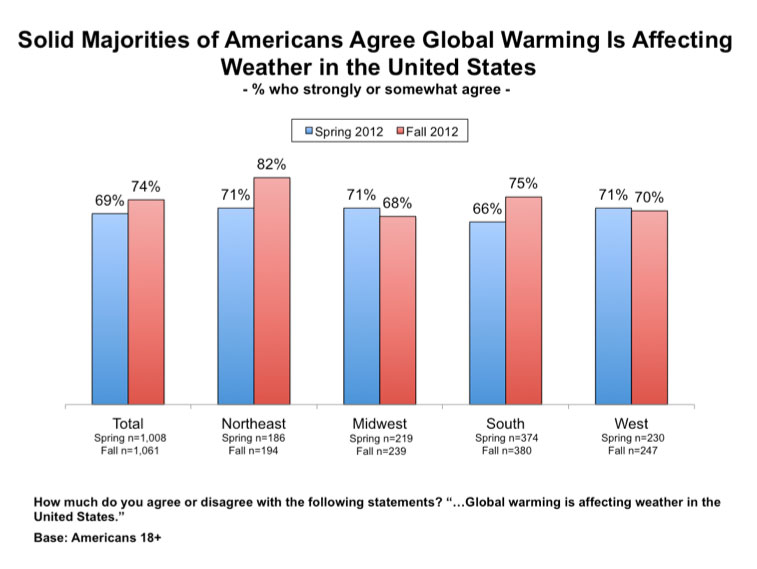
Today we are releasing the second report from our latest national survey. In Extreme Weather and Climate Change in the American Mind, we report that:
· A large and growing majority of Americans say “global warming is affecting weather in the United States” (74%, up 5 points since our last national survey in March 2012).
· Asked about six recent extreme weather events in the United States, including record high summer temperatures, the Midwest drought, and the unusually warm winter and spring of 2011-12, majorities say global warming made each event “worse.” Americans were most likely to connect global warming to the record high temperatures in the summer of 2012 (73%).
· Americans increasingly say weather in the U.S. has been getting worse over the past several years (61%, up 9 percentage points since March).
· A majority of Americans (58%) say that heat waves have become more common in their local area over the past few decades, up 5 points since March, with especially large increases in the Northeast and Midwest (+12 and +15 points, respectively).
· More than twice as many Midwesterners say they personally experienced an extreme heat wave (83%, up 48 points since March) or drought (81%, up 55 points) in the past year.
· One in five Americans (20%) says they suffered harm to their health, property, and/or finances from an extreme heat wave in the past year, a 6-point increase since March. In addition, 15 percent say they suffered harm from a drought in the past year, up 4 points.
The report includes an Executive Summary and a breakdown of results by region and can be downloaded here:
Complete bullets from the Executive summary below.
While Romney and Tea Party Ramp up Hate for Renewables – Germany Blasts Ahead with Lower Costs and Surprising Benefits

Yesterday, the European Energy Exchange (AEX) released figures for September, revealing that the price of baseload power in Germany has fallen by nearly 0.8 cents per kilowatt-hour over the past year – and has been cheaper than baseload power in France for 12 consecutive months
he EEX published the trading results for September yesterday, but unfortunately the press release is currently only available in German. What it shows is that day-ahead prices in Germany & Austria are lower than in France or Switzerland both in terms of base load and peak load. Indeed, though the press release explains that prices on the German and French markets “converge 75% of the time” (during periods of low consumption, such as during the night and on weekends), the difference in prices has become considerable, with the difference in base load prices being 4% on the average for September.
And our colleagues at Photon magazine point out something in their German newsletter today (not in the English version) that the press release does not explicitly say – day-ahead prices have been lower in Germany than in France for 12 consecutive months. The average German baseload price in September was slightly below the price in August, so the downward pressure on prices continues. The drop over the past 12 months in Germany has indeed been quite dramatic at around 18% – from 5.264 cents per kilowatt-hour in September 2011 to the current 4.467 cents last month.
The news is especially important because nuclear power, which provides slightly more than 75% of France’s power supply, is often held to be an especially inexpensive source of baseload power. Furthermore, opponents of renewables repeatedly voice their concern about the cost impact of green power scaring away industry. But in fact, industry by and large pays rates on the power exchange, which are determined by the most expensive power generator that needs to be ramped up to meet demand, not by the least expensive source. And over the past year in particular, the tremendous growth of photovoltaics in Germany has offset demand for more expensive peak power, thereby bringing down spot market prices.
By now, almost every claim and counter-claim from last night’s presidential debate has been picked apart. But there’s one assertion that has received minimal attention in the after-action coverage of the debate — and it was one of the most blatant lies of the night.
The comment came about two thirds of the way through the conversation. As Romney was riffing on funding education, he pivoted to his talking points on Obama’s support of renewable energy and let this whopper loose:
“And these [clean energy] businesses, many of them have gone out of business, I think about half of them, of the ones have been invested in, have gone out of business.”
The New York Times, one of the few mainstream organizations to follow up on this claim, called Romney’s comment a “gross overstatement.”
Actually, it’s much more offensive than that.
Smart Candidates Highlight Climate Issue to Stand Out
Want to paint yourself as rational, moderate, middle of the road, and looking to the future? Let voters know you care about climate and renewable energy. More and more, climate denial is becoming, like sexism, racism, and homophobia – the mark of the tea party troglodyte.
See Maine Independent Senate candidate Angus King’s ad above.
KING HITS GOP OPPONENT OVER CLIMATE CHANGE SCIENCE: In a new TV spot, Angus King, the independent running for Maine’s Senate seat, slams Republican opponent Charlie Summers on climate change science. “Charlie … doubts climate change science, favors taxpayer subsidies for big oil, and thinks Washington isn’t broken,” King says into the camera. “I want to bring common sense to the budget, get us off foreign oil with cleaner energy made in this country.”
SUMMERS’S POSITION: He has said he does not believe climate change is happening but that “we all have a responsibility to be good stewards of the environment.” Bangor Daily News:http://bit.ly/KzPYOM
CLIMATE CHANGE SCIENCE ALSO MADE AN APPEARANCE at last night’s debate between Democrat Bob Kerrey and Republican Deb Fischer for Nebraska’s open Senate seat, when Kerrey hit Fischer for saying at a previous debate that “I do not believe that we have a huge influence on our climate.” Full video (climate remarks come around 44:23):http://cs.pn/QSTswC
Fischer: “In regards to climate change, what matters there is the policies the United States is going to implement to address the climate change. What we have seen from the government in the past is cap and trade. And I don’t support cap and trade. … The climate changes. But again, it’s our reaction to that with policy. That’s what a United States senator addresses. Cap and trade is not the policy that this country should be implementing.”
Kerrey: “If we don’t do something about this problem — and I don’t disagree about cap and trade, I think there’s better ways to do it — if we don’t identify it as a problem, and then bring our ingenuity and our innovation to try to solve the problem, don’t count 40 years from now our grandchildren looking back and thanking us. Because they’re not going to. They’re going to ask the question, ‘What were you guys thinking? Why didn’t you acknowledge that the scientists are telling you, that this is a problem, and why didn’t you use your considerable talent to solve it?’”
Democrats and independent voters overwhelmingly accept the scientific evidence that human activity is warming the earth’s temperature, while almost two out of three Republicans don’t.
Among likely voters, 78 percent of Democrats and 56 percent of independents believe humans are warming the earth, according to a Bloomberg National Poll. That finding is consistent with other polls that show undecided voters, and majorities in contested states such as Ohio andVirginia are in line with President Barack Obama and most Democratic candidates in wanting to address the issue.
“Taking a pro-climate stance is a political winner, especially for Democrats,” Edward Maibach, director for the Center for Climate Change Communication at George Mason University, said in an interview. “It’s not the most important issue” for most undecided voters, but “it’s somewhere in their lexicon of issues.”
–
Pollsters had already recorded a spurt in acceptance of global warming following the hot, dry weather in the U.S. this year, and the Bloomberg Poll found views fairly consistent across income levels, geography, education attainment and sex. There is one key division: political party. And that is reflected in the positions of each presidential candidate this year.
Using Green to Make Green
A new episode of “Fully Charged” visits a solar module manufacturing facility that is built around not only producing green energy devices, but producing them in the greenest way possible.