

Month: April 2012
Richard Alley in USAToday: Why the Extremes?
Above, Richard Alley demonstrates how to patiently answer questions from someone who has no interest in learning the answers.
Below, Dr. Alley comments on this spring’s extreme weather events.
Did humans contribute to the record heat of March and the strength of April’s tornadoes across much of the U.S.? Science still says, “Maybe, maybe not.” But we’re rolling the dice in a serious game where the “jackpot” means we lose.
There’s very high scientific confidence that our fossil-fuel burning and other activities, which add carbon dioxide to the air, are turning up the planet’s thermostat. In a warmer world, we expect more record highs and heat waves but fewer record lows, just as we’re observing. Warmer air can carry more water vapor, so a warmer rainstorm can deliver more inches per hour. Hair dryers have a “hot” setting for good reasons, and warmer air between rainstorms can dry out the ground faster.
Thus, we expect rising CO2 to bring more floods in some places and more droughts in others, with some places getting more of both. That might seem contradictory, but it’s not. And with more energy to drive hurricanes, the peak winds may increase, even if the number of storms drops.
—-
Unfortunately, if three rotten cherries come up on the climate slot machine before we master sustainable energy, we could lose the jackpot. Science hasn’t found a plausible way for rapidly rising CO2 to turn Earth into Eden, but there is at least a slight chance of a rapidly collapsing ice sheet flooding the coasts, or widespread droughts and heat stress risking famine, or other very large problems.
Much of my research, and that of many colleagues, has been devoted to replacing these worrisome “what if’s” with hard numbers. And in some cases, the worries have grown smaller as we learned more. But in other cases, the worries are still there and might even be bigger.
Irony Alert: Pennsylvania Fracking Operation Stopped due to Drought
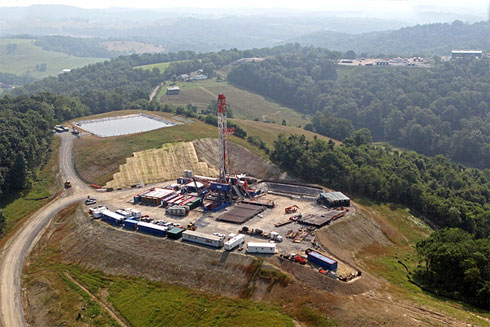
Low stream flows have forced officials to suspend water usage for the natural gas development (fracking) in portions of Pennsylvania.
A lack of snowfall this winter and a lack of rain this spring were the major players in abnormally low stream flows, low ground water levels and depleted soil moisture.
According to a report published by the Susquehanna River Basin Commission (SBRC), 17 separate water withdrawals were temporarily suspended.
The suspension, initiated to mitigate plunging stream flows in the basin affects 10 companies in five Pennsylvania counties. Those counties are Bradford, Luzerne, Lycoming, Susquehanna and Tioga.
Additional withdrawals may be suspended if rainfall continues to trend below normal.
According to officials, the restrictions are applied to various streams when flow rates reach a certain threshold and do not wait for declaration of a drought.
The abnormally dry conditions have also resulted in an elevated and extended wildfire season this year.
While a storm is forecast to bring some rain to the region this weekend, more rain (not in excess) is needed on a regular basis to reverse the building drought conditions.
Music Break: Gil Scott-Heron Updated
The Update: The Photographs of Your Junk (will be publicized) by Ronnie Butler
The original: The Revolution will Not Be Televised by Gil Scott-Heron
Weird Winter/Mad March – Part 2
If you missed part one of this two part video about this spring’s wild weather, go there now. Its part of the new “This is Not Cool” series I’m doing for The Yale Forum on Climate Change & The Media
If you watched that one, but failed to click on the link to part 2 at the end – you can watch that here, now. This one is getting a lot of attention.
One of the most confounding effects of climate change involves the increasing incidence of weather extremes that may include hot and cold. And snow and rain, and wet and dry, and drought and flooding. Research is starting to catch up with just why that is, and why we can expect more of it.
Heat + Frost = Complete Wipeout of Michigan Grapes. Deniers – They Just Need More CO2
Clueless deniers continue to tell me that “CO2 is Good for plants”. Obviously it’s good in a controlled lab or greenhouse environment. The rest of us, particularly farmers, have to live in the inconvenient real world – where droughts, floods, and extreme heat events like we had this march, have actual effects.
Watch carefully here to see if you see any mention of March’s extreme heat as the set-up for this frost disaster. (much less any mention of the climate change that made it much more likely to happen, and continue happening…)
SAINT JOSEPH, Mich. – For Welch’s grape growers, it was the most devastating frost in Michigan’s history. That’s according to the National Grape Cooperation, better known as Welch’s Foods.
Cold temperatures wiped out 95 percent of all the juice grapes in Berrien, Cass and Van Buren County.
“You know it’s a complete wipeout,” said John Jasper, a surveyor for Welch’s Foods. Jasper said more than 10,000 acres of juice grapes were destroyed Thursday morning across Southwest Michigan.
Jasper had a difficult job Friday. He and two other Welch’s surveyors tried to figure out how many grapes the company could expect this year at harvest. “I went through hundreds of acres before I found a spot that had a live bud,” he said.
“I’ve probably been to 100 farms in the last two days,” said Jasper. “The majority (are destroyed) 95 percent.”
According to the National Grape Cooperation, Berrien, Cass and Van Buren farmers collected $24 million in 2011. Jasper said in 2012 they would be lucky to net $2 million.
The situation gets worse for Paul Bixby of Bixby Orchards in Berrien Springs. “Mostly on this tree, everything is gone,” Bixby said pointing out a devastated apple orchard.
Bixby didn’t only lose the grapes. He estimates Thursday’s frost killed half of his apple crop. “You can see the black and you can see five in that cluster. All of them look the same.”
“A lot of these guys know the numbers and they know they’re in trouble,” said Jasper. He said so many juice grapes are gone it’s not cost effective for farmers to harvest the grapes that survived.
Jasper said Welch’s Foods gets one-sixth of their grapes from Southwest Michigan. “This is probably our worst year,” he said. The frost could force the company to change its recipe for some of its products.
Congressman Fred Upton’s office said Friday they support a disaster declaration for Southwest Michigan’s vineyards.

Ask yourself if Congressman Fred Upton made the connection with climate induced extreme weather. hmm. Might be an interesting call to make….
Below, my first video from 3 years ago on the “CO2/Plants” canard.
Yet More Evidence: Wind Farm does Not Reduce Home Values

A Wolfe Island couple’s argument that nearby wind turbines significantly decreased their home’s value has been rejected by Ontario’s assessment review board.
The appeal by Ed and Gail Kenney was being closely watched in rural Ontario, where turbine developments have provoked both support and opposition in local communities.
But the board said the Kenneys had failed to prove that the turbines scattered around their waterfront home have reduced its value.
“We’re incredibly disappointed,” Ed Kenney said in an interview.
“We’re not dissuaded,” he said. “We have concerns that our rights to fair and unbiased representation in the face of a province completely driven by the current agenda have been trampled.”
MPAC, the Municipal Property Assessment Corp., assessed the property near Kingston, Ont., at $357,000 in 2009.
That was up from the earlier level of $200,000, which had been set before a major wind power development came to Wolfe Island.
This is not a surprise to anyone that’s been actually following the issue. Lawrence Berkeley Labs concluded as much in a comprehensive 2009 study –
…based on the data sample and analysis presented here, no evidence is found that home prices surrounding wind facilities are consistently, measurably, and significantly affected by either the view of wind facilities or the distance of the home to those facilities. Although the analysis cannot dismiss the possibility that individual homes or small numbers of homes have been or could be negatively impacted, it finds that if these impacts do exist, they are either too small and/or too infrequent to result in any widespread, statistically observable impact. Moreover, to the degree that homes and wind facilities in this sample are similar to homes and facilities in other areas of the United States, the results presented here are expected to be transferable to other areas.
Connect the Dots
Master of emotive video Stephen Thomson has put together a video announcement for Climate Impacts Day, an upcoming consciousness raising event on May 5. (Since then, Stephen has graciously allowed me to use a number of his lush electronic soundscapes in my videos)
 Stephen’s video on the connection between extreme weather and climate last year went seriously viral, and presaged the poll released this week indicating a large number of Americans are now making exactly that connection.
That video was based on Bill McKibben’s op-ed in the Washingon Post, following last year’s catastrophic Joplin tornado – which is going to remain relevant for us this year, and our grandchildren as well. It begins thusly –
Caution: It is vitally important not to make connections. When you see pictures of rubble like this week’s shots from Joplin, Mo., you should not wonder: Is this somehow related to the tornado outbreak three weeks ago in Tuscaloosa, Ala., or the enormous outbreak a couple of weeks before that (which, together, comprised the most active April for tornadoes in U.S. history). No, that doesn’t mean a thing.
It is far better to think of these as isolated, unpredictable, discrete events. It is not advisable to try to connect them in your mind with, say, the fires burning across Texas — fires that have burned more of America at this point this year than any wildfires have in previous years. Texas, and adjoining parts of Oklahoma and New Mexico, are drier than they’ve ever been — the drought is worse than that of the Dust Bowl. But do not wonder if they’re somehow connected.
How many times, after the 9-11 event, did you hear someone say, “We failed to connect the dots”, despite evidence that alarms were “blinking red” in the intelligence community all thru the summer of 2001? Even though the director of the CIA made a special unannounced visit to the National Security Advisor to warn that an attack was imminent, and that an intel briefing to the President himself spelled that out as well.
The human ability to shut out information we do not wish to hear is staggering and sobering to contemplate. That’s why they call it denial.
Per Wiki:
Denial (also called abnegation) is a defense mechanism postulated by Sigmund Freud, in which a person is faced with a fact that is too uncomfortable to accept and rejects it instead, insisting that it is not true despite what may be overwhelming evidence.[1] The subject may use:
- simple denial: deny the reality of the unpleasant fact altogether
- minimisation: admit the fact but deny its seriousness (a combination of denial and rationalization)
- projection: admit both the fact and seriousness but deny responsibility.
Sound like a familiar process?
5 years from now it will be interesting to hear how Fox News, and certain politicians, rewrite history to include their prescient and insistent warnings about the impending crisis.
Northeast Cap and Trade System Boosts Economic Growth

Since 2001, 10 Northeast states that participated in the Regional Greenhouse Gas Initiativehave proved to be pioneers in reducing fossil fuel pollution and creating a clean energy economy, according to a report released Wednesday by Environment Connecticut.
Between 2001 and 2009, the six New England states along with New York, New Jersey, Maryland and Delaware cut per capita carbon dioxide emissions 20 percent faster than the rest of the nation. In those years, the Northeast’s total economic output per capita grew 87 percent faster than the rest of the nation, the report said.
“Those figures challenge the claim that reducing emissions undermines economic growth,” said Johanna Neumann, regional director of Environment Connecticut, which is based in West Hartford.
Overall, the 10 states reduced the creation of carbon dioxide from energy use by nearly 18 percent between 2000 to 2009. During that same period, per capita gross domestic product in the 10 states increased by more than 8 percent, while the rest of the nation experienced a 4.5 percent increase in per capita GDP, the report said.
Participating northeastern states have realized nearly $1.6 billion in consumer savings, according to a study last year by the Analysis Group, the report said.
“The initiative requires polluters to pay for the right to emit carbon pollution. Those payments are invested in programs to install more efficient lighting, heating and power generating equipment.
This is not the first study to show the program’s benefits.
A study by the Boston consulting firm Analysis Group that was commissioned by four nonprofit foundations last year noted that states participating in the program had received $912 million over three years by charging electricity providers for their carbon dioxide emissions. Many of the states invested most of those funds in programs to retrofit homes and buildings to make them more energy-efficient, lowering consumption of electricity.
So while the program led to a slight rise in electricity rates – less than 1 percent — consumers in those states ended up seeing lower bills over all as their demand declined.
“All told,” the study said,” electricity consumers over all – households, businesses, government users and others – enjoy a net gain of nearly $1.1 billion as their overall electric bills drop over time. This reflects average savings of $25 for residential consumers, $181 for commercial consumers and $2,493 for industrial consumers over the study period.”
…RGGI has saved customers money and created jobs, as participating states have used proceeds from the auctions to promote energy efficiency and electricity generation from renewables
• Because of lower demand for allowances with the much greater than expected declines in emissions, participating states are retiring more than 90 percent of unsold credits, so as to prop up the prices of future allowances and encourage further carbon cuts
(In May last year, New Jersey Governor Chris Christie took the state out of RGGI, the whole notion of climate change having become a dirty word in Republican politics. But it’s worth noting that party leaders like John McCain and Newt Gingrich had once strongly promoted cap-and-trade.)
Public Linking Severe Weather to Climate Change

Climate Deniers respond – “This is not Happening”.
A poll due for release on Wednesday shows that a large majority of Americans believe that this year’s unusually warm winter, last year’s blistering summer and some other weather disasters were probably made worse by global warming. And by a 2-to-1 margin, the public says the weather has been getting worse, rather than better, in recent years.
The survey, the most detailed to date on the public response to weather extremes, comes atop other polling showing a recent uptick in concern about climate change. Read together, the polls suggest that direct experience of erratic weather may be convincing some people that the problem is no longer just a vague and distant threat.
“Most people in the country are looking at everything that’s happened; it just seems to be one disaster after another after another,” said Anthony A. Leiserowitz of Yale University, one of the researchers who commissioned the new poll. “People are starting to connect the dots.”
In 2011, Americans experienced a record-breaking 14 weather and climate disasters that each caused $1 billion or more in damages, in total costing approximately $53 billion, along with incalculable loss of human life. These disasters included severe drought in Texas and the Great Plains, Hurricane Irene along the eastern seaboard, tornadoes in the Midwest, and massive floods in the Mississippi River Valley. In the period of January through March 2012, Americans also experienced record warm temperatures, with temperatures across the contiguous United States 6.0 degrees F above the long-term average. In March alone, 15,292 warm temperature records were broken across the United States.
In March 2012 we conducted a nationally representative survey and found that a large majority of Americans say they personally experienced an extreme weather event or natural disaster in the past year. A majority of Americans also say the weather in the United States is getting worse and many report that extreme weather in their own local area has become more frequent and damaging. Further, large majorities believe that global warming made a number of recent extreme weather events worse.
A majority of Americans say that unusual weather events have occurred in the past twelve months in both their local area (56%) and elsewhere in the U.S. (62%). Overall, 82 percent of Americans report that they personally experienced one or more types of extreme weather or natural disaster in the past year. These include extreme high winds (60%), extreme rainstorms (49%), extreme heat waves (42%), drought (34%), extreme cold temperatures (29%), extreme snowstorms (26%), tornadoes (21%), floods (19%), hurricanes (16%) or wildfires (15%).People in the Northeast are more likely to report having personally experienced extreme high winds, rainstorms, cold temperatures, snowstorms, floods and hurricanes in the past year. People in the Midwest are more likely to report having personally experienced extreme high winds, rainstorms, snowstorms, and tornadoes. People in the South are more likely to report having experienced an extreme heat wave or drought, while people in the West are more likely to report having experienced a wildfire in the past year.