In a startling development widely reported across Europe in the English-, French-, and German-language press, France imported electricity to meet peak demand during a brutal cold snap February 7, 2012.
And one of the countries France imported electricity from was Germany.
Post Fukushima, Germany closed two-fifths of its nuclear reactors and there were fears that Germany would not be able to meet its own demand let alone export electricity.
Nuclear reactors provided one-fourth of Germany’s electricity before Fukushima.
Available French nuclear capacity was operating flat-out with three reactors off line. However, France’s famed nuclear fleet delivered only 60% of the 100,000 MW of peak load experienced at 7:00 pm (19:00 hours) as millions of French homeowners switched on their electric heaters.
The remainder of demand was met by oil, coal, hydro, imports from neighboring countries, and renewables.
French wind turbines produced 3,600 MW at the time, or 3.6% of demand. There is 6,600 MW of wind capacity installed in France. Thus, wind delivered 55% of its installed capacity during peak demand, indicating good but not exceptional wind in parts of France.
The amount of wind generation during peak demand was roughly equivalent to the three nuclear reactors that were not available at the time.
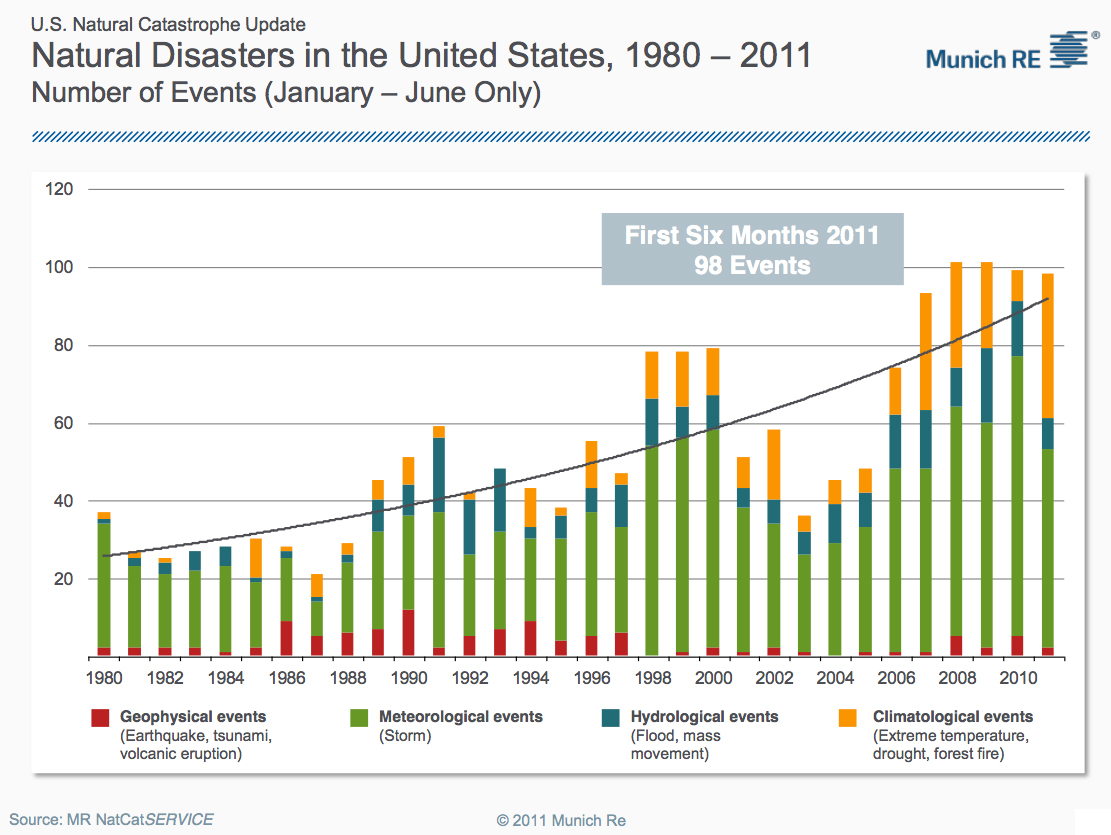
At an environmental law conference last fall, I accidentally sat down for lunch with a group of insurance salesman from an adjoining insurance conference (I meant to sit with attendees from my conference). At first I thought we had almost nothing in common to talk about, but then the salesmen began to discuss how climate change and its impacts dominate the conversation at industry events. One of them sent me this chart, which is a nice visual to document the growing impact of a warming climate on our economy over the past 30 years:
(I’ve substituted a more recent and readable chart from Munich Re – Peter)
Since these salesmen do such a good job selling the public on the need for all sorts of insurance policies, environmentalists should set them loose on arguably the most important issue facing the planet today. For further resources, Dan’s link to Evan Mills website is a great start, and I would be remiss in not pointing out that co-blogger Sean Hecht explored this topic in a 2007 article with Evan in the Stanford Journal of International Law and in a 2008 law review article for UCLA.
My recent interview with climate scientist and Evangelical Christian Katharine Hayhoe has provoked a lot of discussion. On the same day that I spoke to Hayhoe, I also had the opportunity to meet Richard Cizek, President of the New Evangelical Partnership for the Common Good.
The nugget I take away from meetings with these two is that the notion of Evangelicals as a monolithic lockstep army of anti-science zealots is breaking down, if it ever had any validity. A group of “New Evanglicals” – large enough to change electoral calculus, is here.
Richard Cizik, a prominent conservative evangelical Christian, provides some of the most convincing testimony that science and conservatism can still coexist. Until 2002, Cizik says, he rejected climate change. Then, he says, he accepted an invitation to learn about it, from scientists. “I was persuaded at that time by the scientific evidence,” Cizik says. “It was one of the most disturbing things I’d ever heard in my life – that climate shifts are negatively altering the planet forever. There’s no denying the catastrophic impacts from global warming on people, never mind the rest of the planet.”
But it was the theological implications that humans were changing the planet so profoundly that really moved Cizik. “You have to care,” he says, “not because of the science, but because God cares.”
The best solution to the climate impasse, in other words, and to get science back into the national conversation, is probably not more data. And it’s certainly not more heated debate. Rather, it lies in finding ways to talk across political and cultural divides, and within communities and organizations. Democracy, in other words. The way it was meant to be.
Potholer is johnny-debunker-on-the-spot once again, with this most recent video on last week’s blaring headlines – you may have seen them – “The Himalaya Glaciers aren’t melting so there is no global warming”.
The basic story is that we have a new paper in Nature with recent results from the GRACE satellite, which gives measurements on mass gain and loss, especially for areas of ocean and ice. The study basically confirms large ice loss globally over the previous 8 years, which have been contributing to sea level rise – but raises some questions about whether ice in the highest Himalayas is melting as rapidly as previous surveys have suggested.
As Potholer shows, whatever the disposition of the Himalayan area, the Fox news headlines are, as always, false and misleading.
As in all scientific inquiry, one paper is never the complete and final picture.
Dr. Mauri Pelto, an advisor to this series, and director of the North Cascade Glacier Climate Project, expresses some doubts about the current Nature paper:
“This result is certainly not correct. A quick glance at the results suggests problems in the region with GRACE, and the fact that the results do not jive with the detailed inventories that have looked at 1000’s of glaciers and their areal losses. I cannot tell you why GRACE was not accurate in the Himalaya, though we will find out in time.”
“GRACE has demonstrated itself to be quite sensitive to glacier and ice sheet mass change and has been validated in several regions. The recent paper is an ambitious step assessing all of the worlds ice covered areas. GRACE has problems with small glaciers and has not been validated in such areas.”
“The results from the Himalaya do not appear robust, when compared to the very extensive inventories that have documented the changes in extent of thousands of glaciers in the region and have found significant changes in areal extent across all ranges except the Karakoram. The glacier by glacier mapping completed by GLIMS or ICIMOD for example tell a different and better verified story, from Kyrgyzstan to Bhutan and Afghanistan”
“If Global warming is real, why don’t you debate (his weirdship “Lord”) Christopher Monckton?”
Well, one problem is, when you debate someone who just makes shit up on the spot, its kind of hard to do any fact checking. Now Monckton may have been lured into a situation where this is no longer possible.
The redoubtable Potholer (aka Peter Hadfield, see video below) seems to have lured Monckton into a public, online debate – where citations can be linked, and facts can be checked for accuracy by all interested onlookers. Given Monckton’s record, this is not terrain that plays to his long-winded, loquacious strengths.
It appears that after a series of Potholer’s videos tore Monckton nonsense to shreds, His Serene Magnificence took to replying on the WattsUpWithThat climate denial blog. This lead to Potholer politely asking to respond, and blogmaster Anthony Watts, ever looking to present himself as fair minded, to open up the forum, and even dub the exchange as a “debate”.
Potholer has a video record of the ongoing exchange here:
Dr. John Abraham and his wife, Molly, packed up their kids and headed to Disneyland in July 2010 for the family’s first real vacation. Four-year-old Olivia and 3-year-old Lilith fell in love with Disney’s dazzling King Arthur Carousel. They didn’t ride it once or twice, they went on it seven times.
While his kids were having the time of their lives, the St. Thomas associate professor of mechanical engineering unfortunately had other things on his mind. Between carousel
rides, Abraham kept checking his cell phone for messages. Headlines like this one – not only in the United States but in Europe, Australia and New Zealand – explain why: “The Monckton Files: Bombshell!!! John Abraham to be Sued!!!”
Abraham had tangled with Scotland’s Christopher Monckton, one of the world’s most prominent global-warming skeptics and a sought-after speaker by the kind of organizations that share his skepticism.
In fact, what became a global confrontation between Abraham and Monckton can be traced to an invitation that the Minnesota Free Market Institute extended to Monckton in October 2009 to speak on the Bethel University campus in Arden Hills. In his talk (not sponsored by Bethel), Monckton maintained that scientists are wrong about warming temperatures, rising sea levels, ocean acidification and even problems facing polar bears. At last count, a YouTube video of that talk had received 259,517 views.
“I knew I needed to respond,” Abraham recalled. “I could not let that go unanswered,
and I asked myself, ‘If I don’t, who will?’” He spent that winter researching Monckton’s
statements to the Minnesota Free Market Institute.
“I thought, man, this guy is a great speaker and he is very convincing. If I didn’t know the science, I would believe him. Frankly, the nonscientists in the audience didn’t have a chance. They had no way of knowing what he said was not true. I felt Monckton took advantage of them and he knew he was taking advantage of them.”
As part of his research, Abraham wrote to the authors or the directors of organizations
that had published papers that Monckton referenced in his Bethel lecture. In case after case, the scientists wrote back to say that Monckton had it wrong.
If you believed Monckton, Abraham said, you would believe that: the world is not warming, sea levels are not rising, ice is not melting, the ocean is not heating, scientists
are lying and there’s a conspiracy.
Abraham’s calm and cerebral response took the form of an 83-minute video that he
made available on the web in late May 2010. And there the point-by-point rebuttal sat
for some weeks, for the most part unnoticed. That changed, and dramatically so, when
George Monbiot, a reporter for the Guardian newspaper in England, wrote about Abraham’s work.
“Viscount Monckton’s assertions have been comprehensively discredited by professor of mechanical engineering John Abraham, at the University of St. Thomas in Minnesota,” Monbiot wrote. “Abraham, like the other brave souls who have taken on this thankless task, has plainly spent a very long time on it.
“The results of Abraham’s investigation are astonishing: not one of the claims he looks into withstands scrutiny. He exposes a repeated pattern of misinformation, distortion and manipulation. Some of Monckton’s assertions are breathtaking in their brazen disregard of facts.”
(Below, for an OMG experience – watch and marvel at His Magnificence Lord Monkton’s spittle flecked rant on the paranoid conspiracy theorist Alex Jone’s show – Peter)
Following several strong harvests, global stocks were again pushed downward in 2010 when drought, wildfires, and a scorching heat wave decimated wheat crops in Russia and neighboring countries. Exports were banned. Food prices again started to rise, prompting warnings of a second food price crisis in three years. Ultimately the higher food prices between June 2010 and December 2010 pushed an additional 44 million people down the economic ladder into extreme poverty, according to the World Bank. The prospects for the world’s poorest remain grim, as even the record production in 2011 failed to outpace consumption enough to rebuild stocks sufficiently.
The wide swings in weather were matched by major outlier events. All of us experienced the shifting weather patterns. This is the new norm. And as the climate changes, the extremes are proving especially costly for global food security.
Grains are taking a particular beating. In the past year, wheat prices increased 75 percent. In 2009, the United Nations estimates, over one billion people were undernourished, and a greater toll is projected. Malnutrition — accounting annually for 2.2 million under-five child deaths (and underlying much of childhood illness) — is increasing, undermining health and well-being.
Did you ever wonder about the hordes of angry comments that appear after any major online story breaks about climate change? The ones that angrily attack the very idea that climate is changing, or that man could cause it, or that attack the integrity of the science and the climate scientists? Sometimes you might wonder if such feeding frenzies are organized.
Wonder no more. We now have a convincing demonstration of exactly how its done.
On February 8, Anthony Watts over at the denialist Wattsupwiththat blog posted that the book was available, and added coyly, “I hope some climate realists eventually review the book as well.”
Wonder of wonders, within hours, a horde of denialists had apparently bought and read the 400 page book, and were furiously posting indignant denunciations of the book, science, and the scientist. Apparently climate denialism is correlated with speed reading abilities, albeit with low comprehension.
An example of the level of Watts-inspired attacks – “This book is exactly like a turd. It’s small, it stinks, and it’s disgusting. Just like Mann.”
The beauty of this pure example is that it shows how the relatively small constituency of rabid deniers exhibit swarming behavior so as to inflate one’s idea of their numbers. We’ve recently seen evidence of how PR firms like HP Gary provide “persona management” software, so as to create exactly this effect thru a manufactured army of sock-puppet social media posters.
Now we see that climate deniers have an even better way. Why use sock-puppets when you can deploy real puppets?
UPDATE: In the video below, see how a Koch Brother funded Tea Party activists teaches a workshop on how to specifically game the “review” system as a “guerrilla” tactic to promote “our ideals”. The speaker helpfully admits that “80 percent of the books I put a star on – I don’t read!”
A number of institutions across the country, including many military bases, are looking at insuring reliable, resilient and efficient electricity production in the age of peak oil and terrorism. Above, a Sandia Lab video describes the concept.
This technology is being pioneered, like transistors, computers, microchips, jet engines, global positioning, the internet, and now renewable energy, by the military, as a template for future wide civilian deployment.
Below, The University of California at San Diego demonstrates a working example.