The Real Story of Heartland: The Template of Lies

Take some time to view the video above, well worth it. Then read the post below.

Guest post by Kaitlin Alexander:

Exhibit A:

“There is no experimental data to support the hypothesis that smoking causes lung cancer, chronic obstructive pulmonary disease, emphysema, or chronic bronchitis………any number of things can influence the onset of a disease. The list includes genetics, diet, workplace environment, and stress…….we understand public anxiety about smoking causing disease, but are concerned that many of these much-publicized associations are ill-informed and misleading……….the media continue to uncritically accept and vigorously promote an anti-smoking agenda…….after hundreds of millions of dollars spent on clinical research, and decades of screaming headlines, we have no more certainty today about smoking causing disease than we did decades ago……….if even a small part of the time and money spent trying to link smoking to cancer were spent instead on studying the other causes of cancer, millions of lives could be saved.”

Exhibit B:

“The claim that human activities cause climate change has not been scientifically proven……….it is a reductionist error and not keeping with the current theories of climate science to attempt  to assign each temperature change to an exclusive single cause………..the use of results from flawed computer models to frighten people by attributing catastrophic future change to current human activities may be misleading and is highly regrettable……..that emotionalism can override objective analysis is illustrated by the headlines………..despite millions of dollars spent by the government on climate modeling and research, many questions about the relationship between human activities and global temperature change remain unanswered……….indeed, many scientists are becoming concerned that preoccupation with anthropogenic global warming may be both unfounded and dangerous – unfounded because evidence on many critical points is conflicting, dangerous because it diverts attention from other suspected hazards.”

Now read the originals.

Exhibit A

“There is no experimental data to support the hypothesis that increases in hydrocarbon use or in atmospheric carbon dioxide and other greenhouse gases are causing or can be expected to cause unfavourable changes in global temperatures, weather, or landscape…….any number of things can influence earth’s temperature. The list includes volcanic eruptions, variations in the amount of energy received from the sun, El Niños, and La Niñas – all of which are natural………we understand public anxiety about climate change, but are concerned that many of these much publicized predictions are ill-informed and misleading……….the media continue to uncritically accept and vigorously promote shrill global warming alarmism………after hundreds of millions of dollars spent on climate modeling, and decades of screaming headlines, we have no more certainty today about global warming prediction than we did decades ago………..if even a small part of the money spent trying to reduce carbon dioxide emissions were spent instead on fighting hunger or disease in Third World countries, millions of lives could be saved.”

-from the various articles on the Heartland Institute’s global warming page

Exhibit B

“The claim that cigarette smoking causes lung cancer has not been scientifically proven………..it is a reductionist error and not keeping with the current theories of cancer causation to attempt to assign each cancer to an exclusive single cause…………the use of results from flawed population studies to frighten people by attributing large numbers of death yearly to smoking may be misleading and is most regrettable……….that emotionalism can override objective analysis is illustrated by the headlines………despite millions of dollars spent by the government on smoking and health-related research, many questions about the relationship between smoking and disease remain unanswered…………indeed, many scientists are becoming concerned that preoccupation with smoking may be both unfounded and dangerous – unfounded because evidence on many critical points is conflicting, dangerous because it diverts attention from other suspected hazards.”

-from Smoking and Health: 1964-1979: The Continuing Controversy, published in 1979 by the Tobacco Institute

If I hadn’t told you which set of quotes was unchanged, and which I had replaced words like “smoking” and “cancer” with “human activities” and “climate change”, or vice versa, would you even have known the difference?
#DenialGate – Get it All Here

Discussions of the Heartless Documents

A Bright Spotlight on Heartland Donors

What may come out of the DenierGate Leak does not rest on whether or not the single disputed document is real or not. We already know, because Heartland has confirmed, that the most important and telling information IS real – the names of (most of) the donors, especially large corporate donors.

The New York Times has shown a bright spotlight on this in its coverage of the issue – and what jumps out at you is the general embarrassment and discomfort exhibited by normally sane, well educated, and scientifically literate corporate citizens to be caught in the same company with bigoted, anti-science, tobacco-trough troglodytes like the Heartland crew.

“We absolutely do not endorse or support their views on the environment or climate change,” said Sarah Alspach, a spokeswoman for GlaxoSmithKline, a multinational drug company shown in the documents as contributing $50,000 in the past two years to support a medical newsletter.

A spokesman for Microsoft, another listed donor, said that the company believes that “climate change is a serious issue that demands immediate worldwide action.” The company is shown in the documents as having contributed $59,908 last year to a Heartland technology newsletter. But the Microsoft spokesman, Mark Murray, said the gift was not a cash contribution but rather the value of free software, which Microsoft gives to thousands of nonprofit groups.

The reactions read as if showing up on Heartland’s ledger is a little like being caught in a raid at a dogfight, or insisting you only joined the Ku Klux Klan to make new friends.

Continue reading “A Bright Spotlight on Heartland Donors”

Denia-geddon: Bjorn Lomborg Think Tank to Close

Another sign of the times – Devious Danish Disinformer Bjorn Lomborg is finding, like his Heartland Institute soul mates here in the US – that bumping up against reality sucks, even in Denmark.

Guardian:

The much-criticised author and climate policy sceptic Bjorn Lomborg has told the Ecologist he is the victim of a vendetta after his funding was cut by the Danish government.

Lomborg, working through the Copenhagen Consensus Centre, of which he is director, has been highly critical of proposals to tackle climate change. While accepting that climate change is happening, he argues that current policies for reducing emissions are not only failing but are a waste of money as well. Instead of trying to cut emissions we should focus on adaptation, he says, investing in renewable technologies and tackling poverty today.

—

However, Denmark’s general election last year ushered in a new administration less keen to support his views. Earlier this month, the Danish government confirmed that it had cut more than £1 million in funding for Lomborg’s centre. As a result, he only has funding in place until the end of June.

Fake Science, “Fox”perts, Funny Finance, Tax Free!!

John Mashey in Desmogblog:

Modern anti-science was created by the tobacco industry in the 1950s and then used against climate science, often by the same well-experienced think tanks and individuals.  Tobacco anti-science is strangely entangled with climate anti-science, as the report linked below shows in detail, involving Fred Singer’s SEPP, Joseph Bast’s Heartland, and more.

S. Fred Singer is President of the Science and Environmental Policy Project (SEPP), but has done almost all the work himself for 20 years., including help for tobacco in the early 1990s. Research for Weird Science sent me on a  trek through his and other IRS Form 990s, which unearthed many curiosities of strange governance, fakery and funny finances, all tax-free.

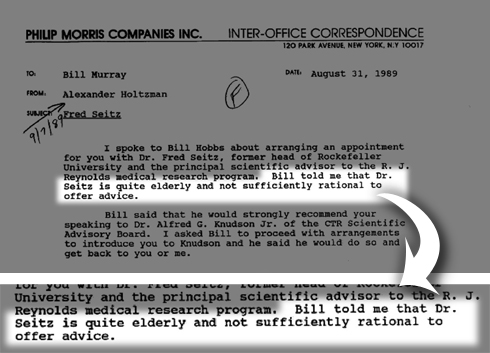
Singer claimed Frederick Seitz as Chairman for two years after his demise and 20 years after a Philip Morris staffer had written in 1989:

“Dr. Seitz is quite elderly and not sufficiently rational to offer advice.” 

(more on this in the climate crock video here – Peter)

SEPP’s finances were curious.  SEPP paid no salaries, even for Singer’s 60-hour workweeks.  Money flowed oddly.  Asset trades often exceeded normal income and they accumulated to $1.5M, tax-free.   Then one money trail led to Heartland.

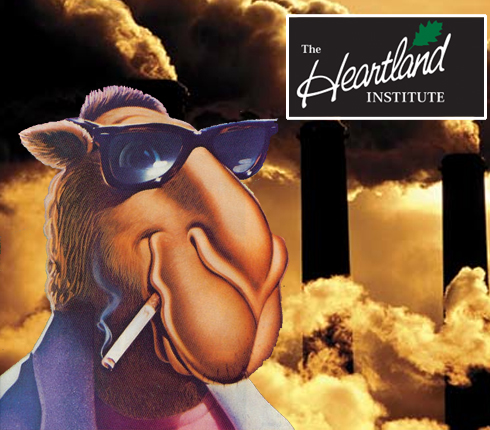
Heartland Institute’s Joseph Bast staunchly defended “Joe Camel,” the infamous campaign to addict younger children.  Heartland got tobacco funding for many years, along with a Philip Morris Board member.

More in this video about the Heartland/Tobacco relationship with climate denier Anthony Watts -Peter

Whitney Ball’s DONORS TRUST funded a major expansion of Heartland climate anti-science.  Singer collected old associates to help write “NonGovernmental International Panel on Climate Change“ (NIPCC) reports, filled with unsupported claims and long-refuted anti-science.

He was helped by Craig Idso, of the Center for the Study of Carbon Dioxide and Global Change (CDCDGC), whose money flows also seem unusual.  Robert Ferguson’s Science and Public Policy Institute (SPPI) was a website and a  PO Box in a UPS store and he was actually aCSCDGC employee.

Under Jay Lehr and James Taylor, anti-science permeated Heartland’s Environment and Climate News (E&CN) sent mostly to elected officials.  Heartland incessantly touted its access and influence with such officials, but its tax forms claimed no lobbying.  It ran “fake science” conferences, paying for government staff attendance.  It sent money to foreign non-charity advocacy groups, sent anti-science handbooks to school boards and urged parents to complain.  It has been criticized in Nature and Science.

Free speech allows people to express opinions, even lie about facts, but tax-free operation is a revocable privilege.  Spreading factual untruths and confusion about smoking or climate science is neither research nor education in the public interest.

Read the report, at least the first 21 pages, backed by nearly 200 of detailed backup.

This report was scheduled to be published in a few days,  and by astonishing coincidence, just today we see Heartland Institute Exposed.  The report was done entirely from public sources, but today’s new information is quite consistent and fills some holes.  However, the unnamed large Anonymous donor is now seen to be someone hiding behind DONORS TRUST, and some of the smaller ones dedicating funds appear in pp.57-59, with red itemizations. We also see some of the actual payments I had to infer.

See Mashey’s report here

Links to new Heartland Denialgate Documents here

Toxic Leak Swamps Denial-ville

It started when a small group of key journalists and investigators received a mysterious package in the mail.

It seems that an anonymous source opened a gmail account, dropped in a zipped file of internal documents from the leading vector of climate denial information, the Heartland Institute, closed the gmail account, and disappeared.

The contents quickly bounced around to a small group of astute observers, and the general consensus after close exam of  the files was that they were genuine – although Heartland now has a statement out claiming at least one of the files is a hoax.

See the Documents here

One of the first to receive the package was John Mashey, the relentless investigator who helped uncover the plagiarism and distortion that lead to the withdrawal of a key climate denial study last year.

At the present time numerous avenues are being pursued to establish the authenticity of the newly released documents.  In a statement, Heartland Institute has stated the following:

One document, titled “Confidential Memo: 2012 Heartland Climate Strategy,” is a total fake apparently intended to defame and discredit The Heartland Institute. It was not written by anyone associated with The Heartland Institute. It does not express Heartland’s goals, plans, or tactics. It contains several obvious and gross misstatements of fact.

Mashey has used the release of the new documents to add a final flourish to his most recent investigations, which have now been released online. Mashey’s allegations, relating to Heartland and senior climate denialist scientist Fred Singer, include:

1. Climate denialist Fred Singer committed perjury in his tax filings to the IRS by claiming that Fred Seitz continued to chair Singer’s own tax-protected SEPP for two years after Seitz death in 2008.

2. Singer made other representations in his 990 tax filings that either skirted the rules or, at the very least, let him shelter his own investments from taxation.

3. Singer is a lobbyist, not a scientist (at least, he has not produced any significant work of science in several decades) and is therefore in violation of limits to undeclared lobbying activity.

4. The Heartland Institute has a long-established reputation as an organization dedicated to providing legitimacy to industries that want to confuse the public about science. For example, Heartland’s President Joe Bast has been a leading defender of such things as the “Joe Camel” campaign to encourage children to take up smoking – even while the tobacco industry was funding Heartland’s operations. This was corroborated by the Heartland budget documents which show that both Phillip Morris and Reynolds American continue as Heartland donors.

How is Joe Bast Like Joe Camel? Looks Like We’re Going to Find Out…..

How is Joe Bast like Joe Camel?

Well, let’s see –  they both promote the sale of addictive poisons to children, they both are funded by the tobacco industry, and they both are leading proponents of the anti-science movement that threatens to cripple our education system and our economy.

Joe Bast is the  President and CEO of the Heartland Institute, a right wing “think” tank in Chicago that has been the prime mover behind major disinformation initiatives on both global climate and tobacco dangers.

Mr. Bast is well known for insisting that the science of climate change is “science is very sketchy, very uncertain..”, as well as famously asserting that  “No victim of cancer, heart disease, etc. can “prove” his or her cancer or heart disease was caused by exposure to secondhand smoke.” 

Not surprisingly, the Heartland has been the recipient of major funding from both tobacco and fossil fuel interests over the years.

We’re going to be finding out a lot more about the Heartland Institute and their operations in coming weeks and months, thanks to an anonymous whistleblower who, on Valentine’s Day, opened a gmail account, sent a bundle of damning internal documents to key climate bloggers and researchers around the country, then closed the account and disappeared.

Now, in a statement, Heartland is admitting that the budget and donor documents are genuine, but claiming that an alleged “Policy” paper is a forgery.

See the Documents here

Desmogblog:

It is clear from the documents that Heartland advocates against responsible climate mitigation and then uses that advocacy to raise money from oil companies and “other corporations whose interests are threatened by climate policies.” Heartland particularly celebrates the funding that it receives from the fossil fuel fortune being the Charles G. Koch Foundation.

Heartland also continues to collect money from Philip Morris parent company Altria as well as from the tobacco giant Reynolds American, while maintaining ongoing advocacy against policies related to smoking and health.

Heartland’s policy positions, strategies and budget distinguish it clear as a lobby firm that is misrepresenting itself as a “think tank” – it budgets $4.1 million of its $6.4 million in projected expenditures for Editorial, Government Relations, Communications, Fundraising, and Publications, and the only activity it plans that could vaguely be considered policy development is the writing of a curriculum package for use in confusing high schoolers about climate change.

Among the documents were tantalizing clues as to where major funding for the climate denial movement is coming from, and who it’s going to.

The information is flying faster than any one person can keep up.

As stated above, Heartland has now released a statement claiming that one of the alleged internal documents is a fake. It’s worth noting that several credible sources have pronounced the material genuine.  I will keep updating the situation as best I can.

Continue reading “How is Joe Bast Like Joe Camel? Looks Like We’re Going to Find Out…..”

Contributions for Kenyan Wind Needed now

I’m so sorry I was not aware of this until today.

This sounds like a very worthy project for jumpstarting an indigenous wind industry in Kenya, based on local labor, spare parts and scrap metal – with a workable design. The “crowd sourcing” model used here means that, if those making the proposal can get pledges to donate the funds needed in a specific amount of time, those donations all go through and they get their funding.

Unfortunately,  the funding deadline runs out midnight wednesday the 15th (tomorrow).

I have made small, totally inadequate pledge.

In any case, watch the video, contribute if you can, spread to twitter and Facebook or whatever, and lets see if we can help these guys out.

Upper Midwest Winters Milder

For those of us in the upper midwest, it’s been a disorienting winter. We’ve finally gotten a kept a small amount of snow in my area – but I suspect way too late to salvage the season for ski resorts, snow mobilers or ice fishermen.

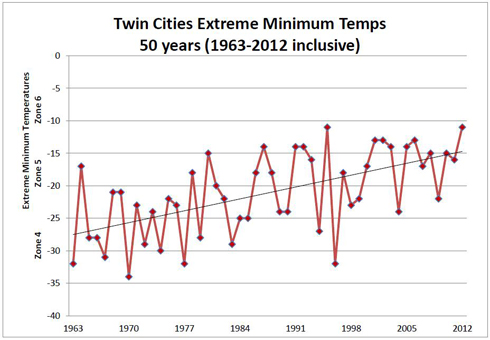
A Meteorologist friend passes along this, a graph of the changes for Minneapolis/St. Paul minimum winter temperatures over the last several decades, that I am sure are typical of the region – indicating exactly the steady warming that all of us have observed.

Minnesota  Winters Milder

Let’s take a look at the historic EMT data for Minneapolis/St. Paul from the University of Minnesota Climatology Working Group site (http://climate.umn.edu/doc/prelim_lcd_msp.htm). For example, if we take the same 30 year period as the just released USDA study (1976-2005 inclusive), the average annual extreme minimum temperature (EMT) was -19.4 degrees, which is right on the low edge of Zone 5a. However, if we update these numbers for the 30 year period just ending (1983-2012) the average annual EMT becomes -18.6, which is more convincingly in Zone 5a. That average is definitely being “pulled” by the warmer winters of the last 10 years. For the 10 years 2003-2012, the average EMT is -16.1 degrees, which is closing in on Zone 5b (EMT -10 to -15). Although the winter of 2012 is still with us, it appears that our EMT was -11 degrees on January 19th, which is edging close to Zone 6a (EMT -5 to -10). Having lived in Zone 6a (Detroit) until 1977, I can attest that this winter reminds me a lot of southern Michigan.

Astute readers will recognize that the US Department of Agriculture’s Hardiness Zones maps have changed over the years, reflecting weather changes obvious to farmers, gardeners, or anyone who spends time outdoors throughout the year. A quick look at the comparison between 1990 and more recent years shows why winter, not just this winter, but any winter, feels more like Kentucky than the upper midwest I grew up in.(these comparative maps, based on NCDC data, are from the Arbor Day Foundation, and demonstrate the changes)

Continue reading “Upper Midwest Winters Milder”