Detroit Rising

That was the front page of USAToday on monday, just before the Lions kicked the buh-jeezus out of the Chicago Bears.  I don’t know who made the inspired video above, but I’m going to find out.

Here’s my read. Detroit is Manhattan, circa 1977. Remember the headlines? “Ford to City: Drop Dead”?  New York was looking like some kind of post apocalyptic Gotham, descending into Mad Max territory. John Carpenter made a movie called “Escape from New York” that kind of captured the out-of-control feeling.

So that was then. The creative types were moving into SoHo, finding bargains, and sprucing up that very, very funky neighborhood. Fast forward two decades, and with help from some good administration and policing, and a reassessment of what the possibilities of the city were, New York became again a shining, prosperous, safe, magnetic center where everyone wanted to be.

Well, that’s happening now in Detroit.  City hits bottom. Impoverished but imaginitive creative types move in, transformation begins. The latest sign? Whole Foods is moving in to midtown, an area “.. reportedly a magnet for young people and small businesses.”

What’s this got to do with Climate Change? Everything. The transformation that will solve the climate crisis is  the very same one that will transform our economy from the bottom up. And Detroit is bottom floor, ground zero.

Many people still don’t get it, but Michigan was the number one creator in the US of new jobs in 2010 – largely due to an aggressive pursuit of renewable energy and green jobs. (that was before the tea party “we can’t compete with china let’s throw in the towel” defeatist anti-greens took over the governor’s mansion. They’ll try to slow progress, but they can’t repeal the laws of economics)

From the USA Today article: 

And Detroit is becoming an environmental leader.

GM’s Chevrolet Cruze Eco is the highest-mileage gasoline car available, matching highway mileage ratings for small diesel cars. Ford converted a factory in nearby Wayne, Mich., that once made big SUVs to make Focus compacts and, soon, some hybrids and electric vehicles. Chrysler will build in the USA high-gas-mileage, four-cylinder engines for a line of cars developed by its majority owner, Fiat.

“The image change for Detroit in the last three years probably has been more than any of us in the industry anticipated,” says Jesse Toprak, vice president for industry trends and analysis at TrueCar.com, a car pricing and research company.

Not long ago, the auto-buying cognoscenti disdained Detroit and favored foreign brands. That attitude is uninformed, Toprak says. Detroit cars, overall, are “head to head with imports,” he says.

“The real quality gaps between domestics and imports have almost vanished,” he says, and considering “how much car you get for your money,” Detroit vehicles tend to be better values than foreign-brand rivals.

The Christian Science Monitor picks up the Electric Car Revolution story:

The mind-set is catching on. Global sales of plug-in vehicles are starting gradually, but expected rapid growth will push annual sales to 1.3 million vehicles by 2017, says John Gartner, an analyst with Pike Research in Boulder, Colo. He expects 2012 to be the first big year with a quarter million plug-in vehicles sold worldwide. At least a dozen new plug-in models from 10 automakers will hit showrooms in 2012.

Pumping a clean jobs agenda and greater energy independence, President Obama wants to put 1 million plug-in vehicles on US roads by 2015.

US plug-in sales will be just 61,000 next year, rising to 303,000 by 2017, according to Pike Research estimates. And Mr. Obama’s goal, says Mr. Gartner, probably won’t be achieved until 2016. Long-term growth projections by the Electric Power Research Institute (EPRI) suggest dramatic growth: 5.8 million plug-in vehicles on US roads by 2020. The Institute’s “high” scenario shows those numbers could soar to 12 million by 2020 and 65 million by 2030.

Still, at this point, just 10,000 Americans have purchased an electric-drive plug-in vehicle – either a Nissan Leaf or a Chevrolet Volt, the only such vehicles currently available from major automakers. But that’s not a reflection of demand: Both GM and Nissan have long waiting lists and are sold out this year – and maybe next, says Bradley Berman, editor of Plugincars.com.

The article points out that 6 in 10 Americans still tell pollsters that they would not buy an electric no matter how high prices rise – (hmmm, sounds like the percentage who would have said they didn’t need a computer – in 1992….)  Anyway, forward looking execs note that 43 percent of the sample said they would go electric. There’s a market big enough to drive the transition.

Worth a look – video  below:
Continue reading “Detroit Rising”

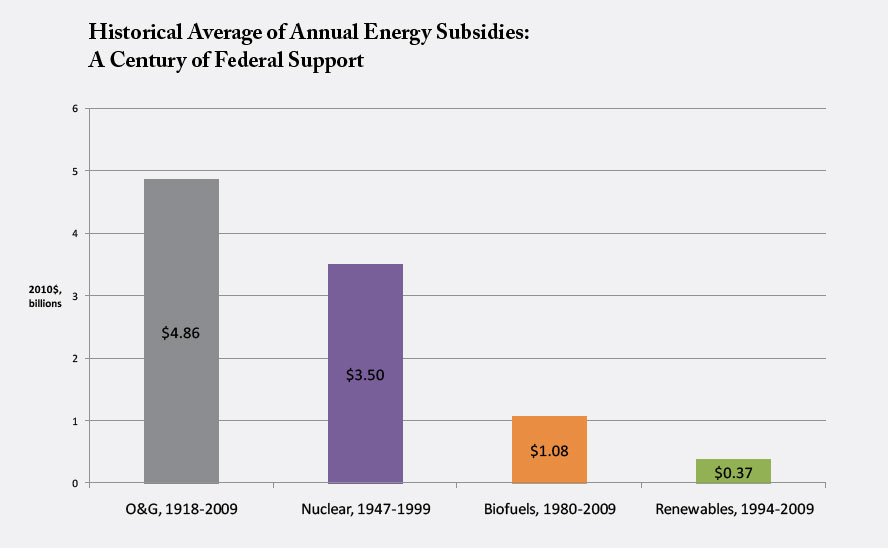
Graph of the Day: Energy Subsidies by Source

 Next time you hear Aunt Teabag and Uncle Dittohead railing about socialistic subsidies to renewable energy, run this by them –

From What Would Jefferson Do? The Historical Role of Federal Subsidies in Shaping America’s Energy Future, from DBL Investors:

Using data culled from the academic literature, government documents, and NGO sources, in this paper we examine the extent of federal support (as well as support from the various states in pre-Civil War America) for emerging energy technologies in their early days. We then analyze discrete periods in history when the federal government enacted specific subsidies.

While other scholars have suggested that the scope of earlier subsidies was quite large, we are—as far as we know—the first to quantify exactly how the current federal commitment to renewables compares to support for earlier energy transitions. Our findings suggest that current renewable energy subsidies do not constitute an over-subsidized outlier when compared to the historical norm for emerging sources of energy.

For example:

As a percentage of inflation-adjusted federal spending, nuclear subsidies accounted for more than 1% of the federal budget over their first 15 years, and oil and gas subsidies made up half a percent of the total budget, while renewables have constituted only about a tenth of a percent. That is to say, the federal commitment to O&G was five times greater than the federal commitment to renewables during the first 15 years of each subsidies’ life, and it was more than 10 times greater for nuclear.

– In inflation-adjusted dollars, nuclear spending averaged $3.3 billion over the first 15 years of subsidy life, and O&G subsidies averaged $1.8 billion, while renewables averaged less than $0.4 billion.

NOAA: Multi Year Ice Disappearing

I’ve been using Jim Maslanik’s animation on this for several years. Now, he’s updated it.
Watch several decades worth of ice thickness data, as the oldest, thickest ice – the whitest shade, is steadily broken down and flushed out of the arctic, to disappear in the open ocean. The pulsing of the winter to summer cycle is like the beating of a cold polar heart.

Silent. Eloquent.

National Oceanic and Atmospheric Administration:

The Arctic Ocean is virtually surrounded by land. The blanket of sea ice that forms there during the winter isn’t completely free to drift away into warmer, southern waters. Because of that geography, it’s common for sea ice to linger for many years at high latitudes, growing thicker and stronger, which makes it more likely to survive the summer melt. Or at least, itused to be common.

The animation above shows how dramatically the amount of multi-year ice (ice that has survived at least one summer melt season) in the Arctic has decreased over the past two decades. Based on satellite tracking of ice parcels over time, the maps show the estimated age of sea ice once a week from January 1987 through mid-summer 2011. Ice age increases from darkest blue (1 year old) to white (9 or more years old).

At the outermost edges of the ocean basin, the ice is seasonal: it forms every winter and melts every summer. Off the northeast coast of Greenland, a river of old ice continually flows out of the Arctic through the Fram Strait into warmer waters. Natural climate patterns accelerate the loss in some years and slow it down in others.

Continue reading “NOAA: Multi Year Ice Disappearing”

This Year’s Sea Ice: Lowest? — or So Close it doesn’t Matter…

ScienceNews:

On October 4, the National Snow and Ice Data Center posted information on its website indicating that the summer melt of sea ice in the Arctic, this year, approached — but did not quite match — a record set four years ago. A team of European scientists now concludes NSIDC got it wrong. This year’s loss was every bit as big.

“I know what NSIDC said,” saysMarcel Nicolaus of the Alfred Wegener Institute for Polar and Marine Research in Bremerhaven, Germany. “Nevertheless, we have just found that this year’s ice [loss] was very comparable to the extent reported in 2007.”

The sea ice physicist had just returned that morning at daybreak (October 5) from a cruise aboard the research ice breaker Polarstern. Some 130 scientists from six countries participated in parts or all of the ship’s 16-week, 11,800-nautical-mile trek mapping Arctic sea ice. To gauge ice thickness, they collected measurements with a 4-meter-long sensor deployed from a helicopter above the ice and with a remotely piloted mini-sub under the ice. By mapping the sea surface, they were able to observe gaps between floes to gauge how completely ice covered the surface.

Their data now indicate that at its minimum, ice covered 4.3 million square kilometers of the sea surface,” saysStefan Hendricks, another Alfred Wegener Institute sea ice physicist. And depth profiles show the ice cover “is exactly as thin as in the record year.” Taken together, he says: This summer’s sea-ice cover “appears to have melted to exactly the same degree as in 2007.”

Continue reading “This Year’s Sea Ice: Lowest? — or So Close it doesn’t Matter…”

Graph of the Day: Renewables Lead Way in New Production

Energy Information Administration:

The U.S. Energy Information Administration’s International Energy Outlook 2011 (IEO2011) projects that the amount of global hydroelectric and other renewable electric generating capacity will rise 2.7% per year through 2035, more than any other electricity generating source (see chart above). The IEO2011 also projects that China and India will lead the way in adding hydroelectric and renewable electric generating capacity.

In pointing this out, Bruce Nilles of Sierra Club notes in an email:

Its as much renewables as natural gas that is replacing coal.

Non-hydro renewables are on a pace to surpass hydro in two years.

Utility scale solar also had a record month.  Production from wood is down significantly.

Iowa comes in at a full quarter, i.e. 25.2%, of its electricity from wind power.

6 coal fired units retired including one in PA that was 279 MW.

However, overall consumption continues to go up and is at pre-recession levels (not good)

Capture CO2. Oil out of Air.

Clean Technica:

We’ve been reporting on the efforts and strides being made by energy researchers around the country to reduce CO2 emissions and produce clean energy by mimicking photosynthesis. Well, a research team at the University of Illinois at Urbana-Champaign recently overcame a major obstacle in efforts to use CO2 emissions to produce liquid fuel.

University of Illinois professor of chemical and biomolecular engineering Paul Kenis and his research team succeeded in lower the potential energy needed to convert CO2 into carbon monoxide (CO), a big step forward in creating energy-efficient ‘artificial photosynthesis’.

In artificial photosynthesis, electricity produced from clean renewable sources, such as solar PV cells or wind turbines, is fed to an electrochemical cell — sounds like something akin to a fuel cell — to convert CO2 “to simple carbon fuels such as formic acid or methanol,” which are then refined further to make ethanol and other fuels, aEurekaAlert report explains.

If the artificial photosynthesis process can be scaled up and improved further, it would eliminate having to go through the process of collecting biomass and converting the sugars they contain into biofuels. That would be a much more efficient and environmentally friendly way of both removing CO2 from the atmosphere and producing fuel. It would also address the issue and criticism of using farmland to produce energy crops, which puts upward pressure on food prices.

Continue reading “Capture CO2. Oil out of Air.”

Rust Belt to Renewable Belt: Turbines Bloom in Rural Michigan

While the Tea Party Congress lobbies to throw in the towel on the new industrial revolution, here in America’s manufacturing heart, people are just going ahead and making the future happen.

Reuters:

Michigan’s “green” economy is growing fast, data shows, with thousands of clean energy jobs on the horizon as a new manufacturing base is being built on the expertise of its battered auto industry.

The change raises the prospect that Michigan might one day be a global hub for electric vehicles and advanced battery development, along with biofuel technologies, wind power parts and solar panels.

Former Gov. Jennifer M. Granholm, whose second term ended in January, said in an interview that Michigan businesses are expected to create more than 150,000 clean energy jobs in the next decade from $14 billion of projects in the pipeline.

The jobs will stem from 17 advanced battery companies and nearly 50 solar, wind and biofuels companies that came to Michigan from August 2009 to December 2010, lured by state tax credits and federal stimulus grants, Granholm told SolveClimate News.

Economists now anticipate Michigan will add 64,600 jobs in 2011 and 61,500 more in 2012. The increase reflects “in part a bounce in manufacturing following the traumatic situation of the recent past,” they wrote.

The state lost more than 900,000 jobs in the last decade due largely to the bankrupt auto industry, fleeting manufacturers and the national economic downturn, the economists said.

Today, however, Michigan ranks No. 1 in the nation for job creation improvement in a recent Gallup survey of state job markets.

Occupy Oil Street

Anybody can become angry – that is easy, but to be angry with the right person and to the right degree and at the right time and for the right purpose, and in the right way – that is not within everybody’s power and is not easy. –
Aristotle 

Paul Krugman in the Times:
There’s something happening here. What it is ain’t exactly clear, but we may, at long last, be seeing the rise of a popular movement that, unlike the Tea Party, is angry at the right people.

What can we say about the protests? First things first: The protesters’ indictment of Wall Street as a destructive force, economically and politically, is completely right.

A weary cynicism, a belief that justice will never get served, has taken over much of our political debate — and, yes, I myself have sometimes succumbed. In the process, it has been easy to forget just how outrageous the story of our economic woes really is. So, in case you’ve forgotten, it was a play in three acts.

In the first act, bankers took advantage of deregulation to run wild (and pay themselves princely sums), inflating huge bubbles through reckless lending. In the second act, the bubbles burst — but bankers were bailed out by taxpayers, with remarkably few strings attached, even as ordinary workers continued to suffer the consequences of the bankers’ sins. And, in the third act, bankers showed their gratitude by turning on the people who had saved them, throwing their support — and the wealth they still possessed thanks to the bailouts — behind politicians who promised to keep their taxes low and dismantle the mild regulations erected in the aftermath of the crisis.

Tea Party Congress: We Can’t compete with China. Let’s Throw in the Towel.

I thought  “I apologize to BP”   was the bottom, but there just seems to be no lower limit to the abject toadyism of the Tea Party congress around the issue of energy.  Make it oil, make it coal, make it dirty, or don’t make it at all, seems to be the motto.

Washington Monthly:

For nearly a year now, President Obama has pushed the line that the United States has to be prepared to “out-innovate, out-build, and out-compete” the rest of the world in the 21st century. Republicans have generally been hostile to such a proposition, largely because innovation and building requires investments they’re unwilling to make.

GOP officials are loath to admit it, but keeping the United States in a global leadership position in areas of technology and innovation simply isn’t a high priority. If Americans fall behind in global competition, for much of the right, it doesn’t much matter — so long as the wealthy aren’t paying more in taxes.

It’s what makes comments like these stand out as noteworthy.

Rep. Cliff Stearns (R-FL), who chairs an energy and commerce subcommittee on oversight and investigations, originally supported the [Department of Energy’s loan-guarantees program for clean energy] when Congress created it.

Now he says, “I think the administration is putting taxpayers’ money at risk in areas that are not creating jobs.” […]

“We can’t compete with China to make solar panels and wind turbines,” Stearns says.

He says he doesn’t believe in any type of subsidy for industry. And, he says, where solar is concerned, it makes more sense to invest in research and development on a technology where the U.S. still has a chance of winning.

So on the one hand we see a White House committed to out-competing our international rivals, and on the other, we see leading congressional Republicans who believe the United States simply can’t keep up anymore, and is content to let China take the lead.

GOP officials, apparently, see this as a global competition, and are throwing in the towel.