

The topic is water, but the parallels to our need to manage carbon in the biosphere are, I think, obvious.
Month: October 2011
Hybrids in the Grids: The Evolving Car/Battery Equation
As I described in my Electric/hybrid car video above – a number of different models are being looked at for electric vehicles, some of which involve owning the car, but leasing the battery, an idea being deployed by Better Place, in Denmark and Israel. Now other big players are taking a look. (if you’ve seen the video and just want a review, go to 6:40)
General Electric may lease costly vehicle batteries to electric-car buyers, joining other companies looking to get more people to buy alternative-energy automobiles.
The largest U.S. conglomerate is just at the “thinking stage” of such a move, said Mark Little, head of GE’s research and development efforts, on Friday at an event at Nissan Motor Co’s research center near Detroit.
GE makes batteries and is one of the biggest investors in Massachusetts-based battery maker A123 Systems Inc.
A battery leasing program is a venture that could allow GE to show off its range of businesses, from its industrial core which could be influential in manufacturing the batteries, to its GE Capital finance arm which could support the leasing.
These kinds of batteries are relatively new to the auto industry, leading to a level of skepticism among consumers. Questions about durability and performance could be addressed if buyers were simply asked to lease the battery that came with the electric vehicle.
“The life span and the performance of the batteries is not well understood,” Little said. “We may be better off owning the asset.”
Changing the ownership model for car batteries opens up a host of possibilities. First, you can change the cost equation. If the auto company, or, in some models, the electrical utility, owns the batteries, the driver’s costs could be markedly lower. And when lithium batteries come to the end of their useful life in a car, they still have a lot of “mileage” in them as storage units, and, stacked in giant arrays, could add load management flexibility and back up to the system – a huge value to utilities and consumers.
Research on different configurations is ongoing.
Continue reading “Hybrids in the Grids: The Evolving Car/Battery Equation”
Jolly Green Giant Updated
I understand Greenpeace hates this commercial, as the company behind it is somewhat less than “green” – and the little segment in the strip mine is jarring —
 Nevertheless, images have a power of their own – and images like this reinforce a vision of renewable technology – and a powerful, subconscious connection with the earth – that resonates beyond the intentions, good or bad, of those that commissioned it.
The Green Man motif has many variations. Found in many cultures around the world, the Green Man is often related to natural vegetative deities springing up in different cultures throughout the ages. Primarily it is interpreted as a symbol of rebirth, or “renaissance,” representing the cycle of growth each spring. Some[1][2]speculate that the mythology of the Green Man developed independently in the traditions of separate ancient cultures and evolved into the wide variety of examples found throughout history.
Here’s the whole mythical, archetypical deal. The Green Man is an ineradicable symbolic construct that arises somehow out of our deep genetic and biological connection with the earth, some kind of male principle in the psyche – complimentary to the more commonly recognized “Mother Earth”. Ubiquitous in Medieval Cathedrals and more ancient art, the Industrial Revolution tried to reason him away. But he keeps coming back, as a leprechaun, a fairy, as Robin Hood, as an icon in commercial advertisements, – and for space age technological sophisticates, as the Hulk, as Green Lantern, – as “Little Green Men” – from “outer space”.
Good. Bad. Angry, Inspirational. Indifferent. Same guy. He’s hardwired.
And lately, he’s been trying to get your attention.
Continue reading “Jolly Green Giant Updated”
What’s Up with Conservative Males and Climate?
When it comes to climate change denial, not all human beings are created equal. As a recent study shows, conservative white males are less likely to believe in climate change.
“It’s not surprising,” said Aaron McCright, sociology professor at Michigan State University, who is a white male himself. But anecdotal evidence is not scientific, he said. “You really don’t know what’s going on until you crunch the numbers and find out.”
Besides the trend amongst skeptics, the study also found that conservative white men who self-report a high understanding of global warming — dubbed “confident” conservative males — are even more likely to express climate change denial.
McCright’s study, “Cool dudes: The denial of climate change among conservative white males in the United States,” was published online in July and printed in the October 2011 issue of Global Environmental Change, which ranks first out of 77 journals on environmental studies.
The study has created somewhat of a buzz, said Riley Dunlap, co-author and professor of sociology at Oklahoma State University. The paper was well received in academic circles, but he admitted he was concerned about a backlash from the conservative movement. While there have not been any major outcries, the study appears to have raised a few temperatures in Chicago.
“This paper is a transparent effort to take the focus off the actual scientific debate and instead engage in race baiting, class baiting and other sociological devices to win a science argument,” said James Taylor, [not that James Taylor -PS] senior fellow for environment policy at the Chicago-based Heartland Institute. (the Heartland Institute is a “thinktank” that defends the rights of tobacco addicts to blow smoke in your baby’s face, among other things…PS)
Beyond LEED. Living.
SEATTLE — One of the most highly anticipated development projects in the Pacific Northwest is still little more than a grid of concrete and rebar at the edge of the Capitol Hill neighborhood here. When completed near the end of next year, though, the six-story office building may be the greenest commercial structure in the world.
The building, the $30 million Bullitt Center at 1501 East Madison Street, is expected to set a new precedent for environmentally friendly design and construction and in doing so would reinforce Seattle’s reputation as a global leader in sustainable development.
As the future home of the environmentally focused Bullitt Foundation and other like-minded tenants, the Bullitt Center is designed to produce as much electricity as it uses, making it both energy- and carbon-neutral. The building will supply and treat all of its own water, capturing rainwater in a 50,000-gallon underground cistern. And its construction will exclude items on a “red list” of hazardous materials like lead and cadmium, a stipulation that has required developers to compile a spreadsheet of 362 prohibited building components.
If the Bullitt Center passes the self-sufficiency test after its first full year of occupancy, it will be certified as a “living building” by the International Living Future Institute, a group based in Seattle that has established a green building standard, called the Living Building Challenge, widely viewed as the world’s toughest.
Continue reading “Beyond LEED. Living.”
Trees: Climate Giants in Deep Trouble Worldwide
WISE RIVER, Mont. — The trees spanning many of the mountainsides of western Montana glow an earthy red, like a broadleaf forest at the beginning of autumn.
But these trees are not supposed to turn red. They are evergreens, falling victim to beetles that used to be controlled in part by bitterly cold winters. As the climate warms, scientists say, that control is no longer happening.
Across millions of acres, the pines of the northern and central Rockies are dying, just one among many types of forests that are showing signs of distress these days.
The devastation extends worldwide. The great euphorbia trees of southern Africa are succumbing to heat and water stress. So are the Atlas cedars of northern Algeria. Fires fed by hot, dry weather are killing enormous stretches of Siberian forest. Eucalyptus trees are succumbing on a large scale to a heat blast in Australia, and the Amazon recently suffered two “once a century” droughts just five years apart, killing many large trees.
Experts are scrambling to understand the situation, and to predict how serious it may become.
Scientists say the future habitability of the Earth might well depend on the answer. For, while a majority of the world’s people now live in cities, they depend more than ever on forests, in a way that few of them understand.
Scientists have figured out — with the precise numbers deduced only recently — that forests have been absorbing more than a quarter of the carbon dioxide that people are putting into the air by burning fossil fuels and other activities. It is an amount so large that trees are effectively absorbing the emissions from all the world’s cars and trucks.
Continue reading “Trees: Climate Giants in Deep Trouble Worldwide”
Music Break: Sarah Jarosz – Ring Them Bells
OK, this is the best live performance I’ve found on you tube, but do yourself a favor and immediately DL this from Itunes. Failing that, listen to the studio version here.
The reason you love the tune is because it’s a Bob Dylan song – one I’d not heard. Now read who the backups on the album are: Bela Fleck, Jerry Douglas, Shawn Colvin, Punch Brothers, Vince Gill “and more”. Produced by Gary Paczosa, who also produced Alison Kraus and John Prine. Now you know why it sounds so damn good.
Want Bigger Profits? Cut Carbon.

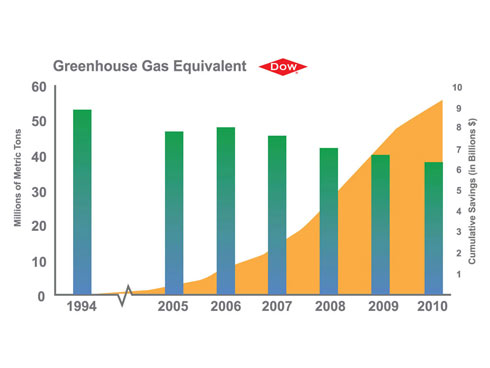
As I pointed out in my first video on Energy Efficiency – it’s a myth that dealing with CO2 will cause economic hardship. The truth is exactly the opposite. The graph above shows how one major US company has continually cut greenhouse gases since the mid-nineties, and has realized more than 9 billion dollars in increased profits from that effort.
The global companies with the sharpest focus on climate change have rewarded their investors with double the average return of the world’s corporate titans. That’s the startling message from the Carbon Disclosure Project, which released its annual Global 500 report on Wednesday.
On behalf of over 550 investment companies, managing $71 trillion of assets between them, the CDP challenged the 500 biggest companies in the world by market capitalisation to reveal detailed information about their carbon footprints and the action they are taking to tackle and adapt to global warming: 404 (81%) responded.
The CDP then compared the total financial returns between January 2005 and May 2011 of the companies identified as “carbon performance leaders” against the average of all 500. The former generated a return of 86%, the latter 43%.
Jonathan Grant, at PwC, which produced the CDP report, told me: “There is very definitely a strong correlation between good carbon performance and good financial performance. But we are not saying that one definitely caused the other.”
Grant suggests that high quality management will perform well on both financial returns and carbon strategy. But he adds: “Many companies point to the financial benefits of carbon strategy in both energy and resource efficiency.” Good carbon performance was defined as transparent reporting of carbon, setting and meeting carbon reduction targets and intelligent responses to both the risks and opportunities presented by changing climate.
“Own Less, Do More”: Snap-Goods, ZipCars, Bubble Cars and the Post Acquisitive Consumer
More evidence that the “own less, do more” model, as explained in the recent interview with SnapGoods founder, Ron J. Williams.
Bubble-shaped vehicles will appear on Paris streets next week which billionaire entrepreneur Vincent Bollore hopes will help clear the traffic-clogged arteries of the French capital as well as providing a charge to his nascent battery business.
The electrically powered Autolib cars will be available for hire in a two-month trial starting October 2 at 4 to 8 euros per half hour to motorists prepared to pay a membership fee starting at 10 euros for a day of driving.
The 235 million euro ($321 million) project is the brainchild of Paris Mayor Bertrand Delanoe, who hopes to duplicate the success of Velib, the bicycle-sharing scheme he launched in 2007 and which has been copied by several cities in France and abroad.
–
The scheme echoes increasingly popular car clubs such as City Car which allow members to hire a local car for as little as an hour at a time.
“We want to persuade people to shift from the concept of owning a car to that of using a car,” Autolib General Manager Morald Chibout told Reuters.
Pay-as-You-Go Solar: Cheap, Affordable, Accessible
More stubborn, smart-alecky third-worlders unwilling to wait for a nuclear plant and a power grid.
In a model parallel to that described in last week’s post on Snap Goods,(“own less, do more”) customers dial in the amount of solar energy they are willing to pay for at a given time, and avoid having to purchase what they do not need.
Pay as you go is a common way of paying for calls on your cellphone. Now the idea could help make solar power a more realistic option for families in Kenya and other African countries.
The system, called IndiGo, consists of a low-cost flexible plastic  2.5W solar panel that charges a battery. This is connected to a USB mobile phone charger and an LED lamp that provides around 5 hours of light from one day’s charge.
Developed by solar energy firm Eight19, based in Cambridge, UK, IndiGo costs $1 a week to run, though the unit itself must be leased for an initial $10 fee. Users add credit by buying a scratchcard that they validate by sending a text message from their phone.
IndiGo is being trialled in Kenya and will be tested in other countries in the next few months. Eight19 hopes the device will go on sale early next year. The company also plans to offer higher-power systems as demand for solar energy increases, such as a 50W system that could power a small TV.
Continue reading “Pay-as-You-Go Solar: Cheap, Affordable, Accessible”