The Greening of Detroit: Urban Solar in Ypsilanti

from the Solar Ypsi website

The number of solar installations continues to grow in Ypsilanti. Independent of SolarYpsi, in the summer of 2011 a house on South Huron, with three apartment units installed 55 solar panels. The installer of the system was Oak Electric and included the building of a carport to house many of the panels. The fall of 2011 also saw the Corner Brewery win approval from the Ypsilanti Historic Commission to install 144 panels on their brewery on Norris Street. They hope to have that project completed by December of 2011. SolarYpsi is working with both these locations to put information about these installations on the website and track their power generation, consumption, and exportation in real time.

Google picked up the story for the video below:

Continue reading “The Greening of Detroit: Urban Solar in Ypsilanti”

Wind Power: Reducing Tax Burdens from Maine to Maui

Bangor News:

LINCOLN, Maine — Owners of $100,000 properties will pay $26 less in town taxes annually than they would have paid last year under a new 19.86 mill rate town officials have set, they said Tuesday.

Town Manager Lisa Goodwin attributed the lower rate to the $42.2 million in value added to local taxes by the Rollins Mountain industrial wind-to-energy site as part of site owner First Wind’s tax increment financing agreement with the town.

Revenue from the project allowed town leaders to purchase or partially pay for several pieces of needed equipment without raising taxes, Goodwin said.

Without the TIF revenues, the equipment purchases and other expenses would have increased the town’s mill rate from last year’s 20.12 mills, under which $100,000 in property was assessed $2,012 in taxes, to 22.12 mills, or $2,212 for every $100,000 of property.

“That is one of the economic benefits of this project,” Goodwin said Tuesday of the Lincoln portion of the 40 1½-megawatt turbines on Rollins ridgelines in Burlington, Lee, Lincoln and Winn. “We don’t directly get their electricity, but we do get a benefit from the project.”

Texas A&M Experts Among Perry’s Critics

The video above is a shortened clip from last week’s feature with Dessler being interviewed on a Houston TV station.
San Antonio Express-News:

When it comes to the science behind global warming, the Aggies are ganging up on one of their own.

Gov. Rick Perry‘s alma mater, Texas A&M University, boasts some of the world’s leading experts on climate change, and they’re at odds with their fellow Aggie on what the evidence shows — and not just a little.

Andrew Dessler, a professor of atmospheric sciences at A&M, took issue with the governor’s campaign-trail skepticism about whether the scientific evidence of warming is “settled” in an article in the Houston Chronicle.

And Gerald North, A&M’s distinguished professor of atmospheric sciences and oceanography, puts 35 years of experience behind the view that there’s no longer any doubt that the planet is warming.

“The evidence has been piling up for 30 years now.”

A physicist by training, North began exploring the science behind global warming not because it was the sexy topic of the day but because it piqued his curiosity.

“I got interested in this problem 35 years ago because it’s such an interesting scientific problem,” he said. “The politics is really quite secondary.”

He tiptoed when I asked about Perry but still managed to convey what he thinks.

“I really don’t know what he believes,” North said. “What he says — I have to be careful here. Let’s take him at his word that he believes exactly what he says. Given that, I think he’s not listening to the right people.”

Back in July, two U.S. scientists published a paper in the journal Remote Sensing claiming that new data from NASA blew a hole in the science behind global warming.

According to The Guardian, the paper was downloaded 56,000 times within a month before other scientists began to challenge its conclusions. The media, including the Express-News, gave it a good ride.

Less publicized was the fact that the editor of the journal subsequently resigned, conceding that the science behind the paper was “fundamentally flawed and therefore wrongly accepted by the journal.”

Great Lakes Under Threat. Are Lake Erie’s Bad Old Days Back?

One Earth:

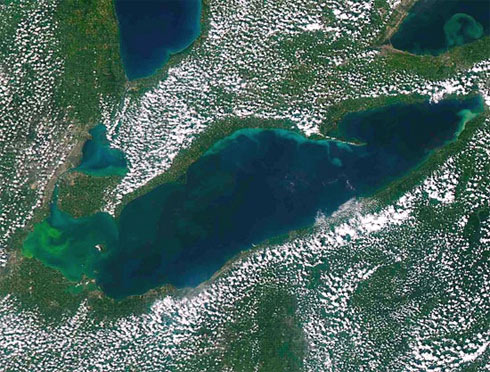
..a research technician at the University of Toledo’s Lake Erie Center, dangles a long, white plankton net off the side of the boat, then hauls it in and filters the sludgy water into a canister for testing back in the lab. “Dogs get sick when they drink this,” he says: three in Ohio died last year after swimming in a contaminated inland lake not far from here, and nine people got sick (including one with memory loss and partial blindness) after skin contact.

After a decades-long absence, blue-green algae is again flourishing in Lake Erie — and it’s never been worse than it is this summer. The algal infestation is just one of many factors that biologists in Ohio, Michigan, and elsewhere say are pointing toward an ecosystem in danger of collapse.

Continue reading “Great Lakes Under Threat. Are Lake Erie’s Bad Old Days Back?”

Toronto Star: Southern US Welcomes our New Gelatinous Overlords


 As I’ve continued to make clear, I, for one, welcome our new gelatinous Overlords.

The Star:

Blobs of slimy jellyfish are taking over some beaches in the southern United States, the result of a shrinking fish population caused by humans, scientists claim.

“Now that fish are being overfished in a lot of ecosystems, it’s providing an opportunity for jellyfish populations to explode,” said Sean Colin, an associate professor of marine biology at Roger Williams University in Rhode Island.

“There’s been evidence suggesting that there are more and more jellyfish blooms globally.”

When there are fewer fish, the jellyfish are able to ingest more food as there is less competition for it.

Climate change is also a factor, Colin said in an interview, because fish higher up in the food chain are affected by changing water temperatures and the availability of their food sources.

Junior Walk. I Quit Massey Energy to Fight Mountain Top Removal

Junior Walk lives in one of many coal-dependent communities of West Virginia, where criticizing the coal industry can be grounds for ostracism. But Junior quit a job at Massey Energy, and broke thru the barrier of fear to openly oppose Mountain top removal.

He travels across the nation educating people about the long-term environmental, health and community degradation caused by coal mining.

He has just won a David Brower Youth Award from Earth Island Institute.

Arnie Gunderson: Lessons from Fukushima

Gundersen expresses concerns that the nuclear industry and the Nuclear Regulatory Commission are not addressing major safety issues that have become evident since Fukushima. These issues include serious design flaws in the BWR Mark 1 containment, fundamental flaws in the Boiling Water Reactor vessel design, and problems with detonation shockwaves. The NRC and the nuclear industry are using a flawed cost benefit computer code that underestimates the value of human life and minimize property damages after an accident, which has the effect of justifying continued operation of reactors without safety modifications.

Denialists: Read About it here before you turn on Glenn Beck

Somebody Goofed at Harper Collins. I’m waiting for the stream of posts claiming that “Greenland was Green”, and that the Rothchild’s, the New World Order, the Club of Rome, and Al Gore  are behind this.
Remember, I’m here to help.

The Independent:

The publisher Harper Collins made international headlines when it declared that the new edition of its “comprehensive” atlas, which claims to be the “most authoritative” in the world, had been forced to depict an area the size of the UK and Ireland, previously part of Greenland’s permanent ice sheet, as “green and ice-free” due to climate change.

According to promotional material for the 13th edition of the atlas, this provides “concrete evidence of how climate change is altering the face of the planet for ever – and doing so at an alarming and accelerating rate.”

However, scientists at the Scott Polar Research Institute at Cambridge University, which investigates climate change in the Arctic and is headed by the revered glaciologist Julian Dowdeswell, have asserted that the publisher’s claims are flawed.

“Recent satellite images of Greenland make it clear that there are in fact still numerous glaciers and permanent ice cover where the new Times Atlas shows ice-free conditions and the emergence of new lands,” the Institute said in a letter to Harper Collins, made public yesterday.

Science:
CAMBRIDGE, UNITED KINGDOM—So much for claims that climate scientists deliberately misrepresent their data: glaciologists are broadly and loudly panning the latest version of The Times Comprehensive Atlas of the World, released last week, which shows Greenland having lost 15% of its ice cover in the past 12 years due to warming, turning an area the size of the United Kingdom and Ireland “green.” The atlas is published by HarperCollins on behalf of London’s The Times newspaper.

Continue reading “Denialists: Read About it here before you turn on Glenn Beck”

Native Alaskans Tell of Climate Change Impacts

High Country News:

In a paper published in the journal Human Organization, social scientists from the US Geological Survey interviewed indigenous Yup’ik people to understand how climate change is affecting their age-old, subsistence lifestyle on the lower Yukon River.

“Salmonberries are getting fewer, that’s due to lack of snow,” one resident explained of an important wild food source. “See what’s happening is, after the snow melts right away the tundra dries up. And that’s one of the reasons for lack of salmonberries, the tundra is drying up and they can’t grow when it’s dry.”

As computer models crunch volumes of data to explain climate change impacts, this study sought to understand on-the-ground effects by “relating indigenous observation as described by elders and hunters … to those described by scientific literature.” Another participant described changing weather over time:

Let’s see, maybe in the 80s, late 70s, 80s there was this gradual change started, and it seemed like the winters were getting a little warmer, less snow, rain in December and January. It seems like there’s hardly any snow, frozen tundra, ice.

Continue reading “Native Alaskans Tell of Climate Change Impacts”