A rainy summer might be one reason for an apparent lack of public attention with respect to the ongoing sea-ice loss. Another reason, however, is possibly the fact that we scientists have failed to make sufficiently clear that a major loss of sea ice during the early summer months is climatologically more important than a record minimum in September. This importance of sea-ice evolution during the early summer months is directly related to the role of sea ice as an efficient cooling machine: Because of its high albedo (reflectivity), sea ice reflects most of the incoming sunlight and helps to keep the Arctic cold throughout summer. The relative importance of this cooling is largest when days are long and the input of solar radiation is at its maximum, which happens at the beginning of summer.
Eden Full, a 19-year-old Princeton University mechanical engineering student has developed a non-toxic, cheap, recyclable device made out of metal and bamboo that allows solar panels to follow or track the Sun without the use of an electric motor. This does two things: 1) it boosts the output of the solar panels by about 40% (huge) and 2) it does so using a much cheaper and simpler method than traditional trackers commonly used in commercial projects (her technology costs $10, a lot less than the typical $600 solar tracker).
The concept is simple, really. Steel expands at a different rate than aluminum when exposed to heat. Full has combined steel and aluminum into bimetallic strips, which are attached to an axel running across the back of a solar panel.
She won’t go into too much detail until her patent on the invention is published, but when the sun hits the strips the resulting heat causes the aluminum part of the strip to expand more than the steel part. This causes bending and twisting of the strips.
Full has figured out a way to configure and control her system so that the bending strips keep her panels, for the most part, directly aimed at the sun.
AUSTIN, TEXAS — The worst single-year drought in the recorded history of Texas has caused cotton crops to wither and ranchers to sell off cattle. It may also hurt power plants, which need vast amounts of water to cool their equipment.
“We will be very concerned” if it does not rain by spring, said Kent Saathoff, an official with the Texas electric grid operator.
The worries in Texas bear out what an increasingly vocal group of researchers has been warning in recent years: that planners must pay more attention to how much water is needed in energy production.
“Water and energy are really linked,” said Henrik Larsen, a water policy expert with the DHI Group, a research and consulting firm based in Denmark. “If you save water, you save energy, and vice-versa.”
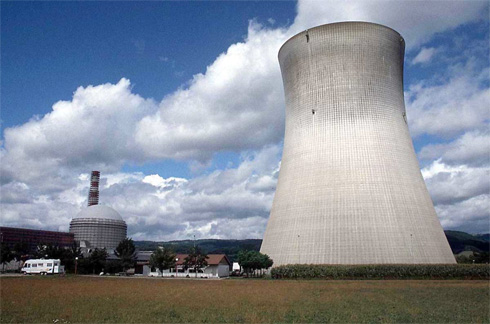
Experts call this the “water-energy nexus.” It takes huge quantities of water to produce electricity from a plant powered by nuclear energy or fossil fuels, and it also takes lots of energy to pump and process the water that irrigates fields and supplies cities.
In the United States, 4 percent of all fresh water is consumed in the energy sector, and 3 percent of all electricity used daily goes toward water and wastewater pumping, distribution, and treatment, according to Mike Hightower, a member of the technical staff at Sandia National Laboratories.
Water Intensities of Power Generation (m3/MWh). PV – Photovoltaic; CSP – Concentrated Solar Power; NGCC – Natural Gas Combined Cycle; CT – Cooling Tower; CCS – Carbon Capture and Storage; PC – Pulverized Coal (Source: Vestas). Source: Clean Technica (http://s.tt/12XBK)
BERLIN — Siemens, the largest engineering conglomerate in Europe, announced Sunday that following the German government’s decision to phase out nuclear power by 2022, it would stop building nuclear power plants anywhere in the world.
“The chapter for us is closed,” Peter Löscher, the chief executive of the Munich-based conglomerate, said in an interview with Der Spiegel, the weekly news magazine. He emphasized the company’s commitment to the rapidly growing renewable energy sector.
He said the decision was also “an answer” to political and social opposition to nuclear power in Germany.
Siemens, which built all of Germany’s 17 nuclear power plants, is the first big company to announce such a shift in strategy. But other German companies involved in the nuclear energy industry are also reconsidering their options.
In May, Chancellor Angela Merkel said that the accident at the nuclear power station in Fukushima, Japan, had convinced her that Germany should look to other power sources. The decision represented a turnaround for Mrs. Merkel, who a year ago agreed to prolong the life of the country’s nuclear plants by an average of 12 years.
Nuclear power accounts for 23 percent of electricity production in Germany. The government is putting in place an ambitious plan to increase the share of electricity generated from renewable sources to 35 percent by 2020, up from around 18 percent now.
Mr. Löscher called the government’s plans for renewable energy “the project of the century.” Although the government’s goal has met with skepticism in some quarters, he said the 35 percent figure was “achievable.”
Arctic sea ice extent fell to 4.33 million square kilometers (1.67 million square miles) on September 9, 2011. This year’s minimum was the second lowest in the satellite record, which started in 1979. The lowest extent was recorded in 2007.
Over the last thirty years, ice extent, a two-dimensional measure of the ice cover on the Arctic Ocean, has declined in all months, with a more pronounced drop in summer. Scientists attribute this decline in large part to climate change.
The graph above is an early preview of my upcoming review of sea ice, where I will underline once again, that the most virulent form of climate denialism is not just ignorance, but evidence of a psychological disorder. ( see today’s video on the tobacco industry)
I was going to wait on this, but it’s too important. The point has often been made that the climate denial industry is based on the disinformation techniques pioneered and developed by the Tobacco industry – Naomi Oreskes does it elsewhere on this page. There’s a lot of footage here of tobacco flacks presenting to media and congress.
The parallels between “there is still debate about the link between smoking and cancer” and “there is still debate about the link between CO2 and global climate” are obvious.
See if you can pick out the specific techniques – and see if you can listen to this whole film without getting nauseous as I did.
WASHINGTON, Sept 15 (Reuters) – More Americans than last year believe the world is warming and the change is likely influenced by the Republican presidential debates, a Reuters/Ipsos poll said on Thursday.
The percentage of Americans who believe the Earth has been warming rose to 83 percent from 75 percent last year in the poll conducted Sept 8-12.
U.S. Republican presidential candidates, aside from Jon Huntsman, have mostly blasted the idea that emissions from burning fossil fuels and other human actions are warming the planet.
The current front-runner, Texas Governor Rick Perry, has accused scientists of manipulating climate data while Michele Bachmann has said climate change is a hoax.
As Americans watch Republicans debate the issue, they are forced to mull over what they think about global warming, said Jon Krosnick, a political science professor at Stanford University.
And what they think is also influenced by reports this year that global temperatures in 2010 were tied with 2005 to be the warmest year since the 1880s.