

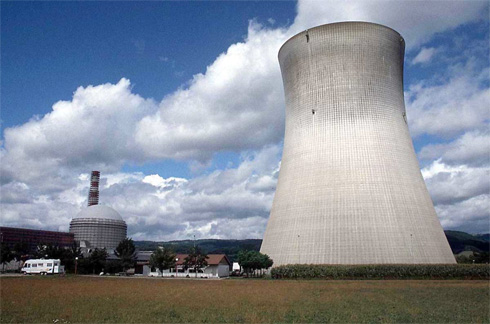
BERLIN — Siemens, the largest engineering conglomerate in Europe, announced Sunday that following the German government’s decision to phase out nuclear power by 2022, it would stop building nuclear power plants anywhere in the world.
“The chapter for us is closed,” Peter Löscher, the chief executive of the Munich-based conglomerate, said in an interview with Der Spiegel, the weekly news magazine. He emphasized the company’s commitment to the rapidly growing renewable energy sector.
He said the decision was also “an answer” to political and social opposition to nuclear power in Germany.
Siemens, which built all of Germany’s 17 nuclear power plants, is the first big company to announce such a shift in strategy. But other German companies involved in the nuclear energy industry are also reconsidering their options.
In May, Chancellor Angela Merkel said that the accident at the nuclear power station in Fukushima, Japan, had convinced her that Germany should look to other power sources. The decision represented a turnaround for Mrs. Merkel, who a year ago agreed to prolong the life of the country’s nuclear plants by an average of 12 years.
Nuclear power accounts for 23 percent of electricity production in Germany. The government is putting in place an ambitious plan to increase the share of electricity generated from renewable sources to 35 percent by 2020, up from around 18 percent now.
Mr. Löscher called the government’s plans for renewable energy “the project of the century.” Although the government’s goal has met with skepticism in some quarters, he said the 35 percent figure was “achievable.”
Yes, BlueRock, I know how debates work: who said this is a debate? You’re welcome to debate the wind, if you wish, but I have already said I don’t want to argue. I have not “failed” to refute your arguments, I simply don’t care to. As I have already written, I have no interest in altering your beliefs or anybody else’s. Moreover, I do not share your confidence that a complex issue such as the desirability of nuclear power can be resolved in a few blog posts. The literature on this subject is huge; the notion that you or I could condense that literature into this tiny forum is absurd.
Again, if you wish to discuss our differences, I’ll be happy to engage you in a constructive discussion. If an intellectual joust is what you’re looking for, well, I’m not your guy.
So, you’re admitting that you’re not interested in facts. You like your beliefs, no matter how false they are – you prefer them to reality. Got it.
P.S. To “engage in a constructive discussion” you need to be intellectually honest and respond to facts and reality. I’m not sure if you’re an idiot or a troll – but the effect is the same.
Good luck working it all out.
No, BlueRock, I’m very much interested in facts. You have brought to bear on this discussion a trivial whiff of facts that, while adequate to make very narrow and simplistic points, fail to address the complexity of these issues.
I am eager to participate in a serious discussion — but you seem more interested in some kind of contest. As always, I renew my offer for serious discussion.
Obviously ‘Chris Crawford’ isn’t capable or honest enough to absorb facts, but this is another good article for those who are:
* Costs for Nuclear Energy Skyrocket While Cost of Renewables Plummet. http://stephenleahy.net/2011/09/20/costs-for-nuclear-energy-skyrocket-while-cost-of-renewables-plummet/
It actually doesn’t matter whether or not any coal plants are being built to replace nuclear plants, the logic of the virtually zero-sum game between nuclear and fossil fuels still holds.
The development of renewables can and should be campaigned for, accelerated, and make progress as rapidly and as thoroughly as possible, irrespective of how much nuclear power we have. The same can be said of reducing energy consumption. Having nuclear power stations doesn’t somehow make that difficult or undesirable.
The problem is the (huge) shortfall between renewable energy capacity and overall energy demand. While that shortfall is there, it will be filled either by fossil fuels or by nuclear.
It doesn’t matter whether this shortfall is increasing or decreasing, whether new power stations are being built or not. Every nuclear power station meets a demand that would otherwise have been met by fossil fuels, and every nuclear power station decommissioned, and every nuclear power station not built, leaves a gap that will be filled by fossil fuels.
If a country ignores renewables, they have the choice between fossil fuels and nuclear. If a country adopts renewables at an unprecedented rate, they still have the choice of whether to prioritise the decommissioning of nuclear or the decommissioning of fossil fuel plants. Either way, the choice is between fossil fuels and nuclear, and every nuclear plant STILL fills a gap that would otherwise be filled by fossil fuels.
I’m no fan of nuclear, but I find articles like this both convincing and disturbing: http://www.newscientist.com/article/mg21128236.300-the-carbon-cost-of-germanys-nuclear-nein-danke.html
So by all means campaign against nuclear if you wish – but don’t pretend that decommissioning nuclear will somehow result in an equivalent development of wind farms. It doesn’t make sense. An honest argument against nuclear should proceed with a keen awareness of the fact that every gigawatt of nuclear capacity dropped is effectively a green light to a gigawatt of fossil fuels, and with a keen awareness of what that implies. Otherwise the debate seems a little vacuous.
I think what matters is not a “campaign” for or against nuclear energy, but a recognition that the current cost factors of nuclear
construction are the most serious impediment to more nuclear builds. (campaign or no)
We are betwixt a rock and a hard place, in that there are very real constraints on the large thermal plant centralized model of the
past – and going as quickly as possible to renewables makes sense for a number of reasons.
Yes, I agree with you there.
The UK Government’s policy on new nuclear is that it must be privately funded, not subsidised. It’ll be interesting to see how that goes. If it goes at all.
The Tories are ideologically attached to nuclear. They’ll pull every trick they can think of to make it happen.
They orchestrated a PR campaign in conjunction with the nuke industry to downplay Fukushima as soon as it went BANG!
They’ve manipulated the upcoming carbon price so that nuke operators receive £50 million a year from 2013 to 2030 for doing nothing different than they are today, meaning that there will be higher bills for consumer for no benefit to carbon emissions.
Still, it’s possible that even that amount of back door subsidy is not not enough to get the things built:
* Hinkley C – Somerset’s nuclear money pit? Uncosted, unapproved, and unwanted: why Britain’s new nuclear plant may never get built. http://www.guardian.co.uk/environment/blog/2011/aug/01/hinkley-c-reactor-plans
Even if they do build some, it’ll do exactly nothing to mitigate the UK’s emissions because 9 of our 10 nukes are due to go offline by 2023 – with each new nuke taking ~10 years to deploy. We’ll be handing billions of £££s to French and American corporations to stand still.
> …I find articles like this both convincing and disturbing:
There’s no shortage of pundits who have been wringing their hands over Germany’s commitment to (stick to their) abandonment of nukes, claiming it will increase carbon emissions. They are wrong.
1. the Germans don’t agree – and they have a *solid* record of meeting and beating their renewable energy targets.
2. Germany is already one of the lowest CO2 per capita western nations, so it’s the height of hypocrisy for anyone from especially USA, Canada or Australia (all of whom are still ‘debating’ the reality of ACC) to make a squeak about Germany’s energy strategy. And it’s clearly a smokescreen for many who are horrified that a large industrial nation is going to demonstrate that they can dump nuclear and prosper from it – some because they have vested interest nukes, others because they don’t want their ‘nuclear utopia’ dream spoiled.
3. there will be *no* increase in CO2 emissions across the European Union due to cap and trade.
4. by announcing their exit from nuclear, the German government gives its industry and investors a clear signal that they will have support and stability which is essential for progress. Compare it to the UK where the idiots in government just slashed solar FITs for ‘large’ installations, thereby killing confidence and investment.
5. German communities, towns and villages are already going 100% renewable independent of the entire country. That’s the great thing about renewables – everyone can have a slice of the action.
* “CO2 emissions would rise only in the short term under a phase-out of nuclear power by 2020 instead of 2022. … The additional emissions could be decreased by 20 percent if more power plants were deployed fired with gas instead of coal. Climate change mitigation would not be affected, contrary to some widespread beliefs. There is a cap for European greenhouse gas emissions. When one country increases its emissions, they have to be reduced somewhere else.” http://www.pik-potsdam.de/news/press-releases/der-atomausstieg-ist-bezahlbar-2013-die-energiewende-aber-braucht-einen-kraftakt-en
> …don’t pretend that decommissioning nuclear will somehow result in an equivalent development of wind farms.
There’s no need to pretend. You just need to look at reality and educate yourself to see that wind (+ other renewables) are already being deployed in Europe and the US faster than fossils + nukes combined. There’s nothing to suggest that process will do anything other than accelerate – in Germany especially.
> An honest argument against nuclear should proceed with…
I do like when someone predefines what must be agreed in order for an argument to be “honest”.
> …every gigawatt of nuclear capacity dropped is effectively a green light to a gigawatt of fossil fuels…
Can you post an image of your crystal ball showing that? Because it’s a startling revelation when there’s absolutely no evidence that it’s true, and much to show that it’s false.
* “By 2020, Germany may realistically have 90 GW of solar and wind capacity to cover peak demand of generally no more than 75 GW. We will have surpassed peak demand parity.” http://www.renewablesinternational.net/yes-we-have-no-base-load/150/537/29353/
> Otherwise the debate seems a little vacuous.
I’ll agree with you on that single point. Too many people come to the debate with cherished but flawed *beliefs* instead of *facts*.
Oh my.
Height of hypocrisy, you say, to make any comment critical of a country that might have a better record in some ways than the country I’m in? Is the record of the entire nation I inhabit my responsibility?
Wow.
I don’t live in any of the countries you mention anyway. The UK has lower per capita emissions than Germany.
I don’t agree with your assertions that ditching nuclear is climate neutral, or your *facts*. Or your characterisation of what I said. Or your tone.
Let’s agree to disagree, please.
You call *that* an “honest argument”?!
That looks more like a tone troll who won’t acknowledge or respond to arguments and evidence because he’s incapable of doing so… which is standard issue for the nuke fan club.
Over and over again I find that the nuke cult is as intellectually dishonest and immune to reality as the ACC deniers.
> Let’s agree to disagree, please.
I’ll stick with the overwhelming facts, thanks.
No, I don’t call that an argument, I call it pointing out a huge logical blunder and declining to respond to contemptuous provocation.
If you prefer to pretend that you’ve proved me incapable of responding to arguments and evidence, then you go ahead 🙂
Again, no pretending needed – it’s there in a black and white. 🙂 You whined about “tone” and failed to respond to any evidence or argument presented.
Unlike whoever you think you’re fighting, I’ve never argued for nuclear power, and I’ve made it very clear that I’m strongly in favour of renewables.
If I were to dispute you I’d have to start by attempting to dismantle the version of me and what I’ve said that you’ve concocted, and to clarify the bizarre logic that is somehow obvious to you but vague and unconvincing to others.
I’ll freely admit that I’m not up to that task. You win.
I kind of admire the ability of people like you to write paragraphs but say absolutely nothing substantive.
Any time you want to have that “honest argument” you were lecturing us on earlier, you’ll need to start by responding to the arguments and evidence presented.
P.S. Forgot two:
6. multi-GW thermal plants are incompatible with a grid of massively distributed micro-generators:
* Renewable energies and base load power plants: Are they compatible? “…the so-called “residual load” – the electricity produced by conventional power plants – will be halved by 2020. In this case, the extension of the nuclear power phase-out as well as the construction of new coal-fired power plants will be unnecessary, if not counter-productive.” http://www.unendlich-viel-energie.de/en/details/article/4/campatibility.html
* Nuclear Power And Renewable Energy Not Compatible. http://www.energymatters.com.au/index.php?main_page=news_article&article_id=1404
7. the German people overwhelmingly do not want the risk of a Chernobyl / Fukushima hanging over their head nor the obscenity of increasing piles of radioactive waste. It’s a crazy concept, but the government has acted in a democratic manner and complied with the public’s wishes.
Alex, I strongly agree with your point about the zero-sum game that we’re faced with between coal and nuclear. That trade-off will stick with us for a long time, and even the most advanced country in this matter, Germany, will probably end up reversing its no-nukes policy towards the end of this decade, when it becomes clear that its renewable program, ambitious as it is, will not suffice to power the country. They’ll probably extend the life of some of the plants as part of a grand bargain in which they shut down coal-fired plants as the political trade for keeping the nuclear plants open. If they don’t do something like this, they will surely end up in a really bad crunch. Even our friend Blue Rock admits that they’ll have, at best, only 90 GW of renewable capacity by then, against a demand of 75 GW. Since the best wind so far has a capacity factor of only 25%, that means that their average power supply will be about 22 GW — one third of their demand. But it gets worse: the best locations for wind generation have already been taken. Because of this, any wind program suffers from negative economies of scale: the bigger it gets, the lower its return on investment.
I am enthusiastic about the German experiment because it will demonstrate what can be accomplished by a country that is truly dedicated to the ideal. The Germans will accomplish a lot; I expect this to be their version of the American Apollo program. They will fail to achieve anything like a renewable-only system anytime in the foreseeable future, but I think that the world will learn much from their efforts.
Meanwhile, China is pursuing the best overall strategy: push every opportunity as hard as they can, and be ready to run with whatever works. I just hope that they move away from coal sooner rather than later — but I’m none too confident of that.
By the way, you should take BlueRock’s endless cited claims with a grain of salt: his sources always turn out to be websites with strong political or anti-nuclear agendas. It’s no different than the ACC deniers providing long lists of citations from (guess what?) ACC denial sites.
^ Gotta be a troll! No one can be *that* stupid. Can they?! I’m always slow working it out because I can’t understand how someone making themselves look stupid and dishonest works in their favour! 😀
Completely wrong about Germany hitting peak grid parity – but you’d need to read as far as the very first line of the linked article to understand that.
Yeah, the German Renewable Energy Agency and the Potsdam Institute are very biased – towards facts and reality. You should try that some time. 😉
Hey blueorck yeah you’ve got a troll on the end of the line there!! leave it to wriggle on its own! 🙂
Thanks for all the links and arguments — I’m on the fence with the nuclear debate but you argue a strong case. I think Germany recently announced they had reached 20% from renewable sources — so I guess we don’t have to long to wait and see if they succeed shutting down all their nuclear reactors.
Thanks, Andrew. It’s not unusual – the nuke cult can’t win the debate with facts, so they try to spoil the conversation and smear anyone who communicates the truth.
Yes, Germany now get just over 20% of their electricity from renewables and they now have the infrastructure to push forward rapidly due to steady and progressive investment over the past couple of decades.
Because Germany was (still is?) a net exporter of electricity, they were able to immediately close down 8 of their 17 nukes following Fukushima without any impact on supply.
They’ve already proven that they can quickly pump out renewable capacity – e.g. they deployed 1% of their total grid from solar in 2010 alone. The anti-renewable shills will try to minimise that success by invoking a capacity factor, but solar closely matches demand so the fact that it’s not producing electricity in the middle of the night is not an issue because demand is low then. The investment in solar continues and they’re also ramping up wind capacity:
* Germany Aims for Massive Increase of Onshore and Offshore Wind Power. http://www.offshorewind.biz/2011/06/06/germany-aims-for-massive-increase-of-onshore-and-offshore-wind-power/
Even private companies are getting in on the action: VW just announced they’re spending €1 billion on wind turbines.
You can get lots more info. on Germany’s renewable program here:
* German Renewable Energy Agency. http://www.unendlich-viel-energie.de/en/homepage.html
And a good resource is: http://www.reddit.com/r/RenewableEnergy/
Just pay attention to the *facts* of what is happening and not the evidence-free ranting from the fossil / nuke shills and their useful idiots who infect comment threads, and you’ll not go wrong.
P.S. I see our little troll, ‘Chris Crawford’, has switched back from trolling to pretending to be honest again. Here’s something from the NAS that he recommends:
* “A preponderance of scientific evidence shows that even low doses of ionizing radiation, such as gamma rays and X-rays, are likely to pose some risk of adverse health effects….” http://www.nas.edu/gateway/foundations/jul05.html#2560
That’s a good part of the reason why the Germans want nothing to do with nuclear power. Nukes release radiation in to the environment even if they don’t do a ‘Chernobyl / Fukushima’, so a very low risk spread across millions of people gives us things like this:
* The authors found 14 cases of leukemia in children living within 5 km of the nuclear plant. The 14 observed cases significantly exceeded the 0.45 predicted cases based on national incidence rates. An inverse distance – effect relationship linked the cancers directly to the nuclear facilities. http://www.ippnw-europe.org/en/nuclear-energy-and-security.html?expand=176&cHash=abf6cd63d1 + http://www.bfs.de/en/kerntechnik/kinderkrebs/kikk.html + http://www.ncbi.nlm.nih.gov/pubmed/18082395
* “…cancer … risks are increased even with the smallest dose of radiation. The so-called permissible dose of radiation, for nuclear workers or for the public at large, represents only a legalized permit for the nuclear industry to commit random, premeditated murders upon the … population.” http://ratical.org/radiation/CNR/PP/Foreward1979.html
P.P.P.S. While I’m swamping this thread, might as well leave one more – an excellent resource which includes:
“A new myth of the nuclear lobby is the claim that nuclear power and renewable energies are complementary forms of energy. The authors Antony Froggat and Mycle Schneider prove the opposite: Those who build nuclear power plants hinder the expansion of renewable energies.”
* Myth of Nuclear Power – A Guide. http://www.boell.org/web/index-644.html
Andrew, if you haven’t made up your mind regarding nuclear power, I urge you to peruse BOTH sides of the issue. BlueRock has presented a large collection of anti-nuclear materials, and these materials present the anti-nuclear case quite well. However, there are also tons of pro-nuclear materials out there — and not just industry propaganda.
I highly recommend the National Academy of Sciences materials: they cover every aspect of nuclear power and are extremely thorough:
http://search.nap.edu/napsearch.php?term=nuclear+power&x=0&y=0
Another good source for non-propaganda information about nuclear power is the Alsos Digital Library:
http://alsos.wlu.edu/
It is a bibliography, but it will get you pointed in the right direction, and some of the articles to which it links can be read directly.
I’d like to emphasize that these sources, unlike the sources provided by BlueRock, are serious, sober analyses of the various issues related to nuclear power, and have no political agenda. They are, admittedly, rather technical; if you prefer something less technical, I’ll be happy to provide some links for such material.
Lastly, I’ll be happy to address any particular questions you may have regarding nuclear power.
Hey ‘Chris’, you’re back from being a dishonest troll! See if you can keep it going? 🙂 Just a shame that you’ve still not responded to any fact or argument or presented any of your own. 🙁
I’ve already provided Andrew with evidence that originates from NAP. Here’s some from ALSOS:
* Insurmountable Risks: The Dangers of Using Nuclear Power to Combat Global Climate Change. http://alsos.wlu.edu/information.aspx?id=2700&search=
* The coming German energy turnaround. “The German energy turnaround not only leads to a sustainable energy supply, it clearly offers more opportunities than risks.” http://www.thebulletin.org/web-edition/op-eds/the-coming-german-energy-turnaround
* Beyond our imagination: Fukushima and the problem of assessing risk. “Catastrophic nuclear accidents are inevitable, because designers and risk modelers cannot envision all possible ways in which complex systems can fail.” http://thebulletin.org/web-edition/features/beyond-our-imagination-fukushima-and-the-problem-of-assessing-risk
* The financial difficulties facing nuclear power projects are not a market failure, but a market success – the capital markets correctly understand the grim economic realities of nuclear power. [If we] force taxpayers to subsidize new reactors, consumers and the economy will pay a heavy price. http://www.thebulletin.org/web-edition/op-eds/further-nuclear-power-subsidies-are-wrongheaded
Is that what you meant when you said they would “get you pointed in the right direction”? 😉
Baffles me that you can call anyone else a troll, least of all Chris. But never mind.
Link one: “The author, a physicist, is a senior fellow at … an organization … that has a very strong stance against nuclear power.” Another measured article from someone with no vested interests then.
The other links are from the Bulletin of the Atomic Scientists, which also has its own agenda.
Link two: As ever, the benefits relate to the adoption of sustainable energy, not the ditching of nuclear. My point (about the zero-sum game between nuclear and fossil fuels) is that the benefits be much greater if fossil fuels were ditched first, and nuclear later, for the same uptake of sustainable energy.
Link three: risk assessment methods for catastrophic risks may well be in need of upheaval, I’d support that. And I’d support a similar risk-benefit assessment for long-term global effects of fossil fuel burning being taken equally seriously.
Link four: yes, subsidies are wrong-headed.
To be fair, you seem to be baffled by many things – partly due to your refusal to respond to facts that don’t fit your preconceived beliefs. But never mind.
Pointing out that an individual or organisation “has a very strong stance against nuclear power” or “has its own agenda” is nothing but empty rhetoric. Who else do you expect to argue against nukes? The IAEA?! The NEI?!
You’ve not refuted anything. You’ve not offered any substantive argument or evidence in return.
Are you a teenager, BlueRock?
I like the way you and your suspiciously similar buddy alternate between trying to make a coherent argument and then trolling. 😉
It’s true that Alsos has some anti-nuclear material; it also has plenty of pro-nuclear material. It presents both sides of the issues. I happen to agree with some of the points raised by anti-nuclear advocates (see my comments elsewhere on BWRs). My approach is based on intellectual integrity. I don’t start off with a political decision and then find arguments to justify that decision; instead, I simply follow the best available evidence.
Uncle B here again, self-professed ignoramus, troll, and general intellectual midget, but still in absolute wonderment as to why no one here has quoted http://Www.theoildrum.com/node/4971 and the Thorium fueled LFTR reactors, about to see fruition by Chinese hands, re-engineering a U.S. proven concept and technology. Can China, through her huge domestic energy efforts, including Thorium fueled LFTR reactor technology and in full consideration of her Thorium fueled CANDU success, relieve herself from the parasitic practices of this world: Saudis and OPEC, trading in only U.S. dollars, every deal with the heavy thumb of the U.S. Feds, and American money manipulators on the scales? Will China bring goods to world markets at much better prices than Americans can? Can China make deals in Yuan for oil – Hell! They already do! They buy petroleum products from Siberia with Yuan, as we speak! What of Iran’s South Azadegan Oilfield, largest oil find in Middle East this century, bought outright by China, traded in Yuan? or U.S. dollars? You tell me! Still amazed by the magnificant rhetoric here, very ‘ariodite’ well educated, manipulators of the English language, but little substance from the new world realities!
The origional topic, Germany’s pulling out of most specifically, Uranium fueled humanocidal plutonium creating reactors with waste problems, disposal problems remaining un-resolved, for perpetual, or renewable domestic energy sources seems lost now in the tirades of bull Shiite we see here! Better, mopre practical, and relevent questions should be: Can Germany survive with sustainable enjoyable life-styles for their people this way? Can corproatist/capitalist hidden super insulation technologies be revivied there to heat/cool homes, factories? Can Wind Turbine generated energy be stored by some means? Large numbers of re-chargeable cars, perhaqps? Outside the American “horsepower race” tradition, maybe? Perhaps more sustainable realistic fact driven not driven as in America by Corporatist/capitalist drive for higher ROI, regardless of damages? Unthinkable by the totally mesmerized American mind?
Bruce, I agree with you that thorium-cycle plants are the way to go with nuclear; I wrote elsewhere that I’d like to the BWRs replaced with newer models, and if those models were thorium-fueled, that would be fabulous. I don’t think that we’re ready for full-scale deployment of such reactors, but we’re close enough that one last spurt of research could bring us to the commercial-scale prototype stage.
As to the questions you ask, here are my own answers:
1. Can Germany survive with sustainable enjoyable life-styles for their people this way?
Sure, they’ll survive, but my guess is that sometime late in this decade, the German government will commission a report that comes back announcing that, if the proposed shutdown of reactors in 2021 proceeds as planned, Germany will face serious electricity shortages. The German government (especially if it’s CDU/CSU) will regretfully announce that the licenses of some of these plants must be renewed for a short period of time. Some of them are already offline, so only a handful of plants will end up staying on.
2. Can corproatist/capitalist hidden super insulation technologies be revivied there to heat/cool homes, factories?
We really don’t have a problem with insulation technologies — for most homes, you can get up to R20 using ancient technology. Above R20, the benefits fall off fast because heat loss is dominated by windows and doors at that point.
3. Can Wind Turbine generated energy be stored by some means?
Electricity storage has been the Holy Grail of power technology for years, and research on it is intense in the automotive industry. Everybody recognizes that the future belongs to electric cars, and they’re working hard to come up with better batteries. However, the amount of electricity that can be stored in batteries is still way too low to be useful for grids. The best technology we have is pumped storage, in which we maintain high baseload capacity, and then use that capacity during periods of low demand to pump water from a low reservoir to a high reservoir. When we approach peak load, we let the water flow back down through generators. But this requires pretty special terrain to be practical.
4. Large numbers of re-chargeable cars, perhaqps?
Absolutely. We already have some on the market, and the number of offerings is just about to explode. All the big carmakers are pushing this hard. Of course, we’ll need to build more power plants if we start moving to electric cars.
Ah, the inevitable thorium fantasy arrives. Let us know when a commercially viable thorium MSR LFTR exists – then it might be part of the solution.
P.S. No, the Oakridge experiment in the ’60s was not a commercially viable reactor.