

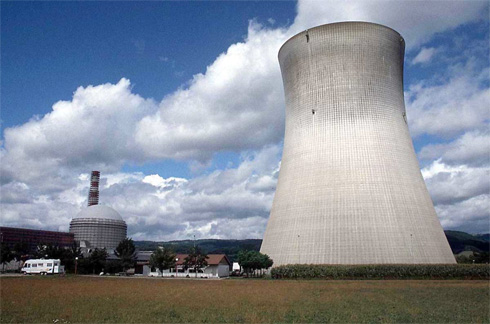
BERLIN — Siemens, the largest engineering conglomerate in Europe, announced Sunday that following the German government’s decision to phase out nuclear power by 2022, it would stop building nuclear power plants anywhere in the world.
“The chapter for us is closed,” Peter Löscher, the chief executive of the Munich-based conglomerate, said in an interview with Der Spiegel, the weekly news magazine. He emphasized the company’s commitment to the rapidly growing renewable energy sector.
He said the decision was also “an answer” to political and social opposition to nuclear power in Germany.
Siemens, which built all of Germany’s 17 nuclear power plants, is the first big company to announce such a shift in strategy. But other German companies involved in the nuclear energy industry are also reconsidering their options.
In May, Chancellor Angela Merkel said that the accident at the nuclear power station in Fukushima, Japan, had convinced her that Germany should look to other power sources. The decision represented a turnaround for Mrs. Merkel, who a year ago agreed to prolong the life of the country’s nuclear plants by an average of 12 years.
Nuclear power accounts for 23 percent of electricity production in Germany. The government is putting in place an ambitious plan to increase the share of electricity generated from renewable sources to 35 percent by 2020, up from around 18 percent now.
Mr. Löscher called the government’s plans for renewable energy “the project of the century.” Although the government’s goal has met with skepticism in some quarters, he said the 35 percent figure was “achievable.”
Atomkraft? Nein danka.
http://1789.wikispaces.com/file/view/atomkraft_nein_danke_studien-akw-ausstieg.jpg/217406402/atomkraft_nein_danke_studien-akw-ausstieg.jpg
Atomkraft? Nein danke.
What do the German scientists know that we do not know? Why do we not know this? Down the road, will Germany buy Thorium fueled LFTR reactors from China? Can Solar, Wind, Wave, Hydro, Tidal, Geothermal, Anaerobic sewage digestion, Algae-diesel, really provide enough energy for this nation to survive? Do super-insulations count into this equation? Will America regret its strict and massive adherance to Uranium fueled, Fuckoshima styled reactors and oil for its energy? Can the spent fuel dilemma in America be resolved? Will Canada foolw the U.S. into the abyss or will they change course away from Fuckoshima styled reactors from the U.S.?
What they know is that renewables are taking over, because they are cheaper and more competitive, and efficiency is cheaper still. It would be easy enough for a company this size to simply concentrate its operations in some more nuclear friendly country, but the economics of nuclear are simply too daunting.
> …will Germany buy Thorium fueled LFTR reactors from China?
It’s possible if China manages what every other nuclear nation has failed to achieve over the last 60 years and develops a commercially viable MSR. Don’t hold your breath.
And when I say “possible”, I mean in the sense that anything is possible – but the reality is that the Germans are all aboard the renewable energy train, and multi-GW, multi-billion $$$ power plants are not compatible with a network of massively distributed micro-generators:
* Renewable energies and base load power plants: Are they compatible? “…the so-called “residual load” – the electricity produced by conventional power plants – will be halved by 2020. In this case, the extension of the nuclear power phase-out as well as the construction of new coal-fired power plants will be unnecessary, if not counter-productive.” http://www.unendlich-viel-energie.de/en/details/article/4/campatibility.html
* Renewable Energies and Base Load Power Plants Are Essentially Incompatible. http://www.unendlich-viel-energie.de/en/details/article/523/campatibility.html
P.S. Peter, any chance you could up the number of links that sends a comment to pre-moderation? 1 seems a little parsimonious! 🙂
Settings > Discussion > Hold a comment in the queue if it contains [xx] or more links.
upped it to 3
Cheers.
I think Thorium reactors are still science fiction. Same as nuclear fusion. But renewables already work safe and with a much better carbon footprint than nuclear.
The future belongs to the renewables. And Siemens has just seen this.
A very good tech analysis of MSRs:
* The Molten Salt Reactor concept. “So in summary we can say that, while there is some promise here of “something better” than a LWR, we’re a long way from acheiving this. Any MSR concepts are a long way from anything resembling a working commercial reactor. There are a whole bunch of technical challenges to overcome first.” http://daryanenergyblog.wordpress.com/ca/part-8-msr-lftr/ + http://daryanenergyblog.wordpress.com/ca/
But minor details, like no one knowing how to build the things, doesn’t stop the Thorium Fan Club working themselves in to a frenzy over a few YouTube videos and some PowerPoint slides.
Also => Spiegel Online – Siemens to Exit Nuclear Energy Business:
“The chapter is closed for us,” Löscher said. “We will no longer be involved in managing the building or financing of nuclear plants.”
Nuclear. Dead
manwhite elephant walking.I don’t share the strong anti-nuclear sentiments here. The Fukushima accident does not provide evidence that conventional reactors are unsafe — the accident was triggered by extraordinary conditions that simply cannot arise for many reactors (although I’ll agree that the Diablo Canyon plant is vulnerable to the same problem).
For me, the decisive argument is that nuclear replaces coal. The brutal fact remains that we’re generating a large percentage of our electricity by burning coal, and coal is the worst possible energy source when it comes to carbon dioxide emissions. Every nuclear plant that comes on-line permits us to shut down a coal plant. Every nuclear plant that is taken off-line ends up being replaced by a coal plant.
Nuclear provides us with a necessary bridge between the current fossil-fuel regime and some future renewable regime. Without that bridge, we’re just going to keep spewing more and more CO2 into the atmosphere. Anybody who is deeply concerned about climate change would, if thorough, be a strong supporter of nuclear.
We’ll get an interesting competition going on between the Germans, pushing renewables and the Chinese pushing nuclear. I suspect that the Chinese will be the first to get thorium reactors working, and the Germans will lead the way on renewables. In the long run, I think that the Chinese will get the better out of the competition.,
Nuclear is not a “bridge” to renewables, it’s a dead-end road that sucks up billions of $$$ that could be better used to deploy renewables *now*.
> Every nuclear plant that is taken off-line ends up being replaced by a coal plant.
Nonsense.
* EU Replaces Coal Power with Wind Energy. In 2009, Europe installed more wind power capacity than any other electricity-generating technology – and that new wind capacity replaced fossil energy. Europe actually decommissioned more coal, nuclear and gas plants than it built. http://cleantechnica.com/2010/11/26/cap-and-trade-works-eu-replaces-coal-power-with-wind-energy/
> …the Germans, pushing renewables and the Chinese pushing nuclear.
* China has raised its target for renewable energy to 500 GW by 2020 – compared to 70GW for nuclear. http://www.martinot.info/china.htm#targets + http://www.reuters.com/article/idUSBJI00247420101124
China added 37 GW of renewable power capacity in 2009. I don’t know how much nuclear, but it would be in single digits at best.
Even France, that ‘nuclear utopia’, is making massive investment in renewables. Big clue there.
The only thing stopping nuclear power going in to free-fall is its shady connections with military and government – but that will only delay the inevitable.
BlueRock, my comment regarding nuclear versus coal was in the context of the situation here in America — I should have made that clear. Here in the USA, we’re seeing long-term negative growth of nuclear and strong positive growth for coal.
There’s no doubt that the Germans are making big strides forward in renewable energy, and I hope that they show the way for the rest of us, but right now the economics of their efforts aren’t that good.
On the matter of China, the Chinese are aggressively expanding ALL areas of energy production, but they’re starting from a low base. In nuclear, they have only 11 GW of capacity but they are currently building another 28 GW, and they plan to have 70 GW by 2020, and 200 GW by 2030.
Renewables in China are tricky, because their primary renewable source is hydro. In wind, one source I found says that they are aiming for 100 GW capacity by 2020 — but remember, wind capacity factors are sometimes rather low.
Their solar PV capacity is less than a GW and is growing by a goodly fraction of a GW per year — that’s good, but it’s peanuts compared to the thermal power plants.
Coal is where China is doing very badly: they have about 500 GW of capacity, and their capacity factor is quite high: something like 70% of China’s electricity comes from coal, and another 20% from hydro. I read somewhere that China is bringing a new coal plant online every week, although I can’t find the reference and I find that number hard to believe.
Your number for China’s target for renewable energy is for the PROPOSED target, and the proposers are the people behind the website you cite. Their actual targets, as presented on that website, are as follows: hydro: 300; wind: 30; biomass 30; solar PV 1.8. Contrast this with the 70 GW planned for nuclear.
The numbers for targets are, admittedly, conflicting, but I think it fair to say that the Chinese are aggressively pursuing all energy sources — coal and nuclear included.
> Here in the USA, we’re seeing long-term negative growth of nuclear and strong positive growth for coal.
That does not appear to be true:
* Renewables 2010 Global Status Report. For the second year in a row, in both the United States and Europe, more renewable power capacity was added than conventional power capacity (coal, gas, nuclear). http://www.worldwatch.org/node/6481
> In nuclear, they … they plan to have … 200 GW by 2030.
Cite? Even the World Nuclear Association, whose claims you can take with a generous pinch of salt, claim only 136 GW by 2030.
Also, plans for new nukes often fail to appear in reality – and there are lots of concerns about the safety of China’s nukes. They’re building old designs. They just need a ‘Fukushima’ and plans could change drastically.
> In wind, one source I found says that they are aiming for 100 GW capacity by 2020, and 200 GW by 2030.
Wrong. They plan to add another 70GW by 2015 and 150GW by 2020: http://www.renewableenergyworld.com/rea/news/article/2010/07/renewable-energy-policy-update-for-china
But China is fairly unique in its meteoric growth. Nukes are dying a slow death in most of the rest of the world.
BlueRock, you deny that the long-term growth for coal use in the USA is strongly positive. The actual trend from 2000 to 2008 was strongly positive. However, after the financial collapse of 2008, demand for electricity slackened and most generators cut back all their expansion plans. We would expect that, as the economy recovers, coal will resume its upward ascent — EXCEPT for the fact that political opposition to coal power plants has finally started to take shape. I am unsure whether this opposition is substantially stronger than in the past. In any event, I think that the experience of the last ten years demonstrates that the long-term prospect for coal is positive.
You ask for a citation to support my statement that China is planning for 200 GW by 2030. Here it is:
http://news.xinhuanet.com/english/2008-08/05/content_8967806.htm
Now, there are two catches to this: first, they don’t say “200 GW”, they say “16%” of the electricity mix. However, elsewhere I have read that they are planning for 1500 GW by 2030, so the numbers do fit together. The second catch is that this story is three years old; they might have altered their policy since then. I have seen a lot of different numbers dating from different years.
My statement that China is aiming for 100 GW wind capacity by 2020 is indeed incorrect: I misread a source that was mixing together targets for 2015 and 2020, and I presented the 2015 number (100 GW) for 2020.
I agree that China is a special case because of their meteoric growth. But I think that it represents a big data point contradicting any claim that the world is turning away from nuclear power. Let’s not forget that France is still gung-ho for nuclear, and India is also dramatically expanding its nuclear program (and spending real money on thorium reactors).
Moreover, let’s not forget that wind, our best renewable, is still small beans compared with the thermal plants.
> …you deny that the long-term growth for coal use in the USA is strongly positive.
Nope. I said it “does not appear to be true” and you’ve provided no evidence to the contrary.
You’ve switched from claiming “we’re seeing long-term … strong positive growth for coal” to what happened in 2000 – 2008. The past is a poor guide to what is happening now in energy production – exponential growth in renewables.
> We would expect that, as the economy recovers, coal will resume its upward ascent…
Did you read what I wrote? Renewables are receiving all the investment and making up the majority deployment.
> You ask for a citation to support my statement that China is planning for 200 GW by 2030. Here it is:
That does not prove what you claimed. I’m not convinced by your further evidence-free claims given your lack of reliability so far.
> The second catch is that this story is three years old;
Yes, and I’ve already provided evidence that it’s obsolete. Even the nuke propaganda mill doesn’t support your claim.
> …China is a special case because of their meteoric growth. But I think that it represents a big data point contradicting any claim that the world is turning away from nuclear power.
You’re contradicting yourself. Either it’s a special case or it’s not. It clearly is.
* “Worldwide nuclear production is generally declining, and many new projects are experiencing construction delays. Even if reactors can be operated for an average of 40 years, 74 new plants would have to come on line by 2015 to maintain the status quo, which is impossible given current constraints on fabricating reactor components.” http://bos.sagepub.com/content/67/4/60.abstract?rss=1
> Let’s not forget that France is still gung-ho for nuclear…
Wrong again. Their nuke industry is in turmoil. See e.g. Olkiluoto, Finland. The majority of the French population are opposed to new nukes. France are now making massive investment in renewables, e.g. they’re about to start a €10 billion offshore wind farm.
> …wind, our best renewable, is still small beans compared with the thermal plants.
Now you’re switching the argument. The issue is where we’re headed – not a snapshot of where we are today. Renewables are growing exponentially. Nukes are contracting. You don’t need to be a genius to see where that journey ends.
BlueRock, here’s the sequence of comments on the first topic of our discussion:
CC: “Here in the USA, we’re seeing long-term negative growth of nuclear and strong positive growth for coal.”
BR: “That does not appear to be true…”
CC: The actual trend from 2000 to 2008 was strongly positive….
BR: [That’s not what I said].
OK, so either your first comment was irrelevant to my point or your second comment is off the mark. In either case, I see no point in arguing the matter. US use of coal has been increasing for the last ten years and I see no reason why that trend should reverse itself. That’s why we need nuclear: to start reducing the number of coal power plants we’re building.
You point out, quite rightly, that the renewables are showing exponential growth — but that’s from a tiny base. Almost all resources start their lives with exponential growth, and then start settling down. In total magnitude, they still have a long ways to go before they come close to replacing nuclear.
But the remainder of your post seems more intent on argument than discussion, so I’m not going to bother responding to it. I remain firm in my conclusion that nuclear power is a necessary bridge technology for the next three or four decades. I am optimistic that nuclear technology based on the thorium fuel cycle will work out well. I am also optimistic about the renewables, but they need a lot more time to build up strength before we can rely on them. And I am especially worried about capacity factor problems with wind. We need baseload electricity, and wind is really lousy as a baseload source.
No need to go over what’s been written. It’s there in black and white. Your claims have repeatedly failed and you’ve not refuted mine.
> I remain firm in my conclusion that nuclear power is a necessary bridge technology…
It’s common for the nuke fan club to not respond to evidence of reality.
> I am optimistic that nuclear technology based on the thorium fuel cycle will work out well.
Maybe your dreams will come true one day. Meanwhile, renewables keep getting cheaper, more efficient and keep being deployed.
> We need baseload electricity, and wind is really lousy as a baseload source.
Wrong once again while battling a strawman. No one said wind turbines are all that is needed to power the entire grid, but a geographically dispersed network of wind *does* provide baseload.
Starters for you:
* The Base Load Fallacy. http://www.energyscience.org.au/BP16%20BaseLoad.pdf
* Does Renewable Energy Need to Provide Baseload Power? http://www.skepticalscience.com/renewable-baseload-energy.html
BlueRock, I’m not trying to prove anything to anybody. Unless you are an extremely atypical person, no amount of evidence would dent your beliefs. I see no reason to waste my time trying to convince somebody of something that they don’t WANT to believe. I’m perfectly happy to let nuclear power wither away if I see evidence that it just doesn’t stack up. But I’ve studied this matter in some detail, and I have a pretty good grasp of all the issues you’ve raised (although there are too many numbers to keep inside my head at once). This is ultimately a judgement call — neither of us can prove our main thesis in any objective fashion. I look at all the evidence — vastly more than could ever be mentioned in the terse environment of a blog discussion — and I come to the conclusion that nuclear is a necessary part of the mix. You conclude that it is not. That’s fine with me. I’ll be happy to explain my reasoning to you, should you wish, but I’ll not argue with you about it.
Do you not understand how debates work? You make claims, arguments and you back them up with evidence. You refute your opponent’s if you can. You’ve failed repeatedly in both of those.
You have beliefs that are not supported by any evidence and that contradict reality. What you *want* to be true does not trump reality. You clearly do not have a “pretty good grasp of all the issues”. I’ve shown that over and over again.
Given the way you are ignoring all the evidence that proves you wrong, I can see why you’re confused. It’s a form of denial that is common amongst the nuke fan club, very similar to the ACC deniers.