Meanwhile, Windbaggers resort to Threats, Intimidation

I can’t prove that the anti-science “Windbagger” movement is part of the larger right wing astro-turf campaign organized by fossil fuel and Koch-funded interests -yet – but their tactics certainly are reminiscent of what we’ve been seeing elsewhere.

Owen Sound (Ontario) Sun Times reports:

Some local wind-energy supporters say the more they speak out, the more verbal abuse and threats they receive, despite evidence of widespread backing for turbines in Ontario.

Ripley-area farmer and wind energy supporter Jutta Splettstoesser noted an Ipsos Reid poll conducted last July that surveyed 1,361 adults across Ontario and indicated 89% of those surveyed support wind energy in their region of the province.

“We know there is a silent majority out there that supports wind and this just proves it,” she said during a recent meeting at her family farm near Ripley.

But wind-power supporters say rhetoric from opponents is becoming more strident and personal.

Recently a posting appeared on the Wind Concerns Ontario website with a recommendation to teach Splettstoesser a lesson.

“Splettstoesser needs to be tied to a wind turbine blade down at Clear Creek to be spun around a few times to learn something,” a person was quoted as saying in a newspaper story posted on the website this spring. The story was later removed from the website at the reporter’s request.

Continue reading “Meanwhile, Windbaggers resort to Threats, Intimidation”

We don’t need more electricity, just cleaner, more reliable electricity

If you have not heard Jeremy Rifkin riffing on distributed energy, put that on your to-do list.

And, if you haven’t read the post below, on India Leapfrogging the grid, read that next.

John Farrell, by way of Minnesota Public Radio,  asks, “Can we in the US advance beyond the obsolete, centralized grid, to a distributed energy system that matches our distributed information system?”

The United States doesn’t need another nuclear or coal power plant. Instead, it’s time to abandon our 20th century electricity system, dominated by large, centralized utilities, for a 21st century electricity system: a network of independently owned and widely dispersed renewable energy producers.

The 20th century electricity grid was mostly a tale of “bigger is better.” Utilities built ever-larger fossil fuel and nuclear power plants in pursuit of the cheapest possible electricity. For a 20th century society, it worked. But the paradigm has changed.

Since the year 2007, national electricity consumption has leveled off. In many states, it has declined. Coupled with new state policies to promote energy efficiency, it’s possible to halt the growth in electricity use.

We don’t need more electricity. We need cleaner electricity.

Wind and solar power are providing that clean energy. Over the past five years, wind power has made up an average of 35 percent of new power generation in the United States, 60 percent in 2009 alone. In Germany, citizens are putting enough solar on rooftops to replace a nuclear power plant every year.

Clean energy can power the grid, but only if it can connect to the grid. For years, utilities have had a “grid-lock,” a near-monopoly on getting new power onto the grid. When it came to legacy power plants, the grid-lock was unimportant because few folks other than the utilities could handle the cost and complexity of building and supplying big coal, nuclear, and natural gas power plants. But unlike coal or gas, wind and solar power projects can be sized to the community, making them easier to finance, build and connect to the local grid. The community-sizing — democratizing — of energy also means more local economic benefits, especially when the community can actually own the wind turbine or solar panels.

Continue reading “We don’t need more electricity, just cleaner, more reliable electricity”

India’s Poor: Leapfrogging the Grid


One of the most powerful emergent properties of the energy and information revolutions is the way new technologies allow developing nations to “leapfrog” the ponderous and expensive infrastructure that took a century for developed nations to build.  The most visible example is the explosive growth of cell phone technology, giving third world populations instant communications without decades of hard wire network-building.

The same process has been building in the renewable energy space, with the steady drop in prices, particularly for photovoltaic solar cells.

This week the AP shines a light on electrifying developments in India.

Across India, thousands of homes are receiving their first light through small companies and aid programs that are bypassing the central electricity grid to deliver solar panels to the rural poor. Those customers could provide the human energy that advocates of solar power have been looking for to fuel a boom in the next decade.

With 40 percent of India’s rural households lacking electricity and nearly a third of its 30 million agricultural water pumps running on subsidized diesel, “there is a huge market and a lot of potential,” said Santosh Kamath, executive director of consulting firm KPMG in India. “Decentralized solar installations are going to take off in a very big way and will probably be larger than the grid-connected segment.”

Continue reading “India’s Poor: Leapfrogging the Grid”

Roy Spencer: And all this time, we thought you were a scientist. Weird.

When debating climate deniers, often they will bring up the names of the few scientists with actual credentials who remain skeptical that climate change will be disastrous for the planet.  Roy Spencer is usually high on the list.  The self professed “Official Climatologist of the Rush Limbaugh Show”,  Spencer is most famous for being conspicuously, repetitively, and stubbornly wrong with regard to some of the most critical satellite temperature measurements.  Roy has a new book, which is not about climate, but is rather some kind of manifesto of his free-market economics beliefs.

The book was recently announced on his website, and in a curious answer to a comment, Roy Spencer let slip what he’s really been doing all these years.

The complete comment-

Nicholas, I would wager that my job has helped save our economy from the economic ravages of out-of-control environmental extremism.

I view my job a little like a legislator, supported by the taxpayer, to protect the interests of the taxpayer and to minimize the role of government.

If I and others are ultimately successful, it may well be that my job is no longer needed. Well then, that is progress. There are other things I can do.

And here we thought the most important thing was the objective, scientific truth.

In the video below, you can hear him fessing up to messing up  the most critical observations of his career.

Continue reading “Roy Spencer: And all this time, we thought you were a scientist. Weird.”

In Atlantic City, Wind Turbines are a Tourist Draw

Despite the overheated claims of Windbaggers that wind farms are an unwanted eyesore, actual research continues to show that wind turbines have no impact on property values.

Recent news from Atlantic City indicates that wind turbines there have become a tourist attraction.

Philly dot com reports:

ATLANTIC CITY – The 32-story turbines of the Jersey-Atlantic Wind Farm have so dramatically changed Atlantic City’s skyline – perhaps more than any casino could – that tourists haven’t stopped asking questions about them since they went up five years ago along a back-bay salt marsh.

Some casino hotel guests are so fascinated that they ask for rooms with a view of the five delicate fans, resort operators say.

On the heels of record breaking temps, Dust Storm engulfs Phoenix

More images at Scott Wood Photography.

Following on the heels of record breaking temperatures (118 F) – a massive dust storm envelopes Phoenix.


Dust storms are common in the southwestern US, but this event was termed “very large and historic”, by the National Weather Service.

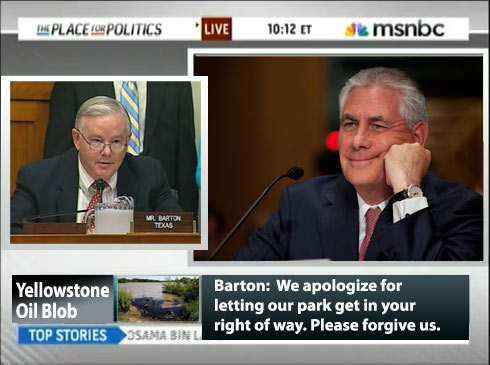
Barton Apologizes to Exxon: “We’re sorry Yellowstone got in the way of your Pipeline. We ask Your Forgiveness.”

Ok, it didn’t happen. Probably won’t happen.

But it’s an opportunity to remind people of who climate deniers are, what they do, who finances them, and what they want for the rest of us.

Our Founding Fathers knew these people well.

Happy fourth of July.