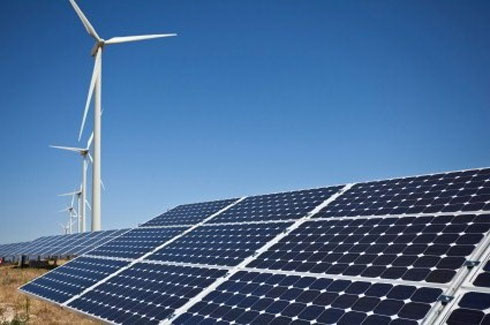
The new industrial revolution, based on transition to renewable energy and sustainable technology is here. Who will seize the initiative to lead in the coming century? The US has stumbled somewhat lately, with a growing anti-science and technology movement, funded by highly regressive fossil fuel interests doing everything it can to fog the issues, distort the science, and confuse the public on this critical area for technological competitiveness.
I present here an OpEd piece from Stanley “Skip” Pruss, former energy advisor to Michigan Governor Jennifer Granholm, on the prospects in renewable deployment and manufacturing in that key industrial state. Then, lets compare to ongoing efforts in Germany, a region similar geographically, and with an equally renowned manufacturing tradition.
Skip Pruss in the Detroit Free Press:
 We got a glimpse this month of Gov. Rick Snyder’s view of renewable energy in Michigan.
Signaling likely opposition to the new proposed ballot initiative that would require 25% of Michigan’s electricity to be derived from renewable sources by 2025, the governor said during a visit to Port Huron that “Michigan is not necessarily a very good renewable state for wind or solar, relative to some of the states out west or in other parts of the country.”
Michigan’s present clean energy standard requires 10% of our electricity to come from clean energy sources by 2015 — the lowest requirement among the 29 states that have mandated clean energy standards.
While it’s true that there are areas within the U.S. that have more wind and solar energy potential than Michigan, any implication that developing Michigan’s clean energy resources would be economically inefficient is plainly wrong.
–
Validating the cost effectiveness of clean energy, the Michigan Public Service Commission has determine that wind energy in Michigan costs about 40% less than energy from a new coal plant.
This is because innovation has led to dramatic improvements in wind and solar technologies, lowering costs and improving the economics — a trend that will continue. And because they don’t burn fossil fuels, there is zero threat of volatile or escalating fuel costs ratcheting up utility bills.
Meanwhile recent electricity costs are up 13.5% for DTE Energy customers and $4.28 per month more for Consumers Energy’s residential customers (using an average of 500 kilowatt hours of electricity per month). These increasing costs are largely attributable to the escalating cost of coal and coal transport — given the fact Michigan utilities import 100% of the coal they burn — and needed environmental upgrades to aging 20th Century infrastructure.
Gov. Snyder needs to take an energy lesson from Germany, an automobile manufacturing country with a highly skilled, unionized labor force similar to Michigan’s. Germany backed renewable energy policies aggressively and now gets 17% of its electricity from clean energy sources, with targets of 35% in 2030 and 80% by 2050. The result: 382,000 new jobs in thriving clean energy technology sector and a projected 600,000 jobs by 2020.
One would think that because Germany lies, on average, 400 miles farther north than Michigan, it might not necessarily be a very good place for solar energy. Yet Germany has deployed 6 times as much solar energy (25 gigawatts) as the entire U.S. (4.2 gigawatts) and has a vibrant wind sector as well.
Now, how does the US’s manufacturing giant compare to a close European counterpart?
Craig Morris, an American writer specializing in German energy issues, brings the current German posture on renewables into focus.
Germany has a trade surplus with China; the uS, a trade deficit. The uS exported 94 billion dollars in goods to China in 2011, compared to 367 billion in imports from China – a deficit of 273 billion. The New York Times attributed the 12.7 billion dollar surplus that Germany had with China in the 12 months leading up to August 2011 “largely [to] the sales of capital equipment that helped China produce more products.” Solar production lines are one such example.
Continue reading “The Renewable Revolution is Here. Will the US Compete?”