
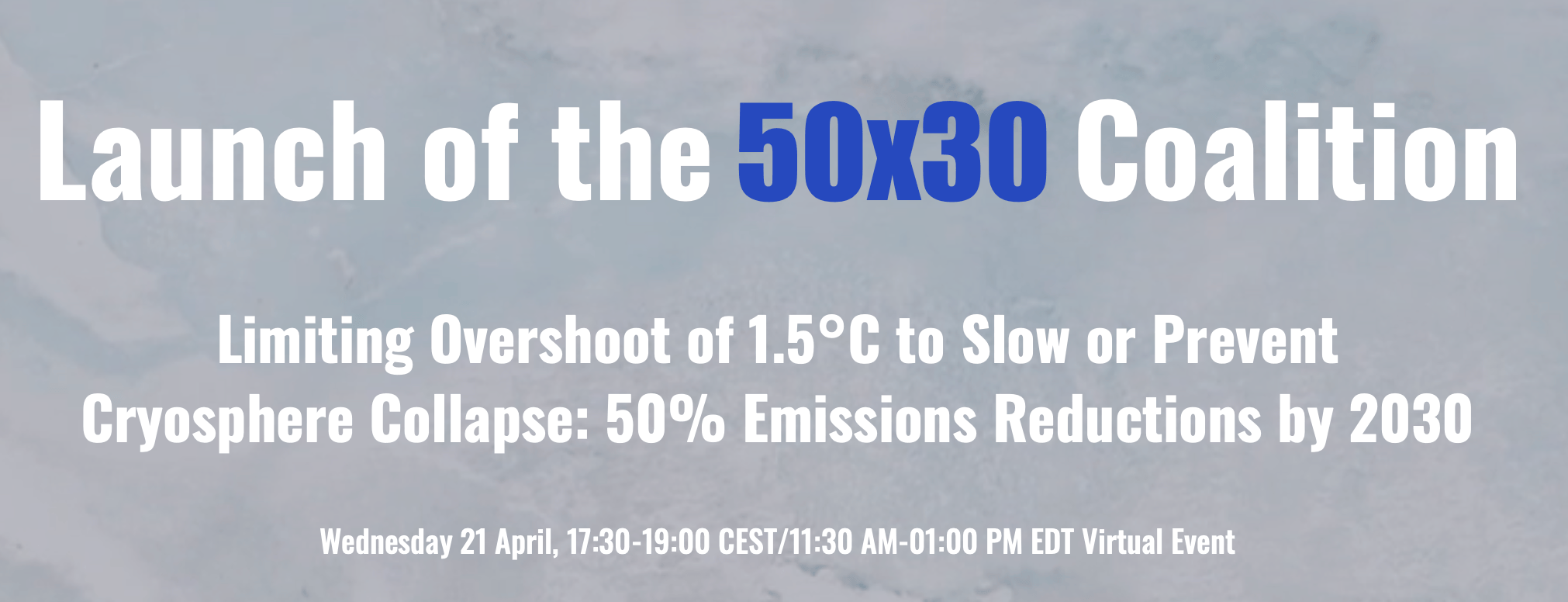
Can We Do 50×30 ?

Launch event for this science/tech/policy initiative Wednesday, free registration here.

50×30.net:

The 50×30 coalition is an alliance between cryosphere and emissions research institutions, and governments that have accepted the scientific necessity to reduce emissions 50% by 2030; in order to prevent cascading and irreversible damage, on a planetary scale, from the impact of greenhouse gas emissions on the cryosphere.

Because of cryosphere, carbon neutrality by 2050 is not enough: the way we get there matters.  Overshoot of the 1.5°C goal cannot be considered a viable or safe option, from either an economic or social standpoint. This is because much of the Earth’s polar and mountain regions – whether glaciers, snowpack, permafrost, sea ice, polar oceans and seas, or the great polar ice sheets – react directly to peaks in temperature and carbon dioxide emissions.  

This can tip many of these systems into a state of decline, where a later return to lower temperatures and CO2 levels makes little difference: the damage is done, and cannot be reversed on any human timescale.

We cannot negotiate with the melting point of ice.

Scientist’s Statement:

As cryosphere scientists and research institutions, we are alarmed by the rapid changes from global warming that we see today in these polar and mountain regions.  Most importantly, we need to communicate to the world that these changes, if they are allowed to continue, will not be reversible; and will spread across the entire globe.

We see this damage already today.  Cold polar seas are acidifying more quickly than any on the planet, threatening humanity’s richest fisheries.  Arctic sea ice continues to disappear at a stunning rate, with warming poles disrupting global weather patterns.  Permafrost thaw is now releasing carbon at the same scale as a top-20 emitter, while intensified wildfires in drier sub-Arctic forests, grasslands and peatlands release even more.  Shrinking glaciers and snowpack threaten reliable water supplies for billions of people, and rising sea levels from melting ice sheets will not be reversible on any human timescale.

Ambitious and effective near-term emissions reductions also lead to less reliance on carbon dioxide removal. These near-term reductions help avoid trade-offs with other needs such as food supply and ecosystem preservation, with. the necessary “negative emissions” achieved in more sustainable ways including more nature-based solutions.

The 2018 IPCC SR1.5 outlined the need for 50% global reductions by 2030 in order to remain within 1.5°C of warming. There are other non-cryosphere impacts from exceeding 1.5°C; but the cryosphere stands out because its changes will persist for hundreds or thousands of years – in the case of ocean acidification, 50-70,000 years.

This is truly an emergency of global proportions.  We call on our governments, and other major stakeholders to listen to the science, and act accordingly.

Continue reading “Can We Do 50×30 ?”

Drought Dries Up Computer Chip Supplies

Apple reportedly faces shortage of power management chips for iPhone, other  devices | AppleInsider

It’s all connected.

Wall Street Journal:

TAIPEI—The worst drought in half a century is hitting Taiwan, adding strain to an island that is home to two-thirds of the world semiconductor manufacturing capacity during the worst global chip shortage in recent memory.

The drought’s impact on semiconductor producers, which require voluminous quantities of water to churn out chips, is so far modest as the government creates exceptions for these manufacturers. But companies are starting to make adjustments, and officials have warned that the water shortage could worsen without adequate rainfall.

Taiwan’s semiconductor wafer-fabrication factories, or fabs, account for 65% of global production, according to the research firm TrendForce. Most of that capacity belongs to Taiwan Semiconductor Manufacturing Co. TSM 0.41% , the world’s biggest contract chip maker.

“Taiwan is the center of gravity for semiconductor manufacturing,” said Syed Alam, global lead of the semiconductors practice at Accenture. “This is one thing you don’t need adding more pressure on the situation.”

Seasonal typhoons provide Taiwan with much of its water reserves. But a lack of storms last year has strained supplies, prompting the government to start rationing water for more than a million businesses and residents.

The heightened risk comes as the global chip supply has been battered by a series of natural disasters just as demand for semiconductors has soared from auto makers and electronics companies around the world.

Severe weather in Texas earlier this year forced Samsung Electronics Co. to close two of its chip factories in Austin temporarily. The auto chip maker Renesas Electronics Corp.’s plant in Japan was hit first by an earthquake in February and then a fire in March that executives said would require months for recovery.

Taiwan’s three science industrial parks, which house most of the island’s chip-making facilities, have had to curb their water intake but are so far exempt from stoppages, which has helped stave off disruptions. Still, some companies are feeling the pinch.

Micron Technology Inc., a U.S. chip maker with Taiwan facilities in Taichung and Taoyuan, said securing alternative sources of water and speeding up conservation would increase production costs after supply to one of its Taiwan-based memory-chip facilities was reduced.

Meantime, TSMC and United Microelectronics Corp. UMC 2.38% , both of which are based in Hsinchu, Taiwan, have arranged for trucks to bring in additional water supplies. TSMC said it is also in talks with some companies to use groundwater from their construction sites.

MacRumors:

Apple supplier TSMC today said it is doing all it can to increase productivity and alleviate the worldwide chip shortage, but that tight supplies will likely continue into next year.

The comments followed a reported 19.4% rise in the Taiwanese firm’s first-quarter profit, which beat market expectations, thanks to strong chip demand and a global shift to home working.

TSMC did not mention Apple specifically, but it is a major Apple supplier and this suggests that the ongoing chip shortage could continue to impact Apple. TSMC produces A-series chips for the iPhone, iPad, and Apple silicon chips for the Mac. Foxconn, another Apple supplier, said in March that it expects the global chip shortage to extend into the second quarter of 2022.

An earlier report claimed Apple is facing a global shortage of certain components for some of its MacBook and ‌iPad‌ models, which is causing the Cupertino tech giant and its suppliers to postpone production of the products. Samsung is also said to be feeling the impact in its production of OLED displays, which Apple uses in its iPhones.

The ongoing chip shortage was caused by supply chain issues that arose during the global health crisis and weather-related events like the freeze in Texas that shut down Austin chip plants.

Ted Cruz: From Climate Denier to Anti-Mask Cultist

These days, Ted Cruz is the leader of the know-nothing anti-mask movement (throwing a tantrum in a Target near you..) – but he’s been the leading voice against science in the Senate for a long time.

Yahoo News:

Texas senator Ted Cruz has confirmed that he will no longer wear a maskwhile in the US Capitol, despite the ongoing coronavirus pandemic.

Speaking to a CNN reporter on Thursday, Mr Cruz, 50, explained his decision by saying: “At this point I’ve been vaccinated. Everybody working in the Senate has been vaccinated.”

The senator then defended the practice by adding: “CDC (Centres for Disease Control and Prevention) has said in small groups, particularly with people who were vaccinated, don’t need to wear masks”.

CNN reported that after Mr Cruz made those remarks, he got into a small elevator with two aides, both of whom were wearing face masks.

I really enjoyed making these take-downs.

The Weekend Wonk: Carbon Capture Gas Plants Planned: Are they Ready for Prime Time?

NET Power

Are gas turbines with carbon capture part of the answer?
There are reasons to be skeptical.
But, If they can build two new planned facilities, we’ll have a test case.

Bloomberg:

A new kind of power plant that doesn’t add greenhouse gases to the atmosphere is being built in the U.S., potentially providing a way for utilities to keep burning natural gas without contributing to global warming.

Net Power intends to build two natural-gas power plants in the U.S. that will have all its emissions captured and buried deep underground. The startup licensed its technology to developer 8 Rivers Capital LLC, which will work with agriculture giant Archer-Daniels-Midlands Co. to replace some emissions from a coal power plant in Illinois.

For the other plant, 8 Rivers is working with the Southern Ute Indian Tribe Growth Fund in Colorado. Both projects will be designed and developed this year, which 8 Rivers says requires spending tens of millions of dollars. A final decision on whether to go ahead with the facilities is due in 2022.

Net Power’s technology uses a new kind of turbine to burn natural gas in oxygen, rather than the air. As a result, the plant only produces carbon dioxide and water as a byproduct. The water can be frozen out of the mixture and the pure stream of CO₂ can be buried in depleted oil and gas wells or similar geological structures.

The required oxygen is secured by separating it from the air, which needs energy. But Net Power says its turbine is more efficient so that, on balance, the overall efficiency of the system matches that of an advanced natural-gas power plant that pumps its emissions into the atmosphere. Another upside of using oxygen is that Net Power plants do not produce any nitrogen emissions, which would cause local air pollution.

Continue reading “The Weekend Wonk: Carbon Capture Gas Plants Planned: Are they Ready for Prime Time?”

Texas Close Call a Warning for Summer?

TKTKTK

Texas Tribune:

Electricity outages in Texas could occur again this summer — just a few months after the devastating winter storm that left millions of Texans without power for days — if the state experiences a severe heat wave or drought combined with high demand for power, according to recent assessments by the state’s grid operator.

Experts and company executives are warning that the power grid that covers most of the state is at risk of another crisis this summer, when demand for electricity typically peaks as homes and businesses crank up air conditioning to ride out the Texas heat. Texas is likely to see a hotter and drier summer than normal this year, according to an April climate outlook from the National Oceanic and Atmospheric Administration, and 2021 is very likely to rank among the 10 warmest years on record globally.

“This summer, I am as worried right now [about the grid] as I was coming into this winter,” said Curt Morgan, CEO of Vistra Corp., an Irving-based power company. “Sounds like I’m the boy that cries wolf, but I’m not. I’ve seen this stuff repeat itself. We can have the same event happen if we don’t fix this.”

As state lawmakers continue debating how to improve the grid after February’s storm nearly caused its collapse, on Tuesday Texans were asked to conserve electricity because the supply of power could barely keep up with demand. A significant chunk of the grid’s power plants were offline due to maintenance this week, some a result of damage from the winter storm.

The warning triggered a torrent of outrage from residents and political leaders across the state who questioned why the Electric Reliability Council of Texas, which manages the grid, allowed it to come so close to emergency conditions on a relatively mild spring day. “I appreciate the increased effort toward transparency, but wow this is nervewracking to see in April,” state Rep. Erin Zwiener, D-Driftwood, tweetedTuesday.

Heading into the summer, ERCOT included three extreme scenarios in a preliminary assessment of the state’s power resources for the summer — the most extreme calculations ERCOT has ever considered for the seasonal assessment. Each scenario would leave the grid short a significant amount of power, which would trigger outages to residents:

  • In the first scenario, a drought similar to what the state saw in 2011, combined with low winds, several natural gas plants offline and an increase in economic activity as the pandemic eases, would leave the power grid short 3,600 megawatts, or enough to power 720,000 homes.
  • Add low solar power generation to the first projection (say it’s a cloudy day), and the grid would be short 7,500 megawatts, or enough to power 1.5 million homes.
  • In the most extreme scenario ERCOT considered, a severe heat wave across the entire state combined with outages for every major power source would leave the grid short 14,000 megawatts, or enough to power 2.8 million homes.

Power grids must keep supply and demand in balance at all times. When Texas’ grid falls below its safety margin of 2,300 megawatts in excess supply, the grid operator starts taking additional precautions, like what happened on Tuesday, to avoid blackouts.

Pete Warnken, ERCOT’s manager of resource adequacy, told reporters near the end of March that the grid operator included the extreme scenarios to “broaden the debate on how to make the grid more resilient.” Still, he said ERCOT expects sufficient power reserves, “assuming normal conditions” this summer.

Continue reading “Texas Close Call a Warning for Summer?”

Study: Clean Energy + Batteries Beat Gas, Hands Down

About 10 years ago, the cost of solar PV dropped below the cost of gas peakers in the American Southwest, particularly California. At that moment the PV revolution, and the attendant plunge in costs, became unstoppable and inevitable – as large scale PVs ramped up, with accompanying scales in production.
If there was any doubt, new study from Australia shows that battery storage has reached that point now as well.

PV Magazine:

Australia’s Clean Energy Council (CEC) says in a newly published paper that large-scale battery energy storage has become the best way to spread energy generated by solar and wind throughout any day, and to instantly respond to peak energy needs in the National Electricity Market (NEM) for long and short durations.

The paper compares the levelized cost of energy delivered by a new 250 MW gas peaker plant with 250 MW four-hour and two-hour grid-scale batteries. It finds that overall – when various costs are calculated – that the batteries are 17% (two-hour) and 30% (four-hour) cheaper.

Improvements in battery-operating technology mean storage now outperforms gas-fired peaking plants on speed and reliability of response, which was the basis of gas technology’s biggest claim to a place in the future renewables-based electricity system.

Where gas plants can respond within 15 minutes, says the CEC report, battery solutions can discharge as “demand (and correspondingly prices) approach peak levels” and sustain output “to cover the typical daily peak duration.”

“Batteries can ramp up quickly, have zero start-up time and provide a better frequency response,” said CEC Chief Executive Kane Thornton.

Dr Fauci Becomes Symbol for the Anti-Science Crowd

Raw Story:

On CNN Thursday, former George W. Bush campaign strategist Matthew Dowd highlighted why Republicans have been so fixated on demonizing National Institutes of Health expert Dr. Anthony Fauci, as Rep. Jim Jordan (R-OH) did at a congressional hearing earlier in the day.

“This is far from the first time we’ve seen Republicans try to beat up on Dr. Fauci,” noted anchor Erin Burnett. “They love these moments. We saw it from Jim Jordan (R-OH) today and Rand Paul (R-KY) not long ago. That’s how it’s been. Why is the GOP so obsessed with going after Dr. Fauci?”

“Well, I think this is fundamentally about the attack on science and data, and if it doesn’t agree from many of the GOP perspective as science or data or knowledge or information doesn’t agree with basically their emotional stand, they want to ignore it,” said Dowd. “And I think that’s the problem, I think, Dr. Fauci has here, because Dr. Fauci is trying to take a rational approach against people who have an emotional place in this.”

Stupid Youtube Tricks: The Video They Don’t Want you to See

Ok, so the new video is out, and it’s about climate denial as one of the key and most important drivers of the disinformation ecosystem that we find ourselves in.

So, we used “QAnon” in the title, originally, and in the tags as well.
Which has apparently earned us a YouTube jail sentence.


So, you can’t watch it here, you’ll have to go on YouTube direct to watch it.

Anyhow, I hear it’s really good.

(I’ve appealed to the robot algorhythm Gods or whoever – we’ll see what happens, but this thing has been delayed long enough)