If you’re a coal junkie, you’ve probably read quite a few press accounts touting the bright future for Powder River Basin coal. This story from Gilette, Wyoming, for example, predicts a resurgence in demand for the low-rank coal produced in the region. This one argues that coal is making a comeback, after years of losing ground to natural gas. This one forecasts “tremendous” demand for the region’s dirtiest fuel. I could go on and on.
Articles of this ilk generally offer breathless quotes from coal industry executives, and point to a few factors, such as rising natural gas prices or the cold winter, that make a rapid rise in coal demand seem plausible.
But what these articles don’t do is provide much supporting data. And when you look at theactual production figures from Western coal country, a very different story emerges. After peaking in 2008, coal production in Wyoming has fallen by 17 percent.
And if I’m right, those the trends won’t be reversing themselves any time soon.
This coal-to-gas plant built by Datang International is the first of its kind in Inner Mongolia. It creates methane that can be piped to Beijing, where it can be used as a cleaner burning fuel to reduce air pollution. But the plant itself can send out quite a stench. Hal Bernton, Seattle Times
I’ve reported, hopefully, that China is moving quickly on renewables, and taking a serious look at reducing air pollution from coal burning in urban areas. One of the proposed ‘solutions” to air quality problems is clearly misguided.
The new coal plant here is an industrial fortress of boilers, tanks and towers that stretches across a lonely plateau in Inner Mongolia.
All day long and through the night, it vents huge gray clouds of steam and emits an awful stench.
Though it may seem odd, this is part of China’s campaign to combat the nation’s notorious urban smog. The plant transforms low-grade coal into a cleaner-burning methane gas that can be piped to cities, replacing dirtier fuels that now are used to cook meals, heat homes and produce electricity.
The Chinese leadership has called for the accelerated development of these coal-to- gas plants, and more are under construction in areas distant from major urban centers.
But embracing this technology to fight air pollution involves a serious environmental trade off. The plants that produce this gas spew far more carbon emissions than those that burn coal to generate electricity.
“They’re going to lock in emissions. China — and the world — will bear the consequences for decades,” said Robert Jackson, professor of environment and energy at Stanford University.
A study published last year in Energy Policy found that producing, transporting and combusting this coal-generated gas results in up to 82 percent more carbon emissions than burning China’s coal directly to generate electricity
Two Weeks ago I spoke at a High School advanced Science class in Southern Michigan. On Friday I was in a middle school classroom here locally. I think its part of the mission.
Turns out lots of Americans know they should know more about climate.
A new study reveals significant gaps in many north Americans’ knowledge about climate change. But the vast majority want to know much more, and 75 per cent want to see climate change taught in schools according to new research from the Yale Forum on Climate Change Communication. We’ve picked five of the most interesting graphs from the research.
1. Hunger for more knowledge
The study also revealed many Americans don’t have a very high opinion of their own knowledge about climate change. Only one in 10 say they are “very well informed” about how the climate system works or the different causes, consequences or potential solutions to climate change. 51 to 52 per cent say they are “fairly well informed”.
But a large majority – 75 per cent – say they would like to know more and, as the graph below shows, 75 per cent say schools should teach children about climate change. 68 per cent say they would welcome a national education programme to teach Americans about the issue.
Good News – Americans trust our leading scientific institutions to have good information about climate. Which is why so many denialist screeds start out with “New NASA study says…” followed by the distortion. The tribute vice pays to virtue.
I think I’ve mentioned before that if anyone knows how to script, send me some kind of app where I can just hit an “f” key and automatically type “a month’s worth of rain in 24 hours”. “F2” will go to “A year’s worth of rain..”
Astrophysicist Neil deGrasse Tyson has found a surprising home on FOX Broadcasting Network to host Cosmos: A Spacetime Odyssey. In the 13-part documentary series, Tyson’s advocacy of scientific literacy — particularly related to climate change — is directly at odds with its sister network, Fox News.
In the latest episode of Cosmos, Tyson devoted the hour to the Earth’s history of changing climates and subsequent mass extinctions. He ended the show by forecasting the next mass extinction due to climate change, imploring his audience to break society’s “addiction” to fossil fuels:
TYSON: We can’t seem to stop burning up all those buried trees from way back in the carboniferous age, in the form of coal. And the remains of ancient plankton in the form of oil and gas. If we could, we’d be home free climate-wise. Instead, we are dumping carbon dioxide into the atmosphere at a rate the earth hasn’t seen since the great climate catastrophes of the past. The ones that led to mass extinctions. We just can’t seem to break our addiction to the kinds of fuel that will bring back a climate last seen by the dinosaurs, a climate that will drown our coastal cities and wreak havoc on the environment and our ability to feed ourselves. All the while, the glorious sun pours immaculate, free energy down upon us, more than we will ever need. Why can’t we summon the ingenuity and courage of the generations that came before us? The dinosaurs never saw that asteroid coming. What’s our excuse?
Big Story. The East Antarctic Ice sheet – the world’s icebox, once thought all but impervious to melt on any meaningful time scale, is , on deeper inspection, much more vulnerable than we supposed. The video above, from December, fleshed that idea out.
The East Antarctic ice sheet is thought by most scientists to be stable. But a German team says it has found how part of it could in time melt unstoppably.
LONDON, 4 May – Part of the East Antarctic ice sheet may be less stable than anyone had realised, researchers based in Germany have found.
Writing in Nature Climate Change, two scientists from the Potsdam Institute for Climate Impact Research (PIK) say the melting of quite a small volume of ice on the East Antarctic shore could ultimately trigger a discharge of ice into the ocean which would result in unstoppable sea-level rise for thousands of years ahead. http://www.nature.com/nclimate/journal/vaop/ncurrent/full/nclimate2226.html
Their findings, which they say amount to the discovery of a hitherto overlooked source of sea level rise, appear unlikely to happen any time soon. They are based on computer simulations of the Antarctic ice flow using improved data of the ground profile beneath the ice sheet.
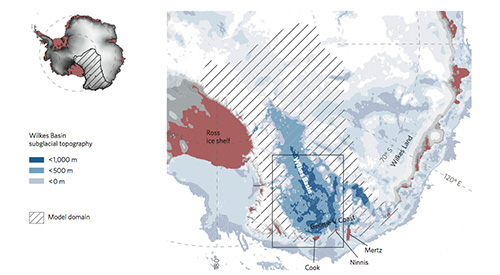
“East Antarctica’s Wilkes Basin is like a bottle on a slant,” said Matthias Mengel, the lead author of the study. “Once uncorked, it empties out.” The basin is the largest region of marine ice on rocky ground in East Antarctica.
The Wilkes Basin; subglacial area and model domain. The Wilkes Basin (labelled blue shadings) is the largest region with topography below sea level in East Antarctica. At George V Coast, the Cook and Ninnis ice streams drain into the Southern Pacific Ocean and rest on deep palaeo-troughs. Our model domain (hatches) extends to the present ice divides.
At the moment a rim of ice at the coast holds the ice behind it in place, like a cork holding back the contents of a bottle. The air over Antarctica remains cold, but oceanic warming can cause the ice on the coast to melt. This could make the relatively small “cork” disappear.
Once it had gone, the result would be a long-term sea level rise of three to four metres. “The full sea-level rise would ultimately be up to 80 times bigger than the initial melting of the ice cork,” says the study’s co-author, Anders Levermann. “Until recently, only West Antarctica was considered unstable, but now we know that its ten times bigger counterpart in the East might also be at risk.”
We know that one of the key negative effects of climate change will be increased rates of species extinction. Climate deniers like to laugh at this, as if the disappearance of other life forms, like Polar Bears, has no effect on things we care about. But the more we follow the strands of life’s web, the more connections we find to everything else in the system.
It might not seem obvious at first, but wolves can have a huge indirect effect on ecosystems. They aren’t just good for reducing deer populations and such; they fundamentally change how these herbivores behave, where they graze and which areas they avoid. This means that trees and plants start growing again in places that were overgrazed, giving shelter to all kinds of species (songbirds, beavers, rabbits). This in turns changes how the local ecosystem works further, providing more ecological niches to more species, until after a few years the area is almost unrecognizably more alive! All this thanks to wolves, this underrated apex predator!
For an idea that he dreamed up in his spare time, 63-year-old Garthen Leslie accepted a $100,000 check last week from Ben Kaufman, the 27-year-old CEO of Quirky. It’s the first of at least 5 checks of that size that the self-employed IT consultant is likely to receive this year from Quirky.
The five-year-old New York City manufacturing company is on a mission to “bring real people’s product ideas to life.” Leslie’s idea—one of many that the self-confessed tinkerer with a PhD has pitched to Quirky—is a smartphone-controlled window-unit air conditioner that learns users’ habits in order to conserve energy and cut costs while keeping them cool.
Leslie had been ruminating on his “smart air conditioner” since summer 2012. That’s when, driving from his Columbia, Md., home into Washington, he was struck by all of the cooling units hanging out of old apartment building windows. Having spent several years of his career at the U.S. Department of Energy, Leslie naturally wondered about the cost to operate them all day.
He recalls, “I realized the people who lived there had two options: Leave the air conditioner running when they’re out, adding up expenses and energy consumption, or shut it off and come home to a hot and sticky home.” A smartphone married with a new type of air conditioner could provide more flexibility, he thought: You could reduce cooling costs by turning on the air conditioner with your phone as you were leaving work and arrive home to a comfortable room.
But Leslie didn’t have the wherewithal to take his invention any further, so it remained just a pipedream on paper for six months. Then, one night in January 2013, as he was falling asleep in front of the TV, he caught Jay Leno interviewing Ben Kaufman about Quirky’s business model.
When Kaufman described how his company “bridges the gap between great ideas and real products” by developing and compensating concepts contributed by regular people, Leslie perked up. “I had defined a great idea as well as I could, but I was stuck on all this other stuff that needs to happen for it to become a product,” he says. He sleepily jotted down the Quirky URL.
A few days later Leslie created an online profile and submitted not just the air conditioner—described in two paragraphs with a crude diagram—but also another 20 or so of his inventions that had been languishing in an inches-thick file on his desk.
When it comes to our nation’s special forces, getting to battle is a key part of the mission. Considering where many of those missions lead, it is just as important to get there unnoticed and traversing long distances without needing to refuel. So how about a hybrid all-wheel-drive motorcycle? The answer is yes.
Motorcycles have long been part of warfare. In WWII, Harley-Davidson and Indian were popular motorcycles that were used as quick vehicles for messengers and other duties. Flash forward to modern warfare and the dirt bike is a crucial part of the Navy SEAL’s specialized vehicle arsenal. They include Kawasaki dirt bikes and Christini AWD military bikes. These speciality bikes feature modifications like inferred headlights, reserve fuel tanks and heat-masking paints.