If there’s one thing Virginia Attorney General Ken Cuccinelli hates more than breasts, it’s renewable energy.
Bringing his deep analytical skills to the energy debate, the ambitious Tea Party poster boy is making the fight against (communist-UN-Kenyan) renewable energy standards a signature issue, and has enlisted Virginia’s Dominion Power to help.
This dovetails with recent reports of Koch funded efforts to thwart the overwhelming majorities of Americans who favor policies in support of renewable energy. Leaked documents detail plans to use “subversion”, fake “grass roots” activists, “dummy businesses” and “counter intelligence” to kill renewable energy projects at the state and local levels.
This is Grist Appreciation Day, and coincidentally it turns out they’ve got this issue covered as well.
RICHMOND—Dominion Virginia Power has informed environmental groups that the company has reached a tentative agreement with Virginia Attorney General Ken Cuccinelli to support legislation that would effectively repeal the state’s signature clean energy law. The move, environmentalists said, would not only harm the environment but also represents a de facto admission of guilt by Dominion. The company has already accepted $77 million from ratepayers without making the clean energy investments that the General Assembly first intended with its original 2007 law.
Cuccinelli, a nationally known global warming denier who has sued the US EPA and the University of Virginia in the past to advance a radical anti-environmental agenda, has been critical of the state’s “Renewable Portfolio Standard (RPS)” law for some time. Dominion, meanwhile, has been publicly criticized for months by environmental and health leaders in the state for exploiting loopholes in the RPS energy law to gain millions of dollars in incentive payments from customers without developing a single wind farm or large solar project in the state.
I’m really starting to like the service Paul Douglas is providing in these “weather at five” style climate updates.
Here’s a quick, digestible, easy to understand rundown on the latest global temperature data, from the “Republican Meteorologist” – perfect for your non-wonky but curious friends and relatives – here’s a vid you can send to your Mom.
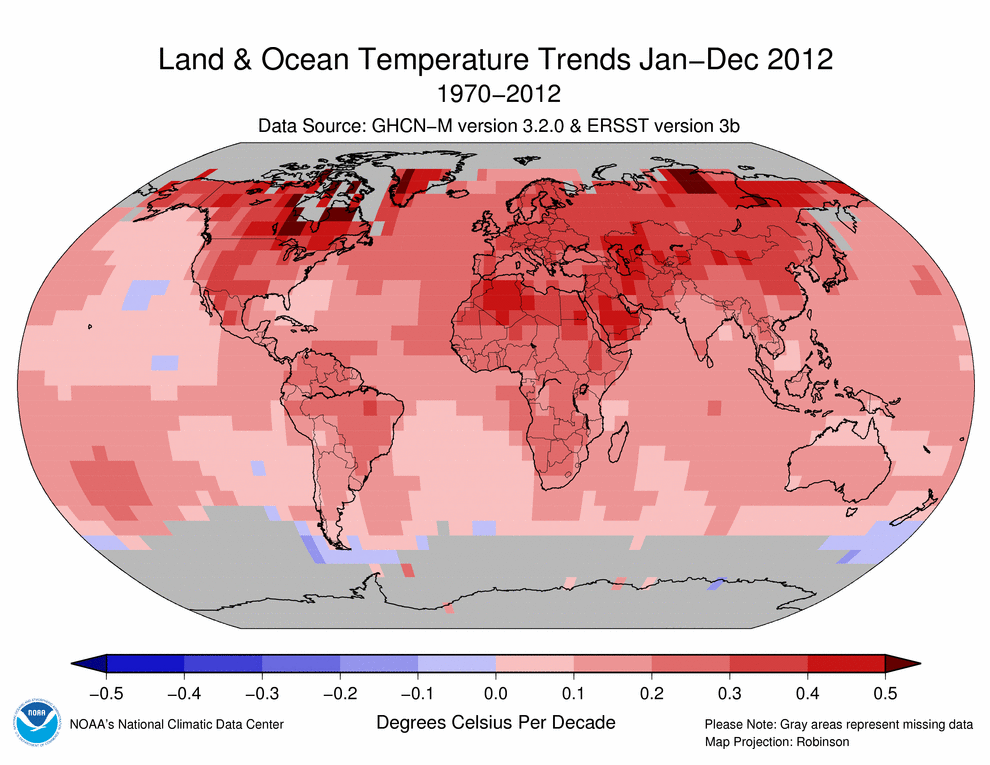
The globally-averaged temperature for 2012 marked the 10th warmest year since record keeping began in 1880. It also marked the 36th consecutive year with a global temperature above the 20th century average. The last below-average annual temperature was 1976. Including 2012, all 12 years to date in the 21st century (2001–2012) rank among the 14 warmest in the 133-year period of record. Only one year during the 20st century—1998—was warmer than 2012.
Most areas of the world experienced higher-than-average annual temperatures, including most of North and South America, most of Europe and Africa, and western, southern, and far northeastern Asia. Meanwhile, most of Alaska, far western Canada, central Asia, parts of the eastern and equatorial Pacific, southern Atlantic, and parts of the Southern Ocean were notably cooler than average. Additionally, the Arctic experienced a record-breaking ice melt season while the Antarctic ice extent was above average.
The average temperature in 2012 was about 58.3 degrees Fahrenheit (14.6 Celsius), which is 1.0 F (0.6 C) warmer than the mid-20th century baseline. The average global temperature has risen about 1.4 degrees F (0.8 C) since 1880, according to the new analysis.
Scientists emphasize that weather patterns always will cause fluctuations in average temperature from year to year, but the continued increase in greenhouse gas levels in Earth’s atmosphere assures a long-term rise in global temperatures. Each successive year will not necessarily be warmer than the year before, but on the current course of greenhouse gas increases, scientists expect each successive decade to be warmer than the previous decade.
“One more year of numbers isn’t in itself significant,” GISS climatologist Gavin Schmidt said. “What matters is this decade is warmer than the last decade, and that decade was warmer than the decade before. The planet is warming. The reason it’s warming is because we are pumping increasing amounts of carbon dioxide into the atmosphere.”
This is no surprise, NASA, NOAA and others have been consistent. For years, they’ve have made it clear that global warming is unequivocal. NASA points out that “A publicly available computer program is used to calculate the difference between surface temperature in a given month and the average temperature for the same place during 1951 to 1980”. The data is widely available on line.
That did not stop climate deniers from doing their best to delude themselves and as many others as possible about the physics of greenhouse gases, and continually accuse NASA and others of somehow fudging numbers.
In recent years, climate deniers hoped they would have a champion in Stanford Physicist Richard Muller, a self declared skeptic, who, with funding from, among others, the Koch Brothers, initiated what he claimed would be the ultimate study of global temperatures, if they were rising, and why.
High profile climate denier Anthony Watts wrote at the inception of the study:
“I’m prepared to accept whatever result they produce, even if it proves my premise wrong. The method isn’t the madness that we’ve seen from NOAA, NCDC, GISS, and CRU. That lack of strings attached to funding, plus the broad mix of people involved especially those who have previous experience in handling large data sets gives me greater confidence in the result being closer to a bona fide ground truth than anything we’ve seen yet.”
To his credit, Muller assembled a team of good scientists, under the leadership of Lead Scientist Robert Rohde. That’s the main reason why, when the results came in, Watts and the denia-sphere were disappointed.
Dr. Muller has been widely covered in the national media, but I was curious to hear from one of the man Muller raved was a great scientist, a mathematical genius. I ran into Dr. Rohde at the American Geophysical Union conference in December 2012, and asked him to sum up what the BEST project had learned.
Now, in a major effort at the University of Delaware, a much more detailed and specific look at how a shift to renewables could replace, watt for watt, the current system in a large regional grid called the PJM Interconnection, representing 13 states and one fifth of the US grid.
Intermittency may be a problem for an individual wind farm or solar power plant, but a diverse array of renewable energy systems—coupled with storage in the form of batteries or hydrogen tanks—apparently wouldn’t suffer such issues.
A study by researchers at the University of Delaware modeled how well renewables could sustain a big chunk of the U.S. grid—72 gigawatts worth, where the entire country has a capacity just north of 1000 GW—and found as high as 99.9 percent reliability at reasonable costs.
The Delaware researchers evaluated 28 billion combinations of renewable energy and storage, modeled out over a theoretical four-year period using historical weather and electricity load requirement data. “At 2030 technology costs and with excess electricity displacing natural gas, we find that the electric system can be powered 90 to 99.9 percent of hours entirely on renewable electricity, at costs comparable to today’s,” the authors wrote. Senior author Willett Kempton has long pushed forvehicle-to-grid (V2G) systems in which plugged in electric vehicles can provide power back to the grid.
–
The 99.9 percent figure can be achieved with, for example, 17 GW of solar power, 68 GW of offshore wind, and 115 GW of onshore wind. The most cost-effective solutions featured huge excesses of generation capacity—up to three times the load requirements at times—in order to minimize costly power storage additions. The authors wrote that “at 2030 technology costs, 90 percent of load hours are met at electric costs below today’s.”
One of several new findings is that a very large electric system can be run almost entirely on renewable energy.
“For example, using hydrogen for storage, we can run an electric system that today would meeting a need of 72 GW, 99.9 percent of the time, using 17 GW of solar, 68 GW of offshore wind, and 115 GW of inland wind,” said co-author Cory Budischak, instructor in the Energy Management Department at Delaware Technical Community College and former UD student.
A GW (“gigawatt”) is a measure of electricity generation capability. One GW is the capacity of 200 large wind turbines or of 250,000 rooftop solar systems. Renewable electricity generators must have higher GW capacity than traditional generators, since wind and solar do not generate at maximum all the time.
The study sheds light on what an electric system might look like with heavy reliance on renewable energy sources. Wind speeds and sun exposure vary with weather and seasons, requiring ways to improve reliability. In this study, reliability was achieved by: expanding the geographic area of renewable generation, using diverse sources, employing storage systems, and for the last few percent of the time, burning fossil fuels as a backup.
During the hours when there was not enough renewable electricity to meet power needs, the model drew from storage and, on the rare hours with neither renewable electricity or stored power, then fossil fuel. When there was more renewable energy generated than needed, the model would first fill storage, use the remaining to replace natural gas for heating homes and businesses and only after those, let the excess go to waste.
The study used estimates of technology costs in 2030 without government subsidies, comparing them to costs of fossil fuel generation in wide use today. The cost of fossil fuels includes both the fuel cost itself and the documented external costs such as human health effects caused by power plant air pollution. The projected capital costs for wind and solar in 2030 are about half of today’s wind and solar costs, whereas maintenance costs are projected to be approximately the same.
What is it about racism and climate denial that they co-exist so cozily?
If time is short, just watch the first minute of the video above, and skip to about 10:00.
It was a pretty stunning wake up for anyone in the Republican party that might have been paying attention.
One of the most respected senior statesmen in the party, sounded yet another warning about the toxic takeover of the GOP by its regressive, racist element. Powell ticked off the dog whistle and not-so-dog whistle messages that senior Republican operatives have been sending, and matter-of-factly closed with the aside that, oh, yeah, climate change is real and we’d better start dealing with that, as well.
Could there be any sharper example than climate denier darling Lord Monckton, whose toxic mix of climate nonsense and birtherism continue to make him a darling of American conservatives, and the intellectual, such as it is, Father of climate denial in this country?
My Father was chairman of the local Republican party, one of the more influential county groups in this state. I know, understand, and have affection for, the ideals and practices of the party that used to be. That is not the one we have today.
Remember a few years ago when Al Gore got so much blowback for drawing a connection between racism and climate change? Gore was talking about his generation’s reaction to the racism of the 1950s and 60s, but he was certainly aware that as Republicans have become more and more hostile to climate science, they’ve also become more shockingly, brazenly, overtly hostile to anyone that doesn’t look like they belong at the country club.
Tell me I’m wrong. Tell Colin Powell he’s wrong. Look at november’s returns and tell the voters they’re wrong.
Ignore the pattern if it makes you uncomfortable – but America does best when we have a vigorous two party conversation, and that can’t happen when one half of the dialogue has been hijacked by bigots, blowhards, and the clinically insane.
Changes in solar radiation, known as solar forcing, have had only a very small effect on climate change, a member of the UN’s top panel of climate scientists said today.
The comment, made by a member of the UN’s Intergovernmental Panel on Climate Change (IPCC), followed the leak of a draft IPCC report late last year, which included comments on the effect of solar forcing on climate change.
At the time of the leak, the climate change skeptics blog, Watts Up With That drew attention to what it described as a “game-changing admission of enhanced solar forcing” but co-chair of the IPCC’s Working Group 1, Professor Thomas Stocker said that solar forcing actually did not play a major role.
“As the scientific publications indicate, the assessment is not yet completed. We are looking at an extremely small effect here, that’s what one can say from the publications but I should stress the experts are still performing their assessment,” he said a press conference in Hobart today.
The person who leaked the report, blogger Alec Rawls, obtained the draft by signing up as an expert reviewer of the draft.
Professor Stocker said the IPCC was “interested to have a very wide range of experts” reviewing their draft reports.
“We don’t want to have quantitative bars on the reviewers, for example requesting a certain number of publications in peer reviewed journals. We rely on an honest self-declaration on why he or she is an expert,” he said.
I interviewed Jeff Masters near his home in southeast Michigan on saturday, for an upcoming video. It just happened to be a day of record warmth, so we spent the time on the shore of a small lake a short walk away, where in former decades a ice would have been thick and safe for walking – we hugged the shore and kicked holes in the slushy surface.
48 hours later, we are in a hard, white freeze. Not enough snow for January, but, it’s cold. We’ll take it.
Above, Paul Douglas gives us another “Live at Five” look at how extremes are reshaping our weather.
Having recently booted a couple of particularly obnoxious and obviously increasingly psychotic posters from my youtube channel, I get this. I try to have an open comments policy, but I do have limits.
Everybody who’s written or blogged about climate change on a prominent website (or, even worse, spoken about it on YouTube) knows the drill. Shortly after you post, the menagerie oftrolls arrives. They’re predominantly climate deniers, and they start in immediately arguing over the content and attacking the science—sometimes by slinging insults and even occasional obscenities.
–
In a recent study, a team of researchers from the George Mason University Center for Climate Change Communication and several other institutions employed a survey of 1,183 Americans to get at the negative consequences of vituperative online comments for the public understanding of science. Participants were asked to read a blog post containing a balanced discussion of the risks and benefits of nanotechnology (which is already all around us and supports a$91 billion US industry). The text of the post was the same for all participants, but the tone of the comments varied. Sometimes, they were “civil”—e.g., no name calling or flaming. But sometimes they were more like this: “If you don’t see the benefits of using nanotechnology in these products, you’re an idiot.”
The researchers were trying to find out what effect exposure to such rudeness had on public perceptions of nanotech risks. They found that it wasn’t a good one. Rather, it polarized the audience: Those who already thought nanorisks were low tended to become more sure of themselves when exposed to name-calling, while those who thought nanorisks are high were more likely to move in their own favored direction. In other words, it appeared that pushing people’s emotional buttons, through derogatory comments, made them double down on their preexisting beliefs.
With the noteable, glowing exception of the bright, brilliant and essential UP with Chris Hayes, coverage of climate issues, even in this year of searing heat and falling records, continues to be abysmal. Apparently, coverage of the biggest issue of the millennium is not yet considered essential enough to bump Honey BooBoo and Kim Kardashian off the mainstream media.
Even In Record-Breaking Year, Broadcast Climate Coverage Remained Minimal. In 2012, the U.S. experienced record-breaking heat, a historicdrought, massive wildfires in the West, and Hurricane Sandy. Meanwhile, Arctic sea ice extent shattered the previous record low and the Greenland ice sheet saw thegreatest melt in recorded history. According to the National Climatic Data Center, 2012 was the warmest year in recorded history for the contiguous U.S. Yet despite these illustrations of climate change, the broadcast news outlets devoted very little time to climate change in 2012, following a downward trend since 2009:
In FourYears, Sunday Shows Have Not Quoted A Single Scientist On Climate Change. Of those who were asked about climate change on the Sunday shows, 54 percent were media figures, 31 percent were politicians and not one was a scientist or climate expert. This is consistent with a previous Media Matters analysis which found that none of the Sunday shows quoted any scientists on climate change between 2009 and 2011. By contrast, two-thirds of those interviewed or quoted on the nightly news programs in 2012 were scientists. [Media Matters, 4/16/12]
Sunday Shows Obscured Scientific Consensus On Climate Change. Not only did the Sunday shows shut out those who accept the science of climate change, but they also failed to inform their audiences that the vast majority of climate scientists agree that climate change is occurring and is driven by human activity. Only 11 percent of coverage implied that scientists agree on global warming, while 44 percent failed to correct a guest who questioned the science. By contrast, 60 percent of nightly news coverage alluded to the scientific consensus.
THE FISCAL conservatives in Congress may be right when they say the $60 billion for Hurricane Sandy relief and reconstruction should be paid for without adding to our national deficit. Fortunately, there’s a way to do so that could unite green-leaning climate realists (such as Marin’s Jared Huffman) and red-ink deficit hawks in both parties.
But first, to get a sense of the magnitude of disaster funding that needs to be addressed, add to the Sandy expense the mounting public tally for last year’s other record-breaking storms, droughts, wildfires and floods. And the $114 billion deficit-funded cost of Hurricane Katrina that’s still rolling forward on the federal books, wrecking hopes for more balanced budgets and more useful public investments.
Expensive as they are, these disasters represent only small down payments on the ballooning costs of climate disruption brought on by our unbridled burning of oil, coal and gas. By blanketing the planet with carbon pollution, fossil fuels have ushered in a state of perpetual climate emergency.
But if carbon is the core cause of climate disruption, it can also be the core solution. Carefully ratcheting up existing fees on the use of fossil fuels could offset the public expense triggered by these storms, droughts, fires and floods. It could also help fund clean-energy innovations and climate-ready infrastructure.
The smartest hedge would be a national carbon tax. It would marshal the market’s power to wring carbon out of the economy, putting decisions about the direction of energy and manufacturing in the hands of consumers and businesses that meet their demands, not Congress and interest groups that lobby lawmakers. When people must pay something for their pollution, they pollute less and invest in cleaner alternatives. A carbon tax would provide more certainty to industry and investors who currently can only guess at what climate policy will look like year to year.