After being left out in the cold all year, global warming is making a reappearance on the campaign trail.
President Obama, who campaigned aggressively in 2008 on the promise of fighting climate change, has barely mentioned the subject during this campaign, despite a summer of record heat and drought and news reports linking such extreme weather events to increases in greenhouse gases.
But on Thursday night, under the spotlight at the Democratic National Convention in Charlotte, just two months from the general election, Obama made his most high-profile mention of the controversial issue this year.
“And yes, my plan will continue to reduce the carbon pollution that is heating our planet—because climate change is not a hoax,” Obama said. “More droughts and floods and wildfires are not a joke. They’re a threat to our children’s future. And in this election, you can do something about it,” he said, to a sustained ovation.
Until now, Obama’s advisers calculated that in a campaign centered on the economy, a pledge to save the environment by cutting carbon pollution would fall flat—and create a target for Republican attacks. But Thursday’s remarks could signal a new willingness to address a crucial public-policy issue which both campaigns have until now avoided.
Credit Republican nominee Mitt Romney with putting the spotlight back on the issue, when, during his speech last week, he essentially mocked Obama’s climate agenda. “President Obama promised to begin to slow the rise of the oceans and to heal the planet,” he said in his acceptance speech for the party’s presidential nomination, drawing a laugh from delegates at the Republican National Convention in Tampa. “My promise is to help you and your family.”
The jab cried out for a response. Republican advisers said that Romney was not mocking climate change per se, but rather Obama’s lofty rhetoric in a 2008 speech, when he said, “This was the moment when the rise of the oceans began to slow and our planet began to heal.” But the remark was widely interpreted as a reinforcement of the extreme right-wing view, espoused by Republicans like Texas Gov. Rick Perry and Sen. James Inhofe of Oklahoma, that climate science is hoax.
Despite conventional campaign wisdom that talking about climate change during economically tough times is a losing issue, some experts say that Romney’s climate jab may have hurt him, while creating a new opening for Obama to win over independent voters. While questioning climate change may have helped Romney win in primaries, polls show that the majority of general-election voters accept climate science.
An August poll from Yale University found that 55 percent of voters say they will consider candidates’ views on global warming when deciding how to vote, and that 88 percent support U.S. action to reduce global warming, even if it has economic costs. The authors of the poll presented their findings to the White House this spring, noting that it ran counter to conventional campaign wisdom.
Anthony Leiserowitz, coauthor of the Yale poll, said of Romney’s convention jab, “He was throwing red meat to the base. It may have been a laugh line, but those who aren’t part of his conservative base may have been shocked that he would mock this. He will be forced to pay for it in some fundamental way with moderates and independents.” (see poll results in post below)
• A majority of all registered voters (55%) say they will consider candidates’ views on global warming when deciding how to vote.
• Among these climate change issue voters, large majorities believe global warming is happening and support action by the U.S. to reduce global warming, even if it has economic costs.
• Independents lean toward “climate action” and look more like Democrats than Republicans on the issue.
• A pro-climate action position wins votes among Democrats and Independents, and has little negative impact with Republican voters.
• Policies to reduce America’s dependence on fossil fuels and promote renewable energy are favored by a majority of registered voters across party lines.
• These patterns are found nationally and among ten swing states.
The crisis originates in this summer’s extreme weather. Almost 80% of the continental United States experienced drought conditions. Russia and Australia experienced drought as well.
The drought has ruined key crops. The corn harvest is expected to drop to the lowest level since 1995. In just July, prices for corn and wheat jumped about 25% each, prices for soybeans about 17%.
These higher grain prices will flow through to higher food prices. For consumers in developed countries, higher food prices are a burden — but in almost all cases, a manageable burden.
Americans spend only about 10% of their after-tax incomes on food of all kinds, including restaurant meals and prepackaged foods. Surveys for Gallup find that the typical American family is spending one-third less on food today, adjusting for inflation, than in 1969.
But step outside the developed world, and the price of food suddenly becomes the single most important fact of human economic life. In poor countries, people typically spend half their incomes on food — and by “food,” they mean first and foremost bread.
When grain prices spiked in 2007-2008, bread riotsshook 30 countries across the developing world, from Haiti to Bangladesh, according to the Financial Times. A drought in Russia in 2010 forced suspension of Russian grain exports that year and set in motion the so-called Arab spring.
–
And if food prices surge again? China is especially vulnerable to food cost inflation. In just one month, July 2011, the cost of living jumped 6.5%. Inflation happily subsided over the course of 2012. Springtime hopes for a bumper U.S. grain crop in 2012 enabled the Chinese central bank to ease credit in the earlier part of the summer. Now the Chinese authorities will face some tough choices over what to do next.
The Arab Spring of 2011 is sometimes compared to the revolutions of 1848. That’s apter than people realize: the “hungry ’40s” were years of bad harvests across Europe. Hungry people are angry people, and angry people bring governments down.
Will 2013 bring us social turmoil in Brazil, strikes in China or revolution in Pakistan? The answer can probably be read in the price indexes of the commodities exchanges — and it is anything but reassuring.
Food price spikes caused by extreme weather events like the US drought will become the norm over the next twenty years, leading to millions
of deaths from malnutrition among the world’s poorest if Governments do not act on climate change, Oxfam has warned.
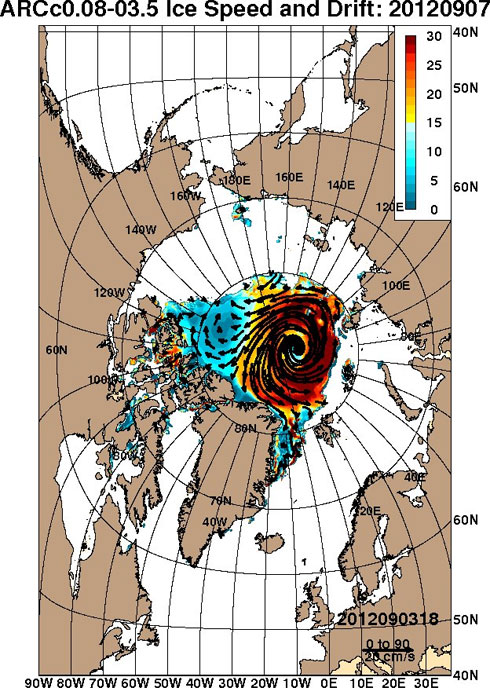
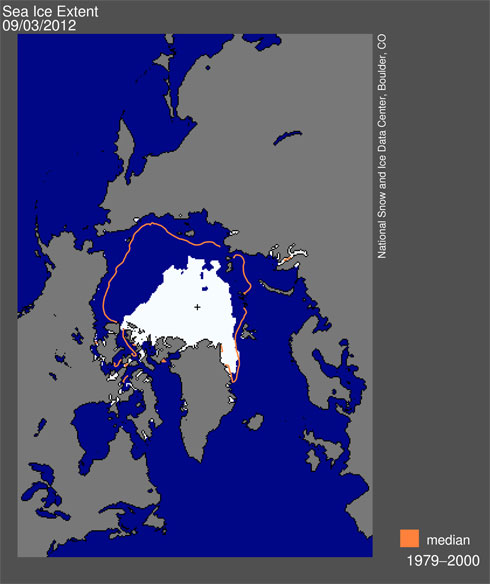
This summer has seen the radically thinning arctic sea ice battered by cyclones that might not have affected it in former years. We may see yet another before the melting process is done this season. This is a new source to me, so I’m posting this with that qualifier, but the news, if true, could impact the final sea ice number’s significantly.
Paul Beckwith warns that another cyclone is forecast to develop in the Arctic by September 7th, 2012, pointing at the image below, from the Naval Research Laboratory.
“This will cause lots of sea ice breakup in the Arctic if it develops and persists”, Paul says. “The sea ice now is thinner than in August, so the potential for severe damage to ice exists. On the other hand, however, the August cyclone lasted for a week, while this one looks like a 2 to 3 day event.”
“Most scientists think that the massacre of Arctic sea ice will stop on/or around September 15th which is the ‘normal’ date at which ice formation is due, as the decrease of solar insolation at the pole will cause the area of the sea ice to start increasing”, Paul says, adding however that “a minority of us think that the melt will continue beyond this date by several weeks, due to the warmness of the sea water both beside and below the very thin sea ice.”
Paul continues: “In fact, I predicted on August 10th that at the end of the melt season there would be virtually no sea ice left; this was predicated on there being a few more cyclones of equal intensity to that of the August 2nd to August 10th cyclone that eliminated around 0.8 million square kilometers of sea ice area (equivalent to about 20% of the ice remaining in 2007, the previous worst year in terms of ice melt). Thankfully, my prediction looks to be wrong, but we are not out of the woods yet. It appears that a strong cyclone will be attacking the sea ice in a few days, with the peak churning occurring on September 7th.”
Good explanation of the hydrological changes we are already starting to observe as part of the warming world – and a warning.
Wet areas may get wetter – dry areas may become deserts.
Since taking office I have established historic standards limiting greenhouse gas emissions from our vehicles for the first time in history. My administration has made unprecedented investments in clean energy, proposed the first-ever carbon pollution limits for new fossil-fuel-fired power plants and reduced carbon emissions within the Federal Government. Since I took office, the U.S. is importing an average of 3 million fewer barrels of oil every day, and our dependence on foreign oil is at a 20-year low. We are also showing international leadership on climate change, reaching historic agreements to set emission limits in unison with all major developed and developing nations. There is still more to be done to address this global problem. I will continue efforts to reduce our dependence on oil and lower our greenhouse gas emissions while creating an economy built to last.
Ultimately, the science is an input to the public policy decision; it does not dictate a particular policy response. President Obama has taken the view that if global warming is occurring, the American response must be to slash carbon dioxide emissions by imposing enormous costs on the U.S. economy. First he tried a massive cap-and-trade bill that would have devastated U.S. industry. When that approach was rejected by Congress, he declared his intention to pursue the same course on his own and proceeded through his EPA to impose rules that will bankrupt the coal industry.
Nowhere along the way has the President indicated what actual results his approach would achieve — and with good reason. The reality is that the problem is called Global Warming, not America Warming. China long ago passed America as the leading emitter of greenhouse gases. Developed world emissions have leveled off while developing world emissions continue to grow rapidly, and developing nations have no interest in accepting economic constraints to change that dynamic. In this context, the primary effect of unilateral action by the U.S. to impose costs on its own emissions will be to shift industrial activity overseas to nations whose industrial processes are more emissions-intensive and less environmentally friendly. That result may make environmentalists feel better, but it will not better the environment.
So I oppose steps like a carbon tax or a cap-and-trade system that would handicap the American economy and drive manufacturing jobs away, all without actually addressing the underlying problem. Economic growth and technological innovation, not economy-suppressing regulation, is the key to environmental protection in the long run. So I believe we should pursue what I call a “No Regrets” policy — steps that will lead to lower emissions, but that will benefit America regardless of whether the risks of global warming materialize and regardless of whether other nations take effective action.
For instance, I support robust government funding for research on efficient, low-emissions technologies that will maintain American leadership in emerging industries. And I believe the federal government must significantly streamline the regulatory framework for the deployment of new energy technologies, including a new wave of investment in nuclear power. These steps will strengthen American industry, reduce greenhouse gas emissions, and produce the economically-attractive technologies that developing nations must have access to if they are to achieve the reductions in their own emissions that will be necessary to address what is a global issue.
Romney’s position on climate change science has shifted around as Brad Plumer documents on the Wonk Blog:
As recently as June 2011, Romney was telling voters in New Hampshire that “the world’s getting warmer,” that “I believe that humans contribute,” and that “I think it’s important for us to reduce our emissions of pollutants and greenhouse gases.”
Since then, however, Romney has softened his stance. “I don’t know if [rising temperatures are] mostly caused by humans,” he told another New Hampshire crowd last summer.
Despite Romney’s thoughtful response, his much-publicized mockery of Obama’s promise to slow sea level rise last week calls into question whether he takes the issue seriously.
“President Obama promised to slow the rise of the oceans — [bites lip and pauses for audience laughter(!)] — and to heal the planet,” Romney said at the Republican National Convention (RNC). “MY promise is to help you and your family.”
ThinkProgress writes the Obama camp responded to Romney’s comment with this scathing response:
It is nothing short of terrifying to imagine a party that openly mocks climate change taking back the White House.
Language in the GOP platform further suggests climate is not high on the Romney/Republican agenda. It does not explicitly discuss climate change except to criticize Obama for classifying it as a national security concern. It says:
…the [Obama] strategy … elevates “climate change” to the level of a “severe threat” equivalent to foreign aggression. The word “climate,” in fact, appears in the current President’s strategy more often than Al Qaeda, nuclear proliferation, radical Islam, or weapons of mass destruction…
Romney’s running mate, Paul Ryan, has gone as far to challenge the motives of climate scientists who have published academic papers on manmade warming.Wonkbook’s Brad Plumer writes:
Ryan’s suggestion that scientists have tried to “intentionally mislead the public” is a charge without much evidence.
Many of the most serious environmental problems that will confront us in the years ahead are global in scope. For example, degradation of the stratospheric ozone layer poses a health hazard not only to Americans, but to all peoples around the globe. The Reagan-Bush Administration successfully pioneered an agreement to attack this problem through world-wide action. In addition, we will continue to lead this effort by promoting private sector initiatives to develop new technologies and adopt processes which protect the ozone layer. A similar ability to develop international agreements to solve complex global problems such as tropical forest destruction, ocean dumping, climate change, and earthquakes will be increasingly vital in the years ahead. All of these efforts will require strong and experienced leadership to lead the other nations of the world in a common effort to combat ecological dangers that threaten all peoples. The Republican Party believes that, toward this end, the National Oceanic and Atmospheric Administration should be joined with the Environmental Protection Agency.
We all have a stake in maintaining the environmental balance and ecological health of our planet and our country. As Republicans, we hold that it is of critical importance to preserve our national heritage. We must assure that programs for economic growth and opportunity sustain the natural abundance of our land and waters and protect the health and well-being of our citizens. As a nation, we should take pride in our accomplishments and look forward to fulfilling our obligation of leaving this land an even better place for our children and future generations.
It’s going to be pretty hard for the GOP to walk back from the unbelievably stupid and regressive position the Romney campaign has taken on climate. As the news from the Arctic gets more shocking by the day, there is a rumor that Romney will try to soften that line in coming weeks, but he’s repeated the “Obama promised to make the seas recede” line now on the campaign trail – and we do have video technology.
The question a lot of folks have been asking is whether Obama will seize this opening to further cast the Republicans as the anti-science party. From here, it looks like we’re not going to see a major change in tone before the election.
Here’s something Mitt Romney actually joked about with pride — and plenty of scorn —
while formally accepting the Republican nomination for president of the United States: “President Obama promised to begin to slow the rise of the oceans and heal the planet.”
And the crowd went wild.
It is nothing short of terrifying to imagine a party that openly mocks climate change taking back the White House.
The contrast between our candidate and theirs couldn’t be any clearer:
The Democratic Platform looks like it has good things to say about climate and science in general, although omitting support for a Cap and Trade policy. (no problem with that, there are other ways to put a price on carbon that might be an easier sell….)
CHARLOTTE, N.C. – The Democrats’ official platform expected to be approved at the party’s national convention on Tuesday calls for an international deal to limit greenhouse gas emissions.
The platform says Democrats will pursue efforts to combat climate change through regulations and market solutions, setting up a continued battle with Republicans who argue such steps could hold back the economy.
“Democrats pledge to continue showing international leadership on climate change, working toward an agreement to set emission limits in unison with other emerging powers,” states the platform.
“Democrats will continue pursuing efforts to combat climate change at home as well, because reducing our emissions domestically – through regulation and market solutions – is necessary to continue being an international leader on this issue,” the platform continues.
Still, the new version’s language on an international agreement is arguably less aggressive than the 2008 platform, which included stronger language making the case for an international deal: “We need a global response to climate change that includes binding and enforceable commitments to reducing emissions, especially for those that pollute the most: the United States, China, India, the European Union, and Russia,” it stated.
Domestically, the platform is weaker in calling for climate change legislation that the party’s previous platform in 2008.
It lacks the 2008 version’s explicit call for cap-and-trade, a proposal that collapsed in the Senate in 2010 after House Democrats moved legislation through the lower chamber. Some Democrats say that vote was a factor in Democrats’ losing their House majority in the fall of 2010.
The 2012 platform mirrors the formal National Security Strategy the White House released in 2010 in calling the climate threat “real, urgent and severe.”
Climate change is happening, yet humans have been terribly slow to curb fossil fuels that emit greenhouse gases and cause the atmosphere to warm. The United States, caught in political gridlock and lacking consensus on the global-warming threat, has failed to take the lead. The latest reports of the shrinking Arctic ice should shock Congress and the president into more aggressive action, but both branches of government have been timid in the face of one of the great challenges of our age — and one that will haunt future generations.
Within this century, and perhaps in the next 30 or 40 years, the Arctic is projected to become nearly ice-free in the summer. A benefit may be that transpolar shipping routes from Europe to the Pacific will be 40 percent shorter, and choke points like the Suez and Panama canals could lose their significance. But there is also potential for conflict over borders, oil and mineral extraction, and jockeying among military forces.
The Arctic promises to be getting hot in more ways than one.
Obama has been reactive. He has been defined by the various negotiating positions he has taken in his confrontations with Congress. He’s used a more partisan political style to mask his small-bore policy substance. It’s not clear what he is passionate to do if he is elected for another four years.
The Democratic convention is his best chance to offer an elevator speech, to define America’s most pressing challenge and how he plans to address it.
He has three clear options.
First, global warming. President Obama has occasionally said he’d like to do something about climate change if he gets a second term. Given the country’s immediate economic and fiscal problems, this seems obtuse to me. But if this is really where Obama’s passion lies, he should go for it.
He could vow to double down on green energy and green technology. He could revive cap-and-trade legislation that would create incentives for clean innovation. He could propose a tax reform package that would substitute gasoline and energy consumption taxes for a piece of our current income taxes. He could say that his No. 1 international priority will be to get a global warming treaty ratified by all the major nations.
This would be a big, intellectually serious agenda, designed to address a big problem.
Mitt Romney threw down the gauntlet on global warming last week by mocking President Obama’s efforts to fight the effects of fossil-fuel pollution.
“President Obama promised to begin to slow the rise of the oceans and to heal the planet,” Romney said in his acceptance speech for the GOP presidential nomination, drawing a laugh from delegates at the Republican National Convention. “My promise is to help you and your family.”
Will Obama strike back this week at the Democratic convention?
In a campaign focused on jobs and the economy, the president has so far been wary of tackling climate change, an issue he addressed head-on in the 2008 campaign. Much has changed since then.
In 2010, his efforts to move a cap-and-trade bill in the Senate failed, and Republicans made “cap-and-trade” a politically toxic catchphrase. The GOP has also waged a political war against Obama’s Environmental Protection Agency, branding new clean-air and climate-related rules as “job-killing regulations.”
In the face of those attacks, the White House has doubled down on its push for investment in wind and solar energy, framing those initiatives as job creators. But Obama has said little on the campaign trail about the impact of climate change or his plans to tackle it—even as the country has been gripped by heat waves, drought, wildfires, and destructive storms.
It appears that Obama intends to play it safe on the issue this week. Interviews with campaign staff and a look at the lineup of convention speakers indicate that climate change won’t be a top-tier issue during the convention.
Until now, it has been conventional wisdom in the Obama campaign that talking about climate change will only open the candidate up for attacks from opponents arguing that he supports increased regulations on industry even as the economy struggles to recover from recession. This has been the concern despite a crop of new polls showing that candidates who support action on climate change are more likely to win over independent voters.
Meanwhile, there’s a growing call from Obama’s base to address the issue. The young voters who helped energize the 2008 campaign say they are disappointed that the president no longer seems to care about climate change.
The top Obama energy official to speak this week will be Interior Secretary Ken Salazar, who is expected to highlight the administration’s efforts to build wind and solar installations on federal land and to pursue an “all of the above” energy policy, including controversial new drilling in the Arctic Ocean.
Notably absent from this week’s lineup are the two Cabinet officials most closely linked to fighting climate change, Energy Secretary Steven Chu and EPA Administrator Lisa Jackson. Sen. John Kerry of Massachusetts, who led efforts on climate change in 2010, will speak, but he is expected to focus on foreign policy.
There is a chance that Obama will seize on Romney’s climate jab as an opportunity to criticize Republicans as antiscience. “They have running for national office a candidate who doesn’t believe in climate science,” said Carol Browner, Obama’s former chief adviser on energy and climate policy, who will be on hand in Charlotte this week.
Ultimately, it would seem the electoral politics of Ohio, Pennsylvania, and perhaps Virginia, have relegated climate to a back burner status. Given the overwhelming threat that an anti science agenda would represent, my own perspective is, just win the damn election, and then use the bully pulpit to amp up awareness as we head into what looks like another hellish El Nino amped year of extremes.