

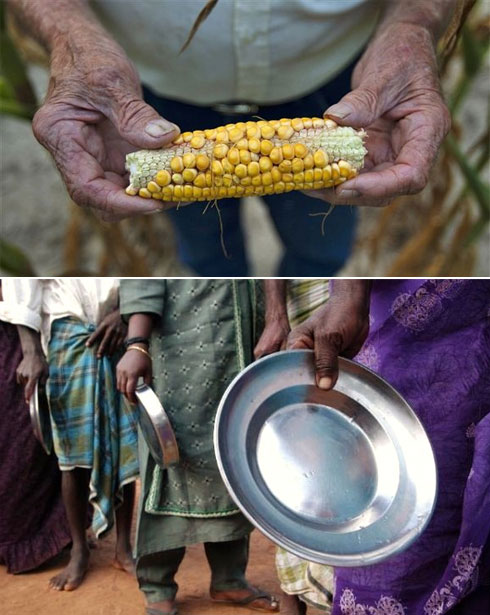
The crisis originates in this summer’s extreme weather. Almost 80% of the continental United States experienced drought conditions. Russia and Australia experienced drought as well.
The drought has ruined key crops. The corn harvest is expected to drop to the lowest level since 1995. In just July, prices for corn and wheat jumped about 25% each, prices for soybeans about 17%.
These higher grain prices will flow through to higher food prices. For consumers in developed countries, higher food prices are a burden — but in almost all cases, a manageable burden.
Americans spend only about 10% of their after-tax incomes on food of all kinds, including restaurant meals and prepackaged foods. Surveys for Gallup find that the typical American family is spending one-third less on food today, adjusting for inflation, than in 1969.
But step outside the developed world, and the price of food suddenly becomes the single most important fact of human economic life. In poor countries, people typically spend half their incomes on food — and by “food,” they mean first and foremost bread.
When grain prices spiked in 2007-2008, bread riotsshook 30 countries across the developing world, from Haiti to Bangladesh, according to the Financial Times. A drought in Russia in 2010 forced suspension of Russian grain exports that year and set in motion the so-called Arab spring.
–
And if food prices surge again? China is especially vulnerable to food cost inflation. In just one month, July 2011, the cost of living jumped 6.5%. Inflation happily subsided over the course of 2012. Springtime hopes for a bumper U.S. grain crop in 2012 enabled the Chinese central bank to ease credit in the earlier part of the summer. Now the Chinese authorities will face some tough choices over what to do next.
The Arab Spring of 2011 is sometimes compared to the revolutions of 1848. That’s apter than people realize: the “hungry ’40s” were years of bad harvests across Europe. Hungry people are angry people, and angry people bring governments down.
Will 2013 bring us social turmoil in Brazil, strikes in China or revolution in Pakistan? The answer can probably be read in the price indexes of the commodities exchanges — and it is anything but reassuring.
Food price spikes caused by extreme weather events like the US drought will become the norm over the next twenty years, leading to millions
of deaths from malnutrition among the world’s poorest if Governments do not act on climate change, Oxfam has warned.
While the average price of staple foods is already expected to double in the next twenty years, the UK’s leading poverty charity predicts that separate catastrophes such as droughts, floods and bad harvests will also become more common as a result of climate change, leading to regular and dramatic jumps in prices.
The effect may have already been seen this year, the charity says. A 10 per cent rise in world food prices in July has been blamed on the severest drought in the USA in fifty years, along with dry weather in Eastern Europe and Kenya. Oxfam warned that policymakers have “underestimated” the full impact of climate change on future food prices.
“The huge potential impact of extreme weather events of future food prices is missing from today’s climate change debate,” said the charity’s climate change policy advisor Tim Gore. “Rising temperatures and changing rainfall patterns hold back crop production and cause steady prices rises. But extreme weather events – like the current US drought – can wipe out entire harvests and trigger dramatic food price spikes.”
July was the USA’s hottest month on record, contributing to the warmest 12 month period for the country since records began. Widespread drought has destroyed one sixth of the country’s corn crop and driven up staple food prices worldwide.
So another new report, from researchers at the University of Minnesota, may prove especially interesting to anyone worried simultaneously about food security and the environment. It offers hope that both problems can be tackled at once.
This report, a scientific study published last week in the journal Nature, is also the result of computer modeling. The researchers asked whether it would be possible to increase global yields while reducing the use of agricultural inputs like water and fertilizers.
The basic finding is that overall output of 17 of the world’s most important crops could be increased by 45 to 70 percent by closing the “yield gap,” or the tendency of farmers in many regions to produce less than they could. And this could be done, the researchers found, while reducing the overall environmental harm from agriculture.
“We have often seen these two goals as a trade-off: We could either have more food, or a cleaner environment, not both,” the study’s lead author, Nathaniel D. Mueller, a doctoral student at the University of Minnesota, said in a statement. “This study shows that doesn’t have to be the case.”
The trick, the researchers found, would be to reduce inputs in some places where, for instance, nitrogen fertilizer is being applied too heavily (government subsidies often play a role) or water is being wasted. Conversely, more inputs and better farming methods are needed in regions where yields are far below potential.
The report found that the use of nitrogen fertilizer, the source of the nitrous oxide that is helping to warm the planet, could be cut by 28 percent without affecting yields for corn, wheat and rice, the world’s three most important grains. Use of phosphate fertilizer, the focus of fears about a long-term shortage, could be reduced by 38 percent, the researchers found.
I hate to say it but, I told you so. I have been warning of this for some time.
However, for those that really want something to worry about, consider the Katla volcano on Iceland: It is due to erupt and when it does the 10km diameter, 750m-thick, glacial plug in its caldera will cause an eruption 50 times worse than the Eyjafjallajokull eruption in 2010. Unlike that one (but very much like the Laki eruption in 1783), Katla’s eruption will reach the stratosphere… The Laki eruption of 1783 blanketed Europe in poisonous/acidic gas, disrupted global weather for 3 years, killed 1 million people, and probably contributed to bringing about the French Revolution…
Maybe all those doomsday preppers are right after all?
Thanks Martin!
You are the kind of doomsayer I love to read. Because you’ve actually got some facts to back up your argument and some interesting conjecture. Yes, the French Revolution which started in 1789 was certainly exacerbated by a number of failed harvests in France. And Katla looks to be a proximate cause of the bad harvests.
I keep a keen eye on the ag commodities markets here: http://www.agrimoney.com/ While the free service here isn’t a solid enough inside scoop to get rich on, one can at least gain some insight into the peregrinations of the food supply. Right now we are not in crisis. But we could easily be pushed into one by any number of ruthless speculators engaging in futures racketeering.
Would a Katla conflagration get the commodities markets into a frenzy? Youbetcha. Would a Katla catastrophe cause rampant commodity hoarding and skyrocketing prices? Seems the natural result.
Is there any regulatory body on the planet to prevent rampant and massive speculation creating an unconscionable price bubble for basic commodities? Uhhhh, let me get back to you about that….
I say wait until the shortage has infiltrated Brazil, then start buying Brazil ETF’s on the cheap, holding for the long haul. I read somewhere that Brazil has something like 12 or 14% or the world’s freshwater for agriculture. Considering that the American bread basket is not looking so good these next decades, secondary to drought from warming, and the price of food is projected to double by 2030, I’m thinking Brazil will eventually profit, with their large agricultural abilities.
I have zero knowledge on commodity speculation, but i suspect a percentage of trading is done with artificial intelligence (computers), like it is with other equity trading. I’m reminded of Hal on Cubric’s Space Odyssey movie.