


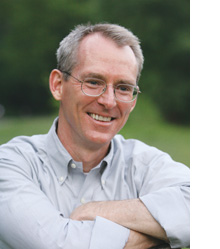
A conservative politician who believes free enterprise is the ubiquitous answer isn’t all that special. But what about a conservative politician who’s dedicated his efforts to combating the risk from climate change? That’s special enough to have earned Bob Inglis an invitation to speak at PennFuture’s “Creating America’s Clean Energy Hub” conference later this month.
To be fair, Inglis isn’t a politician anymore. The founder of the Energy and Enterprise Initiative at George Mason University was a six-term Republican Congressman from South Carolina who lost his re-election bid to a Tea Party candidate in 2010. He’s since refocused on getting conservatives to accept climate change as fact and encouraging innovation in energy to combat its risk.
The answer, he says, is a tax swap — instead of an income tax, let’s have a carbon pollution tax. Remove all energy subsidies and make the entire cost of each fuel transparent to consumers.
“I believe that the cost crashes from the innovation would power an energy revolution faster than any government mandate or fickle tax incentives,” he said.
I talked with Inglis last week about his organization’s mission, the presidential race, and his reception in the business world.
The mission statement of the Energy and Enterprise Initiative says you don’t subscribe to an apocalyptic view of climate change. What does that mean?
“That the end is near, that we are done for and that emergency action is necessary. That tends to really drive away conservatives because conservatives dismiss it as fear mongering. What we prefer to do is to say the science is clear — there’s a very real risk that we’re running and doesn’t it make sense to reduce that risk? We’re talking reasonable risk avoidance rather than rhetoric that the sky is falling, we need to turn off all the lights right now.
We really want a lot of energy — we want more not less. More, not less, mobility. More, not less, comfort in our homes. We have to figure out a way to have much more energy so that people in the developing work can enjoy (its benefits).”
Do you believe the tax swap alone will fix the problem or is that a flash point to get the conversation going?
“That is the solution. It’s not as serious as clumsy government incentives. Setting the economics right — making it so that there’s a true cost comparison between fuels. Right now, there isn’t.
Two things distort the market place: government subsidies, mostly for wind and solar but also true of fossil fuels. The second is when fuels aren’t accountable for their hidden costs and those hidden costs aren’t made apparent. There’s a real distortion.
We believe that the individual consumer, in enlightened self interest and in an accountable marketplace, is the driver for innovation.
In South Carolina, electricity is so cheap I don’t have a solar water heater on my roof because it doesn’t make any sense to call up a solar water heater installer. But if I knew what coal powered electricity is really costing me —in health cost and climactic cost — I’d be looking for a solar water heater installer. Not because anybody gave me incentives. Rather, just (realizing) that power’s expensive and one third of my electricity bill is hot water.”
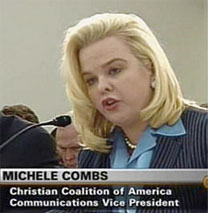
A group of young Republicans has set out to achieve what some might say is an impossible goal: Over the next two years they’ll try to persuade their party to craft and support legislation that would reform the nation’s energy system and set a path toward a future free of fossil fuels.
“We want to show conservatives that this truly is an issue that affects us, affects our families and our businesses,” said Michele Combs, a 45-year-old legislative consultant who founded the group.
The organization—Young Conservatives for Energy Reform, or YCER—joins a small but growing number of like-minded groups and individuals who hope to revive a voice that has been lost in the Republican Party, one that’s focused on curbing, not expanding, fossil fuel production.
At last week’s GOP convention in Florida, the Evangelical Environment Network teamed with the Florida Wildlife Federation to buy billboard ads touting prominent Republicans’ concerns about climate change, including Ohio Governor John Kasich. In July, a group called the Energy and Enterprise Initiative was formed to bring Republicans and libertarians together to find free-market solutions to the climate change problem. Former Rep. Bob Inglis, a South Carolina Republican, is heading the initiative out of George Mason University’s Center for Climate Change Communication.
“A lot of conservatives don’t believe that there are climactic costs” to burning fossil fuels, said Alex Bozmoski, the initiative’s director of strategy and operations. “It’s only prudent to acknowledge that the continued, unabated emission of greenhouse gases poses a risk for current and especially future generations.”
YCER’s leaders have deep roots in the Republican Party. Combs, the group’s president, was a 1989 national “Young Republican of the Year,” and Brian Smith, a 32-year-old Air Force Veteran and chair of the Midwest chapter, is a former co-chair of the Young Republicans National Federation, a training ground for party leaders since 1931. Both support Mitt Romney’s presidential bid, even though his energy platform favors more fossil fuels and less environmental regulation.
Combs said YCER won’t take individual Republican politicians to task for their climate change skepticism or push for specific policy solutions—at least not immediately. They also won’t make climate change science a key part of their agenda.
“Our position on climate change is that it really shouldn’t be a litmus test for Republicans,” said Smith on a call with reporters last month. “We want it to be an issue that Republicans can talk about.”
The R Street Institute has its offices in Dupont Circle, above a shop that specializes in used books and “sort of vintage” fashions.
The newly minted conservative think tank’s headquarters is compact and youthful looking. A wall is devoted to depictions of its small staff as characters from the animated sitcom “South Park.” Another has a flock of black construction paper seagulls flanking a framed Wall Street Journal op-ed criticizing Florida’s move to privatize disaster insurance for hurricanes.
An opposing wall spells out the group’s three-part mission statement in black letters: “deep focus, broad coalitions, rapid response.”
This has been the group’s mission since before it spun off from the Heartland Institute earlier this year. But it is difficult to reconcile a call for “broad coalitions” with a think tank that famously equated climate change belief with the Unabomber in a billboard above a major Chicago expressway.
R Street President Eli Lehrer said during a recent interview that the split was amicable.
“We’re a different organization for a reason,” he said. “But at the same time, we’re still a conservative organization that believes most of the same things that Heartland does.” The two groups both favor more limited government with more power concentrated with states rather than the federal government. But R Street is not in lock step with its more-famous parent on everything.
“We’ll be moving in some other directions,” Lehrer said.
One of these most notable departures is on climate change. Heartland has linked itself inextricably in the public mind with climate skepticism, sponsoring the International Conference on Climate Change where advocates from all walks of life meet to question the scientific underpinnings of man-made climate change. The group also sponsors the so-called Nongovernmental International Panel on Climate Change, which publishes articles by skeptical scientists as a counter to the United Nations’ Intergovernmental Panel on Climate Change.
R Street, which also has offices in Columbus, Ohio; Tallahassee, Fla.; and Austin, Texas, doesn’t plan to wade into climate science — something Lehrer says is better left to universities and research labs. But the new think tank, which devotes 60 to 70 percent of its time to insurance-related policy work, has begun to chart its own course on climate change policy. Among other things, Lehrer briefly attended a meeting last month (Greenwire, July 11) held at the headquarters of the American Enterprise Institute to discuss the possibility of a carbon tax.
The gathering drew attention because conservatives in the past few years have shied away from any effort to price carbon dioxide emissions, but Lehrer cautioned that R Street’s support for such a policy would depend entirely on how it is constructed. The next Congress is expected to take up legislation to overhaul the tax code as soon as next year, and a carbon tax could be part of that package as long as it does not lead to a net tax increase, Lehrer said.
“If it’s a true tax and regulatory swap, I don’t see any reason why conservatives wouldn’t support it,” he said.

At this point we have probably gone too far to rely on the private sector to pull us out of the deep hole we are in with climate change. Government will play a far larger presence in our society in just 5-10 years.
How large that presence becomes can be lessened now if we start reducing out emissions drastically. Too much damage has been done to the atmosphere already. The private sector will not be able to handle the vast infrastructure and societal problems just ahead.
Too little, too late….
“Two things distort the market place: government subsidies, mostly for wind and solar but also true of fossil fuels. The second is when fuels aren’t accountable for their hidden costs and those hidden costs aren’t made apparent. There’s a real distortion.”
Hopefully, when he says government subsidies, he’s including the cost of war and defense to guard our oil (and eventually other resources which are peaking or will peak in several decades). Hopefully people realize that our most recent wars are just the beginning of a long series of 21st century military action that will be fought for resources. China is currently buying reserves around the world and building a navy to guard, and to transport military to those reserves.
Also, as supply starts to fall and demand from India, China, the US, etc. goes up, our (U.S.) economy will chronically slow, in response to the higher and higher costs of fossil energy. Hopefully this guy is taking that into account as a ‘subsidy’ for fossil energy. That alone, will cost me hundreds of thousands of dollars in my retirement account, and as a middle class fellow, that translates into a poorer quality of life.
The only country that seems to be figuring this out is Germany, who will have cheaper energy by 2020 than if they had just followed business as usual. Guess it’s not to late to learn German…
I think the biggest overnight change we could do to cut energy use is to limit speed limits on freeways to 55mph like they did during the 70’s. I’ve seen the physics lecture, and done the calculations myself: Cutting the limit from 70 to 55 saves much more energy than just saying (70-55)/70 x 100%. The energy savings is not linear like that; it’s exponential. Now we don’t have the same global weight we once did, so we won’t get the same bang for our buck as we did in the 70’s, and there is a phenomenon where people start using more energy when it becomes cheaper, but that is not 100% elastic, as shown by these guys:
http://escholarship.org/uc/item/1h6141nj#page-27
…there is still a net savings.
Inglis very explicitly gets the defense connection.
Oh and here’s my source for my spiel about the Germans:
http://www.diw.de/sixcms/media.php/73/diw_wr_2011-06.pdf
According to modelling calculations performed by the German Institute for Economic Research (DIW), inflation-adjusted wholesale prices for electricity will only increase by 11% between 2010 and 2020 to 4.9 euro cents per kilowatt-hour (kWh), despite increasing fuel and CO2 certificate prices. In the absence of expanded deployment of renewable energy, a higher price increase of 20% can be expected. Although electricity generation from renewable sources is forecasted to more than double by 2020, the EEG apportionment borne by consumers will in real terms only be 3.64 euro cents per kWh, and thus only slightly higher than it is today. The main reason for this low growth is the fact that the tariffs for new installations are digressive, falling year by year. In addition, tariffs are diminished in real terms by price inflation. Our modelling
calculations assume that legislators will take action against the recent overinvestment in the solar electricity sector. Thanks to a significant fall in the cost of photovoltaic (PV) systems, the reduction of PV tariffs can be placed on an accelerated timetable. Over the long term, the overall level of support provided under the EEG should be reduced. For the further deployment of renewable energy it is necessary to expand Germany’s power grid in addition to the availability of energy storage facilities. Steps must also be taken to increase competition in electricity markets.
anybody know what the German Institute for Economic Research is?
“The German Institute for Economic Research (German: Deutsches Institut für Wirtschaftsforschung, or DIW Berlin) is one of the leading economic research institutes in Germany. It is an independent, non-profit academic institution which is involved in basic research and policy advice. DIW Berlin was originally founded in 1925 as Institute for Business Cycle Research and was later renamed to its current name.
DIW Berlin presents its research results in science journals, within the scope of national and international scientific events as well as at workshops, symposia and colloquia. The research results provide a basis for the exchange of ideas among experts and other relevant groups. Current economic and structural data, forecasts and advices as well as services in the area of quantitative economics are provided to decision makers in economics and policy and the broad public. DIW Berlin endues a target group specific range of publications, events and data sources. Furthermore, the research results meet with major response in media.
DIW Berlin is striving to become an internationally respected scientific think tank for applied economic research and policy advice to national and international policy makers, the business community and the general public.”
http://en.wikipedia.org/wiki/German_Institute_for_Economic_Research
The problem with Inglis point of view is that it seems to buy into the meme that scientists are being alarmist, when they are actually being conservative.
We’ve lost 70% of Arctic Sea Ice Volume since the 1980s, with only 0.8 C warming.
We already are having increasing extreme weather events, probably largely releated to what’s happening in the Arctic, which is warming 2-3 times faster than the rest of the planet. – changes to the Jet Stream etc.
What does he think is going to happen with 3-4 C warming?
Is he buying into the low climate sensitivity argument of people like Lindzen, who are almost certainly wrong?
Any Republican politician, adequately concerned about climate change and a person of convictions, would leave the GOP, become an Independent and work for action on climate change – NOW.
A vote for Romney is not a vote for the planet.
Great post!
Bob Inglis may be (purposefully) soft pedaling the urgency of addressing the climate change crisis. However, what an iconic contrast he is from Trey Gowdy – who beat him in a GOP landslide of willful, self-centered ignorance.
The Yale Report is, as always, depressingly “real”. However, it does contain hints of a public opinion toehold.