My first reaction on hearing it, a year or two ago, was that a link between climate and seismic activity seemed like utter, millennial, “pole shift”, Mayan calendar crazy talk. However – I’ve come to realize that serious people are taking it seriously. Have not yet read the new book described here, Waking the Giant, by Geophysicist Bill McGuire – it’s not officially out yet – but its now on my list.
Twenty thousand years ago our planet was an icehouse. Temperatures were down six degrees; ice sheets kilometres thick buried much of Europe and North America and sea levels were 130m lower. The following 15 millennia saw an astonishing transformation as our planet metamorphosed into the temperate world upon which our civilisation has grown and thrived.
One of the most dynamic periods in Earth history saw rocketing temperatures melt the great ice sheets like butter on a hot summer’s day; (note: this is a little misleading – the glacial melt took 10,000 years – our own current forcing of the climate is proceeding on the order of decades and centuries, many times faster and stronger than ice age changes – PS) feeding torrents of freshwater into ocean basins that rapidly filled to present levels. The removal of the enormous weight of ice at high latitudes caused the crust to bounce back triggering earthquakes in Europe and North America and provoking an unprecedented volcanic outburst in Iceland. A giant submarine landslide off the coast of Norway sent a tsunami crashing onto the Scottish coast while around the margins of the continents the massive load exerted on the crust by soaring sea levels encouraged a widespread seismic and volcanic rejoinder.
In many ways, this post-glacial world mirrors that projected to arise as a consequence of unmitigated climate change driven by human activities. Already there are signs that the effects of climbing global temperatures are causing the sleeping giant to stir once again. Could it be that we are on track to bequeath to our children and their children not only a far hotter world, but also a more geologically fractious one?
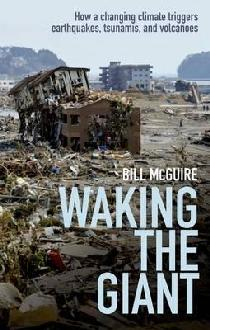 Author Bill McGuire is Professor of Geophysical & Climate Hazards at UCL. He was a member of the UK Government’s Natural Hazards Working Group, established in 2005 in the wake of the 2004 Indian Ocean tsunami, and in 2010 a member of the Scientific Advisory Group for Emergencies (SAGE), addressing the Icelandic ash problem. He is a contributing author on the 2011 IPCC Report on climate change and extreme events. His current research focus is climate forcing of geological hazards. His books include: Natural Hazards and Environmental Change; A Guide to the End of the World – Everything You Never Wanted to Know; Surviving Armageddon – Solutions for a Threatened Planet; and Seven Years to Save the Planet. Bill presented the BBC Radio 4 series: ‘Disasters in Waiting and Scientists Under Pressure’ and ‘The End of the World Reports’ on Channel 5 and Sky News Channel. He has also made television appearances on BBC’s Horizon and Decoding the Past on the History Channel.