

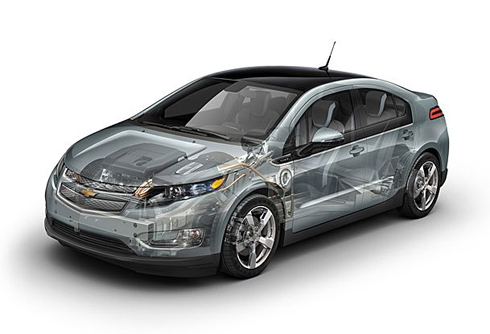
The Fossil Fuel industry and its wholly owned media subsidiary, the Foxis of Evil, have declared a fatwah on electric vehicles, and even General Motors is wondering just how much they are willing to lie to stamp out the threat to their business model. The bonehead me-too media has done its part to snuff out an emerging industry, as well. But the over-arching greed that defines the oil barons may yet be their undoing.
To drivers, the high price of gasoline is a scourge. To the electric car industry, it could be a game-changer.
Nissan’s electric Leaf and the Chevy Volt plug-in hybrid both hit dealer showrooms in late 2010, riding a wave of carefully cultivated hype. But first-year sales were lackluster at best, as consumers balked at the high sticker prices and unfamiliar engineering.
This year’s gas-price spike could change that.
Technology that looked like a gamble to many car buyers last year might look more like an insurance policy now.
“Every time it goes up, my phone rings a little more,” said Ron Coury, with the Northbay Nissan dealership in Petaluma. “It’s the ones who’ve been sitting back and watching, and now they’re sticking their feet in the water.”
–“It gives us the opportunity to convert people, but it’s an opportunity we have to seize,” said Brendan Jones, director of electric vehicle marketing for Nissan North America.
General Motors has launched a new ad campaign that explains how the Volt works and emphasizes the car’s ability to evade the gas station. The Volt operates as an electric car for the first 25 to 50 miles of a trip, before a gasoline motor kicks in. Like the all-electric Leaf, the Volt recharges its batteries via a specialized power plug, with most owners recharging at night.
“I do think that it is probably forcing people to consider fuel-efficient transportation, and the Volt certainly is a gold-medal opportunity for a lot of customers,” said Dan Akerson, GM’s chief executive officer. He referred to the new ads as an effort to “relaunch” the Volt.
Forbes: Now’s the Time to Buy a Volt-
So, in 2010, when I moved back to the U.S. from my old São Paulo home, I bought a black, third-generation Prius II. It’s an updated model of the car Larry David drives in Curb Your Enthusiasm, and as a car goes, it’s got room for five, it’s got speed — I am constantly doing 80 in that thing and not realizing it — and it does what I want it to do most, reduces my gasoline expenses. I”m saving the earth and screwing oil companies one mile at a time.
The Prius gets 50 mpg’s on average. It cost just $23,000. It’s okay looking. But the Chevy Volt is even better looking, sort of like a brand new girlfriend.
If gasoline is going to $6 a gallon, as libertarian presidential candidate Ron Paul thinks, and as Steve Odland considered here at Forbes last week, then I want a car that doesn’t need any gasoline at all. Oil can go to $150 a barrel and my transportation expenses won’t rise a cent. I feel like I’m beating the market, and that feels pretty good; pretty, pretty, pretty good.
–Inside, the first thing I notice are the interior door panels. They have circuit board imagery designed on them. This thing is so 21st Century. The dash board is all digital, and has a more futuristic feel to it than the Prius. Keep in mind, I’m a layman. I’m not a Car & Driver guy out to test how much torque this thing has. I don’t even know what torque is. I just know it’s a word. But I quickly learn that the Volt has no transmission, so it is all torque. No shifting gears. It’s just step on the pedal and watch it move.
We get out of the parking lot and I step on it. It is all torque, alright. The car just goes. He explained how it works. I don’t care how it works. I care about how much it costs, then how much it gets for gas mileage, then how it looks. The Volt looks great, certainly better than the boring and ugly Nissan Leaf. The car rides incredibly. I’m up to 60 easily. The thing doesn’t make a sound.
I love this car!


Boring and ugly Nissan Leaf? Bah! I think the Leaf is cool looking, and if you really don’t want to use any gas, it’s the way to go.
The Volt at $42,000 is still not that viable economically. Since I have a long commute, I would wind up using the gas engine for a significant amount of time. My Prius is payed for and gets almost 50 mpg. The new Prius C with over 50 mpg and an initial cost of $18,500 has better economics. If in the future charging stations become widely available the Leaf and Volt or even the plug in Prius may make better sense. For now the payoff is just not there.
the pay off on first generation flat screen TVs was not there either.
Early adopters buy new technology because its new, because its cool. The oil barons would
like to see the electric car derailed, but the best they can hope for is to destroy
a lot of American jobs and erase our advantage in the technology.
You’re still going to be able to buy one of these from China soon, probably at Wal Mart.
Nobody’s saying we have to all switch over to Volts or Priuses. I’ve stuck with a manual transmission and manage to wring up to 33 mpg out of my full-size sedan (a Passat) on the highway, high 20s in the city. And there are plenty of diesels, efficient gas cars and other options out there if you don’t want to go electric or hybrid. It’s just that we, in general, need to start thinking about fuel economy. A lot.
I can’t cite chapter or verse, but I’m pretty sure I’ve read some studies that suggest due to the cost of making/disposing of batteries, we’re actually better off with a good blend of electrics, hybrids, diesels and high mpg gas engines than we are with all our eggs in any of those one baskets.
I’m getting the Leaf and my Prius shall be donated to my parents, where it will be put to good use since my mother is in the market for a commuter car.
Supporting these technologies, along with sustainable transportation infrastructure is an important part of showing folks that those of us that are informed on the issues of climate change and resource depletion are willing to be early adopters when possible.
A lot of people drive 40 thousand dollar Bimmers and SUVs. Single driver vehicles with 70 dollar fill ups per week. Couldn’t those be 40 thousand dollar EVs instead? What is this fascination with empty 5 and 7 passenger status symbols? If no one could afford a car at that price, it would be understandable, but with gas pump shock, there really are more and more reasons to buy an electric. Given that this is the first generation of EVs, the volume cost is bound to get lower. Battery prices are dropping already.
We’ve been pleased with the Leaf. We charge it off the solar panels on our home so the electricity it uses is free. The vehicle costs more up front- but since we never pay for gas or oil changes, it still made sense to purchase it.
Before, we had a truck and a second vehicle and the monthly gasoline bill was $250 a month for the truck alone, when gas was $3.00 a gallon.
Currently, our gasoline bill has dropped to $65.00 a month total, as the second vehicle is never used on the weekends. The Leaf is on duty all day long Saturday and Sundays and with a quick recharge, out in the evenings as well.
I am wanting the prices to come down and the range to extend to increase the appeal.