

While right wing nutter media is obsessed with trashing anything that might actually move American industry forward in efficiency and away from oil dependence, they’ve gone after GM’s Volt. Meanwhile, over at Ford and Nissan, the unstoppable revolution continues….
Ford Ramps Up EV Production. In order to meet the ever increasing EV demand, Ford is .. tripling its production capacity in order to reach over 100,000 through 2013. The company is also applying to have CARB qualify its growing portfolio of electric and plug-in hybrid, PHEV vehicles for the California Clean Vehicle Rebate Program. The 2013 Fusion Energi plug-in hybrid and the 2013 C-MAX Energi plug-in hybrid will be petitioned. Both vehicles get an impressive overall range in both modes, electric and gas of more than 500 miles.
—
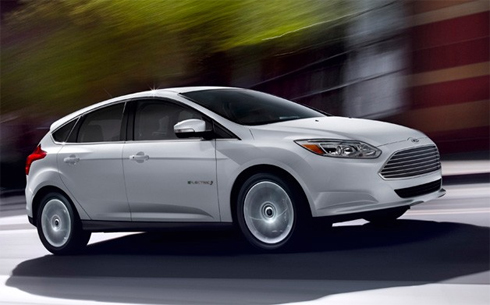
CARB Eases EV Transition. The California Environmental Protection Agency’s Air Resources Board, CARB approved the state’s 2012 Ford Focus Electric owners to drive in the carpool lanes on those highly congested highways. And to sweeten the deal further, they will also be able to take off an extra $2,500 in tax credits on top of the federal tax $7,500 incentive.
According to the Texas Transportation Institute’s annual Urban Mobility Report, Los Angeles and the San Francisco-Oakland metropolitan area rank as the 3rd and 7th worst congestion spots in the U.S. In Los Angeles alone, this means a total of 38 million gallons of fuel are wasted a year, which costs the average commuter an extra $1,464 a year.
America’s Most Fuel Efficient EV. All of this comes in at great time when the Ford Focus Electric was recognized as America’s most fuel-efficient five-seater electric car, EV. With 110-MPGe in city fuel economy rating and 99 MPGe on the highway, this EV is coming onto the market with a splash in the pond. If you were on the fence until now with the Ford Focus Electric and live in California, wait no more. You can now apply for the State’s $2,500 tax rebate whether you purchase or lease it for 36 months or longer and then add the extra $7,500 in federal tax credit to your yearly budget.
Nissan will increase the number of European car dealers carrying Leaf electric vehicles tenfold – to 1,000 – by the end of the year and will sell the car in two dozen European markets by 2013, all part of the Japanese automaker’s plan to boost Leaf sales overseas.
Nissan, which sells the Leaf in 14 European markets and will have 700 dealers selling the car by the end of April, will also install charging stations in all 1,000 European dealers and will give 400 quick-charging stations to various communities in an effort to broaden the EV-charging infrastructure throughout the continent. Such quick-chargers, which cost about 10,000 euros ($13,260 U.S. at today’s exchange rate), can recharge a Leaf to 80 percent capacity in about a half hour.
Nissan will also start Leaf battery production in the U.K. by this June and will work with sister company Renault at developing a system where Leaf owners can resell their cars’ batteries so that they can be used in a so-called “second life” as power-storage devices for the grid.
The company said earlier this week that it would almost double the number of workers at its Tennessee factory within the next year in part to accelerate production of both Nissan Leafs and battery packs.
Great news. The Leaf will be a good car for Europeans, who generally don’t have to drive all that far. It’s a terrific car too, I love mine.
It’s interesting to compare the Focus to the LEAF.
Ford did one thing right, on the assembly line they can put EV drive train in a car or another petrol based drive train (hybrid or straight petrol/diesel). This means they can respond to shifting demands easily.
However the advantage of this approach is also its Achilles heel, not designing the car as an EV from scratch means less innovative design to take advantage of the technology.
Europe has a good network of fast chargers at Nissan dealers, so the LEAF may have a more practical range than the Focus. Until EV’s can routinely do 300+ miles on a charge, quick charging will make these vehicles so much more practical. The EV industry may shoot itself in the foot, because unlike Level 2 charging which has a single standard for the plug and charging protocol, there are competing standards for Level3 charging.
It’ll be interesting to see which car is the most popular over the next few years.
Leaf owner as well and we also think it’s a great car, fun to drive. It’s getting so much use that our gasoline costs dropped to $60 a month for the other vehicle.
Our house is full solar and so we run the Leaf for free.