Graphs of the Day: Arctic Sea Ice and Volume

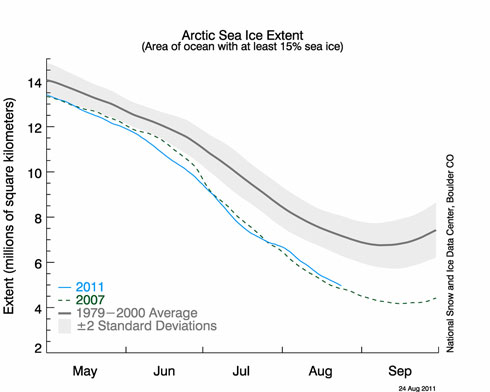
The familiar NSIDC arctic sea ice area graph for August 24.

We’re heading toward another near record low – no sign of the recovery so confidently predicted by climate deniers over the last few years (you betcha!).
Just as interesting is the graph of ice volume below – which is even more definitive and graphic than the area.

Note the blue triangles at the bottom. That’s this year’s ice, well below the 2007 collapse.


The NSIDC has a new “Icelights” page, wherein they’ve invited interested parties to submit their best estimates, as of june, for this year’s sea ice minimum, experts as well as not-so-experts.

Below – I’m sure none of my regular viewers will be surprised with the predictably brain-dead inaccuracy of science denier Anthony Watts and co. in the projections made for this year’s final numbers. (click below for larger image).
Continue reading “Graphs of the Day: Arctic Sea Ice and Volume”

Fox News Checks “Brain Room”, Finds Al Gore’s Brain

In analyzing recent comments by GOP presidential candidate John Huntsman (“To be clear. I believe in evolution and trust scientists on global warming. Call me crazy,” ), Fox News talking heads may have unwittingly revealed too much about their research operation.

Huntsman was differentiating himself from the decidedly brain-dead climate denial drivel of Rick Perry and Michelle Bachman.

MORRIS: If you dive into the weeds a little bit on this global warming thing, you see that it seems that facts are certainly on Huntsman’s side on all of this and fact checkers have come out, and we’re actually having our own brain room look at this right now and many of Perry’s comments don’t seem to hold a lot of water.

The words “Fox News” and  “Brain” don’t easily trip off the tongue, but the mind boggles at the idea that they keep gray matter under lock and key, and apparently allow only certain employees to access it under strictly controlled conditions.

And no wonder. You start going down that road, no telling where things might lead….

What’s that about “Intermittent Power”? Without Rain, Texas Coal Plants will have to shut down.

I’ve already reported on how Texas fossil fuel plants have been hampered by high heat conditions, and how wind energy has been vital and reliable, producing more than the expected amount of energy through the unprecedented drought. An even more pressing long term showstopper will be water.  According to the National Atlas, Large Thermal power plants “account for about half of total water withdrawals. Most of the water is derived from surface water and used for once-through cooling at power plants. About 52 percent of fresh surface-water withdrawals and about 96 percent of saline-water withdrawals are for thermoelectric-power use.”

Fuel Fix:

A number of Texas power plants may need to cut back operations or shut down completely if the state’s severe drought continues into the fall, an official with Texas’ main transmission manager told FuelFix.

At least one North Texas power plant has had to reduce how much it generates because the water level in its cooling reservoir has fallen significantly, said Kent Saathoff, vice president of system planning and operations for the Electric Reliability Council of Texas.

If the state’s drought continues for much longer and water levels continue falling at other power plant reservoirs, other units could be forced to curtail operations or shut-down completely, Saathoff said.

“Right now we don’t have a significant problem with it, but it could become one,” Saathoff said in an interview. “This has been the driest 12-month stretch we’ve seen in Texas in a long time.”

IEEE Spectrum:

Plug your iPhone into the wall, and about half a liter of water must flow through kilometers of pipes, pumps, and the heat exchangers of a power plant. That’s a lot of money and machinery just so you can get a 6–watt-hour charge for your flashy little phone. Now, add up all the half-liters of water used to generate the roughly 17 billion megawatt-hours that the world will burn through this year. Trust us, it’s a lot of water. In the United States alone, on just one average day, more than 500 billion liters of freshwater travel through the country’s power plants—more than twice what flows through the Nile.

When you’re forced to choose between power to keep the lights on, and water for your children to drink, thank a climate denier.

“Any last pressing concerns about getting arrested?”

Grist:

More than 100 activists have been arrested so far for protesting against the proposed Keystone XL pipeline in front of the White House — and more are getting locked up every day. At least 2,100 people have signed up to participate in the two-week sit-in, which kicked off on Saturday and will continue every day through Sept. 3. Not all of the protestors are intending to get arrested, but expect hundreds more to serve some time in the clink.

Letter from the Birmingham Jail, April 16, 1963: 

You may well ask: “Why direct action? Why sit-ins, marches and so forth? Isn’t negotiation a better path?” You are quite right in calling, for negotiation. Indeed, this is the very purpose of direct action. Nonviolent direct action seeks to create such a crisis and foster such a tension that a community which has constantly refused to negotiate is forced to confront the issue. It seeks to so dramatize the issue that it can no longer be ignored. My citing the creation of tension as part of the work of the nonviolent-resister may sound rather shocking. But I must confess that I am not afraid of the word “tension.” I have earnestly opposed violent tension, but there is a type of constructive, nonviolent tension which is necessary for growth. Just as Socrates felt that it was necessary to create a tension in the mind so that individuals could rise from the bondage of myths and half-truths to the unfettered realm of creative analysis and objective appraisal, we must we see the need for nonviolent gadflies to create the kind of tension in society that will help men rise from the dark depths of prejudice and racism to the majestic heights of understanding and brotherhood.

The purpose of our direct-action program is to create a situation so crisis-packed that it will inevitably open the door to negotiation.


Oklahoma State Climatologist: “Out of the realm of your imagining.”

The LA Times updates on the ongoing climate-fueled drought/heat/storm catastrophe in Oklahoma. The video above reviews the looking glass world of Oklahoma Senator James Inhofe, as well as a reality check from Associate Oklahoma State Climatologist Gary McManus.

LA Times:
The year has been so wild that Gary McManus has given up keeping track of the weather records set in Oklahoma. Begrudgingly, McManus, the associate state climatologist, briskly rattled off a few:
—The all-time low temperature (31 degrees below zero).

—Greatest 24-hour snowfall total (27 inches).

—Most tornadoes in one month (50 in April).

There’s been no measurable rain in the western half of the state since October. The 11-month period ending in August was the driest such period statewide since records were first kept in 1895.

McManus said this year’s back-to-back weather calamities were “out of the realm of your imagining. It’s not just that temperatures are above normal, it’s that it’s above normal for so many months in a row.” And this is the state that bore the brunt of the Dust Bowl.

McManus follows up with a candidate for the “It would be funny if it weren’t so damn sad” hall of Fame. –

“I think it would be a mistake to not think that this has become the new normal,” McManus said. “Until it stops happening, we should expect it to continue.”

It’s a classic quote that should go down along with Buckaroo Banzai’s “No matter where you go, there you are…”

Bill McKibben: “Gut Check Time” for Obama over Tar Sands Pipeline

The current civil disobedience actions centered on the Keystone Tar Sands pipeline project are a harbinger of much more to come. It’s appropriate that they come as a new memorial to Martin Luther King is being unveiled.

Bill Mckibben notes that these actions are changing the dialogue at a critical moment on this issue.

The New York Times notes that Tar Sands oil has a far higher greenhouse signature than conventional oil:

Canada will double its current tar sands production over the next decade to more than 1.8 million barrels a day. That rate will mean cutting down some 740,000 acres of boreal forest — a natural carbon reservoir. Extracting oil from tar sands is also much more complicated than pumping conventional crude oil out of the ground. It requires steam-heating the sands to produce a petroleum slurry, then further dilution.

One result of this process, the ministry says, is that greenhouse gas emissions from the oil and gas sector as a whole will rise by nearly one-third from 2005 to 2020 — even as other sectors are reducing emissions. Canada still hopes to meet the overall target it agreed to at Copenhagen in 2009 — a 17 percent reduction from 2005 levels by 2020. If it falls short, as seems likely, tar sands extraction will bear much of the blame.

Canada’s government is committed to the tar sands business. (Alberta’s energy minister, Ronald Liepert, has declared, “I’m not interested in Kyoto-style policies.”) The United States can’t do much about that, but it can stop the Keystone XL pipeline.

The State Department will decide whether to approve or reject the pipeline by the end of the year. It has already delivered two flawed reports on the pipeline’s environmental impact. It should acknowledge the environmental risk of the pipeline and the larger damage caused by tar sands production and block the Keystone XL.

Retiring Utility Exec: Climate Science “Pretty solid – I’d be OK if there were never any more coal.”

 Minnesota Post:

In a week, Dick Kelly will leave Minneapolis and find something to do in Colorado. He will retire as the CEO of Xcel Energy. What will he do?

“I’ve had enough of utilities,” he told me. “I’d like to try something different.”

He deserves a break. He has been working in electricity generation most of his life. On the way to becoming the CEO of one of the most respected electric utility companies in the United States, he walked around with a clipboard and read meters in thousands of backyards. Meter-reader to CEO. It has given Dick Kelly perspective.

The kind of perspective Kelly possesses is not seen very often in his business. Dick Kelly believes the facts are in on global warming.


Real Aspen:

“I’d be OK if there were never any more coal,” retiring Xcel Energy CEO Dick Kelly recently told the non-profit news site MinnPost.com.

Kelly, who’s apparently moving from Minnesota (where Xcel is based) to Colorado (where Xcel is the state’s largest electric utility), went on to question those in Congress denying the science behind global climate change and the need to move away from fossil fuels.

“I think the science is pretty solid. Maybe we haven’t communicated it well enough,” Kelly said. “But I think people do believe we need a change in the way we generate and use electricity. We’ve got to get off fossil fuels. The quicker the better.”

Continue reading “Retiring Utility Exec: Climate Science “Pretty solid – I’d be OK if there were never any more coal.””

Quake knocks Nukes. Wind Keeps spinning. What’s that about “Intermittent power”?

For those that have not yet heard, the East coast USA, including the DC area, was hit today by the largest earthquake yet recorded in that area.

Washington Post:

RICHMOND, Va. — Federal officials say two nuclear reactors at the North Anna Power Station in Louisa County, Va., were automatically taken off line by safety systems around the time of the earthquake.

The Dominion-operated power plant is being run off three emergency diesel generators, which are supplying power for critical safety equipment. The NRC and Dominion are sending people to inspect the plant.

A fourth diesel generator failed, but it wasn’t considered an emergency because the other generators are working, according to the Nuclear Regulatory Commission.

Dominion said it declared an alert at the North Anna facility and the reactors have been shut down safely and no major damage has been reported.

The earthquake was felt at the company’s other Virginia nuclear power station, Surry Power Station in southeast Virginia, but not as strongly there. Both units at that power station continue to operate safely, Dominion said.

The quake also caused Dominion’s newest power station, Bear Garden in Buckingham County, to shut down automatically.

——-

As of now, no reports of shutdowns, oil spills, or radioactive leaks at any wind turbines.

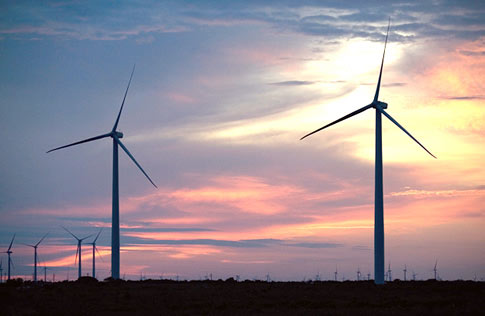
Windbaggers and climate deniers like to say that renewables are “intermittent, unreliable power”. But, when large power plants like nukes trip offline, they very often do so instantaneously, presenting a real challenge to electric grids.  By contrast, when winds calm, wind power generally slows predictably, allowing system operators hours to adjust and shift loads.

My wind video below, explains why the “intermittent” dog don’t hunt.

Continue reading “Quake knocks Nukes. Wind Keeps spinning. What’s that about “Intermittent power”?”


Arnie Gunderson for August 22: Radiation Spread from Fukushima

Video Description from Fairewinds:

Newly released neutron data from three University of California San Diego scientists confirms Fairewinds’ April analysis that the nuclear core at Fukushima Daiichi turned on and off after TEPCO claimed its reactors had been shutdown. This periodic nuclear chain reaction (inadvertent criticality) continued to contaminate the surrounding environment and upper atmosphere with large doses of radioactivity.

In a second area of concern, Fairewinds disagrees the NRC’s latest report claiming that all Fukushima spent fuel pools had no problems following the earthquake. In a new revelation, the NRC claims that the plutonium found more than 1 mile offsite actually came from inside the nuclear reactors. If such a statement were true, it indicates that the nuclear power plant containments failed and were breached with debris landing far from the power plants themselves. Such a failure of the containment system certainly necessitates a complete review of all US reactor containment design and industry assurances that containments will hold in radioactivity in the event of a nuclear accident. The evidence Fairewinds reviewed to date continues to support its April analysis that the detonation in the Unit 3 Spent Fuel pool was the cause of plutonium found off site.

Third, the burning of radioactive materials (building materials, trees, lawn grass, rice straw) by the Japanese government will cause radioactive Cesium to spread even further into areas within Japan that have been previously clean, and across the Pacific Ocean to North America.

And finally, the Japanese government has yet to grasp the severity of the contamination within Japan, and therefore has not developed a coherent plan mitigate the accident and remediate the environment. Without a cohesive plan to deal with this ongoing problem of large scale radioactive contamination, the radioactivity will continue to spread throughout Japan and around the globe further exacerbating the problem and raising costs astronomically.