

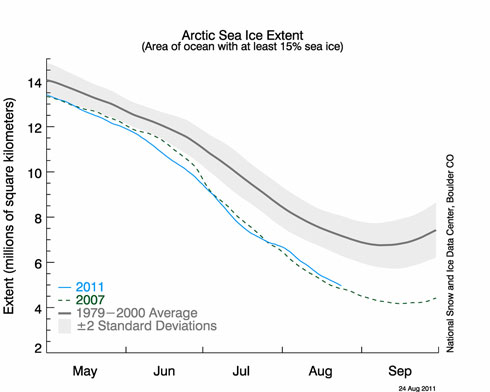
The familiar NSIDC arctic sea ice area graph for August 24.
We’re heading toward another near record low – no sign of the recovery so confidently predicted by climate deniers over the last few years (you betcha!).
Just as interesting is the graph of ice volume below – which is even more definitive and graphic than the area.
Note the blue triangles at the bottom. That’s this year’s ice, well below the 2007 collapse.

The NSIDC has a new “Icelights” page, wherein they’ve invited interested parties to submit their best estimates, as of june, for this year’s sea ice minimum, experts as well as not-so-experts.
Below – I’m sure none of my regular viewers will be surprised with the predictably brain-dead inaccuracy of science denier Anthony Watts and co. in the projections made for this year’s final numbers. (click below for larger image).

According to the graph, Watts et al use a “heuristic” technique for estimating sea ice. Wiki defines “heuristic” as –
“experience-based techniques for problem solving, learning, and discovery.”
Given Watt’s rich experience in being grossly misinformed and misinforming, this current estimate fits the profile, with real-world ice having blown by Watt’s Pollyanna “experience based” estimate with weeks still to go in the melt season.


Oh, and that oft-touted “increase” in southern hemisphere sea ice? Not so much this year. (not that it ever outweighed what’s being lost in the north..)

and here
 We’ll approach the minimum sometime in the next few weeks, I would imagine. I’ll start working on my sea ice annual review sometime soon.
Good post.
Given the current rate of volume decline, what is the likeliest estimate for the first ice-free summer in the Arctic Ocean? I know there are different models and scenarios to consider, but what’s the current betting?
Admiral Titley says between 2030 and 2040.
Mark Serreze of the NSIDC is pretty close in that ballpark,
both allow there may be surprises either way.
Despite the quibbling about year-to-year extent figures that Watts and others like to focus on, I think of it as the Arctic ice is pretty much half gone already.
Sure, the extent isn’t quite half of what it used to be before the decline, but the volume sure seems to be lower than half. All within 30 years or so. Crazy. Many people that don’t follow climate science closely are very surprised when I tell them that.
It all boils down to sound bites. “The Arctic ice cap is half gone.” It ought to be a bumper sticker.