Pilot for a series – fun explanation of how electric cars work, and how they’ll fit in the transportation system of the future.
Below the jump, my vid on how electric and hybrid cars will work with the new “smart grid”.

Pilot for a series – fun explanation of how electric cars work, and how they’ll fit in the transportation system of the future.
Below the jump, my vid on how electric and hybrid cars will work with the new “smart grid”.
I’ve done 3 videos now on the pervasive “CO2 is good for crops” canard.
Finally, the mainstream media might be catching up with what climate activists have been talking about for years. On sunday, the New York Times published a long essay about the dawning realization on the part of scientists, agronomists, and public officials, that climate is already having a major impact on food systems and food prices worldwide.
I can’t improve on Joe Romm’s great discussion piece over at ClimateProgress, but here are a few snips from the Times article, “A Warming Planet Struggles to Feed Itself”.
Now, the latest scientific research suggests that a previously discounted factor is helping to destabilize the food system: climate change.
Many of the failed harvests of the past decade were a consequence of weather disasters, like floods in the United States, drought in Australia and blistering heat waves in Europe and Russia. Scientists believe some, though not all, of those events were caused or worsened by human-induced global warming.
Temperatures are rising rapidly during the growing season in some of the most important agricultural countries, and a paper published several weeks ago found that this had shaved several percentage points off potential yields, adding to the price gyrations.


 The Tea Party congress hates new energy, hates the idea that the nation could be weaned off its oil dependence, or fossil fuels. They hate renewable energy because their primary sponsors in the fossil fuel industry want above all to slow progress on that front, and drag the nation back into the 19th century.
We’ve seen a number of examples of this over recent months, now the anti-science crusade continues. Lead by Rep. Doug Lamborn (R-CO), 9 members of congress have now asked for the closure of the National Renewable Energy Laboratory in Golden, CO.
The lawmakers ask that funding in the 2012 budget be eliminated for the Department of Energy’s Office of Science and Office of Energy Efficiency and Renewable Energy programs because they “have failed to live up to their supposed potential.”
Democratic U.S. Rep. Ed Perlmutter, who represents the district in which the national lab is located, has said the facility generates 5,500 jobs.
“NREL is a crown jewel in the world of renewable energy,” said Les lie Oliver, a spokeswoman for Perlmutter. “It’s providing a lot of jobs; those are things we need to be fostering.”
According to an analysis by the University of Colorado, the lab provides a $714 million annual boost to the state’s economy.
The letter, written by California U.S. Rep. Tom McClintock IR-CA), says: “We should not follow the president’s poor planning in increasing the funding for these anti-energy boondoggles.”
By “boondoggle”, apparently he means wind energy, which has made up more than a third of new US capacity over the last several years, and is currently coming in competitive with, or cheaper than, coal in most areas of the country, or solar energy, which is now the fastest growing industry in the US.
Below the fold, American Wind Energy Association President Denise Bode kicks ass and takes names as Fox News “personalities” try to spread more disinformation about renewable energy.
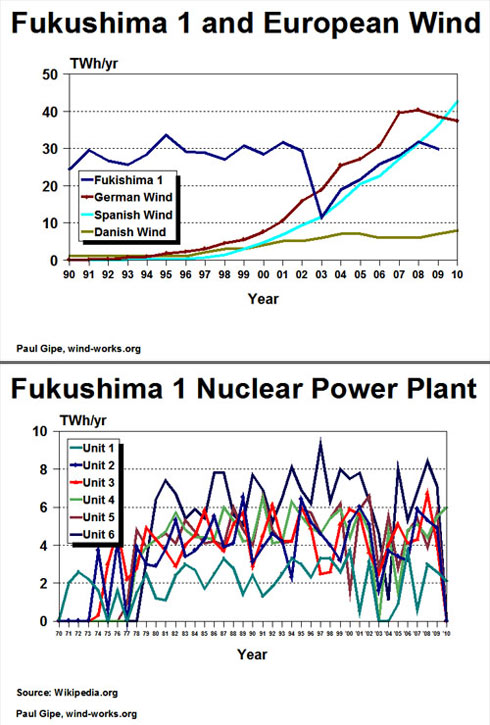
We’ve seen how Japan’s wind turbines successfully road out the historic earthquake and tsunami, and kept on delivering power during the national crisis that followed, while conventional sources, and of course, nuclear, failed miserably.
What may be surprising to some folks, is, how even during normal times, wind systems, as a whole, are more consistent and reliable than tempermental and complex nuclear power.
Continue reading “Wind: More Reliable, Less “Lumpy”, than Nuclear”
The so-called conservatives of the tea party congress claim they are in favor of smaller government, while proposing energy solutions that only increase the dependence of consumers on large government and big industry.
Feed in Tariffs, perhaps the most important tool in use around the world to encourage renewable energy development, result in the gradual dispersion of power and responsibility to communities, small companies, cooperatives and individuals. For Tea Baggers and their plutocrat backers, that burns like acid.
FITs are considered by many to be the most successful instrument for promoting renewable energy. Despite the wonky name, it’s actually a very simple concept — which is why it’s been so effective.
FITs guarantee an owner of a renewable energy project a premium price for every unit of electricity or heat generated over a 15-20 year period of time. That premium is designed to give the owner “a reasonable rate of return” and is changed on a set schedule as technology costs come down, with room to make immediate changes when needed. (In fact, Germany and other European countries have made major changes to their FITs over the last year as the price and cost of solar PV has dropped dramatically.)
The payments come from utilities, which raise the funds by charging ratepayers a small fee each month. This only costs a few dollars— or, as is often said: “About the price of a loaf of bread.”
FITs also give clean energy projects of any size priority access to the grid — meaning that a 5 kilowatt solar PV system has just as much right to plug into the grid (if not more) as a 500 MW coal plant. This, as Ulrich Kelber described, “empowers people.”
The policy drives rapid investment, which is why Germany — a pioneer in creating the modern FIT — has been an historic leader in deployment of solar PV, solar thermal, wind, biogas and combined heat and power.
Investors like FITs because they provide long-term consistency; renewable energy companies like FITs because they create an environment that makes it easy to scale; and consumers like FITs because it provides a simple way for them to invest in renewable energy.
Turns out Fox News does not have a corner on ignorance and anti-science bigotry.
Proving that right wing know-nothing bluster and puffery are the same all over the world, this edition of Australian Broadcasting’s Mediawatch shines some light on radio host Alan Jones, and his “fair and balanced” treatment of climate science.

After a brief hiatus due to world-wide recession, carbon emissions jumped dramatically, putting us as the high end of IPCC emissions scenarios.
After a dip in 2009 caused by the global financial crisis, emissions are estimated to have climbed to a record 30.6 Gigatonnes (Gt), a 5% jump from the previous record year in 2008, when levels reached 29.3 Gt.
In addition, the IEA has estimated that 80% of projected emissions from the power sector in 2020 are already locked in, as they will come from power plants that are currently in place or under construction today.
“This significant increase in CO2 emissions and the locking in of future emissions due to infrastructure investments represent a serious setback to our hopes of limiting the global rise in temperature to no more than 2ºC,” said Dr Fatih Birol, Chief Economist at the IEA who oversees the annual World Energy Outlook, the Agency’s flagship publication.
Ok. No sense in hand wringing. We have work to do.
Spectacular video of a twister moving up a river in Springfield, Massachusetts, as ‘once in one hundred year” events become as common as last week’s thunderstorm.
Nothing to see here, move along.

From Goddard Space Flight Center, 08/30/2007:
Previous climate model studies have shown that heavy rainstorms will be more common in a warmer climate, but few global models have attempted to simulate the strength of updrafts in these storms. The model developed at NASA’s Goddard Institute for Space Studies by researchers Tony Del Genio, Mao-Sung Yao, and Jeff Jonas is the first to successfully simulate the observed difference in strength between land and ocean storms and is the first to estimate how the strength will change in a warming climate, including “severe thunderstorms” that also occur with significant wind shear and produce damaging winds at the ground. This information can be derived from the temperatures and humidities predicted by a climate computer model, according to the new study published on August 17 in the American Geophysical Union’s Geophysical Research Letters. It predicts that in a warmer climate, stronger and more severe storms can be expected, but with fewer storms overall.
–
The central and eastern areas of the United States are especially prone to severe storms and thunderstorms that arise when strong updrafts combine with horizontal winds that become stronger at higher altitudes. This combination produces damaging horizontal and vertical winds and is a major source of weather-related casualties. In the warmer climate simulation there is a small class of the most extreme storms with both strong updrafts and strong horizontal winds at higher levels that occur more often, and thus the model suggests that the most violent severe storms and tornadoes may become more common with warming.The prediction of stronger continental storms and more lightning in a warmer climate is a natural consequence of the tendency of land surfaces to warm more than oceans and for the freezing level to rise with warming to an altitude where lightning-producing updrafts are stronger. These features of global warming are common to all models, but this is the first climate model to explore the ramifications of the warming for thunderstorms.