She was invited to perform it for the Tahltan people at the Iskut Music Festival a year later, where we filmed this video.
One of the Klabona Keepers brought us up to the Headwaters, the birthplace of the Skeena, Nass and Stikine rivers and a traditional Tahltan territory. This area is critically endangered by a number of industrial mega-projects which threaten all 3 watersheds, affecting an area larger than Ireland.
Since the beginning of the Fukushima crisis, anyone watching the media closely has realized that the news coming from TEPCO and the Japanese government has been confused, contradictory, evasive, therapeutically sterile, and inaccurate at best – and downright deceptive a good part of the time.
For relief, I’ve consistently turned to a small group of bloggers and vloggers who have been combing the media to tease out clues to what is really happening behind the Fukushima webcam curtain.
If you haven’t heard one of playbacklapompe’s anguished, passionate, heavily accented rants, this one will show you why they’ve become a relished respite from the Orwellian wall of Tepco doublespeak. Here he’s ruefully taking credit for being right about what Tepco has denied for 2 months now. At least one, and maybe all, of the afflicted reactors, have gone into meltdown and containment breach. Proof that sometimes, you just can’t be paranoid enough.
You know that water you were told was covering up and cooling fuel in the damaged reactors? Turns out, not so much.
The first team of human observers entered Fukushima Unit 1, to find that company reassurances that fuel rods were covered with water were erroneous. In fact, water levels have been up to 16 feet lower than needed to cover the fuel, water has been draining out of the vessel, the fuel has been uncovered, and may have melted through the containment structures.
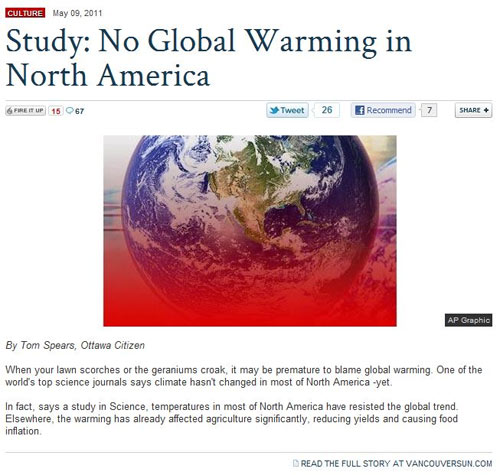
In a recent study published in Science, and blogged here, David Lobell of Stanford University pointed out that global climate change was already having an impact on agriculture around the planet.
One of the findings of the study was that the specific impacts on crop production studied, so far, have not shown up yet in North America.
Fox News’ responded to the story with the headline above.
With yesterday’s announcement by Japan that 14 new nuclear power plants have been shelved in favor of greater emphasis on renewable energy and efficiency, two of the world’s top economies have now explicitly declared themselves as front runners for leadership in the multi-trillion dollar race to become sustainably-powered societies.
Germany is already among the world leaders in deployment of renewable technologies, with widely copied Feed in Tariff policies that have made the the northern European country an unlikely leader in solar energy, and in some parts of the country, so much wind power is being produced that consumers are being “paid to keep the lights on.”
That temporary bonanza is an artifact of power production outstripping transmission grid buildout, but is illustrative of what happens when well-targetted governmental policies are put in place to encourage new technology.
Ok, it’s not the New York Times, it’s RT – but since the US media has moved on from reporting this slow-moving story, (Audiences want bodies, blood and drama, dammit) we have to go with what we have.
This began as speculation among those of us watching the webcam… Just tonight there was an announcement from the Japanese government that work has began to shore up the building from collapsing. The Building contains fuel rods from 3 to 4 reactors in there… If the building were to collapse you would have all the fuel rods from the spent fuel pool scattered around on the ground and the radiation levels would shoot up so high that it would make it very hard for workers to do any work in the area. The flow of information has been limited to control public perception of the disaster.
The reactor building of the No. 4 reactor was destroyed by explosions. TEPCO is to set up a structure to support the pool from underneath to keep it sound.
The report contains additional information about high radiation levels beyond the evacuation zone for the plants.
Wind, after being the darling of the media, business and state governments for much of its history, has suddenly found itself on the receiving end of negative publicity, questions about its value as an energy source and even calls for an end to wind development.
What this boils down to, is that renewable energy is a threat to the business model of far-right conservatives like the Koch brothers, various fossil fuel industries, and a small but influential group of ideologically driven “think-tanks” that they fund.
A popular climate denialist theme is that climate change is an “open debate”, and that scientists disagree on the main points that:
a) climate change is real, and is happening
b) we’re doing it
c) the consequences will most likely be dire
Since climate deniers are terribly embarrassed by the fact that the published science on the issue is so clear, it’s common to see lists of peer reviewed studies that, they tell us, disprove, or disagree with this or that aspect of the problem. Once you knock out the papers that are clearly out of context, and in fact don’t really say what deniers say they say – you’re left with a body of work that is disproportionately the product of a very small group of scientists whose names keep popping up again and again on the Fox News/talk radio circuit.
I know you’ll be as shocked, shocked as I was to find that these scientists are often connected to Big Oil….
… a preliminary data analysis by the Carbon Brief has revealed that nine of the ten most prolific authors cited have links to organisations funded by ExxonMobil, and the tenth has co-authored several papers with Exxon-funded contributors.
Once you crunch the numbers, however, you find a good proportion of this new list is made up of a small network of individuals who co-author papers and share funding ties to the oil industry. There are numerous other names on the list with links to oil-industry funded climate sceptic think-tanks, including more from the International Policy Network (IPN) and the Marshall Institute.
Well, not me. But then I don’t pretend to be one on the internet – I just talk to them and translate what they tell me. They’ve been more and more frustrated over the years about their inability to communicate in language common people can understand, and the power of the Fox News/talk radio/anti-science media machine. They’ve been shouting at us in tech-speak for 20 years.
Now, a young group of real scientists from Australia have laid it out in plain, angry, (and, warning) x-rated English.
The Center for Climate Change Communication (4C) at George Mason University believes that excellence deserves acknowledgment. Since 2009, each year 4C conducts an open nomination and democratic voting process to select one person, and one organization, as Climate Change Communicators of the Year. Eight extraordinary individuals and six extraordinary organizations were nominated this year. After a six-week voting process, with thousands of votes cast, Naomi Oreskesand the Alliance for Climate Education emerged as this year’s winners.
Dr. Oreskes is the author of one of the top science books of the year, Merchants of Doubt.
She shows how a tiny group of ideological cold warriors, funded by the a secretive group of twisted, super-rich far-right fanatics, have distorted science from tobacco, to acid rain, to climate change, right up to the present day, in an attempt to bend reality to a kind of Ayn Randian fantasy world.
If you have time for only one book on climate change this year, this is the one.
Moreover, if you are interested in the broader topic of how information gets buried, distorted, perverted, packaged and spun in the modern media culture, this is the one as well.
For Dr. Oreskes long-form presentation, see below.




 The Center for Climate Change Communication (4C) at George Mason University believes that excellence deserves acknowledgment. Since 2009, each year 4C conducts an open nomination and democratic voting process to select one person, and one organization, as Climate Change Communicators of the Year. Eight extraordinary individuals and six extraordinary organizations were nominated this year. After a six-week voting process, with thousands of votes cast,