Love the song. But the climate debate has taught me that there are, in fact, bad guys. So Dave Mason and I just disagree.
On the Cover of Rolling Stone – POTUS talks climate.
Whatever you do, don’t miss the clip above. (off topic but pretty damn funny, and then again maybe not so off topic)
I’m posting this as kind of a historical note. I think this is a remarkable example of the nexus between news, entertainment, opinion, and the way people perceive and process public issues in this multi media age. Some people will compare this to Bill Clinton’s Sax playing turn on the Arsenio show in ’92, but I think this is a step beyond. It’s hard to imagine Newt Gingrich, or Rick Santorum pulling this off, much less Mitt Romney. Whether it works, we’ll see – but it sure is entertaining.

In a Rolling Stone interview published today, President Obama broke out of his self-imposed silence on climate change. He made some remarkable statements, including his belief that the millions of dollars pouring into the anti-science disinformation campaign will drive climate change into the presidential campaign.
Earlier this year the President omitted any discussion of climate change from his State of the Union address. And he (or the White House communications team) edited it out of his Earth Day proclamation.
But in this interview, Obama was actually the first to bring up climate change, noting it was one of many big issues he’s had to deal with and then slamming the GOP for moving so far to the right on the issue.
From the Rolling Stone Interview:
…..But what’s happened, I think, in the Republican caucus in Congress, and what clearly happened with respect to Republican candidates, was a shift to an agenda that is far out of the mainstream – and, in fact, is contrary to a lot of Republican precepts. I said recently that Ronald Reagan couldn’t get through a Republican primary today, and I genuinely think that’s true. You have every candidate onstage during one of the primary debates rejecting a deficit-reduction plan that involved $10 in cuts for every $1 of revenue increases. You have a Republican front-runner who rejects the Dream Act, which would help young people who, through no fault of their own, are undocumented, but who have, for all intents and purposes, been raised as Americans. You’ve got a Republican Congress whose centerpiece, when it comes to economic development, is getting rid of the Environmental Protection Agency.
Doesn’t all of that kind of talk and behavior during the primaries define the party and what they stand for?
I think it’s fair to say that this has become the way that the Republican political class and activists define themselves. Think about John McCain, who obviously I have profound differences with. Here’s a guy who not only believed in climate change, but co-sponsored a cap-and-trade bill that got 43 votes in the Senate just a few years ago, somebody who thought banning torture was the right thing to do, somebody who co-sponsored immigration reform with Ted Kennedy. That’s the most recent Republican candidate, and that gives you some sense of how profoundly that party has shifted.Continue reading “On the Cover of Rolling Stone – POTUS talks climate.”
Wind Tax Credit Stalls in Congress Despite Bipartisan support. So what’s the Disconnect here?

Politico has an informative piece on the current impasse surrounding the much-needed passage of a Production Tax Credit for Wind Energy (link below).
The article mentions my congressman, Dave Camp, who is chairman of Ways and Means – a position that is usually prefaced in journalism with the qualifiers “the powerful”, or described as being one of the most important legislative posts.
Well, I went to high school with Dave. He’s a nice guy. My wife has taught his kids. He’s a good Father, clearly. We agreeably disagree on almost everything, and I try to restrain myself from beating him up too often for ignoring my early warnings on that nasty Iraq business.
I met with him last fall and discussed the the Wind Production Tax credit, which is vital to keep a consistent, predictable playing field for one of the 21st century’s most important industries. (video coming very soon on this) I spent an hour on the phone with a couple of his staffers afterward. They were polite and well spoken.
But damned if I can tell what he thinks about it, or what he’s doing on it. Turns out some of his colleagues are a little confused as well.
Congress is taking the wind out of turbine sales.
And that’s despite support from President Barack Obama, the U.S. Chamber of Commerce and a substantial roster of House Republicans who see extending the wind tax credit as an electoral imperative.
Rep. Dave Reichert (R-Wash.) is so frustrated he’s thought about trying to go over House Ways and Means Chairman Dave Camp’s head to get legislation moving.
The credit doesn’t expire until the end of this year, but turbine makers are already feeling pain because developers can’t afford to lay bets that Congress will sort it out later.
The bottom line: It takes a long time to get projects up and running, and, amid tight budgets, subsidy scandals and election-year politics, there’s no guarantee that this tax break will catch a tailwind in time to avoid a crippling interruption in production.
On one level, the wind credit is just another casualty of the ongoing tussle between conservative budget hawks who want to rein in government spending and business-minded Republicans who support subsidizing industrial innovation. But what makes this tax break unusual is the damage that’s already being done — and the possibility that inaction could devastate an industry that Congress has propped up for two decades.
“It’s a horrible way to do business,” Rep. Steve LaTourette (R-Ohio) said. “But that’s the way the place works.”
Bottom line, if congress is serious about defunding all energy subsidies and making a truly level playing field, well and good, then start with the oil companies, and by the way, tell them they have to keep the Strait of Hormuz open on their own dime.
But if not, check the graph above. It shows what has happened in the past when congress has made a political football of the PTC. Last time it expired in 2004, the industry had a 77 percent drop the following year. It’s not because wind can not be competitive without subsidies, any more than oil and gas needs them – but predictability is the number one thing you have to give business people if you expect them to make long term investments, and we have not been doing that.
How to Talk to an Ostrich: “We can’t Afford Clean Energy”
Richard Alley shows vividly why this crock, really is a crock. Full-on ceramic porcelain.
How to Talk to an Ostrich: “Today’s CO2 is Nothing Special”
More from the “Earth: the Operators Manual” team.
One of the most common signs of poorly informed but pretentious denier. The assertion that since levels of co2 have been higher in other times, there is no big deal about the current rise.
I actually made a popular video on this topic myself, and drew heavily on one of Alley’s most famous speeches, at the American Geophysical Union in 2009, to make this point in much more detail. See below….
Continue reading “How to Talk to an Ostrich: “Today’s CO2 is Nothing Special””
Deniers in Denial about Why they Deny
Politely but firmly, in the short vid above, Naomi Oreskes asserts to climate denying Australian politician Nick Minchin, that climate denial is based less on science than it is on fears of what the implications of the science are. Nobody who reads the comment threads on my videos could possibly miss the political slant to a significant number of denialist screeds.
There is no better example of the need to construct an alternative reality than Conservapedia, a project of such mind-bending, breathtaking absurdity that it defies parody – and its straight faced disputation Einstein’s relativity theory on the basis of biblical passages, and the insistence that the modern understanding of physics was part of some kind of liberal plot to keep people from reading their Bibles.
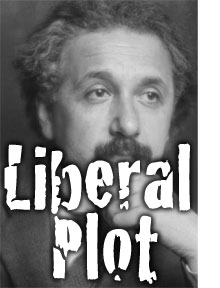
More than a half-century ago, the Nazis dismissed Albert Einstein’s groundbreaking theories as “Jewish science”; in recent years Holocaust revisionists have taken up the anti-Einstein cause. Now the legendary physicist is facing a new wave of attacks, this time from conservative bloggers who say that his theory of relativity and its iconic formula, E=mc2, are part of a “liberal conspiracy.”
The latest debate erupted when a website, Conservapedia, posted a definition of relativity making the charge that it was part of an ideological plot, and then added a list of counter examples it says disprove Einstein’s theories. The postings were picked up by the liberal blog TPMMuckracker and then went viral.
Conservapedia is the creation of Andrew Schlafly, the 49-year-old lawyer son of Phyllis Schlafly, the anti-abortion activist. He has a degree in engineering physics from Princeton University and a law degree from Harvard Law School. Schlafly, who did not respond to repeated attempts to interview him for this article, founded Conservapedia three years ago — reportedly because he feels that Wikipedia, the dominant online encyclopedia and one of the most visited websites in the world, has a liberal, anti-Christian, anti-American bias.
…..does that remind anyone of denier’s hatred for Wikipedia’s info on climate?
To many conservatives, almost everything is a secret liberal plot: from fluoride in the water to medicare reimbursements for end-of-life planning with your doctor to efforts to teach evolution in schools. But Conservapedia founder and Eagle Forum University instructor Andy Schlafly — Phyllis Schlafly’s son — has found one more liberal plot: the theory of relativity.
If you’re behind on your physics, the Theory of Relativity was Albert Einstein’s formulation in the early 20th century that gave rise to the famous theorum that E=mc2, otherwise stated as energy is equal to mass times the square of the speed of light. Why does Andy Schlafly hate the theory of relativity? We’re pretty sure it’s because he’s decided it doesn’t square with the Bible.
In the entry, “Counterexamples to Relativity,” the authors (including Schlafly) write:
The theory of relativity is a mathematical system that allows no exceptions. It is heavily promoted by liberals who like its encouragement of relativism and its tendency to mislead people in how they view the world.[1]
Virtually no one who is taught and believes relativity continues to read the Bible, a book that outsells New York Times bestsellers by a hundred-foldIn other words, reading a theory about physics is correlated to a decrease in people’s interest in reading the Bible, which means that it causes people to stop reading the Bible.
Schlafly also points to the Bible as a reason that Einstein’s theory must be wrong:
9. The action-at-a-distance by Jesus, described in John 4:46-54.Conservapedia defines “action-at-a-distance” as “Action at a distance consists of affecting a distant body instantaneously. At the atom level, this is known as “non-locality.” In non-confusing terms, that indicates the ability to cause something to happen instantaneously in another location (i.e., faster than the speed of light). Since Jesus could, reportedly, do this, thus Einstein is wrong. Schlafly’s evidence is John 4:46-54, in which Jesus reportedly cured someone’s son just by saying it had happened.
Climate science, it seems, is yet another liberal plot to sap our precious bodily fluids.
The “Lack of Recent Warming” Crock: No Cigar, But Thanks for Playing!

Climate Crocks advisor Andrew Dessler alerted me to this new piece by John Nielsen-Gammon.
Per Dessler, “these graphics are some of the best I’ve seen to explain why the “lack of recent” warming is nothing of the kind.”
John Nielsen-Gammon is the Texas State Climatologist and a Professor of Atmospheric Sciences at Texas A&M University. Viewers may remember him from my snapshot of the Great Texas drought.
Reposted with permission:
It’s common knowledge among those who follow such things that global temperatures have not gone up very much in the past several years. This has caused many to believe that the recent lack of warming contradicts what climate models say should happen in response to the increasing Tyndall gases. This, in turn, has provoked the counterargument that the Earth is still warming, just on a longer time scale, or that the recent period is too short to yield statistically significant results.
These counterarguments are not compelling. Fundamentally, any change in global temperature, even if it’s just from one year to another, must have a cause. Saying that we need to look at longer time scales denies the need to find the cause of the actual global temperature changes (or lack thereof) at shorter time scales.
Such causes have been sought, and a few papers have proposed various combinations of cloud cover, volcanic aerosols, the El Niño/Southern Oscillation (ENSO), deep ocean heat uptake, and so forth. A recent paper I like by Foster and Rahmsdorf (discussed here and here) takes a statistical approach to attempt to eliminate the effect of the other known forcing mechanisms, and what’s left over is a fairly steady warming. Others have noted, more casually, that 2011 was the warmest La Niña year on record.
I decided to take a simple approach at looking at the effect of ENSO. Using GISTemp Land/Ocean Index values andNiño 3.4 values, I computed 12-month running averages of Niño 3.4 and compared them to the average GISTemp values at lags of 0, 3, and 6 months. Foster and Rahmsdorf used a diferent ENSO index and found optimal lags between 2 and 5 months. So one would guess that a 3-month lag would fit the data best in my case, and indeed it did.
The normal threshold for El Niño or La Niña, as applied by the Climate Prediction Center, is for five consecutive months of at least 0.5 C above or below normal in a key region of the tropical Pacific. For working with annual data, I decided to call an annual average above 0.5 C an El Niño and an annual average below -0.5 C a La Niña. Then I plotted it up, color-coding each year for whether it was El Niño, La Niña, or neither (neutral). Here’s the result:

We see the latter half of the mid-century flat period, followed by the warming since 1970 and the relatively flat recent few years. We also see a few years that were exceptionally cold and whose timing fits with the known injection of aerosols into the stratosphere by the mighty volcanic eruptions of Agung and Pinatubo. It’s easy to see that both of these eruptions caused global temperatures to drop by about 0.3 C temporarily before recovering as the aerosols settled out of the stratosphere over the following 2-3 years. Finally, we see that, as is well known, La Niña years tend to be globally cold years and El Niño years tend to be globally warm, with a global lag of three months as mentioned earlier. And, we see that in a head-to-head match between El Niño and Pinatubo, Pinatubo wins.
To dig deeper, I’ll zoom in on the period since Agung. This isolates the period of nearly steady warming since 1970 and lets us focus a bit more on what has happened since 1998 or so. Here’s the chart:
Continue reading “The “Lack of Recent Warming” Crock: No Cigar, But Thanks for Playing!”
Legacy of BP Spill : Gulf Seafood Deformities Alarm Scientists
Safe as milk, according to BP.
C’mon Daown!! Bring th’ keeyuds! Eacher fill! ‘tsall good!!
How to Talk to a Climate Ostrich: The Pentagon and Climate Change
Another edition of a new multi part series from the producers of Earth: An Operators Manual.
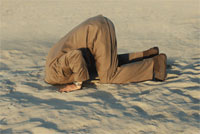
BTW, comparing ostriches to climate deniers does a grave injustice to Ostriches. It turns out, according to Wiki, that:
Contrary to popular belief, Ostriches do not bury their heads in sand.[34] This myth likely began with Pliny the Elder (AD 23-79), who wrote that Ostriches “imagine, when they have thrust their head and neck into a bush, that the whole of their body is concealed.”[35]

Animals generally live in the moment and do what is required. It is human beings who have mastered the arts of living in the past, lying to ourselves, ignoring what our senses tell us, and hiding in the shadows of projection, compartmentalization, repression, and denial.
Paul Douglas: Forecast Calls for Climate Smart Business

Paul Douglas’ essay “A Republican Meteorologist looks at Climate Change” went seriously viral in early april, shortly after I had conducted a Skype interview with him for my recent 2 part video.
In a recent follow-up email, he told me “I’m seeing things I never thought I would see in my career. The analogy I give is Mother Nature picking up the Weather DVR, putting our seasons on fast-forward, turning the volume of extreme weather events up to a deafening 11.”
Now he’s back with a new essay in Bloomberg News on Climate-smart business:
When will American business wake up to the scientific reality of climate change?
When the common-sense moderate middle wakes up. When pragmatic entrepreneurs and investors realize an intransigent, inflexible and, worst of all, factually incorrect political stance could lose the U.S. global influence and mountains of cash. We risk our technological and engineering — and moral — leadership to other countries if we continue to deny and debate established science.
I’m a moderate Republican, a Penn State-trained meteorologist and small-business owner, and I’m disheartened by my party’s refusal to acknowledge the physical evidence of climate change. The denial is disconcerting in and of itself, but it could also have serious and long-term economic consequences.
Action in the U.S. is being held back by a potent concoction of political mendacity about science, misleading talking points from anti-science groups, blind party loyalty (on all sides), investment barriers, century-old energy business models and generation gaps. The 21stcentury will be won by the nation that solves the energy-and-climate problem — and the United States is tripping over itself at the starting line.
Something interesting happens once you acknowledge the world is changing: new opportunities emerge. The beauty of free enterprise is that it empowers individuals to take advantage of change. Any smart company or nation is always in what software developers call “perpetual beta,” a state of continuous reinvention and testing of new products, services and business models.
Entrepreneurs new and old thrive on invention and reinvention. They come as young as three-year-old Ever Cat Fuels, in Anoka, Minnesota, which makes fuel from plant oils and animal fats using zircon catalysts. It’s a closed-loop process that uses no water and provides its own power supply. They come as venerable as 120-year-old General Electric, which in May 2005 launched its Ecomagination strategy. The portfolio has generated $85 billion in sales through 2010, in everything from lighting, to solar and wind power, to aviation.
Robert G. Eccles, Ioannis Ioannou, and George Serafeim compared a matched sample of 180 companies, 90 of which they classify as High Sustainability firms and 90 as Low Sustainability firms, in order to examine issues of governance, culture, and performance. Findings for an 18-year period show that High Sustainability firms dramatically outperformed the Low Sustainability ones in terms of both stock market and accounting measures.
For most investors, “sustainability” isn’t about doing the right thing. The conversation has evolved. It’s about doing the smart thing. This demands an answer to the fundamental question: Does it pay to invest in sustainability?Early results are in.This chart, drawn from a Harvard Business School study, tracks the performance of 180 companies over 18 years. The 90 firms that adopted environmentally and socially responsible policies significantly outperformed their peers. Every dollar invested in a portfolio of sustainable companies (blue line) in 1993 would have grown to $22.60 by 2011. That beats the rise to $15.40 for a portfolio of companies less focused on sustainability (purple line).The Harvard report, first released in November, is the most rigorous attempt yet to identify which companies were transforming themselves in sustainable ways before sustainability was “cool.” It’s also the first study to follow companies’ performance for decades — the kind of time frame needed to evaluate transformative long-term strategies — authors Robert Eccles and George Serafeim said in an interview.”These things take time to pay off,” Serafeim said. “If you are short-term oriented, is this a good strategy? No, it won’t pay off. But if you are patient, it will.”