These two false-color thermal images taken by NASA satellites depict the rapid retreat of the Columbia Glacier in Alaska over the past 25 years. The top image shows the glacier’s terminus just north of Heather Island in 1986. By 2011, the terminus had retreated 12 miles up the inlet, and is identifiable in the bottom image, just below the “Main Branch” label, where the striped glacier surface meets the inlet. The blue in the water below the 2011 terminus is floating ice that has calved off the leading edge of the Columbia Glacier. (NASA Earth Observatory)
Five years ago, the United Nations Food and Agricultural Organization published a report called “Livestock’s Long Shadow,” which maintained that 18 percent of greenhouse gases were attributable to the raising of animals for food. The number was startling.
A couple of years later, however, it was suggested that the number was too small. Two environmental specialists for the World Bank, Robert Goodland (the bank’s former lead environmental adviser) and Jeff Anhang, claimed, in an article in World Watch, that the number was more like 51 percent. It’s been suggested that that number is extreme, but the men stand by it, as Mr. Goodland wrote to me this week: “All that greenhouse gas isn’t emitted directly by animals. ”But according to the most widely-used rules of counting greenhouse gases, indirect emissions should be counted when they are large and when something can be done to mitigate or reduce them.”
The exact number doesn’t matter. What does is that few people take the role of livestock in producing greenhouse gases seriously enough. Even most climate change experts focus on new forms of energy — which cannot possibly be effective quickly enough or produced on a broad enough scale to avert what may be the coming catastrophe — and often ignore the much easier fix of adjusting our eating habits.
It’s good that we’re eating somewhat less meat, but it still amounts to something just shy of a staggering 200 pounds per person per year. And no matter how that number changes domestically, on the world scale there’s troubling movement in the wrong direction. Meat consumption in China is now twice what it is in the United States (in 1978 it was only one-third). We still eat twice as much per capita as the Chinese, but when they catch up they’ll consume more than four times as much as we do.
But the Chinese don’t need to eat like us; we need to eat like them. Or, rather, like they did until recently.
…an acquaintance recently told me she’s joined a meat CSA (wherein you get a butcher box direct from the farm) for “environmental reasons.” No doubt the bucolic pasture where her burgers grow up is a far cry from a Food, Inc.-style feedlot, but aren’t my salads, cage-free egg sandwiches, and veggie burgers always better for the planet than any kind of meat—no matter how responsibly it’s raised?
Not necessarily, says Gidon Eshel, a Bard College geophysicist who analyzes the energy payoff and environmental impacts of food production. In general, Eshel says, it’s true that raw veggies are an excellent nutritional bargain: For every 100 calories of energy put into producing conventional beef, from farm to supermarket shelf, you get only six calories back to eat. Compare that with apples, which yield 110 calories, or raw soy: an amazing 415. In terms of greenhouse gases, switching from a diet that includes red meat to a plants-only one is roughly equivalent to trading in your SUV for a Camry.
The announcement came as NOAA reported that the U.S. also just experienced its third-warmest April on record.
“These temperatures, when added with the first quarter and previous 11 months, calculate to the warmest year-to-date and 12-month periods since recordkeeping began in 1895,” the agency reported.
NOAA said that for the period from May 2011 to April 2012, the nationally averaged temperature was 55.7 degrees, 2.8 degrees higher than the 20th century average. The national average temperature for April was 55 degrees, 3.6 degrees above average.
To be sure, the higher temperatures haven’t hit every region equally. The Pacific Northwest actually saw cooler-than-average temperatures over the past year, according to NOAA data. Much of California was also cooler than normal; Southern California had an average year.
But record averages for the year scorched central Texas — which saw a horrific drought last year — the upper Midwest, and much of the Northeast.
Temperatures that would have once been considered unusually hot and record breaking now aren’t even in the top two or three, said Michael Oppenheimer, a Princeton University climate scientist.
The last time the globe had a month that averaged below the 20th Century normal was February 1985. April makes it 326 months in a row. Nearly half the population of the world has never seen a month that was cooler than normal, according to United Nations data.
“A warmer world is the new normal,” Oppenheimer said. “To me, it’s startling to think that a generation has grown up with global warming defining their world.”
Following close on the heels of the Heartland Institute’s disastrous, ill conceived billboard campaign, this news from Colorado makes one wonder if someone has been switching the sugar cubes at Tea Party meetings lately. Look out for the the brown darjeeling, dude – it’s heavy.
The billboard campaign was rolled out at 28 locations around Colorado by the conservative organization Compass Colorado.
Mahmoud Ahmadinejad claims that the Holocaust was a myth, believes that the U.S. government perpetrated the 9/11 attacks, and has bragged about how effective Iran is in recruiting suicide bombers who “enlighten our future.”
President Obama has said that “this country needs an all-out, all-of-the-above strategy that develops every available source of American energy. A strategy that’s cleaner, cheaper, and full of new jobs.”
According to Compass Colorado, that belief in clean energy is egregious enough to compare Obama to a dictator who promotes mass murder.
When the Heartland Institute attempted the same kind of campaign, the fallout was swift — with 11 corporations pulling support from the organization. Ahmadinejad doesn’t have the same kind of lurid cultural relevance that Ted Kaczynski or Charles Manson have in America, but the attempt at shock value is no different than Heartland’s.
Pharmaceutical maker Eli Lilly (LLY), BB&T Bank (BBT), and PepsiCo (PEP) have all confirmed that they will not continue funding the Heartland Institute, joining GM, State Farm, and numerous other leading corporations in deserting an organization that produces radical attacks on climate science and scientists. The defections come aftergrowing pressure from corporate accountability and environmental groups, which have collected more than 150,000 signatures on a petition saying:
“All corporations should immediately pull their funding from the Heartland Institute in light of Heartland’s ongoing and extreme support of climate change denial.”
The coalition of groups — Forecast the Facts, the Sierra Club,350.org, SumOfUs, the League of Conservation Voters, and Greenpeace — plans to continue pressuring Heartland’s remaining sponsors, including Pfizer, GlaxoSmithKline, and Comcast.
Statements From Coalition Members
“More than 100,000 Americans are telling corporations to stop polluting our democracy by supporting organizations like the Heartland Institute,” said Daniel Souweine, Campaign Director of Forecast the Facts. “Heartland’s remaining funders would be wise to heed their calls. Heartland’s radical agenda stains the reputation of any business that wants to be considered a responsible corporate citizen.”
“Corporate funders have been jumping ship from theHeartland Institute for years. Heartland’s anti climate science agenda was too extreme even for Exxon, which stopped funding Heartland and other front groups in 2007 ‘whose position on climate change could divert attention’ from the discussion of responsible energy production,” said Kert Davies, Greenpeace Research Director, “Heartland’s desperate billboard stunt is just the most recent offense, and its few remaining funders should understand that there will be more to come.”
Get ready for Fox News to start highlighting the Bicycle/Kenyan-UN-Terrorist connection.
(video above features DC, Denver and other cities as well as NYC)
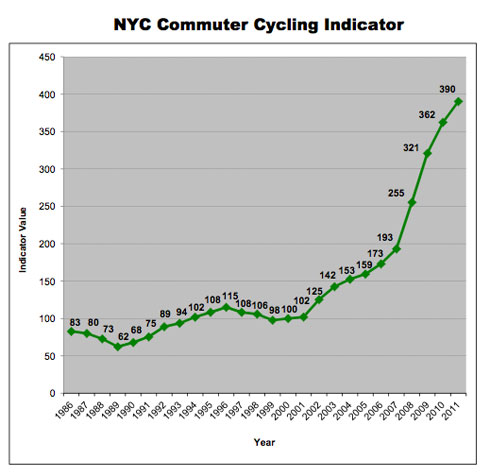
As someone in love with 3rd-generation bike-sharing systems before the large majority of Americans knew anything about them, I’ve been eagerly anticipating and covering NYC’s huge bike-sharing plans for years. This could transform NYC. Bike sharing did so in Paris, and NYC’s program is to be a similar size. Additionally, biking in NYC has been booming under the leadership of Janette Sadik-Khan (Commissioner of the New York City Department of Transportation), see there’s a flame to be fueled with this new program.
Citibank has signed a $41-million, 5-year contract. Additionally, Mastercard is putting in $6.5 million to operate the payment systems for the bikes.
“We’re getting an entirely new 24/7 transportation network ,” Mayor Michael Bloomberg said. “We are getting an entirely new transportation network without spending any taxpayer money. Who thought that that could be done?”
However, while it was initially stated that the system would start at those numbers, it was made clear in the opening announcement that the system wouldn’t actually reach that scale until 2013. The Upper West and East Sides, Cobble Hill, Park Slope, Prospect Heights and Crown Heights will get bikes and stations next Spring, while the first bikes and 420 stations (about two-thirds of them) will be ready in July around Manhattan and part of Brooklyn.
Across the country, activists with ties to the Tea Party are railing against all sorts of local and state efforts to control sprawl and conserve energy. They brand government action for things like expanding public transportation routes and preserving open space as part of a United Nations-led conspiracy to deny property rights and herd citizens toward cities.
They are showing up at planning meetings to denounce bike lanes on public streets and smart meters on home appliances — efforts they equate to a big-government blueprint against individual rights.
That’s going to be the question on a lot crestfallen climate denier’s minds when they attend next week’s International Conference on Climate Change, aka Denia-palooza, sponsored by the Heartland Institute.
The tobacco industry showed us decades ago that if you put out bad information, and repeat it often enough, a certain percentage of people will keep believing it, and repeating it, endlessly. The whole premise of the climate crock series is to tackle those crunchy nuggets of ignorance head on. I’ve been so pleased to see Richard Alley and Geoffrey Haines-Stiles of PBS’s “Earth the Operator’s Manual” series taking the same approach.
During a meeting in 2008, a U.S. senator told me about the many claims that global warming stopped in 1998, suggesting that we really don’t need to be concerned about future warming and that climate scientists were misleading the public.
Google the phrase “global warming stopped in 1998” for yourself, and you’ll see tens of thousands of results. A quick reading of these “results” finds many agreeing with the senator’s sources, with many others debunking this claim. So what were the senator and I to do? The variability of nature often fools us. Everyday experiences with weather — an unexpectedly warm winter, or a cooler-than-anticipated summer — get many folks confused. But science has a way of connecting the dots of temperature over time, to find out what nature is really telling us.
When the senator quizzed me, the hottest year in thermometer records was either 1998 or 2005, depending on which compilation you chose. A huge El Niño had cranked up the 1998 temperature. But, if 1998 was the hottest or second-hottest year through 2007, didn’t that in fact show that global warming had stopped, just as some people argued?
To find out what’s really going on, the analysis is best done with extensions of statistical tests developed by a mathematician working for the Guinness brewery more than a century ago. (But that’s a tale for another day.) Let me walk you through some dates in the past 50 years of Earth’s climate history, keying them to a few personal milestones, and with my tongue somewhat in cheek. Do be aware that Latin for wandering about is “errare”, the root of our word, error.
I’ve delved into this at least twice myself, see below:
HOLMDEL, N.J. — Jay Nuzzi, a New Jersey state trooper, had put off installing solar panels on his home here for years, deterred by the $70,000 it could cost. Then on a trip to Home Depot, he stumbled across a booth for Roof Diagnostics, which offered him a solar system at a price he couldn’t refuse: free.
Mr. Nuzzi had to sign a 20-year contract to buy electricity generated by the roof panels, which he would not own. But the rates were well below what he was paying to the local utility. “It’s no cost to the homeowner — how do you turn it down?” Mr. Nuzzi said on a recent overcast morning as a crew attached 41 shiny black modules to his roof. “It was a no-brainer.”
Similar deals are being struck with tens of thousands of homeowners and businesses across the country. Installers, often working through big-box chains like Home Depot or Lowe’s, are taking advantage of hefty tax breaks, creative financing techniques and a glut of cheap, Chinese-made panels to make solar power accessible to the mass market for the first time. The number of residential and commercial installations more than doubled over the last two years to 213,957, according to Greentech Media, a research firm.
“You hear a lot of the gloom and doom about the industry and, you know, ‘The manufacturers are losing jobs, they’re shutting down,’ but if you look at where the actual money is in these systems and where the jobs are, it’s really in the installation,” said Lynn Jurich, Sunrun’s president.
Big corporations like Google, U.S. Bancorp, Morgan Stanley and Bank of America Merrill Lynch see the potential for steady profits in rooftop solar projects and have been supplying the capital to help cover the upfront costs, which typically run $30,000 or more for a single-family home. The investors say they believe the returns, generally 7 to 13 percent, are relatively safe because the solar providers generally sign up only homeowners and businesses with solid credit. In addition, installers say that people tend to pay their electric bills even when facing other financial problems.
“We have customers that are foreclosed,” said Lyndon Rive, chief executive of SolarCity, one of the largest installers. “They’re still paying their electric bill so they still pay us.”