
The Weather is WACC, but Science Still Unsettled

Above, Warm Arctic, Cold Continents, or WACC is what scientists are calling disruptions like we’ve seen for the past month.
Scientists have made the connection between arctic warming and wild weather, but clear, “pound on the table, we’re done” understanding has been elusive.
In recent months, there has been some pushback on the whole idea that arctic changes have as much impact as had been suggested. (see below)

And yet, here we are.

Something is happening.

Seth Borenstein for AP:

This particular polar vortex breakdown has been a whopper. Meteorologists call it one of the biggest, nastiest and longest-lasting ones they’ve seen, and they’ve been watching since at least the 1950 s. This week’s weather is part of a pattern stretching back to January.

“It’s been a major breakdown,” said Jennifer Francis, a climate scientist at the Woodwell Climate Research Center on Cape Cod. “It really is the cause of all of these crazy weather events in the Northern Hemisphere.”

“It’s been unusual for a few weeks now — very, very crazy,” Francis said. “Totally topsy-turvy.”

RECORD COLD IN WARMER PLACES

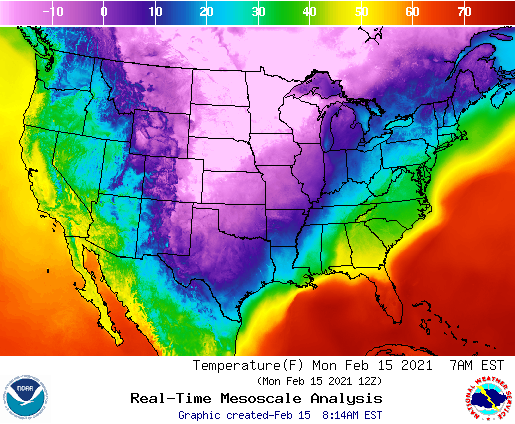
Record subzero temperatures in Texas and Oklahoma knocked millions off the power grid and into deep freezes. A deadly tornado hit North Carolina. Other parts of the South saw thunder snow and reports of something that seemed like a snow tornado but wasn’t. Snow fell hard not just in Chicago, but in Greece and Turkey, where it’s far less normal. Record cold also hit Europe this winter, earning the name the “Beast from the East.”

“We’ve had everything you could possibly think of in the past week,” said Northern Illinois University meteorology professor Victor Gensini, noting that parts of the U.S. have been 50 degrees (28 degrees Celsius) colder than normal. “It’s been a wild ride.”

It was warmer Tuesday in parts of Greenland, Alaska, Norway and Sweden than in Texas and Oklahoma. And somehow people in South Florida have been complaining about record warmth that is causing plants to bloom early.

Continue reading “The Weather is WACC, but Science Still Unsettled”

Texas Guv: Updating Texas Grid “an Emergency”

Above, Texas Governor Greg Abbott explains that the main reason for blackouts in Houston area was the failure of a South Texas Nuclear plant. He also calls for emergency evaluation of the Texas Grid operator, ERCOT.

Power Magazine:

Texas Gov. Greg Abbott has said reforming the Electric Reliability Council of Texas (ERCOT) is an emergency item for state legislators in the current session, as power outages continue across the state for another day due to record cold temperatures as part of a massive winter storm.

The governor on Feb. 16 said he wants lawmakers to investigate ERCOT, which operates much of the state’s electric grid and manages its deregulated power market, even as he said it would have been impossible to prepare “for this type of event, because the last time we had this type of weather was more than 100 years ago.”ERCOT said it lost about 34 GW of power supply as the cold temperatures forced both coal-fired and natural gas-fired plants offline.

The cold also reduced the supply of natural gas to power plants, and caused wind turbines to freeze. Wind supplies the second-most amount of power to Texas customers, behind natural gas, and the turbines in Texas are not equipped with cold weather packages that would enable them to operate in extreme cold.

Confirmed: Gas, Coal Nuclear Failed Texas, not Wind

Bloomberg:

Don’t point too many fingers at Texas wind turbines, because they’re not the main reason broad swaths of the state have been plunged into darkness.

While ice has forced some turbines to shut down just as a brutal cold wave drives record electricity demand, that’s been the least significant factor in the blackouts, according to Dan Woodfin, a senior director for the Electric Reliability Council of Texas, which operates the state’s power grid.

The main factors: Frozen instruments at natural gas, coal and even nuclear facilities, as well as limited supplies of natural gas, he said. “Natural gas pressure” in particular is one reason power is coming back slower than expected Tuesday, added Woodfin.

“We’ve had some issues with pretty much every kind of generating capacity in the course of this multi-day event,” he said.

The blackouts, which have spread from Texas across the Great Plains, have reignited the debate about the reliability of intermittent wind and solar power as the U.S. seeks to accelerate the shift to carbon-free renewable energy. Rolling outages in California last summer were blamed in part on the retirement of gas plants as the state pursued an aggressive clean-energy agenda. (spoiler: that was wrong as well)

Wind shutdowns accounted for 3.6 to 4.5 gigawatts — or less than 13% — of the 30 to 35 gigawatts of total outages, according to Woodfin. That’s in part because wind only comprises 25% of the state’s energy mix this time of year.

While wind can sometimes produce as much as 60% of total electricity in Texas, the resource tends to ebb in the winter, so the grid operator typically assumes that the turbines will generate only about 19% to 43% of their maximum output.

Even so, wind generation has actually exceeded the grid operator’s daily forecast through the weekend. Solar power has been slightly below forecastMonday.

“The performance of wind and solar is way down the list among the smaller factors in the disaster that we’re facing,” Daniel Cohan, associate professor of environmental engineering at Rice University, said in an interview. Blaming renewables for the blackouts “is really a red herring.”

That doesn’t mean that frozen turbines are playing no role in the energy crisis, which the grid operator has highlighted. Cody Moore, head of gas and power trading at Mercuria Energy America, noted that wind generation this week is down markedly this week from last week, possibly indicating that turbines are automatically shutting down due to ice.

Continue reading “Confirmed: Gas, Coal Nuclear Failed Texas, not Wind”

Texas Grid Updates 02/16/21

Image

Jesse Jenkins PhD on Twitter:

Morning. The #TexasFreeze continues & grid operator ERCOT is still reporting >31,000 MW of thermal generation capacity out as of 9AM CT. Down slightly from a peak of 34,000 MW reported yesterday afternoon (ercot.com/news/releases/…) but still >40% of thermal capacity in state!

Wind power is currently producing about 4,000 MW, or 2/3 of the ~6,000 MW that ERCOT was counting on wind to contribute during winter peaking events. Solar is coming online now and helping during daytime, exceeding the <300 MW it is counted on for in system planning.

Main story continues to be the failure of thermal power plants — natural gas, coal, and nuclear plants — which ERCOT counts on to be there when needed. They’ve failed. Of about 70,000 MW of thermal plants in ERCOT, ~25-30,000 MW have been out since Sunday night. Huge problem. 

ERCOT started directing electric utilities (like Oncor or Austin Electic) to start rolling blackouts or involuntary emergency load shedding at 1:25am on Monday morning, with 10,500 MW shed during that late morning. That’s ~2 million homes worth of load

Throughout Monday, many thermal power plants remained offline, as freeze-offs + fuel shortages in gas pipelines forced large numbers of natural gas plants offline.

Many coal plants likely struggled as well w/frozen coal piles, but breakdown of thermal outages by fuel type unclear.

1 nuclear reactor at South Texas Station (STS-1) also failed yesterday, NRC data confirms. That’s 1,280 MW of lost capacity also (en.wikipedia.org/wiki/South_Tex…)
nrc.gov/reading-rm/doc…

Image
Continue reading “Texas Grid Updates 02/16/21”

Texas’ Freeze: “..well beyond the design parameters.. “

Texas Power grid (ERCOT) is configured to meet peak demand in the summer. The graph shows how far outside expectations the current arctic blast pushed electric demand

Not out of the woods yet, more weather systems coming.
Key take-aways – this is a systemic problem, weaknesses in infrastructure revealed by extreme, possibly climate-related event.
Most of the power knocked offline came from thermal sources, .. particularly natural gas.

Some chatter on line about frequency fluctuations causing transmission to trip off.
A knowledgeable source tells me that there is not much information yet, both because of the speed at which problems developed, but also because of the gigantic liability issues sure to be raised.

Houston Chronicle:

The Texas power grid, powered largely by wind and natural gas, is relatively well equipped to handle the state’s hot and humid summers when demand for power soars. But unlike blistering summers, the severe winter weather delivered a crippling blow to power production, cutting supplies as the falling temperatures increased demand.

Natural gas shortages and frozen wind turbines were already curtailing power output when the Arctic blast began knocking generators offline early Monday morning.

The Electric Reliability Council of Texas, or ERCOT, which is responsible for scheduling power and ensuring the reliability of the electrical network, declared a statewide power generation shortfall emergency and asked electricity delivery companies to reduce load through controlled outages.

More than 4 million customers were without power in Texas, including 1.4  million in the Houston area, the worst power crisis in the state in a decade. The forced outages are expected to last at least through part of Tuesday, the state grid manager said.

Dan Woodfin, ERCOT’s senior director of system operations, said the rolling blackouts are taking more power offline for longer periods than ever before. An estimated 34,000 megawatts of power generation — more than a third of the system’s total generating capacity — had been knocked offline by the extreme winter weather amid soaring demand as residents crank up heating systems.

The U.S. Energy Department, in response to an ERCOT request, issued an order late Monday authorizing power plants throughout the state to run at maximum output levels, even if it results in exceeding pollution limits.

Ed Hirs, an energy fellow in the Department of Economics at the University of Houston, blamed the failures on the state’s deregulated power system, which doesn’t provide power generators with the returns needed to invest in maintaining and improving power plants.

“The ERCOT grid has collapsed in exactly the same manner as the old Soviet Union,” said Hirs. “It limped along on underinvestment and neglect until it finally broke under predictable circumstances.

Continue reading “Texas’ Freeze: “..well beyond the design parameters.. “”

Why Texas Has its Own Power Grid

Kind of stands out doesn’t it?
Despite the rest of the central US getting slammed by the same weather system, Texas seems unique in it’s catastrophic inability to respond. Part of the reason is ERCOT.

ERCOT is the Texas power grid, and it is almost unique among grid systems in that it has very few connections to the wider US grid, that might have allowed it to share some power from some other states that were not nearly so hard hit by the polar vortex weather event. Why? There’s a story behind that – this Texas Tribune history written 10 years ago still applies today.

Texas Tribune:

Hey, Texplainer: Why does Texas have its own electric grid?

Texas’ secessionist inclinations do have one modern outlet: the electric grid. There are three grids in the Lower 48 states: the Eastern Interconnection, the Western Interconnection — and Texas.

The Texas grid is called ERCOT, and it is run by an agency of the same name — the Electric Reliability Council of Texas. ERCOT does not actually cover all of Texas. El Paso is on another grid, as is the upper Panhandle and a chunk of East Texas. This presumably has to do with the history of various utilities’ service territories and the remoteness of the non-ERCOT locations (for example the Panhandle is closer to Kansas than to Dallas, notes Kenneth Starcher of the Alternative Energy Institute in Canyon), but Texplainer is still figuring out the particulars on this.

The separation of the Texas grid from the rest of the country has its origins in the evolution of electric utilities early last century. In the decades after Thomas Edison turned on the country’s first power plant in Manhattan in 1882, small generating plants sprouted across Texas, bringing electric light to cities. Later, particularly during the first world war, utilities began to link themselves together. These ties, and the accompanying transmission network, grew further during the second world war, when several Texas utilities joined together to form the Texas Interconnected System, which allowed them to link to the big dams along Texas rivers and also send extra electricity to support the ramped-up factories aiding the war effort.

The Texas Interconnected System — which for a long time was actually operated by two discrete entities, one for northern Texas and one for southern Texas — had another priority: staying out of the reach of federal regulators. In 1935, President Franklin D. Roosevelt signed the Federal Power Act, which charged the Federal Power Commission with overseeing interstate electricity sales. By not crossing state lines, Texas utilities avoided being subjected to federal rules. “Freedom from federal regulation was a cherished goal — more so because Texas had no regulation until the 1970s,” writes Richard D. Cudahy in a 1995 article, “The Second Battle of the Alamo: The Midnight Connection.” (Self-reliance was also made easier in Texas, especially in the early days, because the state has substantial coal, natural gas and oil resources of its own to fuel power plants.)

Continue reading “Why Texas Has its Own Power Grid”

Texas Freeze Brings Grid Emergency

Image result for texas freeze

Apparently historic temperature anomaly brings enormous cold blob over North America. No one (yet) getting hit as hard as Texas.

I’ve been following energy twitter all morning, hard to get a bead on what’s happening, but finally Princeton Energy Ace Jesse Jenkins has shed a little light.

Jesse Jenkins on Twitter:

Confidential info from a market participant in ERCOT: As of ~10 AM Eastern time, the system has ~30 GW of capacity offline, ~26 GW of thermal — mostly natural gas which cant get fuel deliveries which are being priorities for heating loads — and ~4 GW of wind due to icing.

That is a HUGE amount of gas capacity offline, about 30% of total ERCOT capacity and ~half of the natural gas fleet, according to Dec 2020 Capacity Demand and Reserves report here: ercot.com/content/wcm/li…

Devastating for reliability. If we look at Winter planning scenerio ERCOT was using for 2026/27 (table below), they were planning for a peak demand of 67,512 “based on normal weather.” Demand last night (in 2021 not 2026/27!) was 69,150

Developing – more below:

Continue reading “Texas Freeze Brings Grid Emergency”

Bill Gates on 60 Minutes: “We Won’t Solve Climate without Innovation”

Gates is a good messenger for a strata of society that might not hear this message otherwise.

Fumdamentally, Gates is in agreement with me, and I think, most mainstream engineers, that we can definitely see our way to 80 percent or so of energy production with renewables, solar and wind primarily.
After that, the view gets fuzzy, and the imperative of innovation is clear.

I would say that, as I was told not long ago by NREL researcher Paul Denholm, if you go back 15 years, it was hard to see the way clear to 80 percent renewable. They were looking at more like 15-20 percent. But in the meantime technological improvements have changed that picture radically for the better.

National Renewable Energy Laboratory (NREL):

Only in the past decade has the widespread adoption of renewable energy sources become an economic possibility, said Paul Denholm, a principal energy analyst at the National Renewable Energy Laboratory (NREL). He joined NREL 15 years ago and, at the time, he and other analysts were busy plotting a path to 20% of the nation’s energy supply coming from renewable sources. Now, they’re aiming much higher.

“The declining cost of wind and solar and now batteries makes it conceivable to consider 100% renewables,” he said.

NREL’s Renewable Electricity Futures Study estimated that 120 gigawatts of storage would be needed across the continental United States by 2050, when the scenario imagined a future where 80% of electricity will come from renewable resources. The country currently has 22 gigawatts of storage from pumped hydropower, and another gigawatt in batteries.

A massive increase in storage, and transmission, would also make difficult bottlenecks like this weekend’s energy crunch in Texas much more manageable. (see elsewhere on this page)

Below, Gates on how to restore trust in Science:

Continue reading “Bill Gates on 60 Minutes: “We Won’t Solve Climate without Innovation””