
Channel 4 production featuring friends-of-this-blog John Abraham, and Michael Mann.
It’s gettin hot in here.

Channel 4 production featuring friends-of-this-blog John Abraham, and Michael Mann.
It’s gettin hot in here.
Horrific story of oil baron malfeasance in Ecuador, told by Attorney Steven Donziger, who has been pursued and persecuted by Chevron for his activism.
We’d better learn the lesson of how big energy has behaved in the developing world, because this week’s events should show us, – that’s what they have in mind for the USA, maybe sooner than you thought.
Hidden from view by ice kilometres thick, there is a vast network of lakes and streams under the Antarctic ice sheet. Using a decade of altimetry data from European Space Agency’s (ESA) CryoSat satellite, researchers at the University of Edinburgh, including a scientist with the PROPHET project of the International Thwaites Glacier Collaboration (ITGC), have made an unexpected discovery about how lakes beneath Thwaites Glacier drain and recharge in quick succession.
Meltwater beneath the ice arises from frictional heating as the ice flows over the bedrock, as well as from geothermal heat coming from below the bedrock. Measurements of geothermal heat flux beneath the ice are particularly difficult to obtain and there are large differences between the various recent estimates. It is important that our knowledge of the distribution of meltwater and the geothermal heat flux is improved because both factors influence the speed the ice flows into the ocean.
While subglacial meltwater is hidden from view by kilometres-thick ice, its movement beneath the ice causes tiny movements on the surface of the ice, which, remarkably, can be detected and monitored from space.
A study published in the journal Geophysical Research Letters in December 2020 describes how a decade of radar altimetry observations have revealed a network of four subglacial lakes under Thwaites Glacier, which drained and recharged in two events observed within that time period. By comparing the rates to modelled estimates, the team found that previous models underestimated the rate of basal melting by 150%. This finding will help glaciologists reassess models and improve predictions of how the ice sheet might behave in the future.
Thwaites Glacier was the topic of my most recent Yale Climate Connections video, see below.
Continue reading “Under Antarctic Ice: Lakes Ebb and Flow”Every time I see one of these I realize it’s this times a billion with every new catastrophe.
The old “There has been no warming since 1998” scam.
Scientific equivalent of “I did not pay off that porn star.”

The old “There has been no warming since 1998” scam.
Scientific equivalent of “I did not pay off that porn star.”
If you’re still a climate denier, this is the length you have to go to.
The Global Warming Policy Forum, in response to yesterday’s announcement that 2020 tied for hottest year in the record, produced the graph above.
Global Warming Policy Forum: (I’m not giving them a link, find it yourself)
There has been no significant warming trend for 5 years.
Every year in the middle of January various organisations, The UK Met Office, NASA, NOAA, etc. release their estimates of the annual average global temperature of our planet.
This year the conclusion is that 2020 is statistically identical to 2016. Some have placed it the second whereas the Japanese Meteorological Agency has it as the third warmest of the modern era. The overall conclusion to be drawn however is the misunderstanding of statistics used to support a predetermined opinion.
Here’s another view, below, at 170 year scale.

Good video focusing on climate impacts on businesses.
It’s not going to be pretty – those without a plan will see huge impacts.

Watch this space.
Continue reading “BFD: Lab Grown, No-Kill Meat Approved”Cultured meat, produced in bioreactors without the slaughter of an animal, has been approved for sale by a regulatory authority for the first time. The development has been hailed as a landmark moment across the meat industry.
The “chicken bites”, produced by the US company Eat Just, have passed a safety review by the Singapore Food Agency and the approval could open the door to a future when all meat is produced without the killing of livestock, the company said.
Dozens of firms are developing cultivated chicken, beef and pork, with a view to slashing the impact of industrial livestock production on the climate and nature crises, as well as providing cleaner, drug-free and cruelty-free meat. Currently, about 130 million chickens are slaughtered every day for meat, and 4 million pigs. By weight, 60% of the mammals on earth are livestock, 36% are humans and only 4% are wild.
The cells for Eat Just’s product are grown in a 1,200-litre bioreactor and then combined with plant-based ingredients. Initial availability would be limited, the company said, and the bites would be sold in a restaurant in Singapore. The product would be significantly more expensive than conventional chicken until production was scaled up, but Eat Just said it would ultimately be cheaper.
The cells used to start the process came from a cell bank and did not require the slaughter of a chicken because cells can be taken from biopsies of live animals. The nutrients supplied to the growing cells were all from plants.
The growth medium for the Singapore production line includes foetal bovine serum, which is extracted from foetal blood, but this is largely removed before consumption. A plant-based serum would be used in the next production line, the company said, but was not available when the Singapore approval process began two years ago.
A series of scientific studies have shown that people in rich nations eat more meat than is healthy for them or the planet. Research shows cutting meat consumption is vital in tackling the climate crisis and some scientists say this is the best single environmental action a person can take.
The companies developing lab-grown meat believe this is the product most likely to wean committed meat-eaters off traditional sources. Vegan diets are viewed as unappealing by some, and plant-based meat replacements are not always regarded as replicating the texture and flavour of conventional meat. Meat cultivated in bioreactors also avoids the issues of bacterial contamination from animal waste and the overuse of antibioticsand hormones in animals.

Housebound by a pandemic, humanity slowed its emissions of greenhouse gases in 2020. But Earth paid little heed: Temperatures last year tied the modern record, climate scientists reported today. Overall, the planet was about 1.25°C warmer than in preindustrial times, according to jointly reported assessments from NASA, the U.K. Met Office, and other institutions.
The annual update of global surface temperatures—an average of readings from thousands of weather stations and ocean probes—shows 2020 essentially tied records set in 2016. But the years were nothing alike. Temperatures in 2016 were boosted by a strong El Niño, a weather pattern that warms the globe by blocking the rise of cold deep waters in the eastern Pacific Ocean. Last year, however, the Pacific entered La Niña, which has a cooling effect. That La Niña didn’t provide more relief is an unwelcome surprise, says Nerilie Abram, a climate scientist at Australian National University. “It makes me worried about how quickly the global warming trend is growing.”
The past 6 years are the six warmest on record, but the warming of the atmosphere is unsteady because of its chaotic nature. The ocean, which absorbs more than 90% of the heat from global warming, displays a steadier trend, and here, too, 2020 was a record year. The upper levels of the ocean contained 20 zettajoules (1021joules) more heat than in 2019, and the rise was double the typical annual increase, scientists reported yesterday in Advances in Atmospheric Sciences. The subtropical Atlantic Ocean was particularly hot, fueling a record outbreak of hurricanes, says Lijing Cheng, a climate scientist at the Chinese Academy of Sciences’s Institute of Atmospheric Physics who led the work.
This heat, monitored down to 2000 meters by a fleet of 4000 robotic probes, is spreading deeper into the ocean while also migrating toward the poles. An extreme heat wave struck the northern Pacific, killing marine life. For the first time, warm Atlantic waters were seen penetrating into the Arctic Ocean, melting sea ice from below and driving its extent nearly to a record low. The warming ocean and melting ice sheets are raising sea levels by 4.8 millimeters per year, and the rate is accelerating.
Insect populations are suffering “death by a thousand cuts”, with many falling at “frightening” rates that are “tearing apart the tapestry of life”, according to scientists behind a new volume of studies.
The insects face multiple, overlapping threats including the destruction of wild habitats for farming, urbanisation, pesticides and light pollution. Population collapses have been recorded in places where human activities dominate, such as in Germany, but there is little data from outside Europe and North America and in particular from wild, tropical regions where most insects live.
The scientists are especially concerned that the climate crisis may be causing serious damage in the tropics. But even though much more data is needed, the researchers say enough is already known for urgent action to be taken.
Continue reading “Tearing the Fabric of Life on Earth”Insects are by far the most varied and abundant animals on Earth, with millions of species and outweighing humans by 17 times. They are essential to the ecosystems that humanity depends upon, pollinating plants, providing food for other creatures and recycling nature’s waste.
The studies show the situation is complex, with some insect populations increasing, such as those whose range is expanding as global heating curbs cold winter temperatures and others recovering from a low level as pollution in water bodies is reduced.
The good news is that the raised profile of insect declines in the past two years has prompted government action in some places, the scientists said, while a “phenomenal’’ number of citizen scientists are helping with the huge challenge of studying these tiny creatures.
The 12 new studies are published in the journal Proceedings of the National Academy of Sciences. “Nature is under siege [and] most biologists agree that the world has entered its sixth mass extinction event,” concludes the lead analysis in the package. “Insects are suffering from ‘death by a thousand cuts’ [and] severe insect declines can potentially have global ecological and economic consequences.”
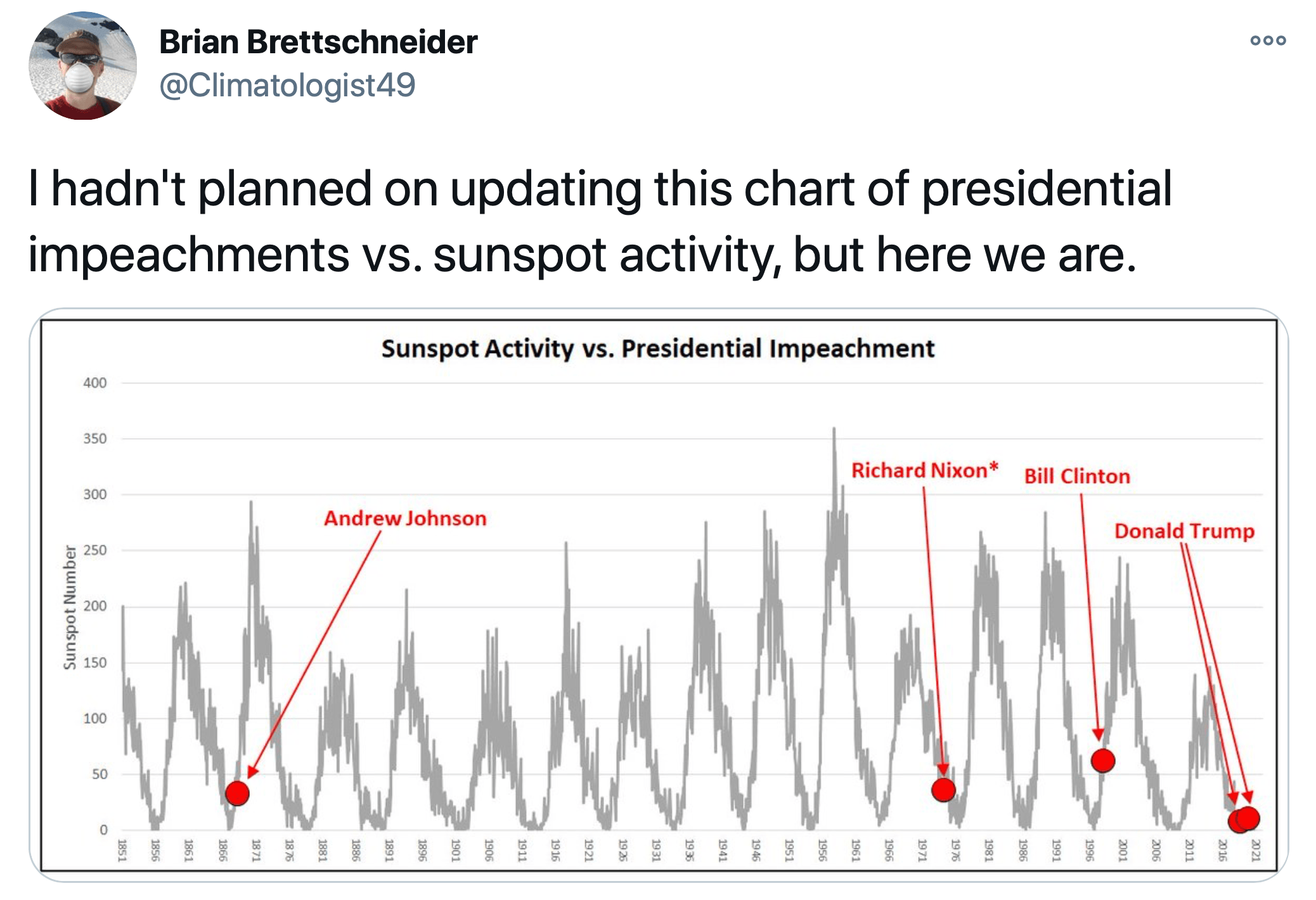
Brian Brettschneider having a little bit of fun with perennial climate denial memes.
Gavin Schmidt reminds us of his swipe at this in 2007.
We are forever being bombarded with apparently incredible correlations of various solar indices and climate. A number of them came up in the excoriable TGGWS mockumentary last month where they were mysteriously ‘improved’ in a number of underhand ways. But even without those improvements (which variously involved changing the axes, drawing in non-existent data, taking out data that would contradict the point etc.), the as-published correlations were superficially quite impressive. Why then are we not impressed?
To give you an idea, I’m going to go through the motions of constructing a new theory of political change using techniques that have been pioneered by a small subset of solar-climate researchers (references will of course be given). And to make it even more relevant, I’m going to take as my starting point research that Richard Lindzen has highlighted on his office door for many years:

That’s right. Forget the economy or the war(s), the fortunes of the Republican party in the US Senate are instead tied closely to the sunspot cycle.
more real climate here
Other science correlation below:
Continue reading “Correlation is Not Causation, but..”