
BP Makes Big Moves Away from Oil

Still frame of an avalanche.

Still frame of an avalanche.

Washington Post:

With climate change bearing down on the planet and the novel coronavirus upending the fossil fuel business, one of the world’s biggest oil and gas companies on Tuesday mapped out how it plans to navigate the next decade by radically cutting back on its oil and gas business.

The London-based BP said that it will transform itself by halting oil and gas exploration in new countries, slashing oil and gas production by 40 percent, lowering carbon emissions by about a third, and boosting capital spending on low-carbon energy tenfold to $5 billion a year.

“This makes the BP the first supermajor to spell out, in detail, what the energy transition will actually entail, in practical terms,” said Pavel Molchanov, senior energy analyst for the investment firm Raymond James.

While BP announced earlier this year its broad strategy shift to comply with the goals of the 2015 Paris climate accord, Tuesday’s earnings report specifically laid out for investors how much — and how soon — this would change the company. BP had in February — before the pandemic hit — vowed to reach net-zero carbon emissions by 2050, but the new details show major impacts on its business by 2030.

“We believe our new strategy provides a comprehensive and coherent approach to turn our net zero ambition into action,” BP chief executive Bernard Looney said in a statement Tuesday. “This coming decade is critical for the world in the fight against climate change, and to drive the necessary change in global energy systems will require action from everyone.”

The earnings briefing on Tuesday also revealed more of the change in mind-set at the company once known as British Petroleum that gobbled up big rivals such as Amoco and Standard Oil of Ohio to bolster its reserves.

For investors, that means an immediate 50 percent cut in dividends, a significant hit for the British pension funds that rely heavily on BP’s quarterly payments to shareholders. But it will arm the company with more cash as the business reacts to climate change. And on Tuesday, investors applauded; at 10 a.m., BP’s shares jumped more than 6 percent, outpacing smaller gains among other oil companies.

Continue reading “BP Makes Big Moves Away from Oil”

Pandemic Pushes Prodigious Pivot Past Petroleum

Subject of two pending videos, but things are happening so fast I hope they get posted while they’re still fresh..

Bloomberg New Energy Finance:

The global pandemic of 2020 has slowed down demand for oil and gas but provided a big boost for renewables, said Mona Dajani, partner and global head of energy and infrastructure at Pillsbury Winthrop Shaw Pittman LLP in New York.

Fossil-fuel companies that saw oil futures drop below zero in April are pivoting toward wind and solar in a big way, Dajani, one of the leading deal makers in the renewable energy industry, said in a phone interview with BloombergNEF in June. She is also seeing storage increasingly bundled into packages with wind and solar.

This interview has been edited for brevity and clarity.

Q: There are a lot of weird things going on in the world of energy right now. What are you seeing?

A: A lot of oil and gas majors are headed to renewables and I’m helping them in their transition. And this pandemic, weirdly, is expediting the investment in renewable energy from oil and gas majors — like BP, Enel, Total, Shell — as well as corporate purchasers. The pandemic has heightened the unpredictability of returns, and the market volatility makes the business case for renewables stronger.

I can’t tell you how strong oil and gas is just pivoting in this space. It’s amazing. BP’s chairman, Bernard Looney, made an announcement that, “Yeah, we’re taking a $17 billion hit, but then we’re investing $12 billion in renewables.” It’s like whiplash, it’s crazy.

Q: What else is driving the decision?

A: Market dynamics are continuing to weaken some of the viability for conventional oil and gas resources. And these companies’ interests in long-term contracts and better ROI now go beyond a response to shareholder activism and carbon commitments. I helped Saudi Aramco recently bid a huge deal, just like with BP, where they are really pivoting in this space, they’re buying other companies, technologies, this is Economics 101.

Q: Among renewables, who are the beneficiaries?

A: The big utilities and oil super majors are jumping into offshore wind. They need the resources and staying power to survive, and they’re jumping into this offshore wind, to build out. They’re bringing in deep pockets to capital-intensive products. We’re seeing fossil-fuel super majors repurpose some of the infrastructure needed on flagships and offshore cranes, which is great. We’re seeing very strong M&A activity and a lot of consolidation in the industry to continue in this space.

Q: What specifically are you seeing in the U.S.?

A: This summer we saw Dominion Energy building the next two offshore wind turbines in America that are off a demonstration project in Virginia. This is the first new project to come online since Block Island’s first five offshore turbines in 2017. Virginia has committed to moving beyond fossil fuels by 2030. So have other states — Connecticut, New New York, Massachusetts, New Jersey, North Carolina.

Continue reading “Pandemic Pushes Prodigious Pivot Past Petroleum”

As Isaias Pounds Coast, Shelters are Empty

Image

Extreme weather is a compounding factor in a pandemic.

Climate Wire:

People in the path of Hurricane Isaias are shunning emergency shelters as officials from Florida to North Carolina have urged evacuating residents to stay with friends or relatives instead or to rent hotel rooms.

Ten shelters were opened in Florida in recent days, yet they received a total of 266 people, according to a Federal Emergency Management Agency report.

In North Carolina, where mandatory evacuation orders are in place for parts of three coastal counties, 17 shelters have been opened with a combined capacity of 2,300. The shelters were largely empty last night, a state website shows.

“We’ve got a lot of people really scared because of the COVID situation, and they will stay at home,” Edward Conrow, emergency manager in Brunswick County, N.C., said in an interview yesterday.

Brunswick County, in North Carolina’s southeast corner, ordered evacuations from some beachfront communities and opened two emergency shelters yesterday in local public schools. But the county’s website says “shelters should be only considered as a last resort” and lists rules that require residents to wear masks “at all times” and to “remain in their assigned section of the building at all times.”

Officials are warning about shelters even as they have made them more spacious to facilitate social distancing during the COVID-19 pandemic. The two Brunswick County shelters are limited to 200 people each — far below their typical capacity of 500, Conrow said.

The precautions about shelters also have forced officials to emphasize that residents should not stay at home if they have been ordered to evacuate.

“Don’t let concerns about COVID-19 prevent your evacuation,” North Carolina Emergency Management Director Mike Sprayberry said yesterday at a briefing on Isaias. “Try to stay with family, friends or at a hotel to minimize contact with others during the pandemic. Remember, if you’re told to evacuate, don’t hesitate.”

More than 2,000 hotel rooms were available in North Carolina for evacuees, Sprayberry said, though it was not clear whether the cost would be covered by government agencies or paid by individuals.

The War on Science is Over. Looks Like We Lost.

Jonathan Swan’s interview with the President revealed a hapless, helplessly ignorant boob, desperately trying to lie to himself, and obviously surrounded by cowardly enablers.

This is what you get after a 30 year Republican War on Science.

Daily Beast:

It’s sometimes hard to determine whether President Trump is being willfully misleading or if he truly believes what he’s saying. But an astonishing interview clip from Axios appears to show that Trump has genuinely managed to convince himself that his response to the coronavirus pandemic has been effective—because he only considers partial and deceptively flattering statistics to be true. Brandishing childishly simplistic, brightly colored COVID-19 graphs presumably provided to him by aides trying to keep him happy, Trump proudly tells Axios’ Jonathan Swan that the U.S. is “lower than the world,” without elaborating.
When Swan looks at the chart, it becomes clear Trump is only considering death as a proportion of coronavirus cases—not as a proportion of population, which shows the U.S. is faring very badly. Trump snaps back: “You can’t do that.” Holding out his charts, he goes on: “You have to go by where… look, here is the United States… You have to go by the cases.” Asked why South Korea has lower deaths by population, Trump hints that he believes the country is faking its stats, without providing any evidence to support himself.

Continue reading “The War on Science is Over. Looks Like We Lost.”

Don’t “Do Your Own Research”

The anti-face-mask movement: Will fines and penalties work?

Ethan Siegel in Forbes:

“Research both sides and make up your own mind.” It’s simple, straightforward, common sense advice. And when it comes to issues like vaccinations, climate change, and the novel coronavirus SARS-CoV-2, it can be dangerous, destructive, and even deadly. The techniques that most of us use to navigate most of our decisions in life — gathering information, evaluating it based on what we know, and choosing a course of action — can lead to spectacular failures when it comes to a scientific matter.

The reason is simple: most of us, even those of us who are scientists ourselves, lack the relevant scientific expertise needed to adequately evaluate that research on our own. In our own fields, we are aware of the full suite of data, of how those puzzle pieces fit together, and what the frontiers of our knowledge is. When laypersons espouse opinions on those matters, it’s immediately clear to us where the gaps in their understanding are and where they’ve misled themselves in their reasoning. When they take up the arguments of a contrarian scientist, we recognize what they’re overlooking, misinterpreting, or omitting. Unless we start valuing the actual expertise that legitimate experts have spent lifetimes developing, “doing our own research” could lead to immeasurable, unnecessary suffering.

Let’s start with a simple, low-stakes example: fluoridated drinking water. On the one hand, fluoride is a simple ion that shows up in various concentrations, including naturally through calcium fluoride, in bodies of water all across the world. When humans ingest too little of it, particularly at a young age, it leads to weakened tooth enamel and greater rates of cavities; when humans ingest too much of it, it leads to tooth discoloration and various severities of dental fluorosis. In extreme cases, significantly too much or too little fluoride can also lead to other problems, such as osteoporosis (with too little) or skeletal fluorosis (with too much).

In most places in the United States and Canada, our drinking water is fluoridated at a specific level that’s safe and effective for humans of all ages. In places like Colorado Springs, CO, significant amounts of fluoride are removed from the water, bringing the levels down to acceptable values; in other places, like New York City, NY, fluoride is added to bring the levels up to acceptable values. Controlling the fluoride levels of water is a safe and effective public health intervention, reducing dental caries in children by 40% where it is implemented versus places where it isn’t implemented.

Continue reading “Don’t “Do Your Own Research””

Recasting Oil’s Expertise

Two new videos will be coming out shortly, examining the blow that Covid-19 has delivered to the fossil fuel industry, and the possibilities for post-Corona recovery.
Finding new job paths for idled petroleum workers is going to be an important piece.

Jigar Shah and Tim Latimer in Utility Dive:

Big Oil came into 2020 with big promises: big drops in greenhouse gas emissions, big investments in carbon-capture technology, big steps to make oil and gas a viable part of the global effort to slow climate change.

Like so many of the industry’s ambitious claims over the years, the efforts have proved to be little more than a glossy public relations fantasy — and the sector’s supposedly solid market fundamentals were exposed to be as flimsy as Hollywood set-dressing.

Even before the spread of COVID-19 oil investors were running for the exits — dropping holdings in fossil fuel companies and proclaiming the start of a “death-knell phase.” In our carbon-constrained future, with viable clean-energy alternatives ready to be deployed, the economics for oil and gas no longer add up. But with the spread of COVID-19 and the abrupt drop in global demand, the sector is now in free-fall — with tens of thousands of American workers bound to bear the brunt of the impact.

It doesn’t have to be this way. We already know that just a fraction of oil and gas jobs will return once the economy recovers: The bulk lost in the 2014-’16 crash simply vanished as companies found ways to do more with less. Business-as-usual won’t work.

We need to think bigger, to harness this opportunity to launch a bold energy transition, one powered by a ready-to-scale, off-the-shelf solution that will put America’s idled oil and gas workforce back into the field almost immediately: clean, abundant and renewable geothermal energy.

Producing geothermal energy involves deep-well drilling, just like oil and gas. But instead of producing hydrocarbons, geothermal wells release steam that is captured, funneled into pipes to spin turbines that generate electricity, then pumped back underground. The only emission is water vapor, while carbon-free electricity is generated around-the-clock.

Geothermal power plants currently account for a small portion of U.S. electricity generation, but a surge is underway. Three companies in January alone signed contracts to build new geothermal plants in California, spurred by the state’s renewable-energy initiative, recent cost reductions, and the long-term value gained by geothermal’s 24-7 electricity generation. The U.S. Department of Energy projects that the share of electricity produced by geothermal plants could swell to 16%, rivaling the aging U.S. nuclear sector as well as all renewable energy sources combined.

Continue reading “Recasting Oil’s Expertise”

Isaias Weakened, Now Rebuilding

Hurricane will Ride East Coast Marine Heat Wave

Washington Post:

Vacationing on Nantucket in early July, Terrence Boylan cast his line in to the strangely warm surf. The creature he reeled in left the veteran angler baffled. It was a skinny, 4-foot-long fish with a needlelike mouth and menacing teeth.

“He was completely surprised,” his wife, Jennifer, said. “He didn’t know what it was.”

The Boylans would soon learn Terrence had hooked a houndfish, a warm-water species that may never have been caught before along the Massachusetts shore.

By itself, the catch would be just a fluke. But it is one of a slew of unusual fish reports from the shores of New England in recent years. Scientists studying the warming waters in the region say it is part of a pattern and an ominous signal of climate change.


Ocean temperatures along the East Coast are near or above their warmest levels on record for this time of year, and they are not only drawing in unusual sea creatures but also helping to fuel the busiest Atlantic hurricane season on record to date.

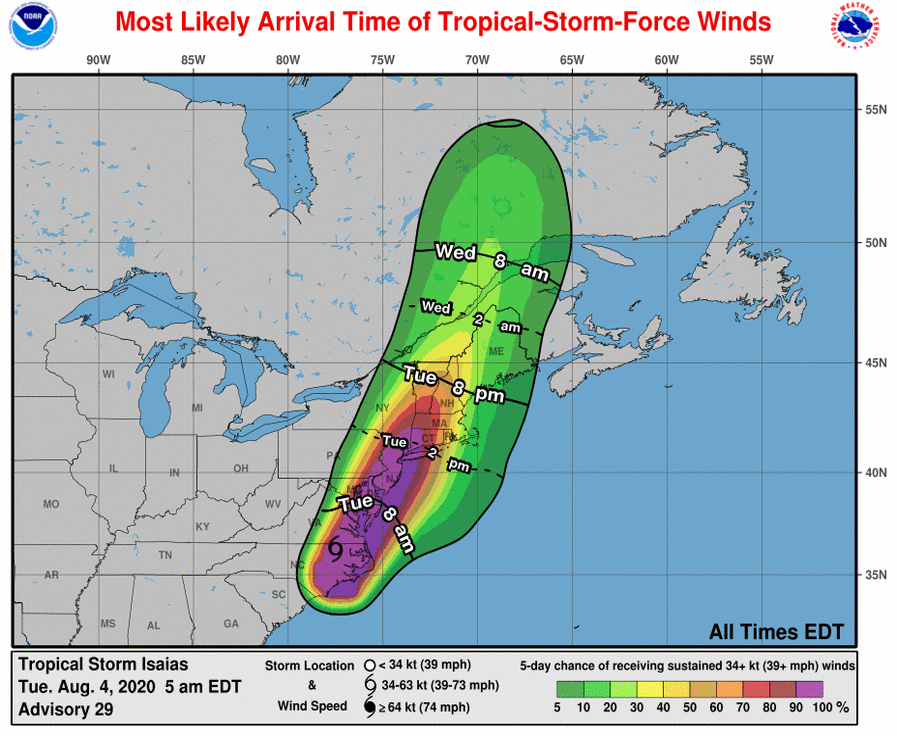
Now, Hurricane Isaias is poised to draw energy from these abnormally toasty waters as it rides up the East Coast and, depending on its course and speed, the consequences could be severe from Florida to Maine.

Continue reading “Hurricane will Ride East Coast Marine Heat Wave”